Lev Vygotsky’s Social Development Theory: Complete Guide for TET & CTET Exams | ZPD, Scaffolding, MKO & PYQ MCQs
Lev Vygotsky social development theory – If you are preparing for TET (Teacher Eligibility Test) or CTET, you already know that Child Development and Pedagogy (CDP) carries 30 marks and Vygotsky’s Social Development Theory is a high-yield topic. Every year, 3–5 direct or application-based questions appear from this chapter. Whether it is “What is ZPD?” or “How will you apply scaffolding in class?”, examiners love testing your understanding of Lev Vygotsky.
Who Was Lev Vygotsky? Quick Background for TET Exams
Lev Semenovich Vygotsky (1896–1934) was a Soviet psychologist often called the founder of Sociocultural Theory or Social Development Theory. Unlike Piaget, who focused on individual exploration, Vygotsky emphasized that social interaction and culture shape cognitive development.
Core Principles of Lev Vygotsky social development theory
Vygotsky’s theory rests on four fundamental ideas that repeatedly appear in TET questions:
- Learning is a social process – Children learn best through interaction with others.
- Development is the result of social learning – Learning precedes development (opposite of Piaget).
- Every function appears twice – First on the social plane (interpsychological), then on the individual plane (intrapsychological).
- Language is the most important psychological tool – It transforms thinking.
These four points are your golden keys for MCQs. Memorize them exactly as written.
Key Concepts of Lev Vygotsky social development theory Every TET Aspirant Must Master
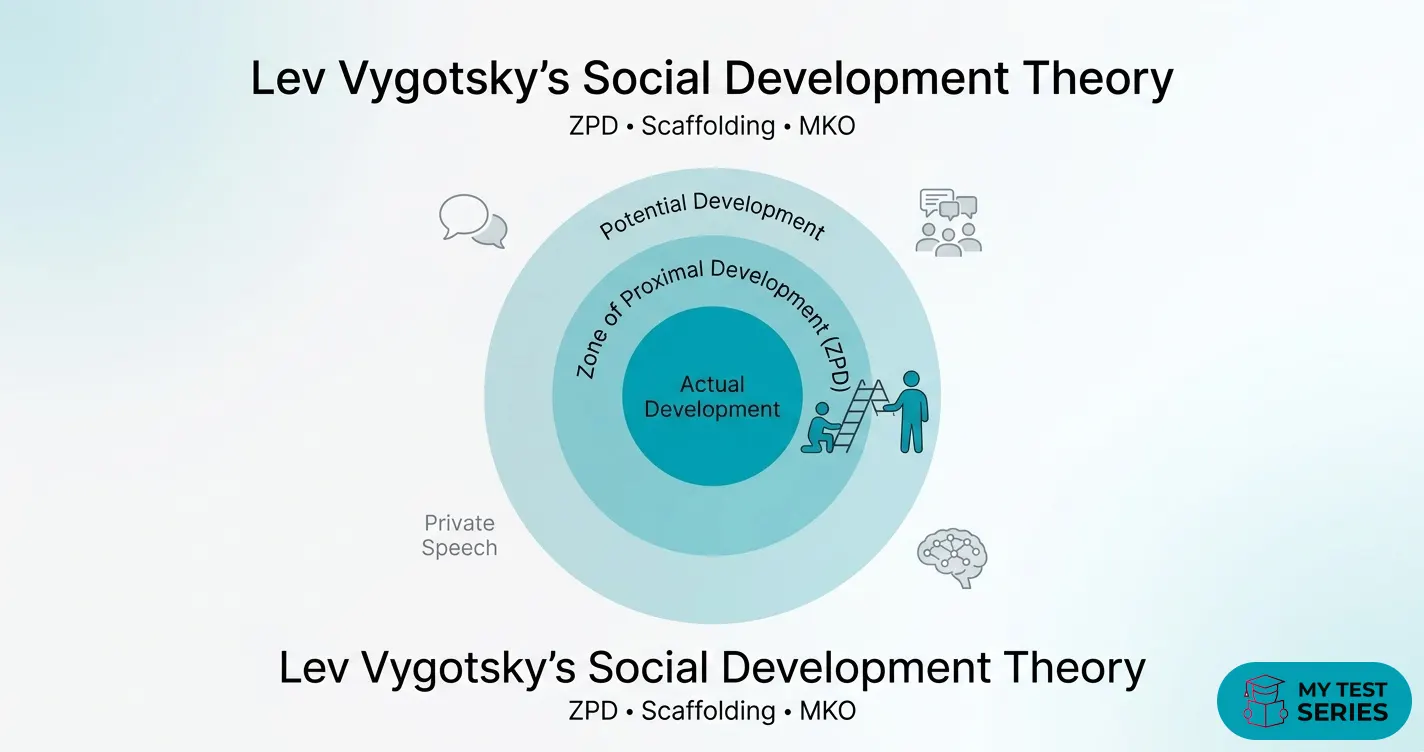
1. Zone of Proximal Development (ZPD)
ZPD is the most important concept in Vygotsky’s theory and appears in almost every TET paper.
Definition: The gap between what a child can do independently (actual developmental level) and what the child can do with guidance from a More Knowledgeable Other (potential developmental level).
Exam Tip: In ZPD, the middle ring is where real learning happens with help. Teachers must design tasks exactly in this zone.
2. More Knowledgeable Other (MKO)
MKO can be a teacher, parent, elder sibling, or even a peer who knows more. It can also be a tool or app in modern classrooms.
Example for TET answer: A Class 3 child cannot solve a two-digit addition alone but can do it when the teacher models it step-by-step. Here, the teacher is the MKO.
3. Scaffolding
Scaffolding is the temporary support given by MKO to help the child cross the ZPD. As the child gains mastery, support is gradually withdrawn.
Strategies of scaffolding (write these in exam):
- Modeling
- Questioning
- Feedback
- Breaking task into smaller steps
- Gradual withdrawal of help
4. Private Speech (Egocentric Speech → Inner Speech)
Children first talk aloud to themselves while solving problems (private speech). Later it becomes silent inner speech that guides thinking.
TET Application: Allow children to talk while solving math problems — it is a sign of healthy cognitive development, not indiscipline.
5. Cultural Tools and Mediation
Language, symbols, maps, calculators, and even smartphones are cultural tools that mediate learning. Indian TET papers often ask how culture influences thinking.
Vygotsky vs Piaget: High-Weightage Comparison Table for TET/CTET
| Aspect | Vygotsky | Piaget |
|---|---|---|
| Focus | Social interaction & culture | Individual exploration |
| Learning vs Development | Learning precedes development | Development precedes learning |
| Stages | No fixed stages | Four fixed stages |
| Role of Language | Primary tool for thinking | Develops after cognitive structures |
| Role of Teacher | Facilitator & MKO | Observer |
| ZPD / Scaffolding | Central concepts | Not present |
Pro Tip: Questions like “Who said learning leads to development?” → Vygotsky.
Practical Classroom Applications of Lev Vygotsky social development theory for TET Teachers
Examiners don’t just ask theory — they ask “How will you apply it?” Here are ready-to-write answers:
- Group Activities & Cooperative Learning: Pair strong and weak students.
- Reciprocal Teaching: Students take turns teaching each other.
- Think-Pair-Share: Perfect scaffolding technique.
- Differentiated Instruction: Design tasks in ZPD of every child.
- Use of Private Speech: Encourage self-talk during problem solving.
- Cultural Responsiveness: Use local stories, folk tales, and mother tongue as tools.
Real TET Scenario Example: A Class 5 student struggles with fractions. The teacher first demonstrates (modeling), then gives hints (scaffolding), then lets the child explain to a peer (MKO shift). Finally, the child solves independently. This entire process is Vygotsky in action.
Strengths and Limitations of Vygotsky’s Theory (Critical Analysis for TET Descriptive Questions)
Strengths:
- Explains cultural differences in development
- Highly applicable in diverse Indian classrooms
- Promotes inclusive and collaborative learning
Limitations:
- Does not explain biological maturation clearly
- Over-emphasizes social factors, ignores individual differences
- Difficult to measure ZPD objectively in large classes
Why Vygotsky Matters Most for Future Teachers
Lev Vygotsky taught us that no child learns in isolation. Every smile, every question, every group discussion shapes their mind. For TET aspirants, mastering this theory is not just about marks — it is about becoming the kind of teacher who truly empowers children.
Revise these notes twice, practice the MCQs below, and you will never lose marks on Vygotsky again.
Frequently Asked Questions (FAQ) on Vygotsky’s Social Development Theory for TET
What is Lev Vygotsky’s Social Development Theory?
It is a sociocultural theory that explains how social interaction, culture, and language drive cognitive development. Learning happens first on the social level and then becomes internal.
What does ZPD stand for and why is it important for TET?
ZPD = Zone of Proximal Development. It is the most frequently asked concept because it directly guides lesson planning and assessment in classrooms.
How does scaffolding work in Vygotsky’s theory?
It is temporary support that is gradually removed as the learner becomes independent. Teachers use modeling, hints, and feedback.
Is Vygotsky’s theory asked in CTET Paper 1 or Paper 2?
Both papers. Paper 1 (primary) focuses more on ZPD and scaffolding; Paper 2 includes deeper applications and comparisons.
What is the main difference between Vygotsky and Piaget for TET exam?
Vygotsky: Social → Learning precedes development. Piaget: Individual → Development precedes learning.
Most Important MCQs from Previous Year TET/CTET Papers on Vygotsky Theory
These are actual pattern questions that have appeared in CTET, UPTET, MPTET, REET, HTET etc. Solve them now!
Q1. The concept of ‘Zone of Proximal Development’ has been proposed by
(A) Jerome Bruner (B) Lev Vygotsky (C) B.F. Skinner (D) Jean Piaget
Answer: (B) Lev Vygotsky
Q2. According to Lev Vygotsky, the zone of proximal development should be used for
(A) Teaching and assessment (B) Only rote learning (C) Punishment (D) Competition
Answer: (A) Teaching and assessment
Q3. Zone of proximal development refers to
(A) Gap between actual and potential development
(B) Only what child can do alone
(C) Fixed stages of development
(D) Biological maturation
Answer: (A)
Q4. Scaffolding in Vygotsky’s theory means
(A) Temporary support by MKO (B) Permanent help (C) Punishment (D) Lecture method
Answer: (A)
Q5. Lev Vygotsky believed that
(A) Learning precedes development (B) Development precedes learning
(C) Both happen simultaneously (D) Development is independent of learning
Answer: (A)
Q6. Private speech is
(A) Children talking to themselves to regulate thinking
(B) Talking to teacher only
(C) Silent reading
(D) Group discussion
Answer: (A)
Q7. Which of the following strategies is in accordance with Vygotsky’s principles?
(A) Scaffolding (B) Conditioning (C) Punishment (D) All of these
Answer: (A)
Q8. More Knowledgeable Other (MKO) can be
(A) Teacher, peer or parent (B) Only teacher (C) Only book (D) Only parent
Answer: (A)
Q9. Vygotsky’s theory is also known as
(A) Social Constructivism (B) Cognitive Constructivism (C) Behaviourism (D) Maturation Theory
Answer: (A)
Q10. In Vygotsky’s view, language is
(A) The most important tool for cognitive development
(B) Only for communication
(C) Not related to thinking
(D) Developed after cognitive structures
Answer: (A)
Bonus Tip: Practice these 10 questions daily for 7 days. You will remember every concept forever.
Thank you for reading this complete guide on Lev Vygotsky Social Development Theory for TET examination. Bookmark this page, share with your fellow aspirants, and keep revising. You’ve got this!
Child Development & Pedagogy – Complete Study Hub
Master the entire Child Development and Pedagogy (CDP) syllabus for CTET and all TET exams with our detailed topic-wise notes.