Kohlberg moral development theory: Complete Guide for TET & CTET Exam 2026
Kohlberg moral development theory – As a TET or CTET aspirant, you already know that Child Development and Pedagogy (CDP) carries 30 marks in both papers. One topic that repeatedly appears in previous year questions is Kohlberg’s Theory of Moral Development. In the last 5 years, 2–4 MCQs have come directly from the six stages, Heinz dilemma and classroom applications.
You will get crystal-clear explanations, real Indian classroom examples, PYQ-based MCQs with detailed solutions, criticisms, NEP 2020 linkages and ready-to-use teaching strategies. Bookmark this page – it is your one-stop resource to score full marks in this topic.
Who Was Lawrence Kohlberg?
Lawrence Kohlberg (1927–1987) was an American psychologist who built upon Jean Piaget’s work on cognitive development. While Piaget focused on how children think logically, Kohlberg wanted to understand how they develop a sense of right and wrong. He interviewed boys aged 10–16 using moral dilemmas and concluded that moral reasoning develops in fixed, sequential stages – just like cognitive stages.
In the Indian context, this theory is extremely relevant because NEP 2020 strongly emphasises value education, ethical reasoning and holistic development of children. As future teachers, you must understand at which stage your students are operating so you can design appropriate moral education activities.
Kohlberg’s Theory – Overview (3 Levels, 6 Stages)
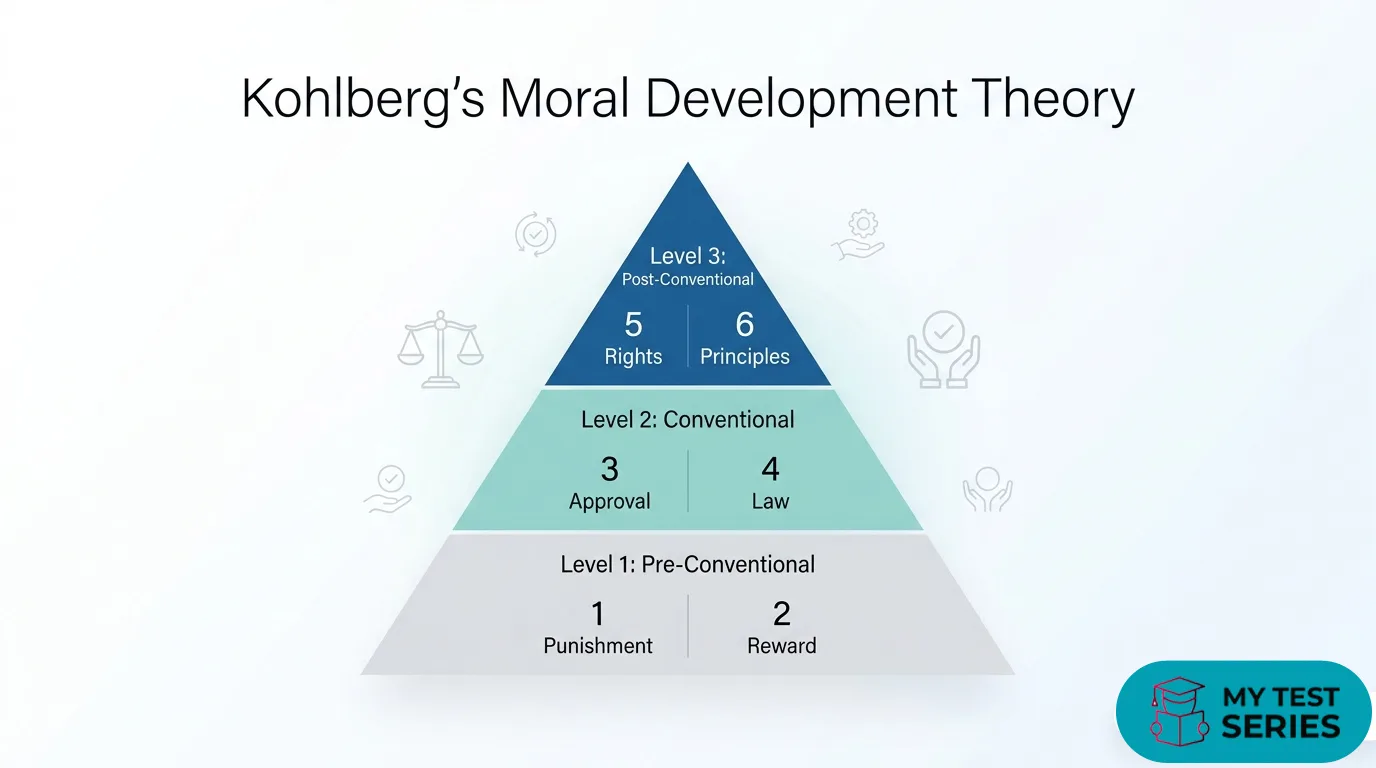
Kohlberg divided moral development into three broad levels. Each level has two stages. The movement from one stage to another happens only when the child is cognitively ready and faces moral dilemmas that challenge their current thinking.
| Level | Stage | Age (Approx) | Basis of Morality |
|---|---|---|---|
| Pre-conventional (Level 1) | Stage 1: Obedience & Punishment | 4–7 years | Avoid punishment |
| Pre-conventional (Level 1) | Stage 2: Individualism & Exchange | 7–10 years | Self-interest & rewards |
| Conventional (Level 2) | Stage 3: Good Boy–Nice Girl | 10–13 years | Approval from others |
| Conventional (Level 2) | Stage 4: Law & Order | 13+ years | Respect for authority & laws |
| Post-conventional (Level 3) | Stage 5: Social Contract | Adult (rare) | Rights & democratic values |
| Post-conventional (Level 3) | Stage 6: Universal Ethical Principles | Very rare | Universal justice & conscience |
Level 1: Pre-Conventional Morality (External Control)
Children at this level have not yet internalised society’s rules. Morality is controlled by external rewards and punishments. This level is common in primary school children.
Stage 1: Obedience and Punishment Orientation
The child obeys rules only to avoid punishment. “Wrong” means “I will get caught and scolded.”
Indian Classroom Example: A Class 2 student does not copy in a test because “Ma’am will punish me.” He does not understand that copying is unfair – only that it brings punishment.
Stage 2: Individualism and Exchange (Instrumental Relativist)
Children start recognising that different people have different interests. Behaviour is right if it serves one’s own needs or brings a reward (“What’s in it for me?”).
Example: “I will share my tiffin only if my friend shares his chocolate with me.”
Level 2: Conventional Morality (Social Approval)
Most adolescents and adults remain at this level. Morality is based on maintaining good relationships and following social order.
Stage 3: Good Boy–Nice Girl Orientation (Interpersonal Accord)
Behaviour is driven by the desire to be seen as a “good” person by family, friends and teachers. Peer approval matters a lot.
PYQ Example (CTET): “Your parents will be proud of you if you are honest. So you should be honest.” → This is Stage 3. (Correct answer in multiple CTET papers)
Stage 4: Law and Order Orientation (Maintaining Social Order)
Rules and laws must be followed because they keep society running smoothly. Authority is respected.
Example: A student says, “We must follow school rules because without rules there will be chaos.”
Level 3: Post-Conventional Morality (Internalised Principles)
Only a small percentage of people reach this level. Morality goes beyond laws and is based on abstract ethical principles.
Stage 5: Social Contract Orientation
Laws are seen as social contracts that can be changed if they don’t serve the greater good. Individual rights are valued.
Stage 6: Universal Ethical Principles
Decisions are guided by universal principles of justice, equality and human dignity – even if they conflict with laws.
The Famous Heinz Dilemma – How It Reveals Stages
Kohlberg used the Heinz dilemma to test moral reasoning:
Heinz’s wife is dying of cancer. A druggist has the only medicine that can save her but charges 10 times the cost. Heinz cannot afford it. Should he steal the drug?
Stage-wise responses:
- Stage 1: “No, he will go to jail.” (punishment)
- Stage 2: “Yes, because his wife will die otherwise – he needs her.” (self-interest)
- Stage 3: “Yes, because a good husband should save his wife.” (approval)
- Stage 4: “No, stealing is against the law.” (law & order)
- Stage 5: “Yes, the right to life is more important than property rights.” (social contract)
- Stage 6: “Yes, human life is sacred and must be preserved at any cost.” (universal ethics)
Comparison with Piaget’s Theory (Important for TET)
Kohlberg extended Piaget’s cognitive stages. Pre-conventional morality aligns with Piaget’s pre-operational and concrete operational stages, while post-conventional requires formal operational thinking (abstract reasoning).
Criticisms of Kohlberg’s Theory
1. Gender Bias (Carol Gilligan): Kohlberg studied only males. Girls focus more on “care and relationships” (ethic of care) rather than “justice” (ethic of justice).
2. Cultural Bias: Tested mostly on Western samples. Indian studies (e.g., by Kalam) show that collectivist cultures emphasise duty and family more than individual rights.
3. Moral reasoning does not always translate into moral behaviour.
4. Stages are not as rigid or universal as claimed.
Applications in Classroom Teaching (NEP 2020 Link)
As per NEP 2020, moral and ethical education is part of the 5+3+3+4 structure. Teachers can:
- Use age-appropriate moral dilemmas in morning assembly or value education periods.
- Encourage group discussions so children move from Stage 3 to Stage 4/5.
- For primary classes (Stage 1–2): Use stories with clear reward/punishment.
- For upper primary: Role plays on honesty, justice and rights.
This helps develop responsible citizens – one of the key goals of NEP 2020.
Most Important MCQs from PYQs for TET/CTET (with Solutions)
Practice these exact previous year questions:
- PYQ (CTET) In the context of Kohlberg’s stages, the response “Your parents will be proud of you if you are honest…” belongs to which stage?
Answer: Stage 3 – Good Boy-Nice Girl Orientation
Explanation: Focus is on gaining approval and maintaining good image. - PYQ According to pre-conventional level, moral decision is based on:
Answer: Potential punishment involved
Explanation: Level 1 is external control. - PYQ In Lawrence Kohlberg’s theory, which level signifies the absence of morality in the true sense?
Answer: Level I (Pre-conventional)
Explanation: Morality is not internalised; it is only fear of punishment or desire for reward. - PYQ Kohlberg has given:
Answer: The stages of moral development
Explanation: Not cognitive, physical or emotional. - Important MCQ A teacher says, “All students should complete assignments without assistance because it helps individual learning.” This reflects:
Answer: Stage 4 – Law and Order Orientation
Explanation: Emphasis on rules and individual responsibility for social good. - MCQ Rajesh returns a lost wallet because “it is the right thing to do and good citizens do it.” Which level?
Answer: Conventional Level (Stage 4)
Explanation: Focus on social duty and order. - PYQ A teacher can instil moral values by:
Answer: Involving children in discussions on moral issues
Explanation: This helps progression to higher stages. - MCQ Major criticism of Kohlberg’s theory is:
Answer: It did not account for cultural and gender differences in moral reasoning
Explanation: Gilligan’s care ethics and cross-cultural studies prove this.
Frequently Asked Questions (FAQs)
1. What is the full form of TET and why study Kohlberg?
TET stands for Teacher Eligibility Test (CTET, UPTET, MPTET, etc.). Kohlberg is a core CDP topic because it helps teachers understand how children judge right and wrong.
2. Do all children pass through all six stages?
Yes, according to Kohlberg the sequence is universal and invariant, but not everyone reaches Stage 6. Most adults stay at Stage 4.
3. Is Kohlberg’s theory in CTET 2026 syllabus?
Yes. It is part of “Child Development and Learning” and “Moral Development” sections.
4. How to remember the stages easily?
Remember “POP GULU” → Punishment, Own interest, People approval, Good laws, Universal rights, Ultimate principles.
5. Difference between Piaget and Kohlberg?
Piaget = cognitive development; Kohlberg = moral reasoning development (based on cognitive readiness).
Why This Topic Matters for Every Future Teacher
Understanding Kohlberg’s Theory of Moral Development is not just about cracking TET/CTET MCQs. It is about becoming a teacher who can nurture ethically strong, responsible citizens. In today’s fast-changing world, children face complex moral choices on social media, peer pressure and environment. Your knowledge of these six stages will help you guide them from fear-based obedience to principled decision-making.
Revise this guide 3–4 times before the exam. Solve at least 50 MCQs on this topic. You will definitely score full marks in this high-scoring area. For daily practice use Mytestseries online test.
Happy studying! You are going to become an excellent teacher.
Last updated: April 2026 | Ready for TET/CTET 2026
Child Development & Pedagogy – Complete Study Hub
Master the entire Child Development and Pedagogy (CDP) syllabus for CTET and all TET exams with our detailed topic-wise notes.