Child Development & Pedagogy – Complete Study Hub
Master the entire Child Development and Pedagogy (CDP) syllabus for CTET and all TET exams with our detailed topic-wise notes.
Howard Gardner Theory of Multiple Intelligences: Complete Guide for TET/CTET Exam
Table of Contents
- 1. Introduction: Why Gardner’s Theory Matters for TET
- 2. Who is Howard Gardner & Origin of the Theory
- 3. The 8 Types of Intelligences (Detailed with TET Examples)
- 4. Key Principles & Characteristics of MI Theory
- 5. Classroom Applications & Teaching Strategies for TET Teachers
- 6. MI Theory vs Traditional Intelligence (IQ Tests)
- 7. Criticisms & Limitations (Must-Know for TET)
- 8. Most Important PYQs & MCQs from CTET/TET Exams
- 9. FAQ – Quick Revision for Exam
- 10. Conclusion & Pro Tips for TET 2026
1. Introduction: Why Howard Gardner’s Theory of Multiple Intelligences is a High-Scoring Topic in TET/CTET
Howard Gardner Theory of Multiple Intelligences – Every year, 4–6 questions appear from Howard Gardner’s Theory of Multiple Intelligences in CTET and State TET exams (Paper 1 & 2). It is one of the most important topics in Child Development and Pedagogy (CDP) section because it directly connects to NCF 2005, inclusive education, and learner-centred teaching.
Imagine walking into a classroom where one child writes beautiful poems, another solves complex puzzles in seconds, a third excels at group discussions, and the fourth identifies every plant in the garden. Traditional IQ tests would call only the first two “intelligent.” Gardner’s theory says all four children are equally intelligent — just in different ways.
This 1983 revolutionary idea by Harvard psychologist Howard Gardner changed how the world looks at intelligence. For TET aspirants, understanding this theory is not just about scoring marks — it is about becoming a better teacher who can nurture every child’s unique potential.
In this 2100+ word comprehensive guide, you will get everything you need: detailed explanations, real classroom examples, PYQ-based MCQs with solutions, and ready-to-use teaching strategies. Let’s dive in!
2. Who is Howard Gardner & Origin of the Theory
Dr. Howard Gardner, a developmental psychologist at Harvard University, published his groundbreaking book Frames of Mind: The Theory of Multiple Intelligences in 1983. He challenged the long-held belief of a single “g-factor” (general intelligence) proposed by Charles Spearman and measured by IQ tests.
Gardner’s research was influenced by his work with brain-damaged patients, prodigies, and people with savant syndrome. He observed that damage to one part of the brain did not affect all abilities equally — proving that intelligence is modular, not unitary.
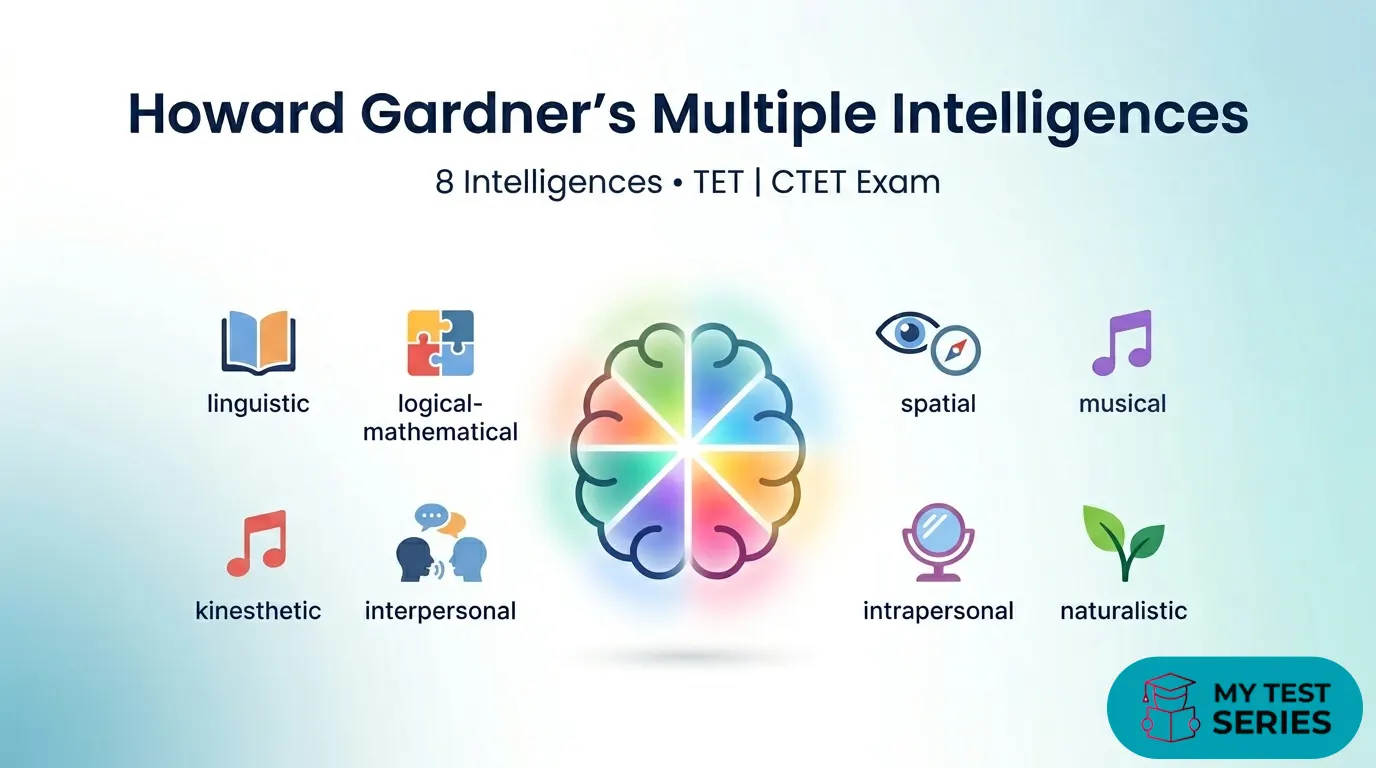
Initially, Gardner listed 7 intelligences. In 1999, he added Naturalistic Intelligence as the 8th. He has also discussed a possible 9th — Existential Intelligence — but it is not yet officially included in the core eight for most TET syllabi.
3. The 8 Types of Intelligences in Gardner’s Theory (With TET-Focused Examples)
1. Linguistic Intelligence (Verbal Intelligence)
Definition: Sensitivity to spoken and written language, ability to learn languages, and use language to express oneself.
Characteristics: Loves reading, writing, storytelling, debating, word games.
TET Example: A child who writes excellent essays or tells stories fluently.
Classroom Strategy: Encourage debates, creative writing, poetry, and language-rich activities.
2. Logical-Mathematical Intelligence
Definition: Ability to analyse problems logically, perform mathematical operations, and investigate issues scientifically.
Characteristics: Good at reasoning, patterns, experiments, numbers, abstract thinking.
TET Example: Child who solves puzzles quickly or loves science experiments.
Classroom Strategy: Use logic games, coding basics, experiments, and problem-solving tasks.
3. Spatial Intelligence (Visual-Spatial)
Definition: Capacity to perceive the visual world accurately and to perform transformations upon one’s initial perceptions. (PYQ favourite!)
Characteristics: Excellent at drawing, maps, 3D objects, imagination, navigation.
TET Example: Child who assembles models or draws detailed diagrams.
Classroom Strategy: Mind-mapping, graphic organisers, art projects, visual aids.
4. Musical Intelligence
Definition: Skill in performing, composing, and appreciating musical patterns.
Characteristics: Sensitive to rhythm, pitch, melody; remembers songs easily.
TET Example: Child who learns concepts through rhymes and songs.
Classroom Strategy: Use songs for multiplication tables, poems set to music, musical instruments.
5. Bodily-Kinesthetic Intelligence
Definition: Ability to use one’s body to solve problems or create products.
Characteristics: Good at sports, dance, acting, hands-on activities.
TET Example: Child who learns best by doing role-plays or experiments.
Classroom Strategy: Role-play, drama, experiments, physical movement in lessons.
6. Interpersonal Intelligence
Definition: Capacity to understand intentions, motivations, and desires of other people and work effectively with them.
Characteristics: Natural leaders, empathetic, good at group work.
TET Example: Child who resolves conflicts and organises group activities.
Classroom Strategy: Cooperative learning, group projects, peer teaching.
7. Intrapersonal Intelligence
Definition: Ability to understand oneself, one’s feelings, and motivations.
Characteristics: Self-aware, independent learners, reflective.
TET Example: Child who maintains a personal diary or sets personal goals.
Classroom Strategy: Self-reflection journals, goal-setting activities, independent projects.
8. Naturalistic Intelligence (Added in 1999)
Definition: Ability to recognise and categorise plants, animals, and other features of the natural world.
Characteristics: Loves nature, gardening, animals, environmental issues.
TET Example: Child who identifies birds, trees, and cares about environment (PYQ example: Abhishek watching garden birds).
Classroom Strategy: Nature walks, eco-projects, classification of living things.
4. Key Principles of Gardner’s Multiple Intelligences Theory
- Every individual possesses all eight intelligences in varying degrees.
- Intelligences are independent but can work together.
- Intelligences can be strengthened and developed through education and experience.
- Intelligences change over time (Important PYQ fact).
- Cultural and environmental factors play a major role.
- Intelligence is not fixed — it is a “biopsychological potential.”
Gardner emphasised that schools should not label children but celebrate their unique profiles.
5. Practical Classroom Applications & Teaching Strategies (TET Favourite)
TET examiners love questions on how teachers can apply MI theory. Here are ready-to-use strategies:
- Differentiated Instruction: Design lessons with multiple entry points (visual, auditory, kinesthetic).
- Project-Based Learning: One topic taught through 8 different activities.
- Assessment: Use portfolios, performances, peer reviews instead of only written tests.
- Inclusive Education: Helps teachers identify strengths of CWSN and gifted children.
Example Lesson Plan (Class 5 EVS – Water): Linguistic → Story writing; Musical → Water song; Kinesthetic → Water conservation skit; Naturalistic → Field visit to river.
6. MI Theory vs Traditional Intelligence (IQ Tests) – Comparison Table
| Aspect | Traditional IQ | Gardner’s MI Theory |
|---|---|---|
| Nature of Intelligence | Single general ability (g-factor) | Multiple independent intelligences |
| Measurement | Standardised IQ tests | Observation, performance, portfolios |
| Focus | Linguistic + Logical only | All 8 intelligences |
| Fixed or Malleable | Mostly inherited & fixed | Can be developed (changes over time) |
7. Criticisms & Limitations of the Theory (Important for TET Descriptive Questions)
While widely accepted in education, Gardner’s theory has faced academic criticism:
- Lacks strong empirical/psychometric evidence (no standardised test validates the 8 intelligences separately).
- Some argue the “intelligences” are actually talents or personality traits.
- Overlaps with existing theories (e.g., emotional intelligence).
- Difficult to implement in large classrooms with limited resources.
However, for TET exams, focus on its strengths in promoting inclusive education.
8. Most Important PYQs & MCQs from CTET/TET Exams (With Solutions)
Practice these 12 high-yield questions. Many are actual or very close to previous year questions.
Howard Gardner’s theory of multiple intelligence proposes that:
1. Intelligences change over time.
2. Intelligence is primarily inherited.
3. Intelligence can be measured accurately and predicted precisely.
4. Intelligence can successfully predict academic success.
Answer: 1. Intelligences change over time.
Explanation: Gardner believes intelligences are not fixed; they develop with experience and education.
According to Howard Gardner’s theory of multiple intelligences, which term is applied to the ability to perceive the visual world accurately and to perform transformations on one’s initial perceptions?
1. Bodily-kinesthetic 2. Spatial 3. Logical-mathematical 4. Intrapersonal
Answer: 2. Spatial intelligence
Which of the following is NOT proposed in Howard Gardner’s theory?
1. Linguistic 2. Bodily-kinesthetic 3. Musical 4. Crystallised Intelligence
Answer: 4. Crystallised Intelligence (Cattell’s theory)
Abhishek always looks out of the classroom window at the garden and talks about birds and trees. This shows:
1. Kinesthetic 2. Interpersonal 3. Naturalistic 4. Spatial
Answer: 3. Naturalistic intelligence
In the light of Gardner’s theory, which statement is NOT correct?
1. Intelligence can be accurately predicted by standardised tests.
2. Intelligence comprises several independent intelligences.
3. Intelligence is a complex interplay of heredity and environment.
4. Intelligence can be nurtured.
Answer: 1
Tip: Save these 12 MCQs. 80% of TET questions on this topic come from these patterns. Download full PDF from our resources section.
9. Frequently Asked Questions (FAQ) – TET Quick Revision
What is the full form of MI Theory?
Multiple Intelligences Theory proposed by Howard Gardner in 1983.
How many intelligences are officially accepted in TET syllabus?
8 intelligences (Naturalistic is included).
Is Gardner’s theory part of NCF 2005?
Yes. It supports child-centred and inclusive education principles.
Can intelligences be developed according to Gardner?
Yes. They are not fixed and can be strengthened with proper environment and training.
Which intelligence is most important for teachers?
All are important. A good teacher balances all eight in lesson planning.
10. Conclusion & Pro Tips to Crack TET Questions on MI Theory
Howard Gardner’s Theory of Multiple Intelligences is more than a chapter — it is a philosophy of teaching that respects every child’s uniqueness. For TET 2026, remember:
- Always link the theory to inclusive education and learner diversity.
- Know the exact names and one classroom example for each intelligence.
- PYQs repeatedly test “intelligences change over time” and “spatial intelligence definition.”
- Use the theory to answer application-based questions in pedagogy.
Start applying these strategies in your practice teaching. The best teachers don’t just teach subjects — they unlock every child’s unique intelligence.