Concept of Inclusive Education for TET Exam : Complete Guide
Table of Contents
- 1. Introduction: Why Inclusive Education Matters for TET
- 2. What is Inclusive Education? Simple Definition for TET
- 3. Historical Evolution & Key Policies in India (RTE Act 2009)
- 4. Core Principles of Inclusive Education
- 5. Key Components, Strategies & Tools (UDL, IEP, Differentiated Instruction)
- 6. Major Barriers to Inclusive Education & Solutions
- 7. Role of Teachers in Creating Inclusive Classrooms (TET Focus)
- 8. Benefits of Inclusive Education for All Children
- 9. Conclusion
- 10. Frequently Asked Questions (FAQ Schema Ready)
- 11. Most Important MCQs from TET/CTET Previous Year Questions (PYQs)
1. Introduction: Why Inclusive Education Matters for TET
As a TET or CTET aspirant, you already know that Child Development and Pedagogy (CDP) carries 30 marks — and Concept of Inclusive Education is one of the most frequently asked topics. In the last 5 years, 4–6 marks have come directly from this chapter in almost every CTET and State TET paper.
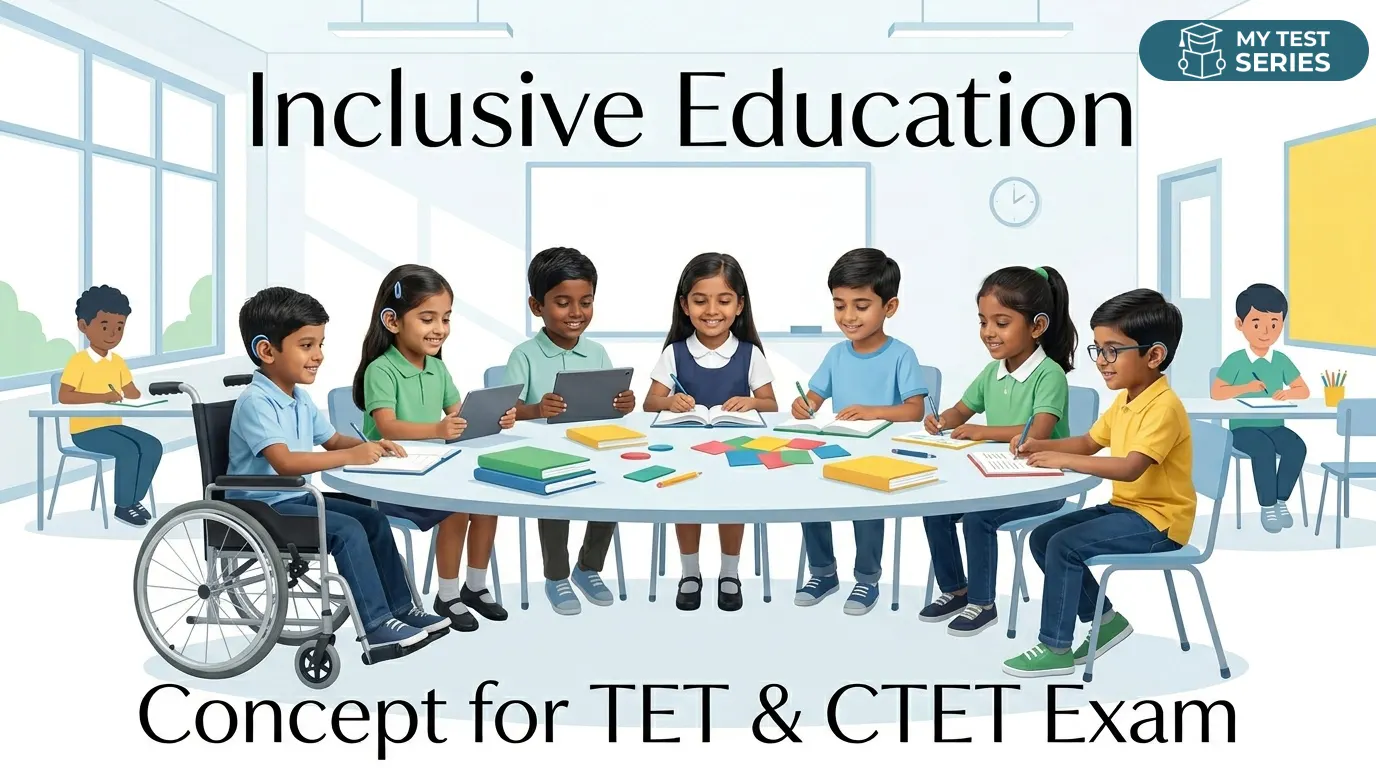
Imagine walking into your dream government school classroom. You see children from different castes, economic backgrounds, abilities, and even those with special needs — all learning together happily. That’s not a dream. That’s the vision of Inclusive Education. The RTE Act 2009 made it a legal right. For TET, you don’t just need to memorize the definition — you must understand how to apply it in real classrooms.
2. What is Inclusive Education? Simple Definition for TET
UNESCO (1994) defines it as: “Inclusive education is a process of addressing and responding to the diversity of needs of all learners through increasing participation in learning, cultures and communities, and reducing exclusion within and from education.”
In simple TET language: It means every child belongs in the same classroom. The school and teacher change — not the child. This is different from “special schools” or even “integrated education”.
Key Phrase for TET: “Inclusion is about changing the system to fit the child, not changing the child to fit the system.”
3. Historical Evolution & Key Policies in India (RTE Act 2009)
The journey started with segregation (special schools only). Then came integration (mainstreaming with minimal support). Finally, the world adopted Inclusion after the Salamanca Statement (1994), which India also endorsed.
In India:
- 86th Constitutional Amendment (2002) made education a Fundamental Right (Article 21A).
- RTE Act 2009 (effective 1 April 2010) is the game-changer. It mandates free and compulsory education for 6–14 years in a neighbourhood school with no discrimination.
- Section 3 of RTE explicitly includes children with special needs (CWSN).
- RPWD Act 2016 further strengthened it by defining 21 types of disabilities and mandating barrier-free access.
RTE’s 25% reservation for EWS/DG category and prohibition of screening tests are practical steps towards inclusion.
4. Core Principles of Inclusive Education
- Equity over Equality — Provide what each child needs, not the same thing to everyone.
- Celebration of Diversity — Treat differences as strengths.
- Child-Centred Approach — Curriculum and teaching adapt to the child.
- Participation & Belonging — Every child feels valued.
- Collaboration — Teachers, parents, special educators, and community work together.
- Zero Rejection Policy — No child can be denied admission (RTE).
5. Key Components, Strategies & Tools (UDL, IEP, Differentiated Instruction)
Universal Design for Learning (UDL) is the most important framework for TET. It has three principles:
- Multiple means of Representation (how information is presented — visual, audio, text).
- Multiple means of Action & Expression (how students show what they know).
- Multiple means of Engagement (how to motivate different learners).
Individualized Education Plan (IEP): A written plan for CWSN that includes specific goals, accommodations, and assessment methods.
Differentiated Instruction: Same topic, different ways — e.g., Braille for visually impaired, sign language for hearing impaired, extra time for slow learners.
Other strategies: Peer tutoring, cooperative learning, assistive technology (talking books, ramps, hearing aids), flexible seating, and positive behaviour support.
6. Major Barriers to Inclusive Education & Solutions
| Barrier Type | Examples | Solution for Teachers |
|---|---|---|
| Attitudinal | Stigma, sympathy instead of empathy | Sensitization workshops, success stories |
| Physical | No ramps, small doors | Advocate for barrier-free infrastructure |
| Curricular | Rigid syllabus | Use UDL & adaptations |
| Resource | Lack of trained teachers | Continuous professional development |
| Policy | Poor implementation of RTE | Form SMC and demand accountability |
7. Role of Teachers in Creating Inclusive Classrooms (TET Focus)
TET questions often ask: “What should a teacher do in an inclusive classroom?”
Answer: Change attitude from “I teach normal children” to “I teach every child.” Use multi-sensory teaching, continuous formative assessment, collaborate with special educators, and celebrate small successes of every child.
8. Benefits of Inclusive Education for All Children
- Develops empathy and social skills in all students.
- Improves academic outcomes through peer learning.
- Reduces discrimination and builds an inclusive society.
- Prepares children for real-world diversity.
9. Conclusion
Inclusive Education is not just a topic for TET — it is the future of Indian education. As future teachers, you are the real agents of change. Master this concept thoroughly, practice the PYQs, and you will score full marks in CDP. Remember: Every child can learn when we remove barriers.
10. Frequently Asked Questions (FAQ)
A: Inclusive Education is a process of addressing and responding to the diverse needs of all learners by increasing participation in learning and reducing exclusion. (UNESCO 1994)
A: Integrated = child adjusts to school. Inclusive = school adjusts to child.
A: RTE Act 2009.
A: Universal Design for Learning — multiple ways to learn, engage, and express.
A: Attitudinal barrier (social stigma).
A: Individualized Education Plan for children with special needs.
A: 4–6 direct questions every year + application-based questions.
A: Use differentiated teaching, peer support, and positive language.
11. Concept of Inclusive Education for TET Exam (PYQs) with Answers
(1) celebrates diversity in the classroom
(2) encourages strict admission procedures
(3) includes indoctrination of facts
(4) includes teachers from marginalized groups
Correct Answer: (1)
Explanation: Inclusive education is based on celebrating diversity.
(1) in special schools
(2) by segregating them from normal children
(3) in regular schools with special support
(4) in special schools with special teachers
Correct Answer: (3)
Explanation: This is the core of inclusive education as per RTE.
(1) teach only normal children
(2) use different teaching strategies for different children
(3) ignore children with disabilities
(4) give same homework to all
Correct Answer: (2)
(1) Inclusive Education
(2) Mid-Day Meal
(3) Sarva Shiksha Abhiyan
(4) Digital India
Correct Answer: (1)
(1) Equity
(2) Segregation
(3) Participation
(4) Flexibility
Correct Answer: (2)
(1) 14 years
(2) 18 years
(3) 21 years
(4) 6 years
Correct Answer: (1) (Note: RPWD extends further)
(1) Universal Design for Learning
(2) Unique Development of Learners
(3) Uniform Daily Lesson
(4) None
Correct Answer: (1)
(1) the same concept
(2) different — Inclusion changes the system
(3) both mean special schools
(4) None
Correct Answer: (2)
(1) provides separate classrooms for CWSN
(2) ensures every child participates meaningfully
(3) focuses only on academic marks
(4) has strict discipline
Correct Answer: (2)
(1) Same test for all
(2) Multiple modes of assessment
(3) Only oral test
(4) Only written test
Correct Answer: (2)