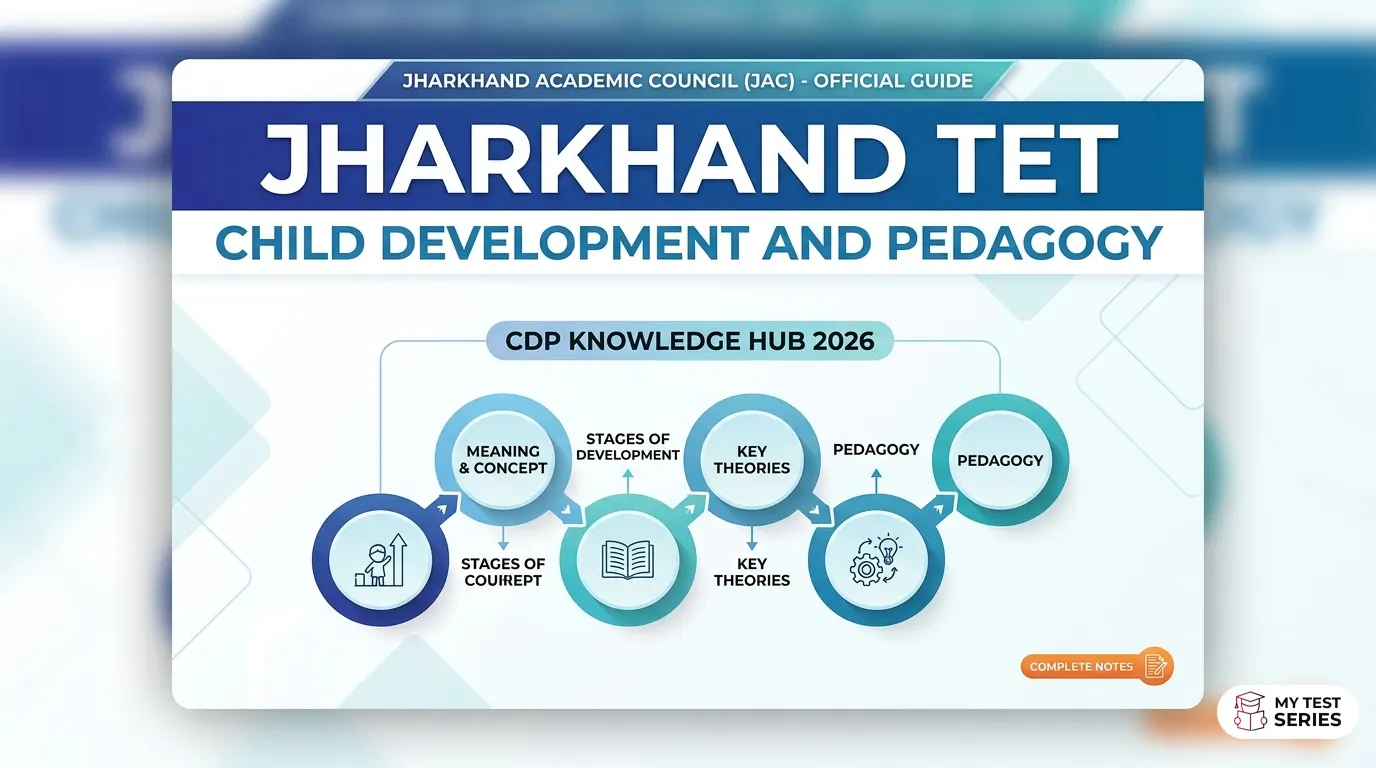
Jharkhand TET Child Development and Pedagogy (CDP) Knowledge Hub 2025
Master the Science of Teaching: Your Ultimate Pillar Guide to JTET Paper 1 & 2 Pedagogy with Expert Notes, Theories, and Exam Strategies.
The Core of JTET: Understanding Child Development
For any aspiring teacher in Jharkhand, Child Development and Pedagogy (CDP) isn’t just a subject—it is the foundation of effective classroom management. In the Jharkhand Teacher Eligibility Test (JTET), CDP accounts for a significant portion of both Paper 1 (Primary) and Paper 2 (Upper Primary).
Child Development refers to the biological, psychological, and emotional changes that occur in human beings between birth and the end of adolescence. As a teacher, understanding the Meaning and Concept of Development allows you to tailor your teaching methods to the specific needs of your students.
Fundamental Principles of Child Development
Why do children develop at different rates? Why does a child learn to sit before they walk? These questions are answered by the Principles of Development. For the Jharkhand TET, you must memorize these patterns as they frequently appear in situational questions.
- Principle of Continuity: Development is a life-long process starting from the womb to the tomb.
- Principle of Individual Differences: No two children are exactly alike in their development.
- Cephalocaudal Sequence: Development proceeds from head to toe.
- Proximodistal Sequence: Development starts from the center of the body and moves outward to the extremities.
Stages of Development for JTET Candidates
Understanding the specific milestones of different age groups is crucial for Paper 1 (Primary Level) and Paper 2 (Upper Primary). The Jharkhand Academic Council (JAC) emphasizes the transition from childhood to adolescence.
| Stage | Age Group | Key Characteristic |
|---|---|---|
| Infancy | Birth to 2 Years | Sensory exploration & Reflexes |
| Early Childhood | 2 to 6 Years | Language acquisition & Toy Age |
| Later Childhood | 7 to 12 Years | Logical thinking & Peer groups |
| Adolescence | 13 to 19 Years | Identity crisis & Abstract thought |
Jean Piaget’s Theory of Cognitive Development
Jean Piaget, the Swiss psychologist, revolutionized how we view children—not as “small adults,” but as active explorers or “Little Scientists.” For JTET, you must understand his four universal stages and how children “construct” knowledge through experience.
Piaget’s theory revolves around three core components:
- Schemas: Mental building blocks of knowledge.
- Assimilation: Using an existing schema to deal with a new object or situation.
- Accommodation: Changing an existing schema to fit new information.
Lev Vygotsky: The Social Development Theory
While Piaget focused on the individual, Vygotsky focused on the Social Context. For Jharkhand TET candidates, this theory is vital because it explains how a teacher’s guidance (Scaffolding) accelerates a student’s growth.
Vygotsky’s three most important concepts for your exam are:
- Zone of Proximal Development (ZPD): The distance between what a child can do alone and what they can do with help.
- More Knowledgeable Other (MKO): Anyone (teacher, peer, or even a computer) who has a better understanding than the learner.
- Scaffolding: Temporary support provided to a student to help them master a new task.
Kohlberg & Erikson: Moral and Emotional Growth
Teaching isn’t just about logic; it’s about character. The JTET syllabus covers how children distinguish right from wrong (Kohlberg) and how their personality evolves (Erikson).
Lawrence Kohlberg: Moral Stages
Kohlberg identified three levels of moral reasoning: Pre-conventional (avoiding punishment), Conventional (following social rules), and Post-conventional (universal ethics). Expect questions on the “Heinz Dilemma” in your pedagogy section.
Erik Erikson: Psychosocial Stages
Erikson’s theory spans the whole life, but for JTET, focus on Trust vs. Mistrust (Infancy), Industry vs. Inferiority (School age), and Identity vs. Role Confusion (Adolescence).
Intelligence: Beyond the IQ Score
Modern pedagogy rejects the idea that a single IQ test defines a child’s potential. Howard Gardner’s Theory of Multiple Intelligences is the cornerstone of inclusive education in the 2026 JTET curriculum.
The 8 Types of Intelligence:
- Linguistic (Word smart)
- Logical-Math (Logic smart)
- Spatial (Picture smart)
- Musical (Music smart)
- Bodily-Kinesthetic (Body smart)
- Interpersonal (People smart)
- Intrapersonal (Self smart)
- Naturalist (Nature smart)
The Science of Learning: Behaviorism to Constructivism
How do children actually learn? The JTET exam tests your ability to distinguish between different “schools of thought” in education. This section bridges the gap between theory and classroom practice.
1. Behaviorism (Pavlov, Skinner, Thorndike)
Focuses on observable behaviors and external stimuli. Learning is seen as a change in behavior through Reinforcement and Punishment.
Example: Using stars or rewards for good behavior.
2. Constructivism (Piaget, Vygotsky)
Focuses on internal mental processes. Learning is an active process where students build their own understanding based on prior knowledge.
Example: Hands-on science experiments or group discussions.
Inclusive Education: Teaching Every Child
In the 2026 Jharkhand TET syllabus, **Inclusive Education** is not just a chapter; it is a philosophy. JAC (Jharkhand Academic Council) emphasizes that a teacher must be equipped to handle diverse learners, including those with disabilities, gifted children, and students from marginalized backgrounds.
Addressing Learning Difficulties
Expect direct questions on common learning disabilities. Memorize these for your JTET Paper 1 & 2:
- Dyslexia: Difficulty in reading and spelling.
- Dysgraphia: Difficulty in writing and fine motor skills.
- Dyscalculia: Difficulty in understanding numbers and math.
- ADHD: Attention Deficit Hyperactivity Disorder (impulsivity and lack of focus).
Constitutional Provisions: RTE Act 2009 & NEP 2020
As a teacher in Jharkhand, you must be aware of the laws governing your profession. The JTET exam frequently features questions from the Right to Education (RTE) Act 2009 and the latest National Education Policy (NEP) 2020.
| Feature | RTE Act 2009 Details |
|---|---|
| Age Group | Free & Compulsory education for 6–14 years. |
| PTR Ratio | 30:1 (Primary) and 35:1 (Upper Primary). |
| Working Hours | Minimum 45 teaching hours per week (including prep). |
NEP 2020 Highlights: The shift from the 10+2 structure to the 5+3+3+4 structure is a high-priority topic for the 2026 exam cycle. Focus on “Foundational Literacy and Numeracy” (FLN) and the emphasis on Mother Tongue instruction.
CCE: Continuous and Comprehensive Evaluation
How do we measure a child’s progress without causing exam stress? The answer lies in CCE. In JTET Pedagogy, you will face questions regarding the difference between assessment for learning and assessment of learning.
- Formative Assessment: Occurs during the instruction (Quizzes, assignments) to improve learning.
- Summative Assessment: Occurs at the end of a term (Final exams) to grade performance.
- Diagnostic Assessment: Used to identify specific learning gaps in a student.
Frequently Asked Questions (FAQs) – JTET CDP 2026
Q1: What is the weightage of CDP in Jharkhand TET?
Ans: CDP carries 30 marks (30 MCQs) in both Paper 1 and Paper 2. It is often the “deciding” section for the final merit list.
Q2: Are there negative marks in JTET 2026?
Ans: No, there is currently no negative marking in the Jharkhand TET exam, making it beneficial to attempt all questions.
Q3: Which theory is most important for JTET Paper 2?
Ans: For Paper 2 (Upper Primary), focus heavily on **Adolescence** and **Piaget’s Formal Operational Stage**, as the questions target the 11–14 age group.