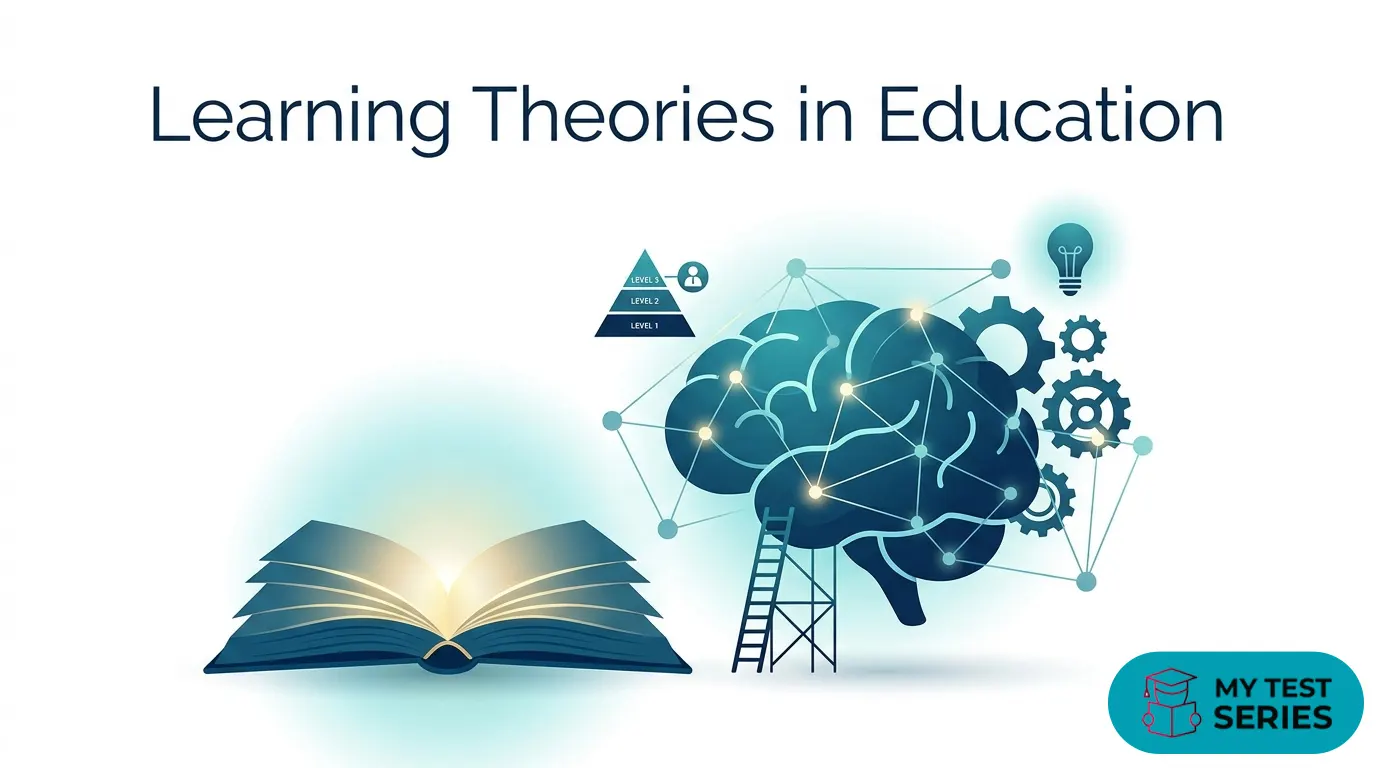
Learning Theories in Education for TET
Struggling with Pedagogy section in TET/CTET?
In this complete guide, we’ll cover every learning theory asked in TET/CTET with practical classroom applications, direct links to previous year questions (PYQs), and ready-to-use MCQs. By the end, you’ll not only score 28+ in Pedagogy but actually become a better teacher.
Let’s dive in — the way real educators do.
What Exactly Are Learning Theories in Education for TET?
Learning theories are systematic explanations of how people acquire, process, and retain knowledge. They answer the big questions every TET examiner loves:
- Why does a child repeat good behaviour?
- How does a child build new ideas from old ones?
- Should teaching be teacher-centred or child-centred?
These theories are broadly classified into four pillars (most important for TET):
- Behaviourism – Learning is observable behaviour change
- Cognitivism – Learning happens inside the mind
- Constructivism – Learners actively build knowledge
- Humanism – Learning is personal growth and self-actualisation
Modern theories like Social Learning and Connectivism are also gaining importance in recent TET papers.
1. Behaviourism: Learning Through Stimulus & Response
Behaviourism dominated education for decades and still forms 20-25% of TET pedagogy questions. It believes learning is a change in observable behaviour due to environmental stimuli.
Key Theorists & Concepts
- Ivan Pavlov (1849-1936) – Classical Conditioning: Bell + Food → Salivation. Real-life: School bell creates excitement even before lunch.
- Edward Thorndike – Law of Effect & Trial-and-Error: “Satisfying consequences strengthen behaviour.”
- B.F. Skinner (1904-1990) – Operant Conditioning: Positive reinforcement (praise, stars), Negative reinforcement (removing homework), Punishment.
Classroom Application for TET Teachers: Use token economy systems, immediate feedback, and behaviour charts. In TET questions, if a teacher gives stars for completing work — that’s pure Skinner!
2. Cognitivism: The Mind as an Information Processor
Cognitivism replaced behaviourism in the 1950s-60s. It focuses on internal mental processes — memory, thinking, problem-solving.
Jean Piaget (1896-1980) – Father of Cognitive Development
Piaget gave us the famous Four Stages of Cognitive Development:
| Stage | Age | Key Feature | TET Example |
|---|---|---|---|
| Sensorimotor | 0-2 years | Object permanence | Hide-and-seek game |
| Pre-operational | 2-7 years | Egocentrism, symbolic play | Child thinks moon follows him |
| Concrete Operational | 7-11 years | Conservation, logical thinking | Understands 5+3=8 and 8-3=5 |
| Formal Operational | 11+ years | Abstract & hypothetical thinking | Debating “What if Earth had two moons?” |
Key Processes: Assimilation (fitting new info into old schema) and Accommodation (changing schema for new info).
Bruner’s Discovery Learning also falls here — students learn best when they discover concepts themselves.
3. Constructivism: Knowledge is Constructed, Not Transmitted
This is the most favourite theory in modern TET papers. Learners actively construct knowledge based on their experiences.
Two Flavours
- Cognitive Constructivism – Piaget: Individual construction through exploration.
- Social Constructivism – Lev Vygotsky (1896-1934): Knowledge is co-constructed through social interaction.
Vygotsky’s Golden Concepts (High-weightage in TET):
- Zone of Proximal Development (ZPD): What a child can do with guidance vs alone.
- Scaffolding: Temporary support from teacher or peer that is gradually removed.
- More Knowledgeable Other (MKO): Teacher, parent, or capable peer.
Classroom Application: Group projects, peer tutoring, think-pair-share — all are Vygotsky in action.
4. Social Learning Theory: Learning by Observing Others
Albert Bandura (1977) – “No trial-and-error needed. We learn by watching.”
Four steps: Attention → Retention → Reproduction → Motivation (vicarious reinforcement).
TET Favourite: Bobo Doll experiment proves children imitate aggression they see. In classroom, model good behaviour yourself!
5. Humanistic Learning Theory: The Whole Child Matters
Focuses on feelings, self-esteem, and personal growth. Learning happens best when basic needs are met.
- Abraham Maslow (1943) – Hierarchy of Needs (Physiological → Self-actualisation). You can’t teach a hungry child algebra.
- Carl Rogers – Student-centred learning, unconditional positive regard, freedom to learn.
In TET, questions often ask: “A child who feels unsafe will not learn” — direct Maslow reference.
Quick Comparison of All Major Learning Theories (TET Revision Chart)
| Theory | Key Thinker | Focus | Teacher Role | TET Keyword |
|---|---|---|---|---|
| Behaviourism | Skinner | Observable behaviour | Controller & reinforcer | Reward, punishment |
| Cognitivism | Piaget | Mental processes | Facilitator of stages | Schema, conservation |
| Constructivism | Vygotsky | Active construction | Scaffolder | ZPD, collaboration |
| Social Learning | Bandura | Observation | Role model | Imitation, modeling |
| Humanism | Maslow | Emotional needs | Facilitator of growth | Self-esteem, needs |
How to Apply These Theories in Your TET Answers & Real Classroom
TET examiners don’t want theory names — they want application. Example question pattern:
“A teacher praises a shy student for speaking up. Which theory is being used?” → Behaviourism (positive reinforcement).
Use this guide as your ready reckoner before exam day.
Learning Theories in Education for TET (PYQ) + Explanations
These are the exact pattern questions repeated in CTET 2018-2025 and various state TETs. Practice them — 8-10 marks guaranteed!
1. According to B.F. Skinner, learning is a change in behaviour due to:
a) Maturation b) Reinforcement c) Imitation d) Insight
Answer: b) Reinforcement
Explanation: Skinner’s Operant Conditioning – positive/negative reinforcement strengthens behaviour. Repeated in CTET Dec 2022.
2. Zone of Proximal Development (ZPD) is a concept given by:
a) Piaget b) Vygotsky c) Skinner d) Bandura
Answer: b) Vygotsky
Explanation: Difference between actual and potential development with help. Most repeated Vygotsky question.
3. A child thinks that the moon follows him while walking. This is an example of:
a) Conservation b) Egocentrism c) Centration d) Seriation
Answer: b) Egocentrism (Piaget’s Pre-operational stage)
4. Which learning theory emphasises that children learn by observing and imitating others?
a) Behaviourism b) Social Learning Theory c) Humanism d) Cognitivism
Answer: b) Social Learning Theory (Bandura)
5. According to Maslow, a teacher should first fulfil a child’s:
a) Need for self-actualisation b) Safety and security needs c) Esteem needs d) Cognitive needs
Answer: b) Safety and security needs
6. Gestalt theory is associated with:
a) Insight learning b) Trial and error c) Classical conditioning d) Operant conditioning
Answer: a) Insight learning (Kohler)
7. The process of fitting new information into existing schema is called:
a) Accommodation b) Assimilation c) Equilibration d) Adaptation
Answer: b) Assimilation (Piaget)
8. Scaffolding in teaching refers to:
a) Reducing support gradually b) Giving full answers always c) Punishment for mistakes d) Rote memorisation
Answer: a) Reducing support gradually (Vygotsky)
9. “Children are blank slates” (Tabula Rasa) is the view of:
a) Behaviourists b) Constructivists c) Humanists d) Cognitivists
Answer: a) Behaviourists
10. In a constructivist classroom, the teacher is a:
a) Transmitter of knowledge b) Facilitator & co-learner c) Strict disciplinarian d) Evaluator only
Answer: b) Facilitator & co-learner
Pro Tip: Save this table. These 10 MCQs have appeared in some form in the last 7 years of CTET/UPTET/MP TET.
(FAQ) on Learning Theories in Education for TET
Q1. Which learning theory is most important for TET 2026?
A: Constructivism (especially Vygotsky) and Behaviourism appear most frequently. Focus 60% time here.
Q2. How many marks does Learning Theories carry in CTET Paper 1 & 2?
A: 8-12 marks directly + indirect application in 5-6 more questions. Total weightage ≈ 30-40% of Pedagogy.
Q3. Should I memorise names and years of theorists?
A: No. TET asks application. Remember key concepts and keywords only.
Q4. Difference between Piaget and Vygotsky for TET?
A: Piaget = Individual, stages, discovery. Vygotsky = Social, ZPD, scaffolding. Both are constructivists but different emphasis.
Final Words: From Theory to TET Topper
Learning theories are not just syllabus topics — they are the foundation of great teaching. Master these, and you will not only clear TET/CTET but also become the kind of teacher every child remembers.
Bookmark this page. Revise the comparison table twice a week. Solve the MCQs daily. You’ve got this!