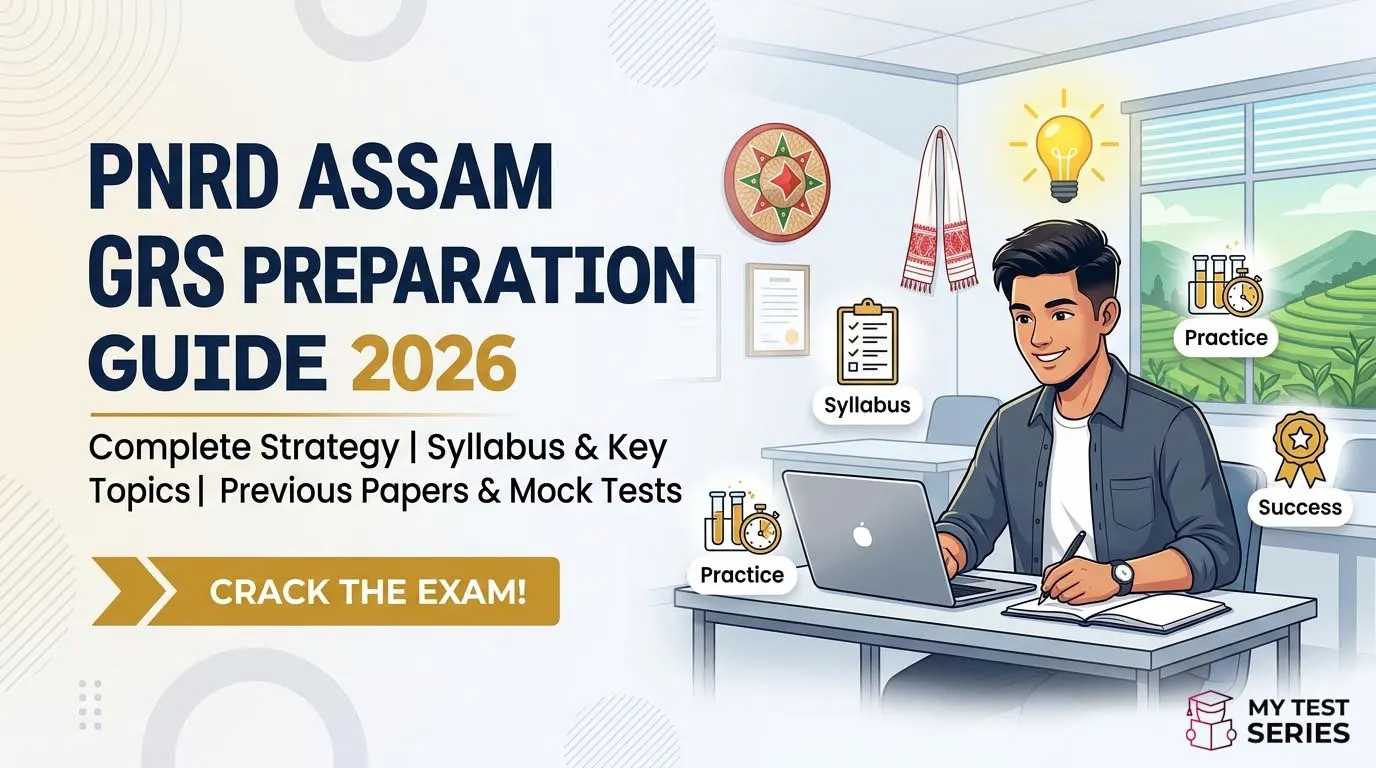
📋 Quick Overview: PNRD Assam has announced 464 GRS vacancies — the highest among all four posts in this recruitment. The written exam is 75 marks, OMR-based with 0.25 negative marking. This guide gives you a full syllabus breakdown, a 90-day study plan, MGNREGA domain facts, and 15 practice MCQs.
Among the four posts under PNRD Assam Recruitment 2026, the Gram Rozgar Sahayak position draws the most applicants — and for good reason. With 464 vacancies spread across Assam’s rural blocks, the GRS role sits at the heart of MGNREGA implementation. You are the person who keeps the scheme running at the ground level. That context matters, not just because it makes the job meaningful, but because it tells you exactly what the exam is going to test.
Every PNRD GRS exam question flows from one central question: do you understand how MGNREGA works at the panchayat level, and do you have the general aptitude and awareness needed to execute that work? The five exam sections — domain knowledge, computer proficiency, reasoning, history and culture, and general knowledge — are all designed around that core assessment.
This guide is built specifically for GRS aspirants. You will get the complete syllabus, a realistic 90-day preparation plan that actually fits around working hours, the MGNREGA facts you absolutely need to memorise, 15 topic-wise practice MCQs with full explanations, and a clear strategy for the viva that most candidates ignore until it is too late.
📌 What This Guide Covers
- GRS Post Overview – Vacancies, Salary, Eligibility
- What Does a GRS Actually Do? – Job Responsibilities
- GRS Exam Pattern 2026 – Paper I Structure
- Complete Section-wise Syllabus with Weightage
- 90-Day Study Plan – Week by Week
- MGNREGA Domain Knowledge – Key Facts for Exam
- 15 Topic-wise Practice MCQs with Explanations
- Best Books and Resources
- Exam Day Strategy – Timing and Attempt Order
- Viva Voce Preparation for GRS
- FAQs – PNRD Assam GRS 2026
PNRD Assam GRS Post 2026 – Vacancy, Salary and Eligibility
Before getting into preparation, it is worth understanding exactly what you are applying for. The GRS post is contractual — meaning its tenure is linked to the continuation of MGNREGA funding and scheme implementation. That said, it is a stable, government-linked role with a clear career path into rural administration.
| Detail | Information |
|---|---|
| Recruiting Body | Commissionerate of Panchayat & Rural Development (PNRD), Assam |
| Post Name | Gram Rozgar Sahayak (GRS) |
| Total Vacancies | 464 posts — highest among all PNRD 2026 posts (under MGNREGA) |
| Monthly Remuneration | ₹15,000 per month (contractual, no additional allowances) |
| Educational Qualification | Graduation (any discipline) with min 50% marks + Diploma in Computer Application (min 6 months, DEC/UGC/AICTE approved) |
| Age Limit | 18 to 40 years | SC/ST: 5 yrs relaxation | OBC/MOBC: 3 yrs | PH: 10 yrs |
| Job Type | Contractual under MGNREGA scheme |
| Language Requirement | Assamese (primary) + good working knowledge of English and Hindi |
| Selection Process | Written Exam – Paper I (75 marks) + Viva Voce (25 marks) |
| Exam Conducted By | Bodoland University (on behalf of PNRD Assam) |
| Application Fee | No fee — completely free to apply |
What Does a Gram Rozgar Sahayak Actually Do?
Understanding the actual job of a GRS will help you answer domain knowledge questions more intuitively — because the exam questions are written to test whether you could perform the real-world responsibilities of this role.
A Gram Rozgar Sahayak works at the Gram Panchayat level as the field operative for MGNREGA. Think of the GRS as the bridge between a rural labourer and the government scheme that is supposed to provide them employment. Here is what that looks like day to day:
- Job Card management: Registering new households, issuing Job Cards, maintaining and updating Job Card records on the NREGASoft platform
- Work demand registration: Recording when workers demand employment and ensuring work is provided within the 15-day window (failing which unemployment allowance is triggered)
- Muster roll maintenance: Documenting daily attendance of MGNREGA workers on worksites — a process now done digitally through the NREGAMobile app
- Wage payment processing: Facilitating wage disbursal through Direct Benefit Transfer to workers’ bank or post office accounts within 15 days of work completion
- Social audit support: Assisting the Gram Sabha’s Social Audit process — sharing records, facilitating transparency, responding to worker grievances
- Work measurement: Recording measurements of completed works for payment processing, often in coordination with the technical supervisor
💡 Exam Tip: Questions in the domain knowledge section will test these exact responsibilities. When you see a question about the 15-day rule, unemployment allowance, muster rolls, or Job Cards — that is directly testing whether you understand the GRS job function. Know the function, and you will know the answer.
PNRD Assam GRS Exam Pattern 2026 – Paper I
The GRS written exam falls under Paper-I, which is shared with the Computer Assistant and Gram Panchayat Coordinator posts. Despite sharing the paper, you should prepare with a GRS-specific focus — especially for domain knowledge, where MGNREGA questions will dominate.
| Section | Key Topics | Est. Questions | Est. Marks |
|---|---|---|---|
| Domain Knowledge | MGNREGA, PMAY-G, Panchayati Raj, rural schemes | 15–20 | 15–20 |
| Computer Proficiency | MS Office, internet, OS basics, shortcut keys, NREGASoft | 15 | 15 |
| Reasoning & Aptitude | Logical reasoning, quantitative aptitude, comprehension | 15–20 | 15–20 |
| History & Culture | Assam history, Indian history, culture, Bihu, Satras | 10–15 | 10–15 |
| General Knowledge | Current affairs, science, economy, environment | 10–15 | 10–15 |
| Total | 75 | 75 |
⚠️ Negative Marking Rule: −0.25 marks for every wrong answer in 1-mark questions. −0.50 marks for 2-mark questions. If you select more than one answer for a question, 0.50 marks are deducted. Never guess randomly — skip if unsure, attempt only when you can eliminate at least two wrong options with confidence.
PNRD GRS 2026 – Complete Section-wise Syllabus
Section 1: Domain Knowledge (Most Important for GRS)
This is the section where GRS-specific preparation pays off. The domain knowledge questions for GRS candidates are drawn primarily from MGNREGA, followed by other rural development schemes. Every other PNRD candidate prepares this section broadly. You prepare MGNREGA deeply.
- MGNREGA (Act, provisions, key rules) – 100-day guarantee, Job Card, 15-day employment provision, unemployment allowance, social audit, wage rates, muster roll, NREGASoft
- PMAY-G – Objectives, SECC 2011 data, AwaasSoft, AwaasApp, unit assistance, fund-sharing ratio
- Panchayati Raj System – 73rd Amendment, three-tier structure, Gram Sabha, Gram Panchayat powers, 11th Schedule
- SBM-G (Swachh Bharat Mission Gramin) – ODF status, IHHL, solid waste management at GP level
- Jal Jeevan Mission – Har Ghar Jal, village water supply committees, Paani Samiti
- SVAMITVA Scheme – Drone-based mapping, property card (Adhikar Patra)
- Finance Commission Grants – 15th Finance Commission, tied and untied grants, GP-level utilisation
- eGramSwaraj Portal – Activity mapping, fund flow, Gram Panchayat Development Plan (GPDP)
- Digital India in Rural Areas – Common Service Centres (CSC), BharatNet, DigiPay
Section 2: Computer Proficiency
- MS Word – creating documents, formatting, mail merge, track changes, page setup
- MS Excel – SUM, AVERAGE, COUNT, MAX, MIN, VLOOKUP formulas; cell referencing (absolute vs relative); sorting and filtering; creating charts
- MS PowerPoint – slide creation, design themes, transitions, animations, slide sorter view
- Internet and Email – browsers, URLs, HTTP vs HTTPS, email etiquette, cybersecurity basics, phishing awareness
- Operating System – Windows file management, Control Panel, Task Manager, keyboard shortcuts
- Mobile applications – government apps like NREGAMobile, AwaasApp, DigiLocker, UMANG
- Important shortcut keys – Ctrl+C (copy), Ctrl+V (paste), Ctrl+Z (undo), Ctrl+S (save), Alt+F4 (close), Windows+E (Explorer), Ctrl+P (print), Ctrl+F (find)
Section 3: Logical Reasoning and Aptitude
- Number and letter series
- Coding-decoding and analogies
- Blood relations and direction sense
- Syllogisms and logical deductions
- Seating arrangement (linear and circular)
- Percentage, ratio and proportion
- Time and work, time speed and distance
- Simple interest and compound interest
- Profit, loss and discount
- Reading comprehension passages
Section 4: History and Culture of Assam and India
- Ahom Kingdom – origin, administration, famous rulers
- Battle of Saraighat (1671) and Lachit Borphukan
- Srimanta Sankardeva – Neo-Vaishnavite movement, Satras, Borgeet, Ankiya Naat
- Bihu festivals – Rongali, Kongali, and Bhogali Bihu
- Gopinath Bordoloi – first CM of Assam, Bharat Ratna 1999
- Assam’s integration with India post-1947
- Indian freedom movement – 1857, Congress, Quit India Movement, partition
- Indian Constitution – Fundamental Rights, Directive Principles, 73rd and 74th Amendments
- UNESCO sites in Assam – Kaziranga and Manas National Parks
- Majuli – world’s largest river island, cultural heritage
Section 5: General Knowledge and Current Affairs
- Last 6 to 12 months of national and Assam state current affairs
- National awards – Padma Awards, Bharat Ratna, Sahitya Akademi, Jnanpith
- International events – summits, treaties, climate agreements
- Sports – Olympics, CWG, national and Assam-specific achievements
- Science and technology – ISRO missions, health breakthroughs, AI in governance
- Indian economy – Union Budget highlights, inflation, GDP basics
- Environment – Ramsar sites, National Parks, COP summits, Paris Agreement
90-Day PNRD GRS 2026 Study Plan – Week by Week
This plan is built for candidates dedicating 3 to 4 hours daily. If you are working or studying alongside, adjust each week’s scope by reducing to the top 3 topics per week — but do not cut the mock test weeks. Practice tests are non-negotiable.
📅 Month 1 (Days 1–30) — Build the Knowledge Base
Week 1 – MGNREGA Deep Dive
Spend this entire week on MGNREGA and nothing else. Read the Act provisions, understand the 15-day employment rule, the Job Card system, the wage payment cycle, and the social audit process. Study the NREGASoft platform — what data it holds, how muster rolls work digitally, and what the GRS is expected to enter. End the week by writing a one-page summary of MGNREGA from memory without looking at notes.
Week 2 – Other Rural Schemes (PMAY-G, SBM-G, JJM, SVAMITVA)
MGNREGA will be your heaviest domain topic, but the remaining rural schemes together will account for another 5 to 8 questions. Cover each scheme’s objective, launch year, target beneficiary, and key implementing platform. For PMAY-G, understand SECC 2011 data, AwaasSoft, and the installment structure. For SBM-G, know the ODF (Open Defecation Free) status criteria and IHHL construction.
Week 3 – Computer Proficiency
Create a shortcut keys cheat sheet on Day 1 of this week and practise it every morning for the rest of the week. Cover MS Word, MS Excel (focus on formulas — these are asked every year), and MS PowerPoint. Practice identifying function outputs: what does =VLOOKUP(A2,B1:D10,3,FALSE) do? These applied questions are harder than definition questions.
Week 4 – Assam History and Culture
Cover the Ahom Kingdom, Lachit Borphukan and the Battle of Saraighat, Srimanta Sankardeva’s contributions, the three Bihu festivals, and Gopinath Bordoloi. Then move to national history — 1857 revolt, Indian National Congress milestones, independence and partition. End with Indian Constitution basics focusing on the 73rd Amendment and Panchayati Raj provisions.
📅 Month 2 (Days 31–60) — Sharpen and Practise
Week 5 – Logical Reasoning
Focus only on verbal reasoning this week — coding-decoding, blood relations, direction sense, syllogisms, and series. Attempt 30 reasoning questions daily, strictly timed. The GRS exam gives you less than 1.5 minutes per question, so speed and pattern recognition matter as much as accuracy in this section.
Week 6 – Quantitative Aptitude
Cover the five highest-frequency topics first: percentage, ratio and proportion, time and work, profit and loss, and simple interest. Then move to speed/distance and compound interest. Use RS Aggarwal’s aptitude book for solved examples. Practice 25 questions daily. Do not move forward if your accuracy in percentage questions is below 80%.
Week 7 – General Knowledge and Current Affairs
Go through the last 6 months of current affairs with a focus on Assam state news, central government scheme updates (especially MGNREGA wage revision, PMAY-G targets, JJM milestones), national awards, and international summits. Build a running notes document of GK facts — 200 facts is a reasonable target for this week.
Week 8 – First Full Mock Test + Diagnosis
Take two complete full-length PNRD GRS mock tests under timed exam conditions — no phone, no breaks. Score each section separately. You will almost certainly find one or two sections where your score drops significantly. That diagnosis is the most valuable output of this week. Spend the remaining days of Week 8 in focused revision of your two weakest sections only.
📅 Month 3 (Days 61–90) — Mock Tests, Revision and Confidence
Week 9 – Domain Knowledge Revision (Deeper)
Return to MGNREGA with fresh eyes. Go beyond memorising facts and understand processes: what happens if a worker demands work and the GP does not provide it within 15 days? How does wage payment reach a worker’s account? What triggers a social audit? These process-based questions appear regularly. Also revise the Panchayati Raj section including the 11th Schedule subjects.
Week 10 – All-Section Rapid Revision
Review all your notes in rapid-fire format. Each day, take one topic from each section and test yourself orally — say the answers aloud before checking. This active recall method strengthens retention far better than rereading notes. Update your shortcut keys list and MGNREGA fact sheet with anything you missed earlier.
Week 11 – Three Full Mock Tests
Take one full-length PNRD GRS mock test every two days. After each test, spend as much time on analysis as you spent taking the test. Review every wrong answer — understand why you went wrong, not just what the right answer is. Track your score trend across the three tests. Scores should be improving each time.
Week 12 – Final Week Before Exam
No new topics this week. Revise your fact sheets — MGNREGA rules, scheme comparison table, Assam GK highlights, current affairs notes, shortcut key list. Take one half-length mock test on Day 83. From Day 85, switch fully to mental preparation — read your notes lightly, sleep well, and finalise your exam day plan including the centre location, required documents, and what time to leave.
🎯 Practice Daily PNRD GRS Mock Tests – Completely Free
Thousands of Assam aspirants are already practising on MyTestSeries.in. Daily fresh tests + topic-wise practice + instant All-Assam Rank. Available in Assamese and English.
👉 Register Free Now – Start Today
✅ No credit card ✅ New test every 24 hours ✅ Assamese + English
MGNREGA – Key Facts Every GRS Aspirant Must Know
The exam will test both factual recall and process understanding from MGNREGA. Here is a consolidated reference of the most frequently tested facts:
| Topic | Key Fact |
|---|---|
| Full form | Mahatma Gandhi National Rural Employment Guarantee Act |
| Enacted | 2005 (implemented from February 2006) |
| Employment Guarantee | 100 days of unskilled wage employment per rural household per financial year |
| Who can apply? | Any adult member of a rural household willing to do unskilled manual work |
| Job Card | Issued to each eligible household; contains photo, MGNREGA registration number, work details |
| 15-Day Rule | Employment must be provided within 15 days of demand. If not, unemployment allowance is payable. |
| Unemployment Allowance | Paid by state government if employment not provided within 15 days of demand |
| Wage Payment | Must be paid within 15 days of work completion via Direct Benefit Transfer (DBT) |
| Muster Roll | Daily attendance record of workers at MGNREGA worksite; now digital via NREGAMobile app |
| Digital Platform | NREGASoft (Management Information System) + NREGAMobile app |
| Social Audit | Mandatory audit by Gram Sabha to verify MGNREGA works and expenditure; conducted every 6 months |
| Fund Sharing | Centre bears 100% of unskilled labour cost; material cost shared Centre:State = 75:25 |
| Labour:Material Ratio | Minimum 60% expenditure on labour, maximum 40% on material in any MGNREGA work |
| Women Participation | Minimum one-third (33%) of MGNREGA workers must be women |
| Work Proximity | Employment must be provided within 5 km of the worker’s residence; otherwise additional travel allowance is paid |
| Assam Wage Rate (approx.) | ₹249 per day (check latest official notification for updated rate) |
📌 Memorise these 5 MGNREGA numbers: 100 days guarantee | 15 days for employment | 15 days for wage payment | 60:40 labour:material ratio | 33% women participation. These five figures appear in exam questions every single time.
PNRD GRS 2026 – 15 Practice MCQs with Full Explanations
Work through each question before reading the explanation. Active recall — trying to answer before seeing the answer — significantly improves exam performance compared to just reading Q&A pairs.
Domain Knowledge – MGNREGA and Rural Schemes
Q1. Under MGNREGA, within how many days of submitting a work demand must the Gram Panchayat provide employment to the applicant?
A) 7 days B) 10 days C) 15 days D) 30 days
MGNREGA legally requires employment to be provided within 15 days of submitting an application. If the Gram Panchayat fails to provide work within this period, the applicant becomes entitled to receive an unemployment allowance paid by the state government.
Q2. What is the minimum percentage of women workers that must be employed in any MGNREGA work?
A) 25% B) 30% C) 33% D) 40%
MGNREGA mandates that at least one-third (33%) of the total workers employed at any given worksite must be women. This provision ensures gender equity in rural employment and gives women financial independence.
Q3. The digital platform used to manage MGNREGA records, Job Cards and wage payments is called:
A) AwaasSoft B) eGramSwaraj C) NREGASoft D) PFMS
NREGASoft is the Management Information System (MIS) for MGNREGA. It records Job Card data, work demand applications, muster rolls, wage payments, and social audit information. AwaasSoft is for PMAY-G, eGramSwaraj is for overall GP management.
Q4. In a MGNREGA work project, what is the minimum percentage of total expenditure that must go towards labour cost?
A) 50% B) 55% C) 60% D) 70%
MGNREGA mandates a 60:40 labour-to-material ratio. At least 60% of funds in any project must be spent on unskilled labour wages, while material costs cannot exceed 40%. This ensures the scheme remains a genuine employment programme rather than a construction scheme.
Q5. The social audit under MGNREGA is conducted by which body?
A) Block Development Officer B) Gram Sabha C) District Collector D) State Audit Authority
Social audit under MGNREGA is conducted by the Gram Sabha — the assembly of all adult voters in a village. It involves publicly verifying MGNREGA records, works, and expenditure to detect irregularities. It must be conducted at least once every six months at the Gram Panchayat level.
Computer Proficiency
Q6. In MS Excel, which formula would you use to count all cells in a range that are not empty?
A) =COUNT() B) =COUNTA() C) =COUNTIF() D) =COUNTBLANK()
=COUNT() counts only cells with numbers. =COUNTA() counts all non-empty cells — including those with text, numbers, and dates. =COUNTBLANK() counts empty cells. =COUNTIF() counts cells that match a specific condition.
Q7. Which keyboard shortcut saves a document in MS Word without opening the Save As dialog?
A) Ctrl + S B) Ctrl + Shift + S C) F12 D) Alt + S
Ctrl + S saves the document directly without opening any dialog (if it has been saved before). F12 opens the Save As dialog. Ctrl + Shift + S also opens Save As in some Office versions.
Q8. HTTPS in a website URL indicates which of the following?
A) The website is hosted on government servers B) The data transferred is encrypted and secure C) The website works offline D) The website is free from malware
HTTPS (HyperText Transfer Protocol Secure) uses SSL/TLS encryption to secure data transferred between a browser and a website. It protects sensitive information like passwords and payment details from interception. It does not guarantee the site is malware-free.
Assam History and Culture
Q9. Which famous Assamese general is celebrated every year on 24th November as Lachit Divas?
A) Chilarai B) Momai Tamuli Borbarua C) Lachit Borphukan D) Sukhrungphaa
Lachit Borphukan was the Commander-in-Chief (Borphukan) of the Ahom Kingdom who led the Assamese forces to victory against the Mughal army at the Battle of Saraighat in 1671. November 24 is observed as Lachit Divas across Assam in his honour.
Q10. The Satras of Majuli were established as centers of which religious-cultural movement?
A) Shakti worship B) Neo-Vaishnavite movement C) Shaivism D) Buddhism
The Satras of Majuli are monastic institutions founded as part of the Neo-Vaishnavite movement initiated by the great saint-scholar Srimanta Sankardeva in the 15th century. These Satras serve as centres of Assamese culture, music, dance (Sattriya), drama (Ankiya Naat), and religious learning.
Q11. Bhogali Bihu (Magh Bihu) primarily celebrates which occasion?
A) Assamese New Year B) The end of the harvest season C) The beginning of sowing season D) The lean season of farming
Bhogali Bihu (also called Magh Bihu) is celebrated in January and marks the end of the paddy harvest season. It is characterised by community feasting, Meji (bonfire) burning, and sports. Rongali Bihu (April) marks the Assamese New Year and the start of the sowing season. Kongali Bihu (October) is observed during the lean season.
Logical Reasoning and Aptitude
Q12. If the cost price of an item is ₹800 and it is sold at a 15% profit, what is the selling price?
A) ₹900 B) ₹920 C) ₹940 D) ₹960
Profit = 15% of ₹800 = ₹120. Selling Price = Cost Price + Profit = ₹800 + ₹120 = ₹920.
Q13. In a certain code, RIVER is written as SIWFS. How is ASSAM written in the same code?
A) BTTNB B) BTTBN C) BSSNM D) BRRNL
Pattern: each letter moves one step forward in the alphabet. R→S, I→J, V→W, E→F, R→S. Applying the same: A→B, S→T, S→T, A→B, M→N. So ASSAM = BTTBN.
Q14. Pipe A can fill a tank in 20 minutes and Pipe B can drain it in 30 minutes. If both are open simultaneously, how long will it take to fill the tank?
A) 45 minutes B) 50 minutes C) 55 minutes D) 60 minutes
Filling rate of A = 1/20 per min. Draining rate of B = 1/30 per min. Net rate = 1/20 − 1/30 = 3/60 − 2/60 = 1/60 per minute. Time to fill = 60 minutes.
General Knowledge
Q15. The Jal Jeevan Mission aims to provide tap water connections to rural households by which target year?
A) 2022 B) 2024 C) 2025 D) 2030
Jal Jeevan Mission (Har Ghar Jal) was launched in 2019 with the original target of providing functional household tap connections to all rural homes by 2024. The mission has been extended. As of 2026, it continues as a priority scheme under the rural development ministry.
Best Books and Resources for PNRD Assam GRS 2026
| Subject | Recommended Book / Resource | Why This One |
|---|---|---|
| Domain Knowledge | Official MGNREGA Guidelines (nrega.nic.in) + PMAY-G portal (pmayg.nic.in) | Primary source — all exam facts come from here. Read the operational guidelines once fully. |
| Reasoning | A Modern Approach to Verbal & Non-Verbal Reasoning – RS Aggarwal | Covers every reasoning topic with graded difficulty. Start from solved examples. |
| Quantitative Aptitude | Quantitative Aptitude for Competitive Exams – RS Aggarwal | Standard reference, covers all exam-relevant topics with practice sets. |
| General Knowledge | Lucent’s General Knowledge (latest edition) | Best for static GK. Covers Indian and Assam history, geography, polity in one volume. |
| Assam GK | Assam Year Book (latest) + MyTestSeries.in Assam GK MCQ pages | Year Book for data, MyTestSeries for MCQ practice directly mapped to exam pattern. |
| Computer Proficiency | Arihant Computer Awareness for Competitive Exams | Exam-focused coverage of MS Office, internet, OS. Includes MCQ practice sets. |
| Current Affairs | Monthly GK magazine (Pratiyogita Darpan or Chronicle) + Assam Tribune highlights | For state-level events, Assam Tribune covers PNRD and government scheme updates specifically. |
| Mock Tests | MyTestSeries.in – Free Registration | Daily PNRD GRS-level mock tests in Assamese and English. Instant rank and performance analysis. |
Exam Day Strategy – Attempt Order and Time Management
The PNRD GRS exam gives you 120 minutes for 75 questions — an average of 1 minute 36 seconds per question. But not all sections deserve equal time. Here is how to distribute your 120 minutes:
| Section | Attempt Order | Time to Allocate | Reason |
|---|---|---|---|
| Domain Knowledge | 1st | 25 minutes | Your strongest and most prepared section. Attempt first while mind is fresh. |
| Computer Proficiency | 2nd | 20 minutes | Fact-based, predictable. Quick wins that secure marks. |
| Assam History & GK | 3rd | 25 minutes | Memory-based. Attempt questions you know; mark uncertain ones to revisit. |
| Reasoning | 4th | 25 minutes | Time-consuming. Skip and return to difficult questions. Never guess here. |
| Aptitude | 5th | 25 minutes | Calculation-heavy. Reserve remaining time. Skip complex sums under pressure. |
Three rules to follow on exam day:
- Never spend more than 2 minutes on a single question. Mark it, move on, come back if time permits.
- Only guess if you can confidently eliminate two wrong options. A pure guess has a 25% chance of being right but costs 0.25 marks if wrong — mathematically not worth it unless you can narrow it down.
- Keep the last 10 minutes for reviewing marked questions and filling in any OMR bubbles you missed.
PNRD GRS Viva Voce 2026 – Preparation Guide
The viva carries 25 marks. Most candidates underestimate it. In a competitive merit list where written scores are close, the viva is what separates the selected from the waitlisted. Here is what the panel typically assesses:
- MGNREGA scheme knowledge: Expect direct questions like “What is a Job Card?”, “What is the 15-day rule?”, “How is wage paid to workers?”, “What is a muster roll?” — know these cold.
- Role awareness: “What will you do on your first day as a GRS?”, “How will you handle a worker who says their wage wasn’t paid?” — prepare 5 to 6 scenario-based answers.
- Communication clarity: Speak in clear, complete sentences in Assamese or English. Do not mix languages mid-sentence. Pace yourself — panels respond better to calm, measured speech than nervous fast-talking.
- Current Assam affairs: Stay updated on PNRD Assam developments, MGNREGA wage revisions, and state government announcements.
- Presentation: Dress formally. Greet the panel in Assamese. Maintain eye contact. Do not fidget. If you don’t know an answer, say “I am not certain about this, but I believe…” — honesty is valued over bluffing.
🎤 Viva Prep Tip: Practice answering the 10 most common MGNREGA questions out loud in front of a mirror or with a friend. Speaking the answer aloud is fundamentally different from knowing it in your head — it builds the muscle memory you need in a panel interview setting.
📱 Start Your Free PNRD GRS Mock Test Today
Get daily full-length PNRD GRS mock tests, topic-wise practice, and your All-Assam Rank instantly. In Assamese and English. No cost, no credit card.
📚 More Practice Resources for PNRD Assam 2026
- Assam PNRD Free Mock Test 2026 – Daily Practice in Assamese & English
- PNRD Assam GPC (Gram Panchayat Coordinator) 2026 – Full Study Plan
- Assam Static GK Questions and Answers – ADRE, PNRD & Police
- 100 Assam History MCQ for Competitive Exams 2026
- PNRD Assam Syllabus 2026 – Complete Exam Pattern and Section-wise Guide
FAQs – PNRD Assam GRS (Gram Rozgar Sahayak) 2026
What is the total number of GRS vacancies in PNRD Assam 2026?
PNRD Assam 2026 has announced 464 Gram Rozgar Sahayak (GRS) vacancies under the MGNREGA scheme. This is the highest vacancy count among all four posts in the PNRD Assam 2026 recruitment — making it the most widely applied-for position in this drive.
What is the educational qualification required for PNRD Assam GRS post?
Candidates must hold a graduation degree in any discipline from a recognized university with a minimum of 50% marks. Additionally, a Diploma in Computer Application of at least 6 months duration from a DEC/UGC/AICTE approved institution is mandatory. Distance education degrees approved by these bodies are also accepted.
What is the salary for PNRD Assam GRS post in 2026?
The monthly remuneration for the GRS post is ₹15,000. The position is contractual in nature, directly linked to the tenure of the MGNREGA scheme. No additional perks or allowances are provided beyond the base monthly remuneration.
What is the role of a Gram Rozgar Sahayak under MGNREGA?
A Gram Rozgar Sahayak is the frontline MGNREGA worker at the Gram Panchayat level. Key responsibilities include issuing and maintaining Job Cards, registering work demands from households, maintaining muster rolls (attendance records) at worksites, facilitating wage payments through DBT, and supporting the Gram Sabha’s social audit process. The GRS essentially ensures that eligible rural households actually receive the 100-day employment guarantee.
What is the PNRD Assam GRS exam pattern 2026?
The GRS written exam is Paper-I — an OMR-based test of 75 questions carrying 75 marks. The five sections are: Domain Knowledge (MGNREGA and rural schemes), Computer Proficiency, Logical Reasoning and Aptitude, History and Culture of Assam and India, and General Knowledge. The exam duration is 2 hours. There is a negative marking of 0.25 marks for every wrong answer.
Is the PNRD Assam GRS exam conducted in the Assamese language?
Yes. The PNRD Assam GRS exam question paper is available in both Assamese and English. Candidates can choose their preferred language at the exam center. MyTestSeries.in provides free GRS mock tests in both languages so Assamese-medium candidates can prepare comfortably in their mother tongue.
Where can I get free PNRD Assam GRS mock tests online?
Free PNRD Assam GRS mock tests are available at MyTestSeries.in. After completing a simple free registration, you get access to daily updated full-length mock tests, topic-wise practice sets, instant All-Assam rank comparison, and detailed performance analysis — all in both Assamese and English, at zero cost.
This preparation guide is created by the exam preparation team at MyTestSeries.in for PNRD Assam GRS 2026 aspirants. For official vacancy details, syllabus, and exam date notifications, always refer to the official PNRD Assam website: rural.assam.gov.in. Last updated: May 2026.