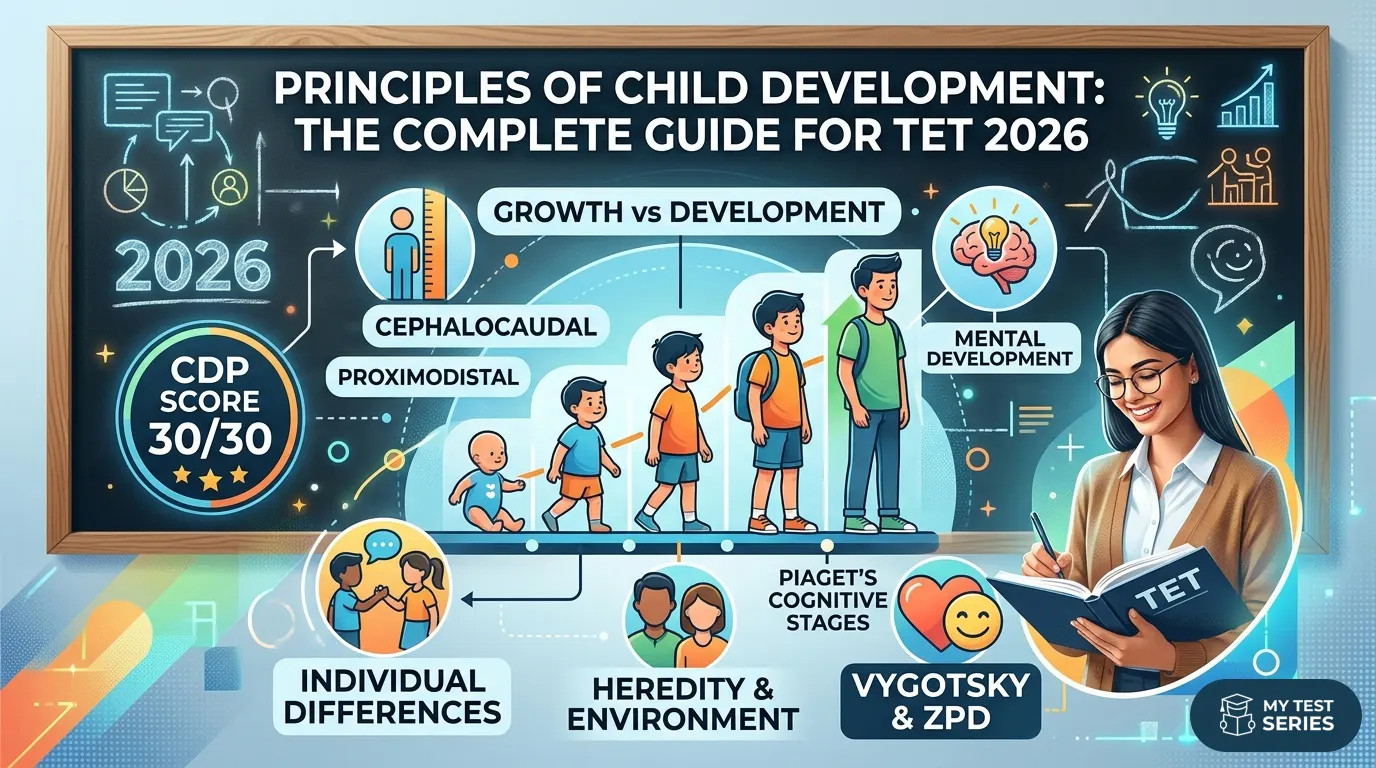
Mastering the Principles of Child Development: The Ultimate Guide for TET Candidates
For any aspiring teacher appearing for the Teacher Eligibility Test (TET)—be it CTET, UPTET, REET, or State TETs—the subject of Child Development and Pedagogy (CDP) is the heartbeat of the examination. Understanding how a child grows isn't just about passing an exam; it’s about becoming an effective educator who can shape the future.
In this comprehensive guide, we dive deep into the Principles of Child Development, exploring the patterns, sequences, and nuances that define the journey from infancy to adolescence. If you want to secure 30/30 in the CDP section, this is the only roadmap you need.
What is Child Development?
Before we dissect the principles, let’s define our subject. Child development refers to the biological, psychological, and emotional changes that occur in human beings between birth and the conclusion of adolescence. It is a progressive, orderly, and predictable process.
10 Fundamental Principles of Child Development
Psychologists and educators have identified several universal principles that govern how children develop. Let’s break them down:
1. Principle of Continuity
Development is a continuous process. It starts in the mother’s womb (pre-natal) and continues until death (pro-natal). There is no sudden jump in development; it is a gradual progression where one stage paves the way for the next.
2. Principle of Sequentiality
Development follows a fixed pattern or sequence. This is a favorite topic for TET examiners, specifically focusing on two directions:
- Cephalocaudal Sequence: Development proceeds from head to toe. A baby first gains control over their head, then their arms, and finally their legs.
- Proximodistal Sequence: Development proceeds from the center of the body outward. A child first controls their torso, then their arms, and finally their fingers.
3. Principle of Individual Differences
While the sequence of development is the same, the rate varies. No two children are exactly alike. One child might start walking at 10 months, while another starts at 15 months. Both are normal; they simply follow their own biological clock.
4. Principle of Generality to Specificity
Children first exhibit general responses before moving toward specific ones. For example, a baby will first move their whole body to reach for a toy (general) before learning to use just their thumb and forefinger (specific/pincer grasp).
5. Principle of Interrelation
Physical, mental, social, and emotional developments are interrelated. If a child is physically weak, it might affect their social interaction and emotional stability. A lag in one domain often impacts others.
6. Principle of Predictability
Because development follows an orderly path, we can predict certain outcomes. By observing a child's current rate of mental growth, we can roughly estimate their future cognitive capabilities.
7. Principle of Interaction between Heredity and Environment
This is perhaps the most crucial principle. Development is the product of Nature (Heredity) and Nurture (Environment).
Formula: Development = Heredity × Environment.
8. Principle of Spiral vs. Linear Advancement
Development does not move in a straight, constant line. Instead, a child develops, then pauses to consolidate their gains, and then moves forward again. It’s a spiral process of advancement and refinement.
9. Principle of Integration
Development involves both the "whole to parts" and "parts to whole" movement. A child learns to integrate various body parts to perform a complex action, like cycling or writing.
10. Principle of Maturation and Learning
Maturation is biological growth, while learning is the change in behavior through experience. Development occurs when a child is biologically "ready" (maturation) and is provided with the right "stimulus" (learning).
Factors Influencing Child Development
To score high in TET, you must understand the 'Why' behind development. The factors are broadly classified into:
| Internal Factors | External Factors |
|---|---|
| Genetic/Hereditary traits | Family Environment (Home) |
| Biological/Constitutional factors | Social-Economic status |
| Intelligence Quotient (IQ) | Quality of Schooling & Peers |
| Emotional Factors | Cultural influences |
Key Stages of Child Development for TET
In the TET exam, questions are frequently framed around the specific characteristics of different age groups. Understanding these stages helps teachers tailor their instruction style.
1. Infancy (Birth to 2 Years)
This is a period of rapid physical growth and sensory exploration. Children learn through their senses and motor activities.
Exam Tip: This is the stage of "Object Permanence" (Jean Piaget).
2. Early Childhood (2 to 6 Years)
Often called the "Toy Age" or "Pre-school Age." This is the most critical period for language acquisition. Children exhibit "Egocentrism" (viewing the world only from their perspective) and "Animism" (believing inanimate objects have feelings).
3. Later Childhood (6 to 12 Years)
Known as the "Gang Age" or "Elementary School Age." Physical growth slows down, but cognitive and social skills sharpen. Children begin to think logically about concrete objects and develop a sense of "Industry" (Erikson).
4. Adolescence (12 to 18 Years)
Stanley Hall famously described this as a period of "Storm and Stress." It involves identity formation, hormonal changes, and the shift toward abstract reasoning.
Key Term: Identity vs. Role Confusion.
Major Theories You Cannot Skip
The principles of development are backed by several psychological theories. For a high score in CDP, ensure you have a grip on these three pillars:
Jean Piaget
Focused on Cognitive Development. He proposed 4 stages: Sensory-motor, Pre-operational, Concrete-operational, and Formal-operational.
Lev Vygotsky
Emphasized Social Constructivism. Key concepts: ZPD (Zone of Proximal Development), Scaffolding, and More Knowledgeable Other (MKO).
Lawrence Kohlberg’s Moral Development
Kohlberg divided moral reasoning into three levels: Pre-conventional, Conventional, and Post-conventional. TET exams often present a "Heinz Dilemma" scenario to test your understanding of these levels.
Educational Implications: Applying Principles in the Classroom
Why does the TET ask these questions? Because a teacher must apply these principles to be effective:
- Individualized Instruction: Recognizing individual differences means using diverse teaching methods for different learners.
- Curriculum Planning: Designing lessons based on the child's "Readiness to Learn" (Principle of Maturation).
- Holistic Development: Focusing not just on marks (cognitive), but also on sports (physical) and arts (emotional).
- Creating a Positive Environment: Since development is an interaction of heredity and environment, the teacher controls the "Nurture" aspect in school.
Frequently Asked Questions (FAQ)
Q1: What is the difference between Cephalocaudal and Proximodistal development?
A: Cephalocaudal refers to development from head to toe, whereas Proximodistal refers to development from the center of the body outward to the extremities (like fingers).
Q2: Is development a linear process?
A: No, development is spiral. A child moves forward, then pauses to consolidate their learning before advancing again.
Q3: Who said development is a product of Heredity and Environment?
A: Most modern psychologists agree on this, but Woodworth is frequently cited for the formula: Development = Heredity × Environment.
Q4: Why is Early Childhood called the 'Critical Period'?
A: It is the most sensitive timeframe for brain development and language acquisition. Experiences during this phase form the foundation for future learning.
Conclusion
Understanding the Principles of Child Development is not just a requirement for your TET certificate; it is the cornerstone of your journey as a pedagogue. By recognizing that every child is unique, that development is continuous, and that environment plays a pivotal role, you can create a classroom where every student thrives.
Keep these principles in mind while solving CDP MCQs—always look for the "most holistic" and "child-centered" answer. Happy studying!