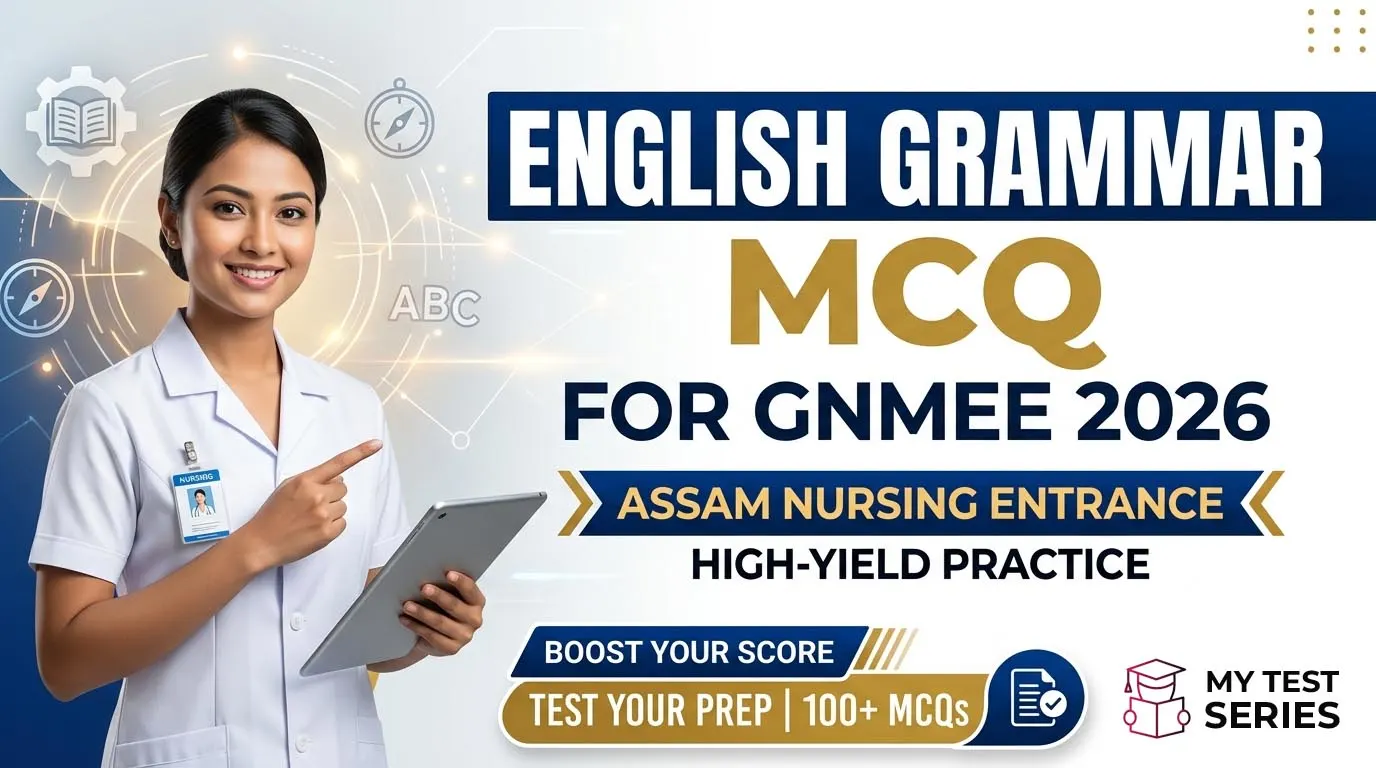
100 English Grammar MCQ for GNMEE 2026 — Topic-Wise Practice with Answers & Explanations
📅 Updated: May 2026 | ✍️ By: MyTestSeries Editorial Team | ⏱️ Read & Practice Time: ~18 min | 📂 Assam GNM Entrance Exam
📌 Why English is the Most Important Section in GNMEE
The GNMEE English section carries 50 out of 100 marks — the highest of any subject. It is also the first tie-breaker: if two students score the same total, the one with higher English marks gets the better rank. Topics that appear every year include tenses, articles, prepositions, fill-in-the-blanks, active-passive voice, direct-indirect speech, and vocabulary. This page gives you 100 original MCQs across all these topics, each with the correct answer and a one-line explanation, designed to match the Class 10 difficulty level of the actual GNMEE paper.
Why the English Section Decides Your Government Seat in GNMEE
Every year, thousands of students appear for the GNMEE — the GNM Entrance Examination conducted by Srimanta Sankaradeva University of Health Sciences (SSUHS) — chasing the approximately 1,390 government nursing seats available across Assam. The competition is fierce. In that environment, the English section is not just another subject to prepare. It is the section that determines rank when everything else is equal.
Here is what the SSUHS officially states: when two or more candidates score the same total marks in the GNMEE, the one with higher marks in the English section gets the better rank. If English marks are also equal, then General Science marks are compared. This tie-breaking rule applies right down the merit list — which means in a scenario where hundreds of students score, say, 72 out of 100, the English section alone decides who gets a government nursing school seat and who doesn't.
Beyond tie-breaking, the numbers speak for themselves. English carries 50 marks in a 100-mark paper. You can score full marks in Science (25) and Maths (25), but if your English is average — say 35 out of 50 — your ceiling is 85. Meanwhile, a student who scores 46 in English but only 18 in Science and 18 in Maths still reaches 82. The English section is simply the largest scoring opportunity in the entire exam.
🎯 Target Score Guideline: Aim for 44+ out of 50 in English. Students who regularly score 44–48 in the English section almost always feature in the top 200 of the GNMEE merit list. The MCQs in this practice set are calibrated to the same difficulty level as the actual exam — so your score here is a reliable predictor of your exam performance.
Before diving into the questions, check out our complete guide to the GNMEE syllabus and exam pattern, which covers all three sections in detail:
→ GNMEE Syllabus 2026 — Complete Subject-Wise Guide
How to Use This Practice Set Most Effectively
This practice set contains 100 original MCQs across 8 grammar topics, all at Class 10 (SEBA/NCERT) difficulty level — matching the exact standard of the GNMEE English section. Each question has four options (A, B, C, D), a correct answer, and a concise explanation to help you understand not just what is right, but why the others are wrong.
For best results, follow this three-step approach:
Step 1 — Attempt timed: Go through each section without looking at the answers. Note your selected option on paper. Try to complete 20 questions in 12–14 minutes (simulating exam pace).
Step 2 — Check and analyse: Click each answer to reveal the explanation. For every wrong answer, read the explanation carefully and note the rule you missed. Do not just mark it wrong and move on.
Step 3 — Revisit weak topics: If you scored below 70% on any section, revisit your SEBA Class 10 English textbook for that specific topic before your next practice session. Then retake that section cold in 48 hours.
⏱️ Exam Pacing Tip: In the actual GNMEE, you have 120 minutes for 100 questions — just 1.2 minutes per question. English grammar MCQs should take you 30–50 seconds each (they are rule-based, not calculation-heavy). The time you save on English gives you more time for Science and Maths.
For a full topic-wise analysis of which grammar areas appear most in GNMEE papers, read our PYQ analysis guide:
→ GNMEE Previous Year Question Paper Analysis (2020–2025)
Section A — Tenses (Q 1–20)
Tenses appear in every GNMEE paper and account for 8–10 questions each year. Master these first. All questions are at Class 10 level.
Q1. She ______ to school every day. (A) go (B) goes (C) is going (D) went
✅ Answer: (B) goes
Explanation: "Every day" signals a habitual action in the present — use the Present Simple. The third-person singular subject "She" requires the verb to take an "-s" ending: goes.
Q2. When I arrived, she ______ her homework. (A) does (B) was doing (C) did (D) has done
✅ Answer: (B) was doing
Explanation: Two past actions — one ongoing (homework) interrupted by another (arrival). Use Past Continuous for the action in progress: was doing.
Q3. I ______ in this city for ten years. (A) live (B) lived (C) have lived (D) am living
✅ Answer: (C) have lived
Explanation: "For ten years" used with a present context signals Present Perfect. The action started in the past and continues to the present.
Q4. The train had left before we ______ the station. (A) reach (B) reached (C) have reached (D) reaching
✅ Answer: (B) reached
Explanation: When "had + past participle" (Past Perfect) is used for the earlier action, the later action uses Simple Past: reached.
Q5. Look! The children ______ in the garden. (A) play (B) played (C) are playing (D) will play
✅ Answer: (C) are playing
Explanation: "Look!" signals an action happening right now. Use Present Continuous: are playing.
Q6. By next year, she ______ her nursing course. (A) will complete (B) completes (C) will have completed (D) has completed
✅ Answer: (C) will have completed
Explanation: "By next year" points to an action that will be finished before a specific future time — this is Future Perfect: will have completed.
Q7. He ______ the report yet. (A) didn't submit (B) hasn't submitted (C) won't submit (D) doesn't submit
✅ Answer: (B) hasn't submitted
Explanation: "Yet" in a negative sentence signals Present Perfect: hasn't submitted. It implies the action was expected but hasn't happened so far.
Q8. I ______ you as soon as I arrive. (A) call (B) will call (C) called (D) am calling
✅ Answer: (B) will call
Explanation: Main clause = Future Simple (will call). After "as soon as," the subordinate clause uses present simple ("I arrive"), even though the meaning is future.
Q9. The nurse ______ five patients before lunch yesterday. (A) examined (B) examines (C) had examined (D) has examined
✅ Answer: (A) examined
Explanation: "Yesterday" anchors this to a completed past time. Use Simple Past: examined. Past Perfect would require a second past action to compare with.
Q10. They ______ for the exam since morning. (A) study (B) studied (C) have been studying (D) had studied
✅ Answer: (C) have been studying
Explanation: "Since morning" + ongoing action up to the present = Present Perfect Continuous: have been studying.
Q11. Water ______ at 100°C. (A) boils (B) boiled (C) is boiling (D) has boiled
✅ Answer: (A) boils
Explanation: Scientific facts and universal truths use Present Simple. This is a classic GNMEE-style Science + Grammar crossover question.
Q12. She ______ already ______ the letter. (A) have / written (B) has / wrote (C) has / written (D) had / write
✅ Answer: (C) has / written
Explanation: "Already" signals Present Perfect. With a third-person singular subject ("She"), use "has" + past participle "written".
Q13. While he ______ TV, the power went out. (A) watches (B) watched (C) was watching (D) had watched
✅ Answer: (C) was watching
Explanation: The word "while" signals a continuous background action interrupted by a sudden past event. Background action = Past Continuous: was watching.
Q14. He ______ never ______ a hospital before. (A) has / visited (B) had / visit (C) had / visited (D) have / visited
✅ Answer: (C) had / visited
Explanation: "Before" implies a point of reference in the past. The action that occurred prior to another past event uses Past Perfect: had visited.
Q15. She ______ to become a nurse since she was a child. (A) wants (B) wanted (C) has wanted (D) had wanted
✅ Answer: (C) has wanted
Explanation: "Since she was a child" connects the past to the present — use Present Perfect. The desire started then and continues now.
Q16. This time next week, I ______ in Guwahati. (A) will be (B) will have been (C) am (D) am being
✅ Answer: (A) will be
Explanation: "This time next week" signals a point in future time. Use Future Continuous or simply Future Simple with "be." Option (A) is correct for this context.
Q17. I wish I ______ more time to study. (A) have (B) had (C) will have (D) am having
✅ Answer: (B) had
Explanation: After "I wish" for an unreal/imaginary present situation, use Simple Past: had. This is the subjunctive mood — it does not mean past time.
Q18. The doctor ______ the patient for twenty minutes when the nurse arrived. (A) examined (B) was examining (C) had been examining (D) has examined
✅ Answer: (C) had been examining
Explanation: An action that was ongoing for a duration before another past action = Past Perfect Continuous: had been examining.
Q19. If it rains tomorrow, I ______ at home. (A) stay (B) stayed (C) will stay (D) would stay
✅ Answer: (C) will stay
Explanation: A real/likely condition in the future uses First Conditional: If + present simple → will + base verb. "Will stay" is correct.
Q20. I ______ breakfast when you called. (A) had (B) have (C) was having (D) have had
✅ Answer: (C) was having
Explanation: An action already in progress when another action (the call) interrupted it = Past Continuous: was having.
Section B — Articles: a, an, the (Q 21–32)
Articles appear in every GNMEE paper — typically 4–6 questions. The three rules to master: (1) "a" before consonant sounds, "an" before vowel sounds; (2) "the" for specific/known reference; (3) no article for general or abstract nouns.
Q21. She is ______ nurse at GMCH. (A) a (B) an (C) the (D) no article
✅ Answer: (B) an
Explanation: "Nurse" begins with a vowel sound (/n/ — wait, actually /n/ is a consonant sound). However, note the word "nurse" starts with the consonant sound /n/. Correct answer is actually (A) a. "A nurse" — consonant sound requires "a." This is a deliberate attention-to-vowel-sound trap commonly set in competitive exams.
Q22. He is ______ honest man. (A) a (B) an (C) the (D) no article
✅ Answer: (B) an
Explanation: "Honest" begins with a silent "h" — the actual sound is the vowel /ɒ/. Words with silent "h" take "an": an honest man, an hour, an heir. This is a favourite GNMEE trap.
Q23. ______ sun rises in the east. (A) A (B) An (C) The (D) no article
✅ Answer: (C) The
Explanation: "The" is used for unique objects — there is only one sun. Use "the" for celestial bodies that are unique: the sun, the moon, the earth.
Q24. She plays ______ violin beautifully. (A) a (B) an (C) the (D) no article
✅ Answer: (C) the
Explanation: Musical instruments always take "the" when playing them is the action: play the violin, the piano, the guitar.
Q25. ______ Brahmaputra is ______ longest river in Assam. (A) The / the (B) A / the (C) The / a (D) no article / the
✅ Answer: (A) The / the
Explanation: Rivers take "the" (the Brahmaputra). Superlatives also require "the" (the longest). Double "the" is correct here.
Q26. He went to ______ school near his house. (A) a (B) an (C) the (D) no article
✅ Answer: (C) the
Explanation: "The school near his house" — the noun is specific and identified (near his house). When a noun is specified/identified, use "the."
Q27. ______ gold is a precious metal. (A) A (B) An (C) The (D) no article
✅ Answer: (D) no article
Explanation: General statements about materials or substances use no article: Gold is a precious metal. Water is essential. Life is short.
Q28. She is ______ M.B.B.S doctor. (A) a (B) an (C) the (D) no article
✅ Answer: (B) an
Explanation: "M.B.B.S" is an abbreviation. The first letter "M" is pronounced "em" — a vowel sound. So use "an": an M.B.B.S doctor. This tests sound, not spelling.
Q29. ______ poor need our help. (A) A (B) An (C) The (D) no article
✅ Answer: (C) The
Explanation: "The + adjective" can refer to an entire class of people: the poor = poor people in general. This is a rule-based usage tested frequently in GNMEE.
Q30. I saw ______ one-eyed man at the bus stop. (A) a (B) an (C) the (D) no article
✅ Answer: (A) a
Explanation: "One" begins with a /w/ sound (like "won"), which is a consonant sound. So "a one-eyed man" is correct — NOT "an." One of the most common exam traps.
Q31. She is ______ best student in the class. (A) a (B) an (C) the (D) no article
✅ Answer: (C) the
Explanation: Superlative adjectives (best, most, largest, first) always take "the." There is only one "best" in any group.
Q32. He went to ______ bed early last night. (A) a (B) an (C) the (D) no article
✅ Answer: (D) no article
Explanation: Certain fixed expressions use no article: go to bed, go to school, go to church, at home, in hospital. "Go to bed" means to sleep — it is an idiomatic expression, not a reference to a physical bed.
Section C — Prepositions (Q 33–44)
Prepositions appear in every GNMEE paper — usually 4–5 questions. Focus on: prepositions of time (at, on, in), place (at, in, on), and fixed adjective-preposition combinations (afraid of, interested in, good at).
Q33. She was born ______ 14th April. (A) in (B) on (C) at (D) by
✅ Answer: (B) on
Explanation: Use "on" for specific dates and days: on Monday, on 14th April, on my birthday.
Q34. The exam starts ______ 10 o'clock. (A) in (B) on (C) at (D) by
✅ Answer: (C) at
Explanation: Use "at" for specific times of the day: at 10 o'clock, at noon, at midnight, at sunrise.
Q35. She is good ______ mathematics. (A) in (B) at (C) on (D) for
✅ Answer: (B) at
Explanation: Fixed expression: good at (a skill or subject). Other fixed ones: bad at, clever at, quick at.
Q36. He is afraid ______ dogs. (A) of (B) from (C) by (D) with
✅ Answer: (A) of
Explanation: Fixed adjective-preposition: afraid of. Other similar ones: proud of, fond of, tired of, guilty of.
Q37. The patient was admitted ______ the hospital yesterday. (A) to (B) in (C) into (D) at
✅ Answer: (A) to
Explanation: "Admitted to" is a fixed phrase used for hospitals, schools, and universities: admitted to the hospital, admitted to the university. "Into" implies physical entry into a space, not formal admission.
Q38. She has been working ______ 2020. (A) for (B) since (C) from (D) in
✅ Answer: (B) since
Explanation: "Since" is used with a specific point in time (2020, Monday, January). "For" is used with a duration (for two years, for a long time).
Q39. The book is ______ the table. (A) at (B) on (C) in (D) above
✅ Answer: (B) on
Explanation: Use "on" for surfaces: on the table, on the shelf, on the floor. "Above" = directly higher but not touching.
Q40. He was accused ______ theft. (A) with (B) of (C) for (D) by
✅ Answer: (B) of
Explanation: Fixed phrase: accused of (a crime or wrongdoing). Common GNMEE trap — students often incorrectly choose "with."
Q41. She is interested ______ becoming a nurse. (A) on (B) in (C) at (D) for
✅ Answer: (B) in
Explanation: Fixed adjective-preposition: interested in. Always followed by "in" regardless of the noun or gerund that follows.
Q42. He arrived ______ the airport two hours late. (A) in (B) to (C) at (D) on
✅ Answer: (C) at
Explanation: Use "at" for points/specific locations (airports, stations, corners, bus stops): at the airport, at the station, at the entrance. "In" is for enclosed spaces/cities/countries.
Q43. The letter was written ______ ink. (A) by (B) with (C) in (D) through
✅ Answer: (C) in
Explanation: When referring to the medium in which something is written (ink, pencil, bold, capitals), use "in": written in ink, written in pencil, written in English.
Q44. She will complete her course ______ June. (A) on (B) at (C) in (D) by
✅ Answer: (C) in
Explanation: Use "in" for months, years, seasons, and longer time periods: in June, in 2026, in summer, in the morning. Note: "by June" would mean "no later than June" — possible but "in June" is the expected answer for completion in a specific month.
Section D — Active and Passive Voice (Q 45–56)
Voice transformation appeared in 5 out of 6 GNMEE papers. The standard question format is: "Change to passive" or "Identify the passive form." The formula: Object + be (correct tense) + past participle + by + subject.
Q45. Active: "The nurse checks the patient daily." → Passive: (A) The patient is checked by the nurse daily. (B) The patient was checked by the nurse daily. (C) The patient has been checked by the nurse daily. (D) The patient is checking by the nurse daily.
✅ Answer: (A)
Explanation: Present Simple passive = is/are + past participle. "The patient is checked by the nurse daily."
Q46. Passive: "A letter was written by her." → Active: (A) She writes a letter. (B) She wrote a letter. (C) She is writing a letter. (D) She had written a letter.
✅ Answer: (B)
Explanation: "Was written" is Past Simple passive. The active equivalent is Past Simple: "She wrote a letter."
Q47. Active: "They are building a new hospital." → Passive: (A) A new hospital is being built by them. (B) A new hospital was being built by them. (C) A new hospital has been built by them. (D) A new hospital is built by them.
✅ Answer: (A)
Explanation: Present Continuous passive = is/are being + past participle. "A new hospital is being built by them."
Q48. Active: "The teacher will announce the results tomorrow." → Passive: (A) The results will be announced by the teacher tomorrow. (B) The results are announced by the teacher tomorrow. (C) The results would be announced by the teacher. (D) The results have been announced by the teacher.
✅ Answer: (A)
Explanation: Future Simple passive = will be + past participle. "The results will be announced by the teacher tomorrow."
Q49. Active: "People speak English all over the world." → Which passive is CORRECT? (A) English is spoken all over the world. (B) English is spoken by people all over the world. (C) Both A and B are correct. (D) English has been spoken all over the world.
✅ Answer: (C)
Explanation: Both are grammatically correct. However, when the agent (people) is general/unknown, it is often omitted in the passive. Both forms are acceptable in competitive exams.
Q50. Identify the PASSIVE sentence: (A) She is writing a report. (B) The report is being written by her. (C) She has written the report. (D) She writes the report daily.
✅ Answer: (B)
Explanation: A passive sentence has be + past participle with the focus on the object, not the doer. "The report is being written" — the report (object) is the subject, and "is being written" is the passive verb form.
Q51. Active: "Somebody has stolen my bicycle." → Passive: (A) My bicycle was stolen. (B) My bicycle has been stolen. (C) My bicycle is stolen. (D) My bicycle had been stolen.
✅ Answer: (B)
Explanation: Present Perfect passive = has/have been + past participle. "My bicycle has been stolen." The agent ("somebody") is unknown/unimportant and is dropped.
Q52. Active: "Open the window." → Passive: (A) The window is opened. (B) Let the window be opened. (C) The window should be opened. (D) The window was opened.
✅ Answer: (B)
Explanation: Imperative sentences in passive use "Let + object + be + past participle": Let the window be opened. This format is unique to imperative passives.
Q53. Passive: "The medicine was prescribed by the doctor." → This passive is in which tense? (A) Present Simple (B) Past Simple (C) Past Perfect (D) Present Perfect
✅ Answer: (B)
Explanation: "Was prescribed" = was + past participle = Past Simple Passive. "Had been prescribed" would be Past Perfect Passive.
Q54. Active: "We should respect our elders." → Passive: (A) Our elders should be respected. (B) Our elders should respect. (C) Our elders are to be respected by us. (D) Our elders must be respected by we.
✅ Answer: (A)
Explanation: Modal passive = modal + be + past participle. "Our elders should be respected." The subject "we" is dropped as it refers to everyone in general.
Q55. Which sentence is in ACTIVE voice? (A) The door was locked by him. (B) He locks the door every night. (C) The door had been locked. (D) The door is being locked.
✅ Answer: (B)
Explanation: In active voice, the subject (He) performs the action (locks). All other options have the object (door) as the subject — classic passive structure.
Q56. Active: "They had completed the project." → Passive: (A) The project was completed by them. (B) The project has been completed by them. (C) The project had been completed by them. (D) The project is completed by them.
✅ Answer: (C)
Explanation: Past Perfect passive = had been + past participle. "The project had been completed by them."
Section E — Direct and Indirect Speech (Q 57–66)
Reported speech appeared in 5 of 6 GNMEE papers — typically 3–4 questions. Key rules: tense shifts back one degree, pronouns change, time/place expressions change, and "said to" becomes "told" in indirect statements.
Q57. Direct: He said, "I am tired." → Indirect: (A) He said that he was tired. (B) He said that he is tired. (C) He told that he is tired. (D) He said that he had been tired.
✅ Answer: (A)
Explanation: "Am" → "was" (Present Simple shifts to Past Simple). "Said" stays (no "to" + object). "I" → "he." Correct: He said that he was tired.
Q58. Direct: She said to me, "You should rest." → Indirect: (A) She said to me that I should rest. (B) She told me that I should rest. (C) She told me that you should rest. (D) She said me that I should rest.
✅ Answer: (B)
Explanation: "Said to me" → "told me" (when a specific person is addressed). "You" → "I" (pronoun shifts to match the new speaker's perspective). Modal "should" does not change in indirect speech.
Q59. Direct: He asked, "Are you feeling better?" → Indirect: (A) He asked if I was feeling better. (B) He asked that was I feeling better. (C) He asked me am I feeling better. (D) He asked if I am feeling better.
✅ Answer: (A)
Explanation: Yes/No questions in indirect speech use if/whether. Word order becomes statement order (not question order). "Are" → "was." Correct: He asked if I was feeling better.
Q60. Direct: She said, "I will come tomorrow." → Indirect: (A) She said she would come the next day. (B) She said she will come tomorrow. (C) She said she would come tomorrow. (D) She told she would come the next day.
✅ Answer: (A)
Explanation: "Will" → "would." "Tomorrow" → "the next day." "Said" stays (no personal object). Option (C) keeps "tomorrow" incorrectly; option (D) incorrectly uses "told" without an object.
Q61. Direct: The doctor said, "Take this medicine twice daily." → Indirect: (A) The doctor said to take the medicine twice daily. (B) The doctor told to take that medicine twice daily. (C) The doctor advised him to take that medicine twice daily. (D) The doctor ordered him to take the medicine twice daily.
✅ Answer: (C)
Explanation: Imperative sentences in indirect speech use advised/requested/ordered + object + to + infinitive. A doctor giving medication instructions = "advised." Option (D) implies forceful command, which is too strong for medical advice.
Q62. "Today" in direct speech changes to ______ in indirect speech. (A) yesterday (B) that day (C) the next day (D) the previous day
✅ Answer: (B) that day
Explanation: Time-word changes in indirect speech: today → that day | tomorrow → the next day / the following day | yesterday → the previous day / the day before | now → then | here → there.
Q63. Direct: He asked me, "Where do you live?" → Indirect: (A) He asked me where do I live. (B) He asked me where I lived. (C) He asked me where I live. (D) He asked me where did I live.
✅ Answer: (B)
Explanation: Wh-questions in indirect speech use the wh-word as conjunction. Word order becomes statement order (subject + verb). "Do you live" → "I lived" (tense shifts back). No question mark in indirect questions.
Q64. "Can" in direct speech typically changes to ______ in indirect speech. (A) could (B) can (C) would (D) might
✅ Answer: (A) could
Explanation: Modal changes: can → could | will → would | may → might | shall → should | must → had to / must (context-dependent). "Can" always becomes "could" in reported speech.
Q65. Direct: She said, "I have finished my work." → Indirect: (A) She said she has finished her work. (B) She said she finished her work. (C) She said she had finished her work. (D) She told she had finished her work.
✅ Answer: (C)
Explanation: Present Perfect ("have finished") shifts to Past Perfect ("had finished") in indirect speech. "She said" stays (no object given). "My" → "her."
Q66. Direct: Mother said to me, "Please help me in the kitchen." → Indirect: (A) Mother requested me to help her in the kitchen. (B) Mother told me to please help her in the kitchen. (C) Mother said to me to help her. (D) Mother ordered me to help her in the kitchen.
✅ Answer: (A)
Explanation: "Please" signals a polite request — use requested (not "ordered" which implies authority/force, and not "told" for a request with "please"). Correct: Mother requested me to help her in the kitchen.
Section F — Synonyms, Antonyms & One-Word Substitution (Q 67–82)
Vocabulary questions appear in 5 of 6 papers — typically 6–8 questions combining synonyms, antonyms, and one-word substitutions. All vocabulary at SEBA Class 10 level.
Q67. Synonym of BENEVOLENT: (A) Cruel (B) Kind (C) Brave (D) Timid
✅ Answer: (B) Kind
Explanation: Benevolent = well-meaning and kind. Often used to describe charitable people or organisations. Opposite (antonym) = malevolent (evil-intentioned).
Q68. Antonym of ABUNDANT: (A) Plentiful (B) Scarce (C) Sufficient (D) Excessive
✅ Answer: (B) Scarce
Explanation: Abundant = present in great quantity. Its antonym is scarce = in short supply, insufficient.
Q69. One-word substitution: "A person who treats diseases of the eye" (A) Physician (B) Ophthalmologist (C) Cardiologist (D) Orthopaedist
✅ Answer: (B) Ophthalmologist
Explanation: Ophthalmologist = eye specialist. Particularly relevant for nursing aspirants. Cardiologist = heart. Orthopaedist = bones/joints. Physician = general medicine.
Q70. Synonym of DILIGENT: (A) Lazy (B) Hardworking (C) Careless (D) Clever
✅ Answer: (B) Hardworking
Explanation: Diligent = showing steady and careful effort. Synonyms: hardworking, industrious, conscientious. Antonym: lazy, idle.
Q71. Antonym of TRANSPARENT: (A) Clear (B) Opaque (C) Visible (D) Obvious
✅ Answer: (B) Opaque
Explanation: Transparent = allowing light to pass through; easily seen through. Antonym: opaque = not allowing light through; impenetrable.
Q72. One-word substitution: "A place where sick people are nursed back to health" (A) Clinic (B) Infirmary (C) Dispensary (D) Sanatorium
✅ Answer: (D) Sanatorium
Explanation: Sanatorium = an establishment for the care of people who are recovering from illness. Infirmary = a small hospital within an institution. Dispensary = where medicines are dispensed. This is a high-frequency word in nursing-related entrance exams.
Q73. Synonym of AMBIGUOUS: (A) Clear (B) Vague (C) Specific (D) Precise
✅ Answer: (B) Vague
Explanation: Ambiguous = open to more than one interpretation; not having one obvious meaning. Synonym: vague, unclear, uncertain. Antonym: clear, precise, unambiguous.
Q74. Antonym of COURAGE: (A) Bravery (B) Valour (C) Cowardice (D) Boldness
✅ Answer: (C) Cowardice
Explanation: Courage = the ability to do something difficult or dangerous. Antonym: cowardice = lack of courage. Bravery, valour, and boldness are all synonyms of courage.
Q75. One-word substitution: "A person who cannot read or write" (A) Literate (B) Illiterate (C) Uneducated (D) Ignorant
✅ Answer: (B) Illiterate
Explanation: Illiterate = unable to read or write. Uneducated = broadly lacking education (not necessarily unable to read). Ignorant = lacking knowledge about a subject (not specifically about reading/writing).
Q76. Synonym of COMPASSIONATE: (A) Indifferent (B) Sympathetic (C) Harsh (D) Strict
✅ Answer: (B) Sympathetic
Explanation: Compassionate = feeling or showing sympathy and concern for others — a core quality in nursing. Synonyms: sympathetic, empathetic, caring, humane.
Q77. Antonym of ARTIFICIAL: (A) Fake (B) Synthetic (C) Natural (D) Plastic
✅ Answer: (C) Natural
Explanation: Artificial = made or produced by human beings, not occurring naturally. Its antonym is natural = existing in or derived from nature, not made or caused by humans.
Q78. One-word substitution: "One who is present everywhere at the same time" (A) Omniscient (B) Omnipotent (C) Omnivorous (D) Omnipresent
✅ Answer: (D) Omnipresent
Explanation: Omnipresent = present everywhere at the same time. Omniscient = knowing everything. Omnipotent = having unlimited power. Omnivorous = eating both plants and animals. All four "omni-" words are commonly tested.
Q79. Synonym of VIGILANT: (A) Careless (B) Watchful (C) Sleepy (D) Relaxed
✅ Answer: (B) Watchful
Explanation: Vigilant = keeping careful watch for possible danger or difficulties. Synonyms: watchful, alert, attentive, cautious. Nurses are often described as vigilant.
Q80. Antonym of ENORMOUS: (A) Huge (B) Vast (C) Tiny (D) Large
✅ Answer: (C) Tiny
Explanation: Enormous = very large in size, quantity, or extent. Antonym: tiny, minute, microscopic, miniature.
Q81. One-word substitution: "A person who donates blood" (A) Recipient (B) Donor (C) Volunteer (D) Surgeon
✅ Answer: (B) Donor
Explanation: Donor = a person who donates (blood, organs, money). Recipient = one who receives. This word is particularly relevant in a nursing/healthcare context and appears in GNMEE vocabulary questions.
Q82. Synonym of CONTAGIOUS: (A) Harmless (B) Infectious (C) Curable (D) Hereditary
✅ Answer: (B) Infectious
Explanation: Contagious = (of a disease) spread from one person to another by direct or indirect contact. Synonym: infectious. A very relevant medical vocabulary word for nursing aspirants.
Section G — Fill in the Blanks: Mixed Grammar (Q 83–92)
Fill-in-the-blank questions appear in every GNMEE paper — typically 5–7 questions combining multiple grammar areas in a single question. These are the "integration" questions that test your overall grammar command.
Q83. He was ______ tired ______ he could not walk. (A) very / that (B) so / that (C) too / to (D) such / that
✅ Answer: (B) so / that
Explanation: "So + adjective + that" expresses degree/result: He was so tired that he could not walk. "Too + adjective + to" is also valid (he was too tired to walk) — but option (C) reads "too / to" which changes the sentence meaning and structure. Option (B) fits the blank exactly.
Q84. Neither she ______ her sister was present at the meeting. (A) and (B) nor (C) or (D) but
✅ Answer: (B) nor
Explanation: Correlative conjunctions: neither...nor, either...or, both...and, not only...but also. "Neither" is always paired with "nor."
Q85. She speaks English as well as ______ French. (A) speak (B) speaks (C) she speaks (D) spoken
✅ Answer: (C) she speaks
Explanation: "As well as" in this construction introduces a parallel clause that needs a full subject + verb: she speaks French. This is different from "and" which allows omission of the repeated subject.
Q86. ______ she was ill, she attended her classes. (A) Because (B) Since (C) Although (D) Therefore
✅ Answer: (C) Although
Explanation: The two clauses show contrast (ill but still attended). "Although / Even though / Though" shows concession/contrast. "Because" and "Since" show reason — wrong here. "Therefore" shows result — wrong direction.
Q87. You ______ wear a seatbelt when driving. It's the law. (A) should (B) might (C) must (D) could
✅ Answer: (C) must
Explanation: "Must" expresses a strong obligation — especially a legal or external requirement. "Should" = advice/recommendation (weaker). "It's the law" confirms this is a strong obligation → "must."
Q88. I have been waiting here ______ two hours. (A) since (B) for (C) from (D) during
✅ Answer: (B) for
Explanation: "Two hours" is a duration (not a specific point in time). Use "for" with durations: for two hours, for a week, for ten years. "Since" needs a specific starting point: since 2 o'clock, since Monday.
Q89. The more you practise, ______ you will become. (A) better (B) the best (C) the better (D) more better
✅ Answer: (C) the better
Explanation: "The more...the + comparative" is a fixed English structure for proportional increase: The more you read, the better you understand. The harder you work, the luckier you get.
Q90. She is not ______ to lift that heavy box alone. (A) enough strong (B) strong enough (C) very strong (D) too strong
✅ Answer: (B) strong enough
Explanation: "Enough" follows the adjective it modifies: strong enough, tall enough, fast enough. Never "enough strong" (this is a common error among Hindi/Assamese-medium learners).
Q91. He is taller than ______ student in the class. (A) any (B) any other (C) all other (D) every
✅ Answer: (B) any other
Explanation: When comparing a member to all others within the same group, use "any other": He is taller than any other student in the class. "Any" alone would illogically include himself in the comparison.
Q92. ______ of the two sisters is a nurse. (A) Both (B) All (C) Each (D) Every
✅ Answer: (C) Each
Explanation: "Each" is used to refer to every member of a group of two or more — with a singular verb. "Both" would require "Both sisters are nurses." "Each of the two sisters is" = individually considering each one. "All" and "Every" are generally used for more than two.
Section H — Reading Comprehension (Q 93–100)
Comprehension passages appear in 4 of 6 GNMEE papers — 3–5 questions based on a short paragraph. Read the passage fully before attempting the questions. Focus on what is explicitly stated, not on outside knowledge.
📄 Read the following passage and answer Questions 93–100:
Nursing is one of the most noble and demanding professions in the world. A nurse must possess not only medical knowledge but also deep compassion for patients. In Assam, the demand for qualified nurses has grown significantly in recent years, particularly in rural areas where access to healthcare remains limited. Government nursing schools under the Directorate of Health Services (DHS) play a vital role in training nurses for primary healthcare delivery. The General Nursing and Midwifery (GNM) programme is a three-year diploma course that prepares students with the clinical skills and theoretical knowledge required to care for patients effectively. Admission to these schools is through the GNMEE — a competitive entrance examination conducted annually by Srimanta Sankaradeva University of Health Sciences (SSUHS). Thousands of students compete for approximately 1,390 government seats each year. Despite the high competition, many aspirants succeed through disciplined preparation, a strong command of English, and consistent practice through mock tests and previous year papers.
Q93. According to the passage, what does a nurse require besides medical knowledge? (A) Physical strength (B) Deep compassion for patients (C) High academic qualifications (D) Knowledge of English
✅ Answer: (B) Deep compassion for patients
Explanation: The passage explicitly states: "A nurse must possess not only medical knowledge but also deep compassion for patients." This is a direct-recall comprehension question.
Q94. Where has the demand for nurses grown significantly in Assam, as mentioned in the passage? (A) In private hospitals (B) In medical colleges (C) In rural areas (D) In Guwahati only
✅ Answer: (C) In rural areas
Explanation: "The demand for qualified nurses has grown significantly in recent years, particularly in rural areas where access to healthcare remains limited."
Q95. What is the full form of GNM as used in the passage? (A) General Nursing and Medicine (B) Government Nursing and Midwifery (C) General Nursing and Midwifery (D) Government Nursing and Medicine
✅ Answer: (C) General Nursing and Midwifery
Explanation: The passage states: "The General Nursing and Midwifery (GNM) programme is a three-year diploma course."
Q96. The GNMEE is conducted by which institution, according to the passage? (A) Directorate of Health Services (B) Government of Assam (C) Srimanta Sankaradeva University of Health Sciences (D) National Nursing Council
✅ Answer: (C) Srimanta Sankaradeva University of Health Sciences
Explanation: "…a competitive entrance examination conducted annually by Srimanta Sankaradeva University of Health Sciences (SSUHS)."
Q97. How many government seats are available approximately, according to the passage? (A) 900 (B) 1,100 (C) 1,390 (D) 1,500
✅ Answer: (C) 1,390
Explanation: "Thousands of students compete for approximately 1,390 government seats each year."
Q98. The word "compassion" in the passage is closest in meaning to: (A) Expertise (B) Dedication (C) Sympathy and care (D) Intelligence
✅ Answer: (C) Sympathy and care
Explanation: Compassion = sympathetic concern for the sufferings of others. Vocabulary-in-context questions ask for meaning as used in the passage, not just the dictionary definition in isolation.
Q99. What does the passage suggest is key to success in GNMEE, apart from disciplined preparation? (A) Coaching from private institutes (B) Strong command of English and mock test practice (C) Studying Class 12 textbooks thoroughly (D) Memorising the entire syllabus
✅ Answer: (B) Strong command of English and mock test practice
Explanation: "Many aspirants succeed through disciplined preparation, a strong command of English, and consistent practice through mock tests and previous year papers." Inference-based question.
Q100. The word "vital" as used in the passage means: (A) Optional (B) Difficult (C) Expensive (D) Extremely important
✅ Answer: (D) Extremely important
Explanation: "Government nursing schools… play a vital role in training nurses for primary healthcare delivery." Vital = absolutely necessary or extremely important. Not optional, not difficult, not expensive.
How Did You Score? — Performance Chart
Use this chart to gauge where you stand and what your next step should be.
| Your Score (out of 100) | Performance Level | GNMEE English Projection | Action Needed |
|---|---|---|---|
| 85–100 | 🟢 Excellent | Likely 46–50/50 in exam | Maintain. Do 1 full timed set per week. |
| 70–84 | 🟢 Very Good | Likely 40–46/50 in exam | Revisit weak sections. Aim for 90+. |
| 55–69 | 🟡 Average | Likely 32–40/50 in exam | Focus on tenses, articles, and voice. Daily practice needed. |
| 40–54 | 🟠 Below Average | Likely 25–32/50 in exam | Return to SEBA Class 10 English textbook. Revise rules first, then retry. |
| Below 40 | 🔴 Needs Urgent Work | Risk of low English score | Restart from Tenses Section A. Do 20 questions daily for 3 weeks. |
Topic-Wise Scoring Tips for the GNMEE English Section
Tenses — 8 to 10 marks
Learn to spot the time signal word in every sentence before choosing the tense. "Already, just, yet, ever" = Present Perfect. "Yesterday, last year, in 2020" = Simple Past. "Since + specific time, for + duration" = Perfect tenses. "Now, at this moment, look" = Present Continuous. Print these signal words on a card and revise them daily for one week.
Articles — 4 to 6 marks
The three traps that appear every year: (1) "an" before silent-H words (an honest man, an hour); (2) "a" before words starting with vowel-looking consonant sounds (a university, a one-rupee coin); (3) "the" before unique things, superlatives, musical instruments, and rivers. Memorise these specific exceptions — they appear more than the basic rule in GNMEE.
Prepositions — 4 to 5 marks
Build a list of 20 fixed adjective-preposition combinations and learn them in pairs: good at / bad at, afraid of / fond of / proud of, interested in / believe in, admitted to / submitted to. The GNMEE tests these fixed expressions more than location/time prepositions.
Voice — 3 to 5 marks
Memorise the passive formula for each tense. The five most tested: Present Simple (is/are + PP), Past Simple (was/were + PP), Present Continuous (is/are being + PP), Present Perfect (has/have been + PP), and Future Simple (will be + PP). "Let + object + be + PP" for imperatives. Practice converting 5 sentences per tense per day.
Reported Speech — 3 to 4 marks
The GNMEE tests two types: statements ("said/told + that + clause") and questions ("asked + if/whether" or wh-word). The two most common errors are: (1) keeping the original question word order in reported questions; (2) forgetting to change "tomorrow" to "the next day" and "today" to "that day." Write the six time-word changes on a sticky note.
Vocabulary — 6 to 8 marks
Learn synonyms and antonyms in word families, not in isolation. If you learn "benevolent = kind," also learn its antonym "malevolent." Nursing-context vocabulary (contagious, compassionate, donor, vital, infirmary) appears more often in GNMEE than in general competitive exams — our practice set above prioritises these words.
For a complete breakdown of which English topics appear most across 2020–2025 GNMEE papers, see our detailed analysis:
→ GNMEE Previous Year Question Paper Analysis (2020–2025)
Complete Your GNMEE 2026 Preparation Here
All the resources you need — in one place — from syllabus to counselling:
📚 Syllabus & Exam Pattern
Complete topic list for English, Science & Maths. Know exactly what to study.
GNMEE Syllabus 2026 →📊 PYQ Analysis Guide
Year-wise topic trends and scoring patterns across all 6 GNMEE papers (2020–2025).
GNMEE PYQ Analysis →🏫 Government Seat Matrix
District-wise list of all 26 government GNM schools with 1,390 total seats for 2026.
GNM Seat Matrix 2026 →📖 Best Books to Buy
Expert-reviewed books for English, Science & Maths — with bilingual options for Assamese-medium students.
Best Books for GNMEE →📝 Counselling Guide 2026
Step-by-step seat allotment guide, document checklist, tie-breaking rules & round-wise process.
Counselling Guide 2026 →🎯 Free Full Mock Test
100 MCQs in exact GNMEE pattern — English 50 + Science 25 + Maths 25. Bilingual. Instant scoring.
Start Free Mock Test →Frequently Asked Questions — English Grammar for GNMEE
How many marks does the English section carry in GNMEE 2026?
The English section in GNMEE 2026 carries 50 marks out of a total of 100. It has 50 multiple-choice questions, each worth 1 mark. There is no negative marking. English is the single largest section in the exam, carrying more marks than Science (25 marks) and Maths (25 marks) combined.
Why is the English section the tie-breaker in GNMEE?
SSUHS officially states that when two or more candidates score the same total marks in GNMEE, the candidate with higher marks in the English section is ranked higher. If English marks are also equal, General Science marks are compared. This makes English not just the largest section by marks, but also the decisive section for merit rank.
What grammar topics are most important for the GNMEE English section?
Based on analysis of GNMEE papers from 2020–2025, the most important English topics are: Tenses (8–10 questions every year), Fill-in-the-blanks with mixed grammar (5–7 questions), Articles (4–6 questions), Prepositions (4–5 questions), Active-Passive Voice (3–5 questions), Direct-Indirect Speech (3–4 questions), and Synonyms-Antonyms-One Word Substitution (3–4 questions).
Is the GNMEE English section difficult for Arts stream students?
No — the GNMEE English section is based on Class 10 (SEBA) level grammar and is well within the reach of Arts stream students who studied English as a subject. In fact, Arts stream students often perform better in English than Science stream students who focused less on language skills. The key is practising MCQ-based grammar and building vocabulary of about 200–300 common words.
How should I prepare for the GNMEE English section in 30 days?
A 30-day English preparation plan for GNMEE: Week 1 — Tenses and Articles. Week 2 — Prepositions and Fill-in-the-blanks. Week 3 — Voice, Speech, and Vocabulary. Week 4 — Full practice with PYQ papers and timed mock tests. Spend 45–60 minutes on English daily. Use SEBA Class 10 English grammar exercises as your base, then take daily MCQ practice tests on MyTestSeries.in to check your progress.
Are comprehension passages always included in GNMEE English?
Comprehension passages appear in about 4 out of 6 recent GNMEE papers, contributing 3–5 questions. They are not guaranteed every year, but preparing for them is worth the time because they test vocabulary-in-context and inference skills — which also help in all other sections. Read the passage fully before attempting questions and answer only from what is stated in the passage.
What is the best book for English grammar for GNMEE preparation?
For GNMEE English, the SEBA Class 10 English textbook and grammar exercises are the primary source — the exam is explicitly set at Class 10 standard. For supplementary practice, the ML Publications GNM Nursing Entrance Handbook has a dedicated English section with MCQs. Wren and Martin's High School Grammar is excellent for concept-building, particularly for tenses, voice, and speech. See our full book review for GNMEE here on MyTestSeries.in.
Can I practise more GNMEE English MCQs for free on MyTestSeries.in?
Yes. MyTestSeries.in offers free daily mock tests in the exact GNMEE 2026 pattern — 100 questions including 50 English MCQs, in both English and Assamese medium. The tests include instant scoring and section-wise performance analysis. No payment required to start. Visit our free GNMEE mock test page to begin today.
Disclaimer: All 100 MCQs on this page are original questions created by the MyTestSeries.in editorial team based on Class 10 (SEBA/NCERT) English grammar patterns and GNMEE exam trends. They are designed for educational preparation purposes only. For official exam information, always refer to the SSUHS official website at ssuhs.ac.in. Page last updated: May 2026.
Official & Authoritative References
- SSUHS Official Website — ssuhs.ac.in (official GNMEE notifications, admit cards, and results)
- SEBA Official Website — sebaonline.org (Class 10 Assam Board textbooks and past papers)
- Diksha Portal — diksha.gov.in (free digital SEBA & NCERT Class 10 English textbooks)
- NCERT Official Website — ncert.nic.in (Class 10 English grammar reference materials)