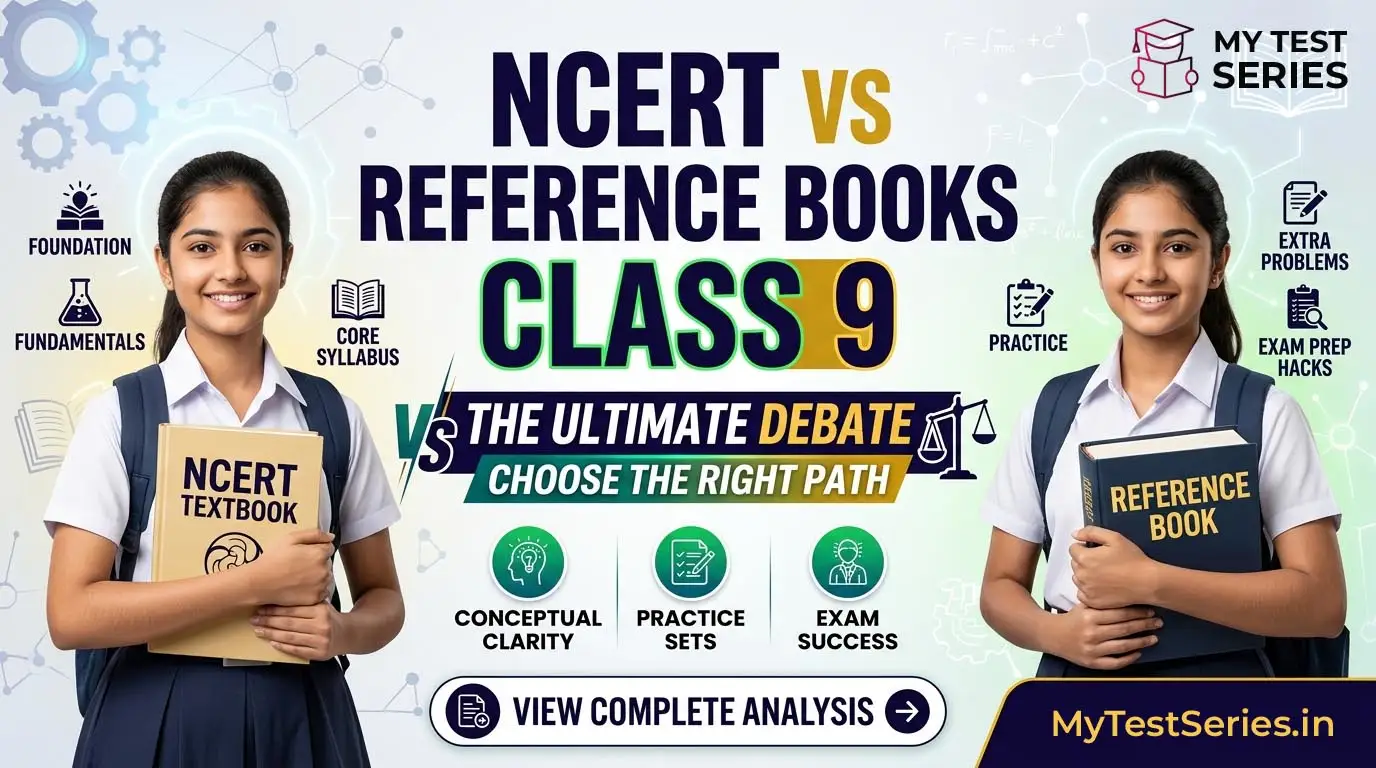
NCERT vs Reference Books: What Should Class 9 Students Study in 2026?
Walk into any bookshop in India before the academic year starts and you'll see it — shelves overflowing with reference books, guide books, and question banks for Class 9. Parents spend thousands. Students carry bags that weigh more than their school bags did in Class 7. And yet, many of them score lower than classmates who used just two books and a notebook.
So what's the truth? Should a Class 9 student stick to NCERT, dive into reference books, or do both? The answer is nuanced — and it depends on which subject you're talking about, what your target is, and how smart you study, not how much.
This guide breaks it all down with clarity, subject-by-subject advice, and a proven strategy that top-scoring Class 9 students actually use. Whether you're preparing for school exams or laying the groundwork for future competitive exams, read on.
Why Class 9 Is More Important Than You Think
Many students make the mistake of treating Class 9 as a "relaxed year" before the real pressure of Class 10 boards hits. This is a costly misconception.
Class 9 is the foundation layer of your entire secondary schooling. Topics like Motion, Number Systems, Democratic Politics, and Coordinate Geometry in Class 9 are not standalone — they are the direct prerequisite for harder Class 10 and Class 11 chapters. Students who rush through Class 9 with a weak foundation struggle significantly when those concepts reappear in a more complex form later.
Additionally, CBSE registers Class 9 students for Class 10 board exams. Your Class 9 internal marks contribute to your overall academic record. Class 9 is not the dress rehearsal — it is the first act.
What Are NCERT Books and Why Are They the Foundation?
NCERT stands for the National Council of Educational Research and Training. These are the official textbooks prescribed by the Indian government for CBSE-affiliated schools. They are written by subject experts, peer-reviewed, and designed to align precisely with the exam pattern set by the CBSE board.
Why NCERT Must Always Come First
Here's what makes NCERT indispensable for every Class 9 student:
- Direct exam alignment: CBSE frames its question papers almost entirely from NCERT content — definitions, examples, exercises, and even the phrasing of questions mirrors NCERT language.
- Conceptual clarity: NCERT books explain topics in simple, stepwise language that builds understanding before application. No reference book does this as cleanly.
- Official authority: NCERT is the single syllabus authority for CBSE. Any content in a reference book that contradicts NCERT is automatically wrong for exam purposes.
- Back exercises are gold: The exercises at the end of every NCERT chapter regularly reappear — sometimes verbatim — in school exams and even Class 10 boards. Never skip them.
- Cost and accessibility: NCERT books are available for free as PDFs on the official NCERT website. Every student, regardless of background, has equal access.
What Are Reference Books and When Do They Help?
Reference books are supplementary study materials authored by educational publishers like S. Chand, Arihant, MTG, Oswaal, and others. They are not prescribed by CBSE but are widely used by students seeking additional practice, deeper explanations, or more varied question types.
Think of reference books as the gym for your academic muscles. NCERT teaches you the technique. Reference books make you stronger through repetition and varied challenges. But just like a gym, they're only useful after you have the basics right — and doing too many exercises without proper form leads to injury.
When Reference Books Add Real Value
- Maths practice: NCERT Maths exercises are limited. A reference book like RD Sharma provides hundreds of graded problems that build speed and accuracy.
- Competitive exam preparation: Students aiming for Olympiads, NTSE, or early JEE/NEET groundwork need the deeper problem-solving that reference books offer.
- Visual learning: Books like Lakhmir Singh for Science offer cleaner diagrams and more visual explanations than NCERT for some chapters.
- MCQ and case-based practice: CBSE's shift toward competency-based questions means practicing the MCQ formats in Oswaal or MTG question banks is useful.
- Weak areas: If a student consistently struggles with a particular topic after reading NCERT, a reference book's alternative explanation can provide the "aha" moment.
NCERT vs Reference Books: Head-to-Head Comparison
| Feature | NCERT Books | Reference Books |
|---|---|---|
| Difficulty Level | Basic to Moderate | Moderate to Advanced |
| CBSE Exam Relevance | ⬤ Extremely High (90%+) | ⬤ Moderate (supporting) |
| Concept Clarity | ⬤ Excellent | ⬤ Varies by book |
| Practice Questions | ⬤ Limited (but high quality) | ⬤ Extensive |
| Competitive Exam Prep | ⬤ Foundation only | ⬤ Good for deeper prep |
| Cost | ⬤ Free (PDF) / Very Low | ⬤ Paid (₹200–₹800+) |
| Updated for NEP 2020 | ⬤ Yes (Official 2026–27) | ⬤ Varies by publisher |
| Required? | ⬤ Absolutely Mandatory | ⬤ Optional but Helpful |
| Replaces Other? | ⬤ Cannot be replaced | ⬤ Cannot replace NCERT |
Subject-Wise Strategy: What to Use for Each Subject
This is where most students go wrong — they apply the same book strategy across all subjects. The right approach is subject-specific. Here's what actually works for each Class 9 subject:
📐 Mathematics
NCERT Maths is conceptually strong, but its exercise bank is limited. This is the one subject where a reference book is almost always necessary for solid preparation.
Strategy: Read NCERT → Solve ALL NCERT exercises → Then practice from reference book.
RD Sharma (Best) RS Aggarwal NCERT Exemplar🔬 Science (Physics + Chemistry + Biology)
NCERT Science is exceptional and directly aligned with CBSE exam questions. Most exam questions come from NCERT diagrams, definitions, and examples. For Biology especially — NCERT is non-negotiable and nearly sufficient.
Strategy: NCERT first, always. Reference book only for extra MCQs or diagram clarity.
Lakhmir Singh (diagrams) NCERT Exemplar MTG Foundation🌍 Social Science
NCERT is the gold standard for History, Geography, Political Science, and Economics at Class 9. The narrative flow, maps, and analytical questions in NCERT are sufficient for full marks in school exams.
Strategy: NCERT thoroughly + map work + current affairs supplement for Civics.
NCERT is sufficient Oswaal (for MCQ practice)📖 English
NCERT English (Beehive, Moments, Words & Expressions) is fully sufficient for school exams. Grammar practice and writing tasks from any good grammar guide can supplement, but the literature portion requires deep reading of NCERT texts.
Strategy: NCERT thoroughly + one grammar reference for writing skills.
NCERT Beehive + Moments Wren & Martin (Grammar)🇮🇳 Hindi
NCERT Hindi (Kshitij, Sparsh, Sanchayan) covers the literature portion completely. Grammar can be strengthened through a reference guide, but NCERT is the primary and sufficient text for exams.
Strategy: NCERT complete reading + grammar drill book.
NCERT Kshitij Any Grammar Guide🏆 For Competitive Prep (NTSE/Olympiad)
If you're targeting NTSE, Science Olympiads, or Maths Olympiads alongside school exams, reference books become significantly more important. Foundation-level books from MTG or Pearson IIT Foundation are suitable supplements after NCERT mastery.
MTG Foundation Pearson IIT Foundation Arihant NTSEThe Winning Hybrid Strategy for Class 9 Students
The smartest students don't choose between NCERT and reference books — they use them in a carefully sequenced system. Here's the 6-step hybrid approach used by consistent high scorers:
Read the NCERT Chapter End-to-End
Don't skip, don't skim. Read every word including examples, footnotes, and in-text questions. The NCERT's narrative is itself the answer to many exam questions. Highlight key definitions and formulas as you go.
Solve Every NCERT Exercise Question
This is non-negotiable. The back exercises in NCERT chapters are carefully curated by experts and frequently appear — sometimes verbatim — in school exams. Don't use guide-book solutions as a shortcut; write your own answers first.
Make Compact Revision Notes
After each chapter, condense key points into a single A4 page. Include formulas, definitions, important dates (for History), diagrams (for Science and Geography), and exceptions. These notes will be your exam-night lifesaver.
Now Open the Reference Book (For Maths and Science Only)
Once NCERT is complete for a chapter, move to RD Sharma for Maths or Lakhmir Singh for Science. Focus on the chapters where NCERT felt thin on practice problems. Don't attempt to complete the entire reference book — be selective.
Take a Chapter-End Mock Test
After completing NCERT + targeted reference practice for a chapter, test yourself with a timed mock test covering that topic. This reveals gaps and reinforces memory far more effectively than re-reading does. Online test platforms like MyTestSeries Maths Practice Series offer exactly this kind of targeted chapter testing.
Weekly Revision Using Your Notes
Every Sunday, spend 2 hours reviewing the notes from that week's chapters. This spaced repetition technique is scientifically proven to move knowledge from short-term to long-term memory, dramatically reducing exam-time stress.
5 Common Myths About Reference Books — Busted
New NCERT Syllabus 2026–27: What Changed for Class 9?
The 2026–27 academic session brings a revised NCERT Class 9 syllabus — the most significant change in years, implemented under NEP 2020. Here's what Class 9 students need to know before selecting study materials:
| Subject | Key Changes in 2026–27 | Impact on Book Choice |
|---|---|---|
| Mathematics | Two-level assessment introduced — Proficiency and Advanced. New topics like AP/GP moved from higher classes. | Choose reference books published in 2026 editions only. Old RD Sharma may not cover new chapters. |
| Social Science | Chapters reduced from 20 to 16. History now covers Early Human History to 1200 CE. Plate Tectonics added to Geography. | Old social science guides are outdated. Use only 2026 NCERT PDFs and updated reference materials. |
| Science | More focus on real-world application and competency-based questions. Greater emphasis on experiments and observations. | NCERT Science 2026 is the only reliable source. Reference books must be 2026 editions to stay relevant. |
| English | New textbook "Kaveri" released. Focus on reading comprehension, creative writing, and communication. | All old English guides based on Beehive (old edition) are irrelevant for 2026–27 students. |
Why Mock Tests Matter More Than Any Book
Here's the reality most book sellers won't tell you: no matter how many books you read, you will not perform well in an exam if you haven't practiced under exam conditions. Reading and recalling are fundamentally different cognitive tasks. Mock tests build the second skill — the one that actually gets you marks.
Regular mock testing for Class 9 students offers several irreplaceable benefits:
- Identifies genuine weak areas — Not what you think is weak, but what actually shows up as wrong in timed conditions.
- Builds time management skills — Knowing the content is different from delivering it within 3 hours. Timed tests train this crucial exam skill.
- Reinforces memory through active recall — Testing yourself on a topic is 2–3x more effective for long-term retention than re-reading the same material.
- Reduces exam anxiety — Students who have taken 10+ mock tests before an exam walk in with confidence, not panic.
- Simulates the actual exam experience — Format, question types, marking patterns — all of it becomes familiar, so nothing surprises you on exam day.
Start Practicing with MyTestSeries — Built for Class 9 Students
Get chapter-wise mock tests, Maths practice sets for Class 7–10, and performance analytics — all in one place. Used by thousands of students across India.
🧮 Try Maths Practice Series 📋 View All Test SeriesFrequently Asked Questions
Final Verdict: NCERT First, Reference Books Second — Always
The debate between NCERT and reference books has a clear answer for Class 9 students: NCERT is the foundation; reference books are the superstructure. You cannot build a strong superstructure on a weak foundation, and you cannot skip the foundation and expect the building to stand.
Complete NCERT thoroughly for every subject. Solve all exercises. Make compact revision notes. Then — and only then — open one good reference book for Maths practice and one for Science MCQs. For Social Science, Hindi, and English, NCERT is sufficient on its own.
Pair this reading strategy with regular mock tests, and you'll find yourself not just passing Class 9 — but genuinely ready for Class 10 boards and beyond.
The students who win aren't those with the heaviest schoolbags. They're the ones who read NCERT three times, solved every exercise, and tested themselves every week.