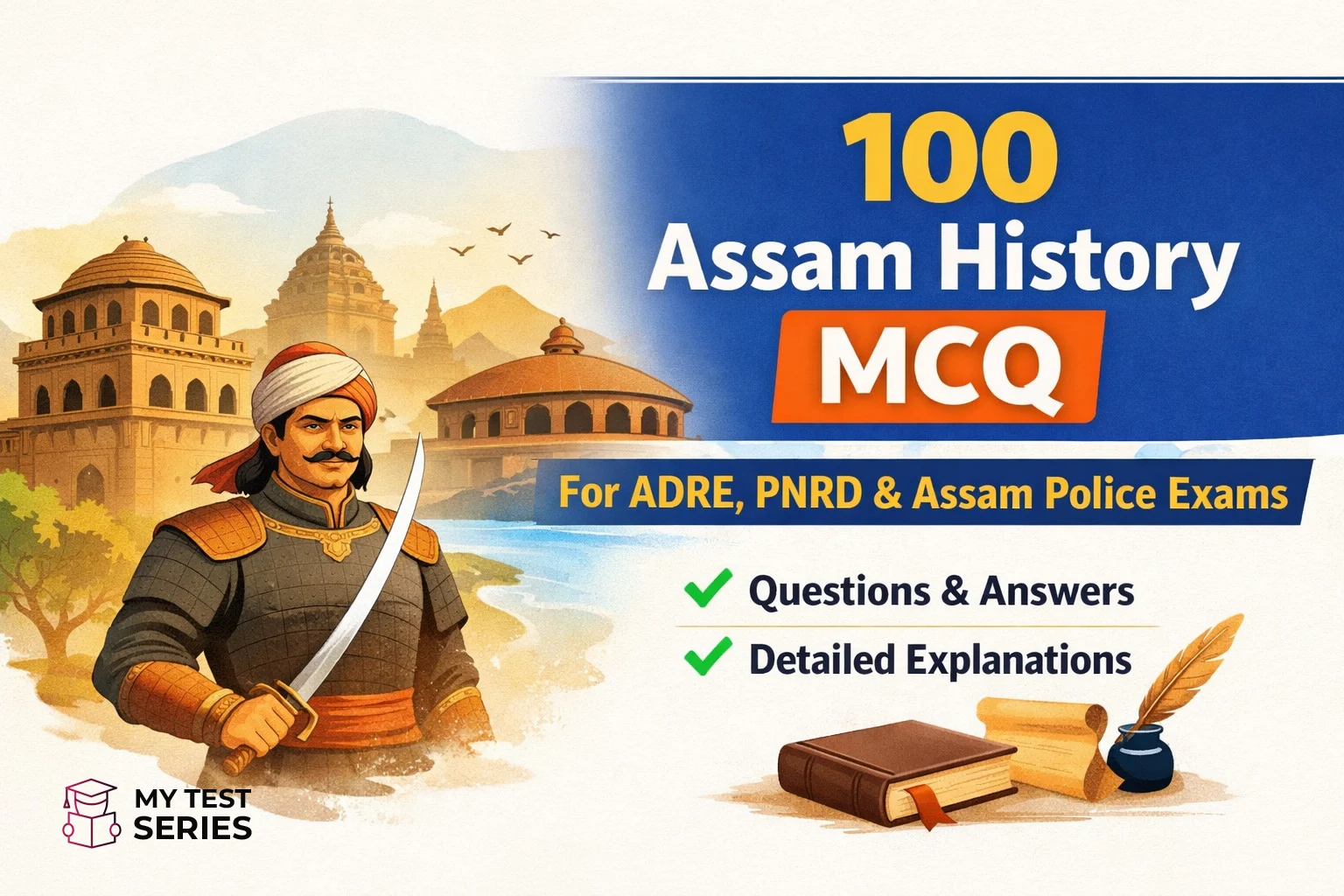
100 Assam History MCQ Questions and Answers for ADRE, PNRD & Assam Police Exams
Assam History MCQ – Assam History plays a very important role in many Assam Government Competitive Exams such as ADRE, PNRD, Assam Police, APSC, and Grade 3 & Grade 4 recruitment exams. Questions are frequently asked from topics like the Ahom dynasty, medieval Assam history, freedom movement, and British rule in Assam.
To help aspirants prepare effectively, we have compiled 100 important Assam History MCQ questions with answers and explanations. These questions are based on the latest exam patterns and are useful for strengthening your preparation.
1. Who founded the Ahom Kingdom in Assam?
Answer: Sukaphaa
Explanation: Sukaphaa, a Tai prince from Myanmar, founded the Ahom Kingdom in 1228 and established a strong political system in Assam.
2. In which year was the Ahom kingdom established?
Answer: 1228
Explanation: The Ahom Kingdom was established in 1228 by Sukaphaa and ruled Assam for nearly 600 years.
3. Who led the Ahom army in the Battle of Saraighat?
Answer: Lachit Borphukan
Explanation: Lachit Borphukan led the Ahom forces against the Mughal army in the Battle of Saraighat in 1671.
4. Which Mughal ruler attempted to capture Assam during the Battle of Saraighat?
Answer: Aurangzeb
Explanation: The Mughal emperor Aurangzeb sent his forces to capture Assam, but they were defeated by the Ahom army.
5. The Treaty of Yandabo was signed in which year?
Answer: 1826
Explanation: The Treaty of Yandabo ended the First Anglo-Burmese War and brought Assam under British rule.
6. Which event marked the beginning of British rule in Assam?
Answer: Treaty of Yandabo
Explanation: After the Treaty of Yandabo in 1826, Assam came under the control of the British East India Company.
7. Who was the first Chief Minister of Assam after independence?
Answer: Gopinath Bordoloi
Explanation: Gopinath Bordoloi became the first Chief Minister of Assam in 1947.
8. Which freedom fighter from Assam was executed during the Quit India Movement?
Answer: Kushal Konwar
Explanation: Kushal Konwar was executed by the British government for supporting the Quit India Movement.
9. Which Ahom king constructed the Rang Ghar?
Answer: Pramatta Singha
Explanation: Rang Ghar in Sivasagar was built during the reign of Ahom king Pramatta Singha.
10. Which historical monument in Assam is known as one of the oldest amphitheaters in Asia?
Answer: Rang Ghar
Explanation: Rang Ghar served as a royal sports pavilion for Ahom kings.
11. Which Ahom king constructed Talatal Ghar?
Answer: Rudra Singha
Explanation: Talatal Ghar was used as a palace and military base during the Ahom period.
12. Which Assamese saint started the Neo-Vaishnavite movement?
Answer: Srimanta Sankardeva
Explanation: Sankardeva was a saint and reformer who influenced Assamese culture and religion.
13. What was the main objective of the Neo-Vaishnavite movement?
Answer: Promotion of devotion to Lord Krishna
Explanation: The movement promoted social harmony and devotion through bhakti.
14. Which historical site in Assam is associated with the Ahom dynasty?
Answer: Sivasagar
Explanation: Sivasagar contains many Ahom monuments such as Rang Ghar, Talatal Ghar, and Kareng Ghar.
15. Which uprising in Assam was a peasant revolt against British taxation?
Answer: Phulaguri Dhawa
Explanation: This uprising occurred in 1861 against British taxation policies.
16. Who discovered tea plants in Assam?
Answer: Robert Bruce
Explanation: Robert Bruce discovered indigenous tea plants in Assam in the early 19th century.
17. Which district was the center of the Phulaguri uprising?
Answer: Nagaon
Explanation: The revolt took place in the Phulaguri area of Nagaon district.
18. Which Ahom king built the Sivadol temple in Sivasagar?
Answer: Siva Singha
Explanation: Sivadol is one of the tallest Shiva temples in India.
19. Who was popularly known as Lokapriya in Assam?
Answer: Gopinath Bordoloi
Explanation: He earned the title Lokapriya due to his popularity among the people.
20. Which war led to the signing of the Treaty of Yandabo?
Answer: First Anglo-Burmese War
Explanation: This war took place between 1824 and 1826 and ended with the Treaty of Yandabo.
Practice Assam History Mock Tests
Prepare for ADRE, PNRD and Assam Police exams with full mock tests.
Assam History MCQ – Part -2
21. Who was the successor of Sukaphaa in the Ahom dynasty?
Answer: Suteupha
Explanation: After the death of Sukaphaa, his son Suteupha became the next ruler of the Ahom kingdom and continued the administration established by his father.
22. Which Ahom king shifted the capital to Garhgaon?
Answer: Suklenmung
Explanation: Suklenmung, also known as Garhgayan Raja, shifted the Ahom capital to Garhgaon which later became an important political center.
23. Who was the Ahom king during the Battle of Saraighat?
Answer: Udayaditya Singha
Explanation: The Battle of Saraighat took place during the reign of Ahom king Udayaditya Singha while the Ahom forces were led by Lachit Borphukan.
24. Which Mughal general was defeated in the Battle of Saraighat?
Answer: Ram Singh I
Explanation: Ram Singh I of Amber led the Mughal army against the Ahoms but was defeated by Lachit Borphukan in 1671.
25. Which Ahom king constructed Kareng Ghar in Sivasagar?
Answer: Rajeswar Singha
Explanation: Kareng Ghar was an important royal palace of the Ahom kings located in Sivasagar.
26. Which historical structure served as the royal palace of the Ahom kings?
Answer: Kareng Ghar
Explanation: Kareng Ghar was used as the royal residence of Ahom kings and is an important architectural monument of Assam.
27. Which movement in Assam was associated with the Non-Cooperation Movement?
Answer: Assam Tea Garden Labour Movement
Explanation: Many workers from tea gardens participated in the Non-Cooperation Movement led by Mahatma Gandhi.
28. Who was the first Assamese to join the Indian Civil Service?
Answer: Anandaram Baruah
Explanation: Anandaram Baruah was the first Assamese to join the prestigious Indian Civil Service during British rule.
29. Which Assamese leader played a major role in the Assam Association?
Answer: Manik Chandra Barooah
Explanation: Manik Chandra Barooah was one of the important leaders associated with the Assam Association which worked for political reforms.
30. Which organization later evolved into the Assam Pradesh Congress Committee?
Answer: Assam Association
Explanation: The Assam Association played an important role in political awakening and later became part of the Indian National Congress structure in Assam.
31. Which British officer is associated with the introduction of tea plantations in Assam?
Answer: Charles Alexander Bruce
Explanation: Charles Alexander Bruce played a significant role in developing tea plantations in Assam.
32. Which historical monument of the Ahom period is located near Sivasagar tank?
Answer: Sivadol
Explanation: Sivadol is a famous Shiva temple built during the Ahom period near the Sivasagar tank.
33. Which queen of the Ahom kingdom constructed the Sivasagar tank?
Answer: Ambika Devi
Explanation: The Sivasagar tank was constructed during the reign of Siva Singha by Queen Ambika Devi.
34. Which Ahom king was known for administrative reforms and expansion of the kingdom?
Answer: Rudra Singha
Explanation: Rudra Singha strengthened the Ahom administration and expanded the kingdom’s influence.
35. Which British war led to the annexation of Assam?
Answer: First Anglo-Burmese War
Explanation: The First Anglo-Burmese War (1824–1826) resulted in British control over Assam.
36. Which Assamese freedom fighter was associated with the Quit India Movement in Golaghat?
Answer: Kushal Konwar
Explanation: Kushal Konwar was actively involved in the Quit India Movement and later executed by the British.
37. Which Assamese reformer contributed greatly to Assamese literature and education?
Answer: Anandaram Dhekial Phukan
Explanation: Anandaram Dhekial Phukan was a pioneer of modern Assamese literature and social reform.
38. Which historic structure was used by Ahom kings to watch cultural events and sports?
Answer: Rang Ghar
Explanation: Rang Ghar served as a royal pavilion where Ahom kings watched traditional games and cultural programs.
39. Which district of Assam is historically associated with the Ahom capital?
Answer: Sivasagar
Explanation: Sivasagar was an important political and cultural center during the Ahom dynasty.
40. Which Assamese leader was popularly called “Sher-e-Assam”?
Answer: Bishnuram Medhi
Explanation: Bishnuram Medhi was a prominent political leader of Assam and served as the Chief Minister of the state.
Assam Exam Preparation Hub – MyTestSeries.in
Practice the most important Assam GK, History, Geography & Polity Questions for
ADRE, PNRD, Assam Police, APSC and Grade 3 & 4 exams.
Boost your preparation with MyTestSeries.in – Assam Government Exam Practice Platform
Assam History MCQ – Part -3
41. Which Ahom king introduced important administrative reforms in the Ahom kingdom?
Answer: Rudra Singha
Explanation: Rudra Singha was known for strengthening the administrative structure of the Ahom kingdom and promoting cultural and economic development.
42. Which Ahom king established the capital at Rangpur?
Answer: Rudra Singha
Explanation: Rudra Singha shifted the Ahom capital to Rangpur, which later became an important political and cultural center.
43. Which historical monument in Assam served as the military base of the Ahom kings?
Answer: Talatal Ghar
Explanation: Talatal Ghar was used as a military base and palace with underground tunnels during the Ahom period.
44. Which Assamese leader was a pioneer of modern Assamese literature?
Answer: Anandaram Dhekial Phukan
Explanation: Anandaram Dhekial Phukan played a crucial role in promoting Assamese language, literature, and social reforms during the 19th century.
45. Which social reformer is known as the father of Assamese prose?
Answer: Hemchandra Barua
Explanation: Hemchandra Barua contributed significantly to Assamese literature and wrote the famous Assamese dictionary “Hemkosh”.
46. Which British officer expanded tea cultivation in Assam?
Answer: Charles Alexander Bruce
Explanation: Charles Alexander Bruce played a major role in establishing tea plantations and developing the tea industry in Assam.
47. Which famous Assamese leader participated in the Non-Cooperation Movement?
Answer: Tarun Ram Phukan
Explanation: Tarun Ram Phukan was an important nationalist leader who actively supported Mahatma Gandhi’s Non-Cooperation Movement in Assam.
48. Which movement in Assam opposed the British taxation system on peasants?
Answer: Phulaguri Dhawa
Explanation: Phulaguri Dhawa was a peasant uprising in 1861 against the taxation policies of the British government.
49. Which Assamese leader was known as “Deshbhakta”?
Answer: Tarun Ram Phukan
Explanation: Tarun Ram Phukan earned the title “Deshbhakta” due to his dedication to India’s freedom struggle.
50. Which historical event is associated with the bravery of Lachit Borphukan?
Answer: Battle of Saraighat
Explanation: Lachit Borphukan led the Ahom forces in the Battle of Saraighat and defeated the Mughal army in 1671.
51. Which Ahom king built the Joy Dol temple in Sivasagar?
Answer: Swargadeo Rudra Singha
Explanation: Joy Dol temple is an important religious structure of the Ahom period located in Sivasagar.
52. Which British policy led to the exploitation of tea garden laborers in Assam?
Answer: Indentured labour system
Explanation: Under the indentured labour system, workers were brought from other parts of India to work in tea plantations under harsh conditions.
53. Which Assamese freedom fighter played a role in the Civil Disobedience Movement?
Answer: Gopinath Bordoloi
Explanation: Gopinath Bordoloi actively participated in various nationalist movements including the Civil Disobedience Movement.
54. Which Ahom king constructed the famous Sivasagar tank?
Answer: Siva Singha
Explanation: The Sivasagar tank was constructed during the reign of Ahom king Siva Singha by Queen Ambika.
55. Which Assamese reformer worked for the spread of modern education in Assam?
Answer: Gunabhiram Barua
Explanation: Gunabhiram Barua was a social reformer who supported modern education and women’s rights.
56. Which historical monument of the Ahom period is located near Joysagar tank?
Answer: Joy Dol
Explanation: Joy Dol temple was constructed near the Joysagar tank and is an important historical structure of the Ahom era.
57. Which Ahom king is known for expanding the Ahom kingdom?
Answer: Suhungmung
Explanation: Suhungmung expanded the Ahom kingdom significantly and introduced several administrative reforms.
58. Which historical monument is associated with the Ahom kings’ royal court?
Answer: Kareng Ghar
Explanation: Kareng Ghar served as the royal palace and administrative center of the Ahom rulers.
59. Which British-era revolt in Assam involved peasants protesting against taxes?
Answer: Phulaguri Uprising
Explanation: The Phulaguri Uprising of 1861 was one of the earliest anti-colonial protests in Assam.
60. Which Assamese freedom fighter was popularly known as “Lokapriya”?
Answer: Gopinath Bordoloi
Explanation: Gopinath Bordoloi earned the title “Lokapriya” due to his popularity and service to the people of Assam.
Assam History MCQ – Part – 4
61. Which Ahom king adopted the Hindu title “Swargadeo”?
Answer: Suhungmung
Explanation: Suhungmung adopted the Hindu title “Swargadeo” and introduced several administrative reforms in the Ahom kingdom.
62. Which Ahom king defeated the Mughal forces in the Battle of Itakhuli?
Answer: Gadadhar Singha
Explanation: Gadadhar Singha successfully defeated the Mughal forces and restored Ahom control over Assam.
63. Which historical structure in Assam is known as the “House of Seven Stories”?
Answer: Kareng Ghar
Explanation: Kareng Ghar was a royal palace of the Ahom kings and is sometimes referred to as the House of Seven Stories.
64. Which British administrative unit was Assam made part of after the Treaty of Yandabo?
Answer: Bengal Presidency
Explanation: After 1826, Assam was initially administered as part of the Bengal Presidency under British rule.
65. Which Assamese leader founded the newspaper “Orunodoi”?
Answer: American Baptist Missionaries
Explanation: Orunodoi was the first Assamese magazine published in 1846 by American Baptist missionaries and played an important role in spreading modern ideas.
66. Which Ahom king built the Joysagar tank?
Answer: Rudra Singha
Explanation: The Joysagar tank was built in memory of Joymoti, the wife of Ahom king Gadadhar Singha.
67. Who was Joymoti in the history of Assam?
Answer: Wife of Gadadhar Singha
Explanation: Joymoti sacrificed her life to protect her husband Gadadhar Singha and is remembered as a symbol of courage.
68. Which Assamese reformer advocated widow remarriage and women’s rights?
Answer: Gunabhiram Barua
Explanation: Gunabhiram Barua was a social reformer who promoted women’s education and widow remarriage.
69. Which Ahom king is known for expanding the kingdom to its greatest extent?
Answer: Suhungmung
Explanation: Suhungmung greatly expanded the Ahom kingdom and strengthened the administrative structure.
70. Which Assamese freedom fighter died during the Quit India Movement protests?
Answer: Kanaklata Barua
Explanation: Kanaklata Barua was a young freedom fighter who was shot by the British police while leading a procession during the Quit India Movement.
71. Which movement in Assam was associated with Mahatma Gandhi’s Civil Disobedience Movement?
Answer: Salt Satyagraha in Assam
Explanation: Many Assamese leaders and citizens participated in the Civil Disobedience Movement inspired by Gandhi.
72. Which Assamese leader founded the Assam Association in 1903?
Answer: Manik Chandra Barooah
Explanation: The Assam Association played a major role in political awareness and later merged with the Indian National Congress.
73. Which Ahom king introduced the Paik system in Assam?
Answer: Sukaphaa
Explanation: The Paik system was a labor and military service system introduced by the Ahom rulers.
74. Which Assamese scholar compiled the Assamese dictionary “Hemkosh”?
Answer: Hemchandra Barua
Explanation: Hemkosh was the first comprehensive Assamese dictionary and played an important role in language development.
75. Which Assamese leader participated in the Simon Commission protests?
Answer: Gopinath Bordoloi
Explanation: Gopinath Bordoloi strongly opposed the Simon Commission as part of the nationalist movement.
76. Which historical monument was used by Ahom kings for royal sports viewing?
Answer: Rang Ghar
Explanation: Rang Ghar served as a royal pavilion where Ahom kings watched sports and cultural events.
77. Which Assamese revolutionary was associated with the Indian National Army?
Answer: Jyoti Prasad Agarwala
Explanation: Jyoti Prasad Agarwala was a cultural icon and supporter of the freedom movement in Assam.
78. Which British policy introduced tea plantation labourers from other regions?
Answer: Indentured Labour System
Explanation: Labourers were brought from central India to work in tea plantations under strict contracts.
79. Which Ahom king constructed the Sivadol temple?
Answer: Siva Singha
Explanation: Sivadol temple is one of the tallest Shiva temples in India and an important historical monument.
80. Which Assamese leader later became the Governor of Uttar Pradesh?
Answer: Bishnuram Medhi
Explanation: Bishnuram Medhi was an important political leader from Assam and later served as Governor of Uttar Pradesh.
Assam History MCQ – Part – 5
81. Which Ahom king adopted Hindu customs and expanded the Ahom administration?
Answer: Suhungmung
Explanation: Suhungmung adopted Hindu titles and expanded the Ahom kingdom while strengthening the administrative system.
82. Which British war led to the annexation of Assam by the British East India Company?
Answer: First Anglo-Burmese War
Explanation: The First Anglo-Burmese War (1824–1826) ended with the Treaty of Yandabo which brought Assam under British rule.
83. Which Assamese leader was a key figure in the Assam Association?
Answer: Manik Chandra Barooah
Explanation: Manik Chandra Barooah played a crucial role in the Assam Association which promoted political awareness.
84. Which Assamese literary pioneer worked for the revival of Assamese language during the British period?
Answer: Anandaram Dhekial Phukan
Explanation: Anandaram Dhekial Phukan promoted Assamese language and literature during the 19th century.
85. Which Ahom king built the Talatal Ghar in Sivasagar?
Answer: Rudra Singha
Explanation: Talatal Ghar served as a palace and military base for the Ahom kings.
86. Which Assamese martyr died while leading the Quit India Movement procession?
Answer: Kanaklata Barua
Explanation: Kanaklata Barua was shot by British police while carrying the Indian national flag during the Quit India Movement.
87. Which Assamese leader earned the title “Lokapriya”?
Answer: Gopinath Bordoloi
Explanation: Gopinath Bordoloi was popularly known as “Lokapriya” due to his dedication to public service.
88. Which Ahom monument was used by kings to watch cultural events and sports?
Answer: Rang Ghar
Explanation: Rang Ghar served as a royal pavilion for viewing cultural events and traditional games.
89. Which British officer played a major role in promoting tea cultivation in Assam?
Answer: Charles Alexander Bruce
Explanation: Charles Alexander Bruce expanded tea plantations and contributed to the growth of Assam’s tea industry.
90. Which historical city served as the capital of the Ahom kingdom for many years?
Answer: Sivasagar
Explanation: Sivasagar was an important political and cultural center during the Ahom dynasty.
91. Which Assamese reformer supported modern education and women’s rights?
Answer: Gunabhiram Barua
Explanation: Gunabhiram Barua was a social reformer who advocated women’s education and social reforms.
92. Which Assamese scholar compiled the first Assamese dictionary Hemkosh?
Answer: Hemchandra Barua
Explanation: Hemchandra Barua compiled Hemkosh which became an important reference for Assamese language.
93. Which Ahom queen is remembered for her sacrifice in Assamese history?
Answer: Joymoti
Explanation: Joymoti sacrificed her life to protect her husband Gadadhar Singha and is remembered as a symbol of courage.
94. Which tank in Sivasagar was constructed in memory of Joymoti?
Answer: Joysagar
Explanation: Joysagar tank was constructed by Rudra Singha in memory of his mother Joymoti.
95. Which Assamese freedom fighter was executed during the Quit India Movement?
Answer: Kushal Konwar
Explanation: Kushal Konwar was falsely accused and executed by the British government for supporting the Quit India Movement.
96. Which Ahom king adopted the title Swargadeo?
Answer: Suhungmung
Explanation: Suhungmung adopted the Hindu title Swargadeo and strengthened the Ahom administration.
97. Which Assamese organization later became part of the Indian National Congress?
Answer: Assam Association
Explanation: Assam Association played an important role in political awakening before merging with the Congress.
98. Which historical event established Ahom supremacy over Mughal forces?
Answer: Battle of Saraighat
Explanation: The Battle of Saraighat in 1671 marked the defeat of the Mughal army by the Ahom forces.
99. Which Assamese leader later became the Governor of Uttar Pradesh?
Answer: Bishnuram Medhi
Explanation: Bishnuram Medhi was an important political leader who served as the Chief Minister of Assam and later Governor of Uttar Pradesh.
100. Which treaty in 1826 officially transferred Assam to British control?
Answer: Treaty of Yandabo
Explanation: The Treaty of Yandabo ended the First Anglo-Burmese War and brought Assam under British administration.
Quick Revision – Assam History Important Facts
- Founder of Ahom Kingdom – Sukaphaa (1228)
- Battle of Saraighat – 1671
- Ahom Commander – Lachit Borphukan
- Beginning of British Rule – Treaty of Yandabo (1826)
- Quit India Martyrs – Kanaklata Barua & Kushal Konwar
- Neo-Vaishnavite Movement – Srimanta Sankardeva
Practice Assam Government Exam Mock Tests
Boost your preparation for ADRE, PNRD, Assam Police and other Assam Govt exams.
Assam Exam Preparation Hub – MyTestSeries.in
Practice the most important Assam GK, History, Geography & Polity Questions for
ADRE, PNRD, Assam Police, APSC and Grade 3 & 4 exams.
Boost your preparation with MyTestSeries.in – Assam Government Exam Practice Platform