CTET Special Knowledge Hub
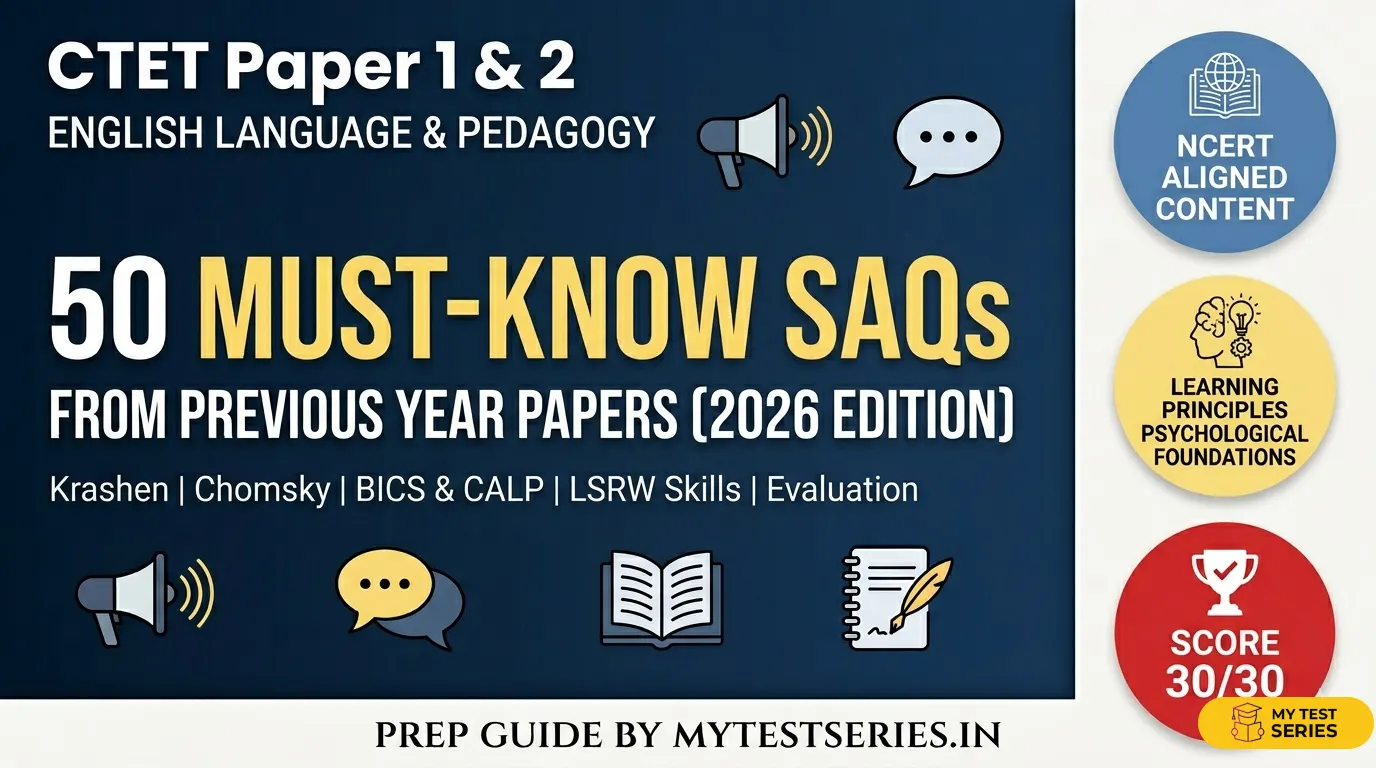
CTET English Pedagogy: 50 Essential SAQs from Previous Year Papers
Mastering English Language and Pedagogy is a decisive factor for success in both CTET Paper 1 and Paper 2. The English section (30 marks) evaluates your understanding of Language Acquisition, Teaching Learning Materials (TLM), and Remedial Teaching. To ensure you secure maximum marks, we have compiled 50 high-frequency Short Answer Questions (SAQs) based on previous year trends.
📲 Free Registration via WhatsApp
Get instant updates on CDT Notes, New Mock Tests, and Exam Alerts directly on your phone. Join our academic community today!
- ✅ Daily Study Materials
- ✅ Free CBT Test Notifications
- ✅ Direct Support: +91 70034 88681
This guide moves beyond rote memorization, providing 5-10 line detailed explanations for core concepts like Stephen Krashen’s Hypothesis, Chomsky’s LAD, and Continuous and Comprehensive Evaluation (CCE). Let’s explore the essential principles of English language teaching.
CTET English Pedagogy – Language Acquisition & Principles (Part 1)
1. What is the difference between Language Acquisition and Language Learning?
Answer: Language Acquisition is a natural, subconscious process where a child picks up their mother tongue without formal instruction. In contrast, Language Learning is a conscious, formal process that usually happens in a classroom setting for a second language. While acquisition focuses on communication and meaning, learning involves the deliberate study of rules, grammar, and vocabulary.
2. Explain Noam Chomsky’s concept of the Language Acquisition Device (LAD).
Answer: Noam Chomsky proposed that humans are born with an innate biological ability to learn language, which he termed the Language Acquisition Device (LAD). This mental faculty contains the principles of Universal Grammar, allowing children to derive the rules of any language they are exposed to. This theory explains why children can generate infinite unique sentences they have never heard before.
3. What is the “Input Hypothesis” proposed by Stephen Krashen?
Answer: Krashen’s Input Hypothesis suggests that language is acquired when learners receive “Comprehensible Input” that is one step beyond their current level of competence (represented as $i + 1$). The focus should be on understanding the message rather than the form. If the input is too simple ($i+0$) or too difficult ($i+2$), acquisition does not take place effectively.
4. Define the “Silent Period” in second language acquisition.
Answer: The Silent Period is a stage where a learner is listening and processing a new language but is not yet ready to produce it (speak or write). This is a natural phase of internalizing vocabulary and syntax. Teachers should not force students to speak during this time, as it can cause anxiety; instead, they should provide a supportive environment with plenty of comprehensible input.
5. What is “BICS” and “CALP” as defined by Jim Cummins?
Answer: BICS (Basic Interpersonal Communicative Skills) refers to everyday social language used for face-to-face interaction (e.g., talking to friends). CALP (Cognitive Academic Language Proficiency) refers to the formal, abstract language required for academic success in subjects like Science or History. While BICS can be developed in 2 years, CALP often takes 5 to 7 years to master in a second language.
6. Explain the “Grammar Translation Method” (GTM).
Answer: GTM is a traditional teaching method where the target language is taught through translation into the mother tongue. The focus is heavily on reading, writing, and grammatical rules, while listening and speaking are often neglected. Although it helps in understanding literary texts and vocabulary, it usually fails to develop the student’s communicative competence in real-life situations.
7. What is the “Direct Method” of teaching English?
Answer: The Direct Method (also known as the Natural Method) forbids the use of the mother tongue in the classroom. Concepts are taught through demonstration, pictures, and realia. The primary focus is on oral communication and correct pronunciation. Grammar is taught inductively, meaning students figure out the rules themselves by observing how the language is used in context.
8. Describe the “Eclectic Approach” to language teaching.
Answer: The Eclectic Approach is a flexible method where a teacher chooses the best techniques from various methods (like GTM, Direct Method, or CLT) based on the needs of the learners and the lesson objectives. It recognizes that no single method works for every student. By combining different strategies, teachers can address diverse learning styles and keep the classroom environment dynamic and effective.
9. What role does the “Affective Filter” play in language learning?
Answer: The Affective Filter is a psychological barrier that can hinder language acquisition. High levels of anxiety, low self-esteem, or lack of motivation act as a “filter” that prevents input from reaching the brain’s language processing center. To facilitate learning, teachers must create a “low-filter” environment where students feel safe, confident, and relaxed enough to take risks with the new language.
📚 CDT Notes & Free Online Tests
Enhance your exam preparation with our comprehensive Child Development Theory notes and real-time CBT mock tests:
- ➜
CDT Notes for TET (Complete Guide) - ➜
Piaget’s Theory CBT Mock Test - ➜
Kohlberg Moral Development Test (Hindi) - ➜
Erikson Psycho-Social Development MCQ
10. What is “Scaffolding” in the context of language education?
Answer: Scaffolding refers to the temporary support provided by a teacher or a more knowledgeable peer to help a student perform a task they cannot yet do independently. As the student gains competence, the support is gradually removed. This concept is closely linked to Vygotsky’s Zone of Proximal Development (ZPD), where learning is most effective when it challenges the student just beyond their current ability.
CTET English Pedagogy – Language Skills: LSRW & Teaching Methods (Part 2)
11. What are the four fundamental language skills?
Answer: The four skills are Listening, Speaking, Reading, and Writing (LSRW). They are divided into two categories: Receptive Skills (Listening and Reading), where the learner receives and processes information, and Productive Skills (Speaking and Writing), where the learner produces language. For effective language acquisition, these skills should be taught in an integrated manner rather than in isolation.
12. Explain the difference between “Skimming” and “Scanning” in Reading.
Answer: Skimming is reading rapidly to get the general overview or the “gist” of a text (e.g., reading a newspaper headline). Scanning is looking for specific information or facts within a text (e.g., searching for a date or a name in a paragraph). Both are essential sub-skills of reading that help students process information efficiently based on their specific goals.
13. What is “Intensive Reading” vs. “Extensive Reading”?
Answer: Intensive Reading involves reading a short text in detail with specific learning aims, such as understanding grammar or vocabulary (e.g., a textbook chapter). Extensive Reading involves reading longer texts for pleasure or general information (e.g., a novel or storybook). Extensive reading is crucial for developing a “love for reading” and improving overall language fluency and vocabulary subconsciously.
14. What is the “Inductive Method” of teaching grammar?
Answer: In the Inductive Method, the teacher presents several examples first, and students are encouraged to discover the grammatical rule themselves. For instance, the teacher shows sentences like “He plays,” “She sings,” and “It rains,” and students conclude that ‘s’ is added to verbs for third-person singular subjects. This method is learner-centered and promotes better retention and understanding.
15. What is the “Deductive Method” of teaching grammar?
Answer: The Deductive Method is the opposite of the inductive method. Here, the teacher first states the rule or definition and then provides examples to illustrate it. It is a traditional, teacher-centered approach that is often faster for covering a large syllabus. However, it may lead to rote memorization as students are not actively involved in the “discovery” of the language rules.
16. Explain “Communicative Language Teaching” (CLT).
Answer: CLT is a modern approach that emphasizes interaction as both the means and the ultimate goal of study. The focus is on “Communicative Competence”—the ability to use language appropriately in different social contexts. Errors are tolerated as a natural part of the learning process, and the classroom often features role-plays, pair work, and information-gap activities to mimic real-life communication.
17. What are “Lexical Words” (Content Words)?
Answer: Lexical words, or content words, carry the primary meaning in a sentence. These include nouns, verbs, adjectives, and most adverbs (e.g., ‘cat’, ‘run’, ‘beautiful’, ‘quickly’). Unlike function words (like ‘the’, ‘is’, ‘at’), lexical words provide the “meat” of the communication. In English pedagogy, helping students build a strong “lexical base” is key to improving their reading comprehension.
18. What is the role of “Realia” in an English classroom?
Answer: Realia refers to real-life objects used as teaching aids in the classroom (e.g., bringing a real fruit, a menu, or a train ticket to teach vocabulary). Realia makes learning concrete and helps bridge the gap between classroom theory and the real world. It is particularly effective for young learners and beginners who need visual and tactile cues to understand new words.
19. Define “Phonology” and “Morphology.”
Answer: Phonology is the study of the sound system of a language, including phonemes (individual sounds) and intonation. Morphology is the study of the structure of words and how they are formed (e.g., understanding prefixes like ‘un-‘ and suffixes like ‘-ing’). Knowledge of these is essential for teachers to help students with correct pronunciation and expanding their vocabulary through word roots.
20. What is “Remedial Teaching”?
Answer: Remedial teaching is a form of specialized instruction designed to help students who are struggling or falling behind their peers in specific language areas. It is not a repeat of the original lesson; instead, it uses different strategies, simpler language, and more practice to “remedy” specific learning gaps identified through diagnostic tests.
21. Explain “Continuous and Comprehensive Evaluation” (CCE) in English.
Answer: CCE is a system of evaluation that covers all aspects of a student’s development throughout the year. It moves away from the “one-time exam” pressure. In English, this means assessing a student’s listening, speaking, reading, and writing skills continuously through quizzes, debates, projects, and portfolios, rather than just a final written paper.
22. What is “Bottom-Up Processing” in Listening?
Answer: Bottom-up processing involves starting with the smallest units of language (sounds/phonemes) and building up to words, phrases, and then full sentences to understand the meaning. It is a “data-driven” approach where the listener decodes every bit of information they hear. This is often what beginners do when they are first learning the sounds of English.
23. What is “Top-Down Processing” in Listening?
Answer: Top-down processing involves using prior knowledge, context, and expectations to understand the overall meaning of what is being said. Instead of focusing on every single word, the listener uses their understanding of the topic to predict and fill in gaps. For example, if you know the speaker is at a restaurant, you expect to hear words related to food and ordering.
24. Why is “Story-telling” considered a pedagogical tool in English?
Answer: Story-telling is an integrated tool that improves listening comprehension, vocabulary, and imagination. It provides a rich linguistic context where grammar is used naturally. Stories also help in developing “Cultural Awareness” and “Empathy,” making the language learning process more holistic and emotionally engaging for children.
25. What is the “Three-Language Formula”?
Answer: The Three-Language Formula is a policy in the Indian education system. It suggests that students should learn: 1) The Mother Tongue or Regional Language, 2) Hindi (in non-Hindi speaking states) or English/any other modern Indian language (in Hindi-speaking states), and 3) English or a modern Indian language. The goal is to promote multilingualism and national integration.
26. What is “Linguistic Competence”?
Answer: Linguistic competence refers to the knowledge of the rules of a language (grammar, vocabulary, syntax, and phonology). It is the ability to produce and understand grammatically correct sentences. While important, modern pedagogy emphasizes that linguistic competence must be paired with “Sociolinguistic Competence” to communicate effectively in real life.
27. Define “Error Analysis” in language teaching.
Answer: Error analysis is the process of studying the mistakes made by learners to understand their current level of language development. Instead of seeing errors as failures, teachers view them as evidence of learning. Analyzing errors helps teachers identify patterns (like mother-tongue interference) and plan effective remedial lessons.
28. What is a “Language Lab”?
Answer: A language lab is a dedicated space equipped with audio-visual tools (computers, headsets, software) designed to help students practice listening and speaking. It allows students to listen to native speakers, record their own voices, and receive instant feedback. It is particularly useful for improving pronunciation and fluency in a controlled environment.
29. What is “Total Physical Response” (TPR)?
Answer: TPR is a method developed by James Asher that coordinates language with physical movement. The teacher gives commands in the target language (e.g., “Stand up,” “Open the window”), and students respond with physical actions. This method reduces student anxiety and is highly effective for teaching beginners and young learners who learn best through movement.
📲 Free Registration via WhatsApp
Get instant updates on CDT Notes, New Mock Tests, and Exam Alerts directly on your phone. Join our academic community today!
- ✅ Daily Study Materials
- ✅ Free CBT Test Notifications
- ✅ Direct Support: +91 70034 88681
30. Explain “Structural Approach.”
Answer: The structural approach is based on the belief that language consists of “structures” or “patterns.” Mastery of a language is achieved through the habit formation of these structures (like “This is a…”, “I am…ing”). It emphasizes the selection and gradation of structures from simple to complex, often using drills to reinforce them.
CTET English Pedagogy – Challenges, Materials, and Evaluation in English (Part 3)
31. What are the common challenges of teaching English in a diverse classroom?
Answer: Teachers often face challenges like Mother Tongue Interference (MTI), lack of interest among students, and overcrowded classrooms. In a diverse setting, students come with different linguistic backgrounds and learning speeds. To overcome this, teachers must use “Differentiated Instruction” and inclusive materials that cater to the varying proficiency levels of all learners.
32. Explain “Mother Tongue Interference” (L1 Interference).
Answer: This occurs when the rules, sounds, or patterns of a student’s first language (L1) affect their production of the target language (English). For example, a student might apply their native language’s word order to an English sentence. Teachers should address this by focusing on “Contrastive Analysis”—highlighting the specific differences between the two languages.
33. What is the role of “Instructional Materials” in English teaching?
Answer: Instructional materials (like textbooks, charts, and digital tools) serve as the bridge between the teacher and the learner. They provide the “Linguistic Input” necessary for acquisition. Good materials should be authentic, age-appropriate, and culturally relevant to keep the students motivated and engaged in the learning process.
34. Define “Authentic Materials” in the context of English.
Answer: Authentic materials are texts or audio clips originally created for native speakers, not specifically for language learners (e.g., newspapers, menus, movie trailers, or podcasts). Using these in the classroom exposes students to “real-world” English, helping them understand how the language is used in natural, everyday contexts.
35. What is “Diagnostic Testing” in English?
Answer: A diagnostic test is used to pinpoint the specific strengths and weaknesses of a learner in language skills. It helps a teacher understand *why* a student is making certain errors. The results are not used for grading but to design a customized “Remedial Teaching” plan to fix identified learning gaps.
36. Explain the “Audio-Lingual Method” (ALM).
Answer: ALM is based on Behaviorism and focuses on “habit formation” through constant drills and repetition. Students listen to a model (teacher or tape) and repeat phrases until they become automatic. While it improves pronunciation and structural accuracy, it often lacks meaningful communication and can become monotonous for students.
37. What is “Cloze Test” and how does it measure proficiency?
Answer: A Cloze test is an exercise where words are removed from a passage at regular intervals (e.g., every 5th word), and the student must fill in the blanks. It measures a student’s ability to use context clues and their overall “Integrative Knowledge” of grammar, vocabulary, and syntax to recreate a meaningful text.
38. Why is “Feedback” important in the Writing process?
Answer: Feedback helps students understand where their writing succeeds and where it needs improvement. Effective feedback should be “Constructive” and “Specific,” focusing on things like organization, clarity, and tone rather than just marking spelling mistakes. It encourages students to revise and refine their thoughts, which is the heart of the writing process.
39. What are “Formative Assessments” in English?
Answer: Formative assessments are low-stakes evaluations used during a lesson to monitor progress (e.g., a quick quiz, a summary sentence, or a group discussion). They provide immediate feedback to both the teacher and the student, allowing for “course correction” before the final summative exam.
40. What is “Summative Assessment”?
Answer: Summative assessment is a high-stakes evaluation conducted at the end of a term or course (e.g., a final exam). Its primary goal is to measure how much a student has learned against a set of standards or benchmarks. In CTET pedagogy, the trend is moving toward balancing this with more formative, continuous evaluation.
📚 CDT Notes & Free Online Tests
Enhance your exam preparation with our comprehensive Child Development Theory notes and real-time CBT mock tests:
- ➜
CDT Notes for TET (Complete Guide) - ➜
Piaget’s Theory CBT Mock Test - ➜
Kohlberg Moral Development Test (Hindi) - ➜
Erikson Psycho-Social Development MCQ
41. Define “Linguistic Diversity.”
Answer: Linguistic diversity refers to a classroom where students speak different home languages. In the Indian context, this is a “Resource” rather than a problem. Multilingualism can be used to teach English by drawing parallels between languages, which enhances a student’s metalinguistic awareness.
42. What is “Substitution Table” in teaching?
Answer: A substitution table is a graphic organizer that allows students to create multiple grammatically correct sentences by picking different words from different columns. It is an excellent tool for practicing “Sentence Patterns” while giving the student a sense of success and reducing the chance of making errors.
43. What is “Peer Correction”?
Answer: Peer correction involves students checking each other’s work under the teacher’s guidance. It promotes a “Collaberative Learning” environment and helps students develop a critical eye. It also reduces the teacher’s workload and makes students more responsible for their own learning journey.
44. Explain “Language Across the Curriculum” (LAC).
Answer: LAC is the idea that language learning happens in every subject—whether it’s Science, Math, or History. Every teacher is, in a way, a language teacher. Students need to master the specific vocabulary and registers of different subjects to succeed academically, which is why English should not be confined to the “English Period” alone.
45. What is the role of “Extensive Reading” in vocabulary building?
Answer: Extensive reading (reading for pleasure) exposes students to words in a natural context repeatedly. Instead of memorizing word lists, students “acquire” the meaning of words through the surrounding text. This leads to a deeper, more permanent understanding of how words are used in real English.
46. What is “Task-Based Language Teaching” (TBLT)?
Answer: TBLT focuses on the use of authentic language to complete meaningful tasks (e.g., “Plan a trip to the zoo” or “Write a letter to the principal”). The task is the central unit of the lesson, and grammar is taught as a tool to help the student complete that task successfully.
47. Define “Intonation” and why it matters.
Answer: Intonation is the “music” of a language—the way the pitch of our voice goes up or down. It can change the meaning of a sentence (e.g., turning a statement into a question). Teaching intonation helps students sound more natural and avoid misunderstandings in spoken communication.
48. What is the “Whole Language Approach”?
Answer: This approach views language as a complete system rather than a collection of separate parts (letters/sounds). It emphasizes reading and writing as natural activities, using “Real Books” and meaningful texts instead of isolated phonics drills or grammar exercises.
49. What is “Elicitation” in teaching?
Answer: Elicitation is a technique where the teacher asks questions to draw information out of the students, rather than simply giving it to them. It keeps students active, checks their prior knowledge, and builds their confidence as they realize they already know a lot about the topic.
50. Why is “Critical Thinking” important in an English classroom?
Answer: Critical thinking involves analyzing and evaluating information rather than just accepting it. In an English class, this means teaching students to question the intent of an author, identify bias in a news report, and express their own opinions logically. This prepares them for the real-world use of language in a digital age.
Roadmap to Success in CTET English
Success in CTET English—whether as Language I or Language II—depends on your ability to apply pedagogical principles to classroom situations. By reviewing these 50 SAQs, you have tackled the most critical themes from previous years, including LSRW skills, Chomsky’s theories, and Remedial strategies. Consistent practice and a deep understanding of how children learn a second language will give you the edge .
📲 Free Registration via WhatsApp
Get instant updates on CDT Notes, New Mock Tests, and Exam Alerts directly on your phone. Join our academic community today!
- ✅ Daily Study Materials
- ✅ Free CBT Test Notifications
- ✅ Direct Support: +91 70034 88681
About the Author
Ranjan Malakar is an education consultant and career mentor specializing in West Bengal recruitment exams, including TET, TGT, PGT, NET, SET and More. With over a decade of experience in the academic sector, they provide deep insights into school management, administrative law, and pedagogical trends. Through this blog, Ranjan Malakar aims to empower aspiring Headmasters and Headmistresses with data-backed strategies and the most reliable study resources to excel in their professional journey.