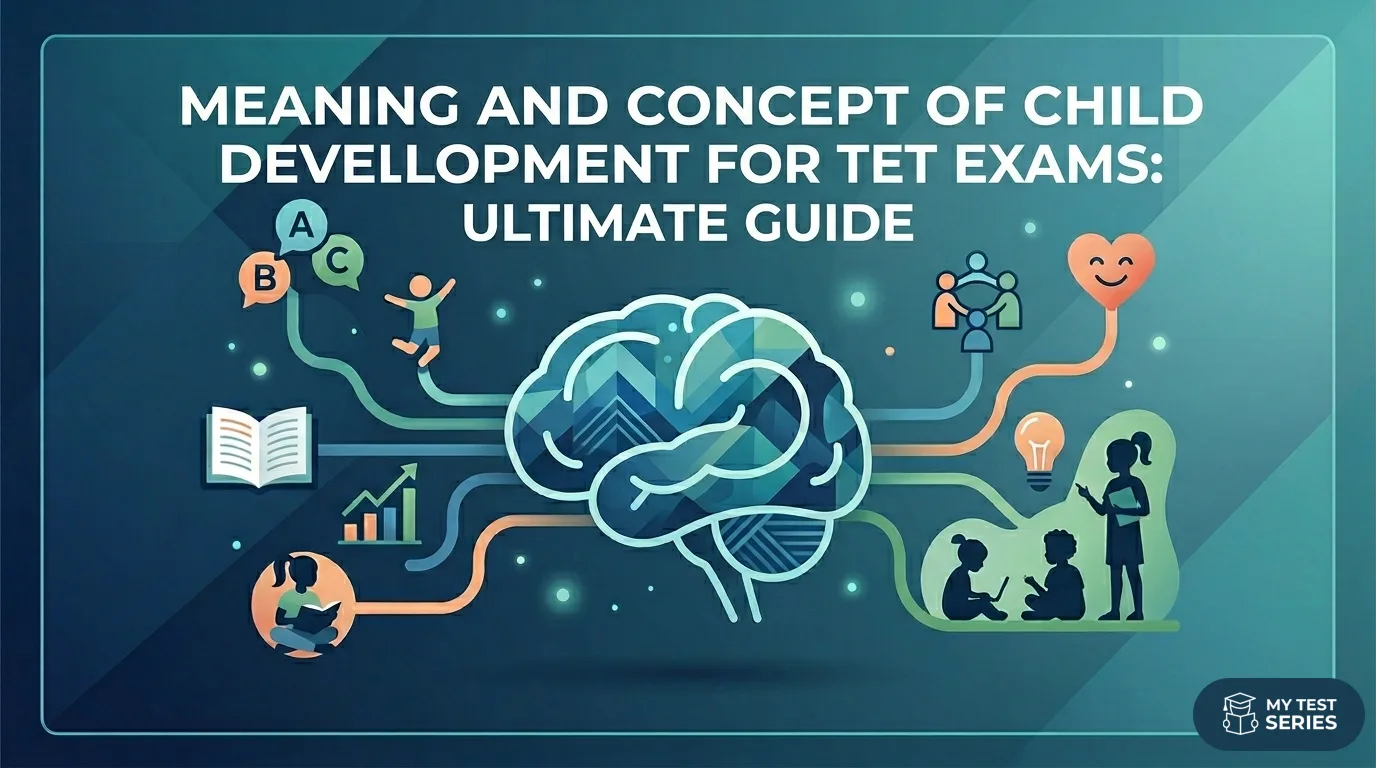
Understanding the Meaning and Concept of Child Development: A Masterclass for TET Aspirants
Comprehensive Study Notes for CTET, UPTET, REET, and State-Level Teacher Eligibility Tests.
Introduction: Why Child Development is the Backbone of TET
If you are an aspirant for the Teacher Eligibility Test (TET), you already know that 'Child Development and Pedagogy' (CDP) isn't just a subject—it's the heart of the examination. Whether it is CTET, UPTET, Super TET, or any state-level exam, nearly 30 marks revolve around how well you understand the journey of a child from conception to adolescence.
But what does "Child Development" actually mean? Is it just about a child getting taller? Or is it about how they start solving complex puzzles? In this guide, we will break down the meaning, concept, and core principles of child development in a way that is easy to remember and apply in your exam.
Defining the Meaning of Child Development
Child development refers to the sequence of physical, language, thought, and emotional changes that occur in a child from birth to the beginning of adulthood. Unlike a simple physical increase in size, development is a progressive, orderly, and coherent series of changes.
"Development is a process by which an individual grows from a single-celled organism to a highly complex functional human being."
In the context of the TET syllabus, you must view development as a multidimensional process. It is not limited to one aspect; it involves the body, the brain, and the social circle of the child.
The Concept of Growth vs. Development: A Crucial Distinction
One of the most common traps in the TET exam is the confusion between 'Growth' and 'Development'. Let’s clear the air with a comparison table that is frequently asked in MCQ formats.
| Feature | Growth (Quantitative) | Development (Qualitative) |
|---|---|---|
| Nature | Physical and measurable (Height, Weight). | Functional and behavioral changes. |
| Duration | Stops at maturity (Adulthood). | Continuous process (Womb to Tomb). |
| Scope | Narrow (Part of development). | Broad (Includes growth). |
Core Domains of Child Development
To score high in Pedagogy, you must understand the four primary domains. These domains are interconnected; a delay in one often affects the others.
1. Physical Domain
This includes Gross Motor Skills (running, jumping) and Fine Motor Skills (writing, buttoning a shirt). For TET, remember that physical development follows the Cephalocaudal (head-to-toe) and Proximodistal (center-to-outward) patterns.
2. Cognitive Domain
This focuses on mental processes such as memory, problem-solving, and imagination. Thinkers like Jean Piaget and Vygotsky are the pillars of this domain. It’s about how a child’s "mental map" expands over time.
3. Social and Emotional Domain
This involves how children develop relationships, manage emotions, and understand the feelings of others (empathy). Moral development, as discussed by Kohlberg, also falls under this umbrella.
4. Language Domain
From cooing and babbling to forming complex sentences, the language domain is a critical indicator of a child's cognitive health.
Key Principles of Child Development
TET questions often present a scenario and ask which "Principle of Development" it represents. Here are the must-know principles:
- Principle of Continuity: Development is a never-ending process. It starts from the mother’s womb and continues until death.
- Principle of Individual Differences: No two children are exactly alike. Even identical twins may differ in their temperament or interests.
- Principle of Uniform Pattern: While the rate varies, the sequence remains the same. Every child crawls before they walk.
- Principle of General to Specific: A child first moves their whole hand to grab something (general) before they learn to use their thumb and forefinger (specific).
Major Stages of Child Development for TET
In the TET syllabus, understanding the age-specific milestones is vital. Most questions are framed around the characteristics of these specific periods:
1. Prenatal Period (Conception to Birth)
Though not often the primary focus of pedagogy, this stage is where the biological foundation is laid. Factors like maternal health and nutrition play a massive role here.
2. Infancy (Birth to 2 Years)
This is a period of rapid physical growth and sensory exploration. According to Piaget, this is the Sensory-Motor Stage. The child learns through their five senses and develops "Object Permanence."
3. Early Childhood (2 to 6 Years)
Often called the 'Toy Age' or 'Pre-school Age'.
- Characteristics: Curiosity, animism (thinking non-living things are alive), and egocentrism.
- TET Tip: This is a critical period for language acquisition.
4. Later Childhood (6 to 12 Years)
Known as the 'Elementary School Age' or 'Gang Age'.
- Characteristics: Development of logical thinking (concrete objects), social cooperation, and creative skills.
- Pedagogy: Teachers should focus on activity-based learning here.
5. Adolescence (12 to 18 Years)
The most complex stage, described by Stanley Hall as a period of "Storm and Stress."
- Characteristics: Identity crisis, abstract thinking, and hero-worship.
- Key Focus: Emotional stability and career guidance.
Factors Influencing Development: Heredity vs. Environment
One of the most debated topics in Child Development and Pedagogy (CDP) is the "Nature vs. Nurture" debate. For a TET aspirant, the answer is always a Product, not an addition.
Development = Heredity × Environment
Heredity (Nature): The genetic blueprint provided by parents. It sets the "limit" for certain traits like height or intelligence potential.
Environment (Nurture): The surroundings, including family, school, and culture. It determines how much of that genetic potential is actually realized.
Educational Implications for Teachers
Why does a TET qualified teacher need to know this? Because a teacher is a facilitator. Understanding development allows you to:
- Identify Individual Differences: You cannot teach all 40 students with the exact same method. Some are visual learners, while others are kinesthetic.
- Design Age-Appropriate Curriculum: You wouldn't teach abstract algebra to a 5-year-old. Development concepts tell us when a child's brain is "ready" for a specific topic.
- Predict Behavior: Knowing that an adolescent is undergoing "Storm and Stress" helps a teacher handle behavioral issues with empathy rather than punishment.
Quick Summary for Last-Minute Revision
- Growth is quantitative; Development is qualitative.
- Development follows a predictable pattern.
- Cephalocaudal means Head to Toe; Proximodistal means Center to Extremities.
- Adolescence is the 'Identity vs. Role Confusion' stage (Erikson).
- Early childhood is the golden period for language learning.
Conclusion
Mastering the Meaning and Concept of Child Development is your first step toward cracking the TET examination. It isn't just about memorizing definitions; it’s about understanding the human soul as it grows. By keeping these principles and stages in mind, you will not only score 30/30 in the CDP section but also become a truly effective educator who can shape the future of their students.
Stay tuned for our next post on Piaget’s Theory of Cognitive Development!
Child Development & Pedagogy – Complete Study Hub
Master the entire Child Development and Pedagogy (CDP) syllabus for CTET and all TET exams with our detailed topic-wise notes.