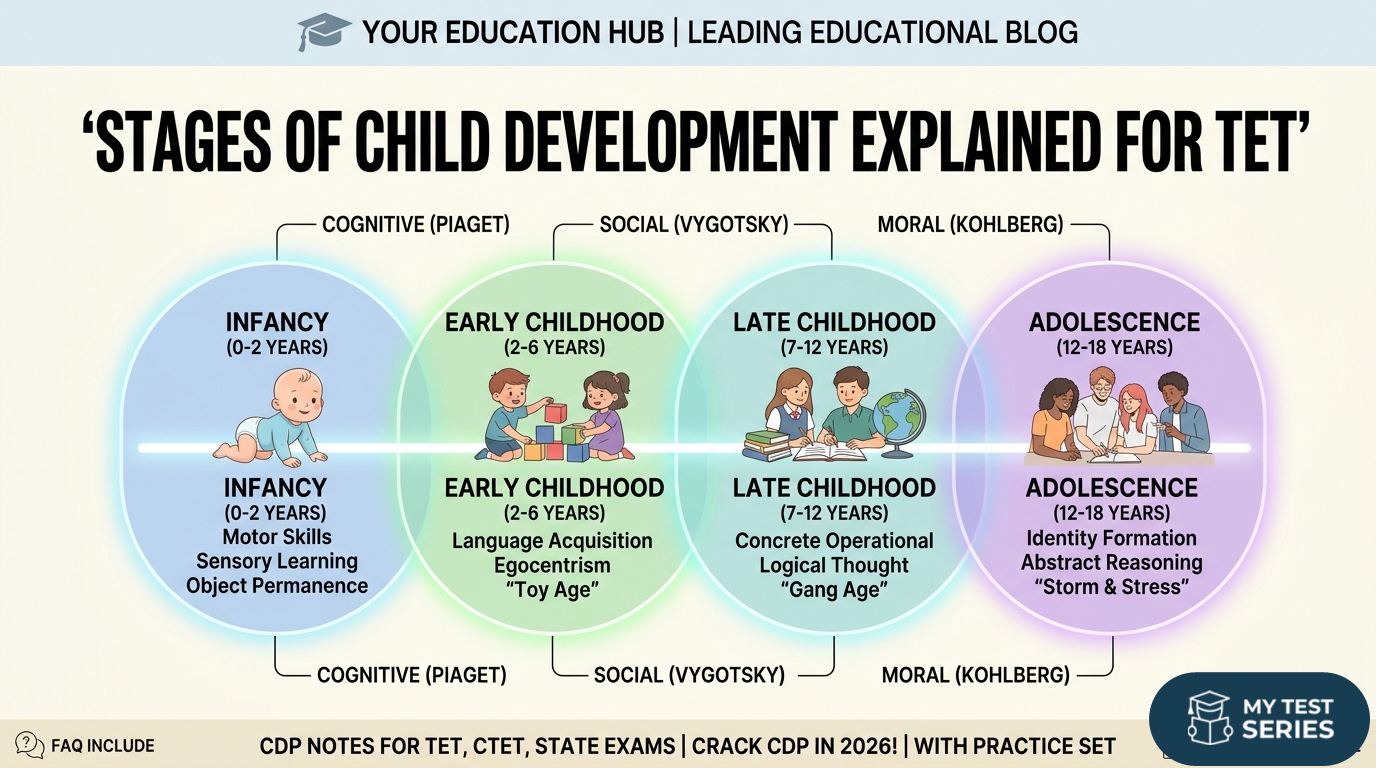
Stages of Child Development: The Ultimate Guide for TET Aspirants
Comprehensive notes on Child Development and Pedagogy (CDP) for CTET, UPTET, REET, and State TET Exams.
Understanding the Stages of Child Development is the cornerstone of the Child Development and Pedagogy (CDP) section in any Teacher Eligibility Test (TET). Whether you are appearing for CTET, KVS, or State-level TETs, a deep dive into how a child grows—physically, mentally, and socially—is non-negotiable.
Development is a continuous, lifelong process that begins at conception and ends at death. For educators, recognizing these patterns isn't just about passing an exam; it’s about tailoring teaching strategies to meet the specific needs of each developmental milestone.
1. Prenatal Period (Conception to Birth)
While often overlooked in general studies, the prenatal stage is vital for TET exams. It is divided into three sub-stages: the Germinal, Embryonic, and Fetal periods. During this time, the foundation for all future physical and neurological growth is laid down.
- Key Fact: Development follows the Cephalocaudal (head to toe) and Proximodistal (center to periphery) principles even before birth.
2. Infancy (0 to 2 Years)
Infancy is characterized by rapid physical growth and the development of basic motor skills. This is the stage of "Total Dependency."
[Image of milestones in infancy development]
Key Features:
- Sensory Learning: Children learn through their senses (sucking, grasping, looking).
- Object Permanence: Towards the end of this stage, children realize that objects exist even when they are out of sight (a favorite Piagetian concept for TET).
- Emotional Bond: Formation of 'Attachment' with the primary caregiver.
3. Early Childhood (2 to 6 Years)
Often called the "Toy Age" or the "Pre-school Age," this stage is critical for language acquisition and social behavior.
Characteristics for TET:
- Animism: The belief that inanimate objects (like dolls) have feelings.
- Egocentrism: The child struggle to see the world from anyone else's perspective.
- Language Explosion: Rapid vocabulary growth occurs here.
4. Late Childhood (7 to 12 Years)
This is known as the "Elementary School Age" or the "Gang Age." Children become more logical and less egocentric.
[Image of Piaget's stages of cognitive development chart]
Developmental Milestones:
- Concrete Thinking: Logical reasoning begins, but it's applied only to physical (concrete) objects.
- Reversibility: The ability to understand that actions can be reversed (e.g., water turning to ice and back to water).
- Social Skills: Importance of peer groups increases significantly.
5. Adolescence (12 to 18 Years)
Described by G. Stanley Hall as a period of "Storm and Stress," adolescence is the bridge between childhood and adulthood.
Critical Factors for Educators:
- Identity vs. Role Confusion: According to Erik Erikson, this is the primary conflict.
- Abstract Thinking: Adolescents can think about hypothetical situations and future possibilities.
- Puberty: Rapid hormonal changes leading to physical and emotional volatility.
Important Theories to Remember
To score high in TET, you must correlate these stages with major theories:
| Psychologist | Focus Area |
|---|---|
| Jean Piaget | Cognitive Development |
| Lawrence Kohlberg | Moral Development |
| Erik Erikson | Psycho-social Development |
| Lev Vygotsky | Social Constructivism |
Frequently Asked Questions (FAQs)
Answer: Growth is quantitative (height, weight), while development is qualitative (functional improvement) as well as quantitative.
Answer: Because the brain is highly plastic, and foundation for language and social behavior is laid during these years.
Deep Dive: The Pillars of Child Development Theory
To secure a 30/30 score in the CDP section, understanding the "Big Three" theorists is essential. These theories explain *how* the stages we discussed in Part 1 actually manifest in a classroom setting.
A. Jean Piaget’s Cognitive Development Theory
Piaget viewed children as "Little Scientists." He believed they actively construct their understanding of the world rather than passively absorbing information.
The Four Stages:
- Sensorimotor (0-2 yrs): Learning through motor actions. TET Tip: Focus on Object Permanence.
- Pre-operational (2-7 yrs): Symbolic thought begins. TET Tip: Focus on Egocentrism and Lack of Conservation.
- Concrete Operational (7-11 yrs): Logic applies to physical objects. TET Tip: Focus on Classification and Seriation.
- Formal Operational (11+ yrs): Abstract and hypothetical reasoning. TET Tip: Focus on Deductive Logic.
B. Lev Vygotsky’s Socio-Cultural Theory
Unlike Piaget, Vygotsky argued that social interaction is the primary driver of development. This is a favorite topic for AEO because it relates to collaborative learning.
- ZPD (Zone of Proximal Development): The gap between what a learner can do alone and what they can do with help.
- Scaffolding: The temporary support provided by a teacher or "More Knowledgeable Other" (MKO).
- Private Speech: When children talk to themselves to guide their own thinking.
C. Lawrence Kohlberg’s Moral Development
Kohlberg’s stages are frequently tested through situational questions (like the Heinz Dilemma).
| Level | Key Characteristic |
|---|---|
| Pre-Conventional | Driven by punishment and reward (Obedience). |
| Conventional | Driven by social order and "Good Boy/Nice Girl" orientation. |
| Post-Conventional | Driven by universal ethical principles and social contracts. |
Educational Implications for TET Aspirants
Why do TET exams focus so much on these stages? Because they dictate Pedagogy. Here is how you apply this knowledge in a exam-style scenario:
For Primary Teachers (PRT)
Focus on Concrete Materials. Use beads for counting, physical maps, and storytelling. Remember that children at this stage are in the "Concrete Operational" phase; they need to see it to believe it.
For Upper Primary/Secondary (TGT/PGT)
Engage in Debates and Problem Solving. Since students are entering "Formal Operations," they can handle "What if?" scenarios and complex moral dilemmas.
Heredity and Environment: The Dynamic Duo
Another high-yield TET topic is the Nature vs. Nurture debate.
Formula to remember: Development = Heredity × Environment
Heredity provides the "canvas" (potential), while the environment provides the "paint" (experiences). A teacher's job is to optimize the environment to ensure the child reaches their full hereditary potential.
Core Principles of Child Development
To master the TET syllabus, you must memorize the "Laws of Development." These principles explain why children grow the way they do and are frequently tested in "Which of the following is NOT a principle..." type questions.
- Principle of Continuity: Development is a "Womb to Tomb" process. It never stops, though its speed may vary.
- Principle of Individual Differences: No two children are the same. Even identical twins grow at different rates and have different temperaments.
- Principle of Sequentiality: Development follows a fixed pattern.
- Cephalocaudal: Head to toe.
- Proximodistal: Center to extremities (Spine to fingers).
- Principle of General to Specific: A child first waves their whole arm (general) before they can pick up a needle with their fingers (specific).
- Principle of Interrelation: Physical, mental, social, and emotional developments are all linked. If one is affected, others likely will be too.
Understanding Individual Differences and Inclusive Education
Modern TET exams place heavy emphasis on Inclusive Education. As an educator, you must recognize that "Individual Differences" are not deficits—they are variations in the human experience. Factors like IQ, aptitude, interest, and socio-economic background play a massive role.
"The aim of education is not to make all children the same, but to ensure every child reaches their unique potential."
TET Practice Set: Stages of Development
(Most Repeated Questions in CTET, KVS, and State TETs)
Q1. Which of the following is a sensitive period for language acquisition?
A) Prenatal period
B) Early childhood
C) Middle childhood
D) Adolescence
Answer: B) Early childhood
Q2. The concept of 'Scaffolding' was given by:
A) Jean Piaget
B) Lev Vygotsky
C) B.F. Skinner
D) Albert Bandura
Answer: B) Lev Vygotsky
Q3. A child thinks that "a cow is a large dog" because it has four legs. This is an example of:
A) Accommodation
B) Assimilation
C) Conservation
D) Object Permanence
Answer: B) Assimilation
Q4. The 'Gang Age' refers to which stage?
A) Infancy
B) Early Childhood
C) Late Childhood
D) Adolescence
Answer: C) Late Childhood
Q5. Development follows which direction?
A) Specific to General
B) Proximodistal
C) Foot to Head
D) Random
Answer: B) Proximodistal
Conclusion: Preparing for the CDP Section
Mastering the Stages of Child Development is about more than memorizing ages and names; it’s about understanding the logic of growth. When answering TET questions, always put yourself in the shoes of a child-centered educator. Look for options that promote active learning, social interaction, and emotional safety.
Child Development & Pedagogy – Complete Study Hub
Master the entire Child Development and Pedagogy (CDP) syllabus for CTET and all TET exams with our detailed topic-wise notes.