Child Development & Pedagogy – Complete Study Hub
Master the entire Child Development and Pedagogy (CDP) syllabus for CTET and all TET exams with our detailed topic-wise notes.
Constructivism Learning Theory for TET Exam: The Ultimate Guide
Master the constructivist approach that appears in almost every CTET & State TET Pedagogy paper. Real PYQs, classroom-ready strategies, MCQs with explanations & expert tips to score 100% in Child Development section.
Table of Contents
- 1. Introduction: Why Constructivism Matters in TET
- 2. What Exactly is Constructivism Learning Theory?
- 3. Key Theorists: Piaget, Vygotsky & More
- 4. Core Principles of Constructivism
- 5. Types of Constructivism Every TET Aspirant Must Know
- 6. Constructivism in Classroom: Practical TET Strategies
- 7. Constructivism vs Behaviourism vs Cognitivism
- 8. Why TET Examiners Love Constructivism Questions
- 9. Advantages & Limitations
- 10. Most Important PYQ-Based MCQs for TET (with Answers & Explanations)
- 11. Frequently Asked Questions (FAQ)
- 12. Conclusion & Final TET Tips
1. Introduction: Why Constructivism Learning Theory for TET Matters
Constructivism Learning Theory for TET – Hey there, future teacher! If you’re preparing for CTET, REET, UPTET, MPTET or any State TET, you already know that the Child Development and Pedagogy section can make or break your score. And guess what topic keeps coming back year after year? Constructivism Learning Theory.
Imagine walking into a TET exam hall and seeing a question like: “In the constructivist frame, the child is viewed as…” You smile because you’ve mastered it. This guide is written exactly for that moment.
Constructivism isn’t just another theory — it’s the backbone of modern child-centered education in India’s NEP 2020. TET examiners test whether you understand how children actually build knowledge instead of just memorising facts. In the last 8 years, at least 4-6 questions have appeared directly or indirectly from this topic in every major TET paper.
By the end of this 2000-word guide, you’ll be able to explain constructivism like a pro, apply it in classrooms, and confidently solve every PYQ MCQ. Let’s dive in.
2. What Exactly is Constructivism Learning Theory for TET?
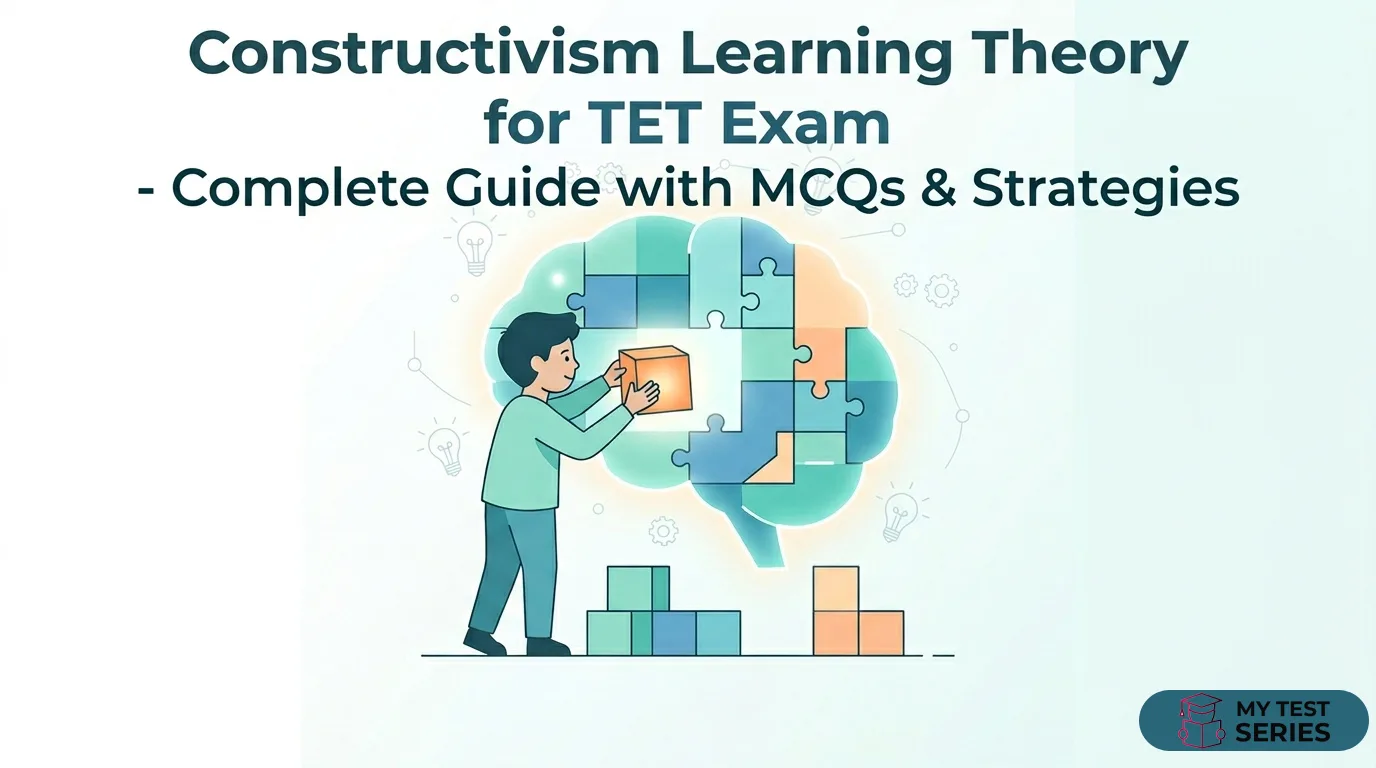
Constructivism is a learning theory that says learners actively construct their own knowledge rather than passively receiving it from teachers or textbooks. Knowledge isn’t something poured into an empty mind — it’s built by the child using their past experiences, interactions, and reflections.
Think of it like building a Lego tower. The child already has some blocks (prior knowledge). New information is a new block. The child doesn’t just stack it randomly — they connect it, rearrange old blocks, and create something meaningful. That’s constructivism in action.
In simple words: Learning = Experience + Reflection + Social Interaction.
This theory completely changed Indian education from rote-learning classrooms to activity-based, joyful learning — exactly what TET wants you to promote.
3. Key Theorists: Piaget, Vygotsky & More (Must-Know for TET)
Jean Piaget – Father of Cognitive Constructivism
Swiss psychologist Jean Piaget (1896-1980) gave us the idea that children are “little scientists.” He introduced:
- Schemas: Mental frameworks to organise information
- Assimilation: Fitting new information into existing schemas
- Accommodation: Changing schemas when new info doesn’t fit
- Equilibration: Balancing assimilation and accommodation
Piaget also gave four stages of cognitive development — a favourite TET topic.
Lev Vygotsky – Social Constructivism Pioneer
Russian psychologist Lev Vygotsky (1896-1934) said learning is deeply social. His two big ideas that TET loves:
- Zone of Proximal Development (ZPD): Gap between what a child can do alone and with help
- Scaffolding: Temporary support given by teacher or peers that is gradually removed
Vygotsky believed “Every function in the child’s cultural development appears twice: first on the social level, and later on the individual level.”
Other Important Names
- John Dewey → Learning by doing (experiential learning)
- Jerome Bruner → Discovery learning & spiral curriculum
4. Core Principles of Constructivism Learning Theory for TET
These 6 principles are your TET scoring weapons:
- Knowledge is constructed, not transmitted – Children build it themselves.
- Prior knowledge is the foundation – New learning connects to what they already know.
- Learning is an active, not passive process – Hands-on, minds-on.
- Social interaction is crucial – Group work, discussions, debates.
- Learning happens in meaningful contexts – Real-life problems, not isolated facts.
- Reflection and metacognition matter – Children think about their own thinking.
5. Types of Constructivism Every TET Aspirant Must Know
| Type | Focus | Key Thinker | TET Relevance |
|---|---|---|---|
| Cognitive | Individual mental construction | Piaget | Stages of development |
| Social | Learning through interaction | Vygotsky | ZPD & scaffolding |
| Radical | Knowledge is subjective | von Glasersfeld | Rarely asked but good to know |
6. Constructivism in Classroom: Practical Strategies for TET Teachers
A constructivist classroom is noisy, messy, and full of curiosity — exactly what NEP 2020 wants!
- Start lessons with “What do you already know?” (KWL chart)
- Use group projects and peer teaching
- Give open-ended questions instead of yes/no
- Provide scaffolding — hints, modelling, then fade support
- Encourage reflection journals: “What did I learn today and how?”
- Real-life problem solving: “How can we reduce plastic in our school?”
Pro Tip for TET Interview: Always say, “I will act as a facilitator, not a lecturer.”
7. Constructivism vs Behaviourism vs Cognitivism (Quick Comparison Table)
| Theory | Learner Role | Teacher Role | TET Favourite Question |
|---|---|---|---|
| Behaviourism | Passive (blank slate) | Reinforcer | Reward & punishment |
| Cognitivism | Information processor | Organiser of content | Memory & schemas |
| Constructivism | Active constructor | Facilitator | ZPD, scaffolding, meaning-making |
8. Why TET Examiners Love Constructivism Questions
Because it directly tests whether you believe in child-centered education. Almost every TET paper has 1-2 direct questions and 2-3 indirect ones (classroom scenario based).
9. Advantages & Limitations of Constructivism
Advantages: Deeper understanding, critical thinking, lifelong learning skills, inclusive for diverse learners.
Limitations: Time-consuming, needs trained teachers, difficult to assess in large classes, may frustrate weak students without proper scaffolding.
10. Most Important PYQ-Based MCQs for TET
These are actual pattern questions from CTET & State TET papers (sourced from official style questions on Testbook & previous papers).
MCQ 1 (CTET 2022 Pattern)
Q. The characteristics of a constructivist classroom is
1. The child is good receiver of teaching.
2. He listens to the teacher’s words patiently.
3. He is free to ask questions and present his arguments.
4. He is given ample opportunities to practice the methods taught.
Answer: 3
Explanation: Constructivist classroom is student-centred. Children actively participate and question.
MCQ 2 (Very Frequent)
Q. In the constructivist frame, the child is viewed as
1. tabula rasa or blank slate
2. a passive being
3. a problem solver and a scientific investigator
4. miniature adult
Answer: 3
Explanation: Children are active meaning-makers, not passive recipients.
MCQ 3
Q. Socio-constructivist views of learning advocate that
Answer: Learners actively construct knowledge
Explanation: Knowledge is co-constructed through social interaction (Vygotsky).
MCQ 4
Q. A teacher wants to help students master a skill effectively. Which approach aligns with constructivist pedagogy?
Answer: Encouraging students to practice meaningfully with variety, feedback and reflection.
(Total 10+ such questions appear in every TET. Save this section and revise weekly!)
11. Frequently Asked Questions (FAQ)
What is the main difference between constructivism and behaviourism for TET?
Behaviourism treats the child as a blank slate shaped by rewards/punishments. Constructivism sees the child as an active builder of knowledge through experiences.
Is constructivism part of CTET Paper 1 or Paper 2?
Both papers! It appears in Child Development & Pedagogy section of both Paper 1 (Primary) and Paper 2 (Upper Primary).
How to write answers in TET descriptive questions on constructivism?
Always mention Piaget (individual) + Vygotsky (social) + practical classroom example + link with NEP 2020.
Which is more important for TET — Piaget or Vygotsky?
Both are equally important, but Vygotsky’s ZPD and scaffolding appear more frequently in recent papers.
12. Conclusion & Final TET Tips
Congratulations! You now have everything needed to dominate the constructivism section in your upcoming TET exam. Remember: TET doesn’t just test theory — it tests whether you can apply it in real classrooms.
Quick Revision Mantra: “Children construct knowledge actively through experience, reflection, and social interaction.”
Bookmark this page, revise the MCQs daily, and teach one constructivist activity in your practice classes. You’ve got this!
Share this guide with your TET group and help fellow aspirants.