Child Development & Pedagogy – Complete Study Hub
Master the entire Child Development and Pedagogy (CDP) syllabus for CTET and all TET exams with our detailed topic-wise notes.
Individual Differences in Learning: Complete Guide for TET/CTET Exam | PYQ MCQs, Strategies & Expert Notes
Introduction: Why Individual Differences in Learning Matter for Every TET Aspirant
Individual Differences in Learning – As you prepare for the Teacher Eligibility Test (TET) or Central Teacher Eligibility Test (CTET), one topic that appears year after year in the Child Development and Pedagogy section is individual differences in learning. It’s not just theory — it’s the foundation of modern, inclusive teaching that every future teacher must master.
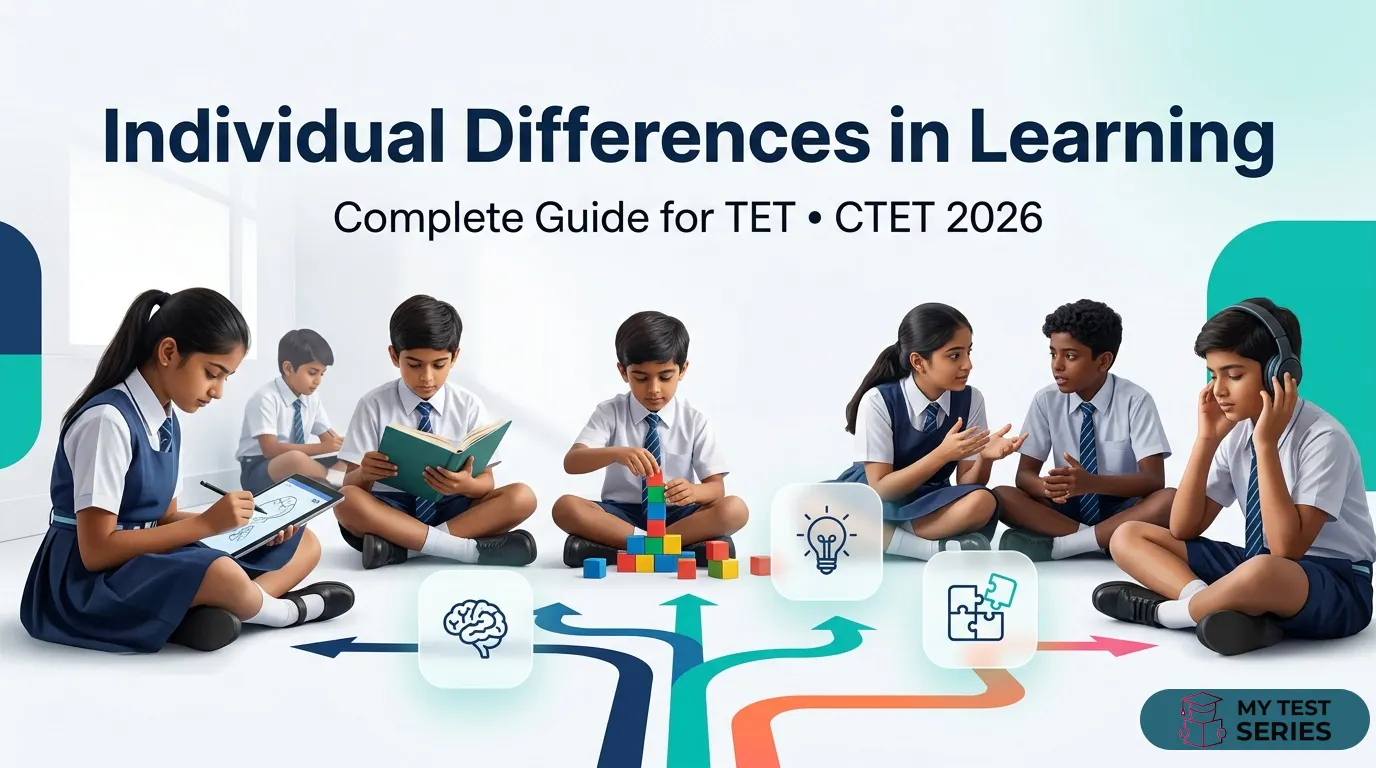
Imagine a classroom in Mumbai where one child learns best through diagrams, another through stories, and a third through hands-on activities. These are not problems to fix — they are natural variations that make teaching both challenging and rewarding. TET examiners love testing whether you understand that every child is unique and how you, as a teacher, should respond.
What Are Individual Differences in Learning?
Individual differences in learning refer to the unique ways in which children acquire, process, retain, and apply knowledge. No two learners are exactly alike — even identical twins show differences in how they learn.
There are two main types:
- Intra-individual differences: Variations within the same child (e.g., strong in math but weak in language).
- Inter-individual differences: Variations between different children (e.g., one child is quick at reading while another needs more time).
These differences arise right from birth and continue to evolve. TET/CTET questions often test whether you view them as a natural process rather than a hindrance. Recognizing them helps teachers create equitable learning opportunities instead of forcing everyone into the same mould.
In the Indian context, factors like multilingual homes, diverse socio-economic backgrounds, and varying access to technology make individual differences even more prominent in our classrooms.
Factors Contributing to Individual Differences in Learning
Understanding the “why” behind these differences is crucial for TET. Here are the major factors:
1. Heredity and Environment (Nature vs Nurture)
Individual differences result from the interaction between heredity and environment. Heredity sets the potential (genetic factors like intelligence and temperament), while environment shapes how that potential develops. A child born with high musical intelligence may never excel if not exposed to music at home or school.
2. Intelligence and Cognitive Abilities
Intelligence is not a single number. Howard Gardner’s Multiple Intelligences theory is a TET favourite. Children may be:
- Linguistic (word smart)
- Logical-mathematical (number smart)
- Spatial (picture smart)
- Musical, Bodily-kinesthetic, Interpersonal, Intrapersonal, Naturalistic
Spearman’s ‘g’ factor and Thurstone’s primary mental abilities also appear in questions.
3. Learning Styles (VARK Model)
Visual, Auditory, Reading/Writing, and Kinesthetic learners process information differently. A kinesthetic learner thrives with models and experiments, while a visual learner loves charts. TET questions frequently ask you to identify the best strategy for each style.
4. Motivation and Personality
Intrinsic motivation (curiosity) vs extrinsic (rewards) greatly affects learning pace. Personality traits like openness, conscientiousness, and emotional stability (Big Five) also play a role. A highly anxious child may need extra emotional support.
5. Socio-Cultural, Linguistic, and Economic Factors
In India, caste, gender, religion, language spoken at home, and family income create real differences. A first-generation learner from a rural area may need more scaffolding than an urban child with private tuition. TET emphasises inclusive education that respects these diversities.
6. Physical, Emotional, and Developmental Factors
Age, gender, health, and emotional well-being also matter. A child with ADHD or mild hearing impairment learns differently and requires differentiated support.
Theoretical Perspectives Relevant for TET
TET loves linking theory to practice:
- Jean Piaget: Children construct knowledge at their own pace through stages. Respect cognitive readiness.
- Lev Vygotsky: Zone of Proximal Development (ZPD) — provide scaffolding according to each child’s current level.
- Howard Gardner: Multiple Intelligences — use varied activities.
- Constructivism: Children build knowledge based on prior experiences. Link new learning to what they already know.
These theories remind us that one-size-fits-all teaching fails many children.
Implications for Teaching: Practical Strategies for TET Aspirants
As a future teacher, you must:
- Assess differences early: Use observation, simple questionnaires, and formative assessments.
- Differentiated Instruction: Provide multiple pathways — same content, different processes.
- Flexible Grouping: Mix ability groups, interest groups, and learning-style groups.
- Universal Design for Learning (UDL): Multiple means of representation, expression, and engagement.
- Inclusive Practices: Adapt materials for CWSN (Children with Special Needs) and multilingual learners.
- Use Technology Wisely: Adaptive learning apps that adjust to each child’s pace.
Remember: The goal is not to make everyone the same, but to help every child reach their full potential.
CTET Child Development & Pedagogy – Most Asked Topics (80% Question Coverage)
Based on previous CTET exams, the following topics cover nearly 70-80% of CDP questions. Students preparing for CTET or other TET exams should focus on these high-weightage concepts.
| Topic | Importance | Expected Questions |
|---|---|---|
| Child Development Concept | Very High | 2-3 Questions |
| Principles of Development | High | 2 Questions |
| Jean Piaget Cognitive Development | Very High | 3-4 Questions |
| Lev Vygotsky Theory & ZPD | Very High | 2-3 Questions |
| Learning Theories | Very High | 3 Questions |
| Howard Gardner Multiple Intelligence | High | 1-2 Questions |
| Inclusive Education | Very High | 2-3 Questions |
| Individual Differences | High | 2 Questions |
| Motivation in Learning | Medium | 1-2 Questions |
📌 Preparation Tip:
If you thoroughly understand the topics listed above, you can easily score 20+ marks out of 30 in the CTET Child Development and Pedagogy section.
Individual Differences in Learning (PYQs) with Explanations
These are actual or closely based on CTET/TET papers. Practice them — they repeat in pattern!
Q1 (CTET Paper 1 – 20 Jan 2023): Individual differences in preferred learning styles of students should be considered as ________.
1. hindrance to teaching-learning process
2. natural and obvious process of development
3. a kind of ‘abnormal behaviour’
4. a result of convergent thinking
Correct Answer: 2
Explanation: Differences in learning styles (visual, auditory, kinesthetic) are completely natural. Good teachers celebrate and accommodate them.
Q2: What should be the role of a teacher in meeting the individual differences?
1. Try to know the abilities, interest and aptitude of the individuals
2. Try to adjust the curriculum as per the need of the individuals
3. Both (1) and (2)
4. None of these
Correct Answer: 3
Explanation: Teachers must first understand each child and then modify teaching methods and curriculum accordingly.
Q3: The determinants of individual differences in humans are related to-
1. interaction with their environment
2. differences in their heredity
3. differences in both heredity and environment
4. interaction between heredity and environment
Correct Answer: 4
Explanation: It is the dynamic interaction between genes and environment that shapes learning differences.
Q4: According to Howard Gardner’s theory, it is important to have a variety of teaching modes/strategies within a classroom because:
1. it helps exercise multiple intelligences
2. it helps improve general intelligence
3. it helps to create ‘star’ students
4. it helps improve practical intelligence
Correct Answer: 1
Explanation: Gardner’s Multiple Intelligences theory demands varied strategies to develop all types of intelligence.
Q5: Learners with ________ learning style learn best through figuring things out by hand.
1. reading/writing 2. kinaesthetic 3. auditory 4. visual
Correct Answer: 2
Explanation: Kinesthetic learners prefer hands-on, tactile experiences.
Q6: Assertion (A): A teacher should adapt instruction through individualized and simplified strategies for a child with below-average intellectual functioning.
Reason (R): Such children require learning experiences matched to their pace and cognitive abilities.
Correct Answer: Both A and R are true and R explains A.
Q7: Individual differences in learning levels are a result of:
(Frequently asked variant) Interaction of heredity and environment.
Q8: Learners display individual differences. So a teacher should:
1. provide a variety of learning experiences
2. enforce strict discipline
3. ignore the differences
4. give same homework to all
Correct Answer: 1
Tip: In CTET, the correct answer is almost always the one that promotes inclusion and variety.
FAQ: Individual Differences in Learning
Q1. What are individual differences in learning?
A: Unique variations in how students learn due to intelligence, styles, motivation, and background. They are natural and should be respected.
Q2. Why is this topic important for TET exam?
A: It forms 15-20% of CDP section. Questions test your understanding of inclusive teaching and differentiated instruction.
Q3. How can teachers address individual differences?
A: Through differentiated instruction, varied methods, UDL principles, and continuous assessment.
Q4. Is individual difference only due to heredity?
A: No. It is the interaction of heredity and environment.
Q5. Which theory is most important for individual differences in TET?
A: Gardner’s Multiple Intelligences and Vygotsky’s ZPD are frequently asked.
Conclusion: Turn Knowledge into Teaching Excellence
Individual differences in learning are not obstacles — they are opportunities to become a truly great teacher. For TET 2026, remember: celebrate diversity, differentiate instruction, and always keep the child at the centre.
Revise these notes, solve the PYQs daily, and you will not only clear the exam but also become the kind of teacher every child deserves. Good luck — you’ve got this!
Share this guide with your TET group and bookmark it for quick revision.