📚 CTET Child Development & Pedagogy – Complete Study Hub
Master the entire Child Development and Pedagogy (CDP) syllabus for CTET and all TET exams with our detailed topic-wise notes.
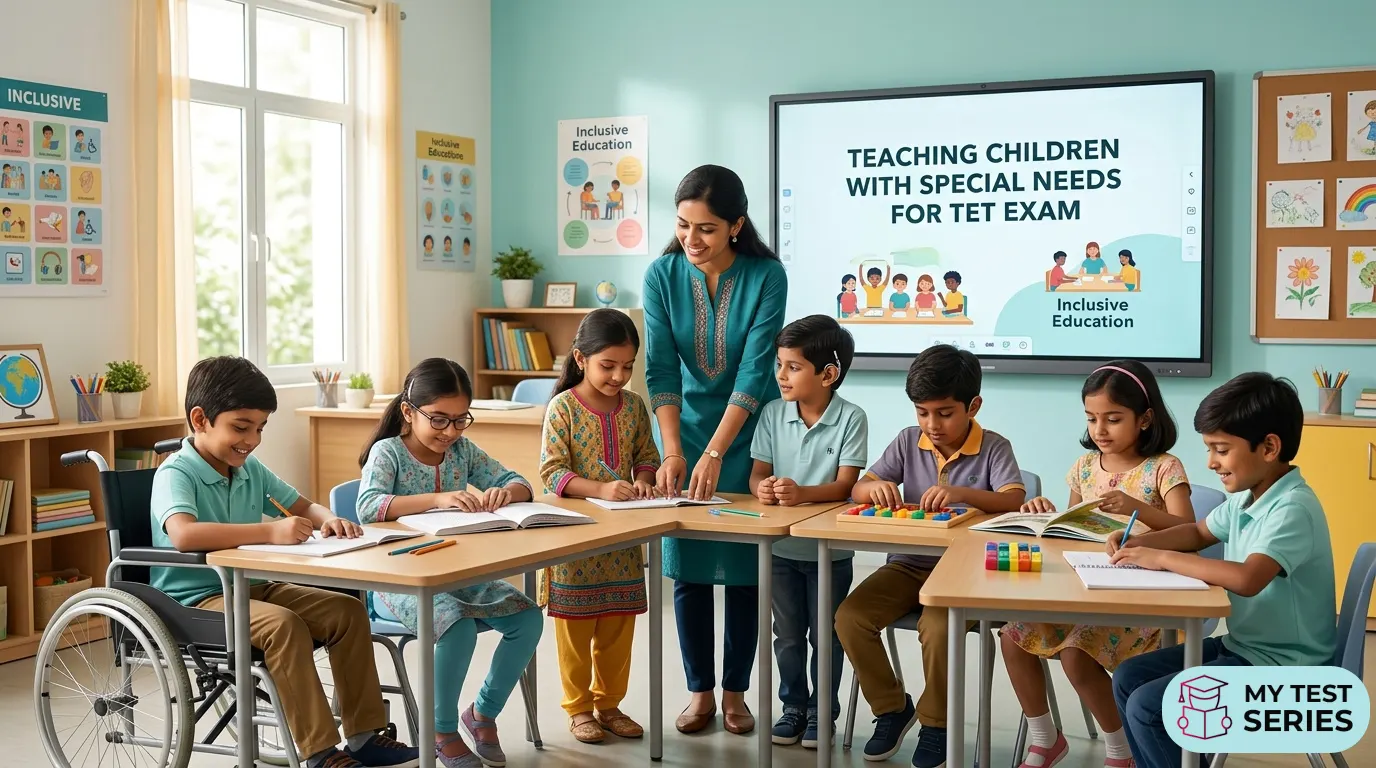
Teaching Children with Special Needs for TET Exam : Complete Guide with Strategies, PYQs & FAQs
Table of Contents
- 1. Introduction: Why This Topic Matters for TET
- 2. Understanding Children with Special Needs (CWSN)
- 3. Legal Framework: RTE & RPWD Acts
- 4. Core Principles of Inclusive Education
- 5. Practical Teaching Strategies for Different Disabilities
- 6. Role of a TET Teacher in Inclusive Classrooms
- 7. Assessment & Evaluation Techniques
- 8. Most Important PYQ MCQs (CTET/TET) with Answers
- 9. Frequently Asked Questions (FAQ)
- 10. Conclusion & Last-Minute TET Tips
1. Introduction: Why Teaching Children with Special Needs is a High-Scoring Topic in TET Exam
As a TET aspirant preparing for CTET, UPTET, MPTET, or any State TET in 2026, you already know that Child Development and Pedagogy (CDP) carries 30 marks. Within CDP, the unit on “Teaching Children with Special Needs” or “Inclusive Education” is one of the most predictable and scoring areas. Every year, 4-7 questions appear directly from this section.
India is home to over 2.2 crore children with special needs (as per recent government data). The Right to Education Act and RPWD Act 2016 have made inclusive education a constitutional and legal mandate. As future teachers, you are not just preparing for an exam — you are preparing to build an equitable classroom where every child feels valued.
Pro Tip: Focus on RPWD 2016 definitions, types of disabilities, and practical strategies — these are favourites in TET papers.
2. Understanding Children with Special Needs (CWSN)
The term “Children with Special Needs” (CWSN) or “Divyang” refers to children who require additional support to learn and participate equally in mainstream education. The Rights of Persons with Disabilities (RPWD) Act, 2016 recognises 21 benchmark disabilities.
For TET exams, you only need to remember the major categories that appear frequently:
- Sensory Disabilities: Blindness, Low Vision, Hearing Impairment, Speech & Language Disability
- Physical Disabilities: Locomotor Disability, Leprosy Cured, Dwarfism, Acid Attack Victim
- Intellectual & Developmental: Intellectual Disability, Specific Learning Disabilities (Dyslexia, Dysgraphia, Dyscalculia), Autism Spectrum Disorder, Multiple Disabilities
- Others: Mental Illness, Chronic Neurological Conditions, Blood Disorders
Important distinction for TET: Learning Disability (LD) vs Intellectual Disability (ID). Children with LD have average or above-average IQ but face difficulty in one specific area (reading/writing/math). Children with ID have below-average IQ and limitations in adaptive behaviour.
3. Legal Framework: RTE Act 2009 & RPWD Act 2016 (Must-Know for TET)
The RTE Act 2009 (Section 3(2)) clearly states that children with disabilities have the right to free and compulsory education till age 14 in a neighbourhood school. It treats CWSN under “disadvantaged groups”.
The RPWD Act 2016 is the game-changer. Key provisions for TET:
- Section 16: Inclusive education in all government and government-aided schools
- Free books, assistive devices, and transportation for CWSN
- Reservation of 5% seats in higher education for benchmark disabilities
- Teacher training in sign language, Braille, and special education
Remember the famous TET line: “Inclusive education assumes we should change the system to fit the child, not the other way around.”
4. Core Principles of Inclusive Education
- Zero Rejection Policy – No child can be denied admission
- Individualised Education Plan (IEP) – Tailored learning goals for every CWSN
- Universal Design for Learning (UDL) – Multiple ways to present, engage, and respond
- Differentiated Instruction – Same content, different methods
- Peer Tutoring & Cooperative Learning – Children learn best from each other
5. Practical Teaching Strategies for Different Disabilities (Exam-Ready)
Visual Impairment
Use Braille, large-print materials, audio books, tactile diagrams. Arrange seating near the board. Verbalise everything you write.
Hearing Impairment
Use sign language, visual aids, FM systems, and facing the child while speaking. Prefer written instructions and peer note-taking.
Intellectual Disability
Break tasks into small steps (task analysis), use concrete examples, repeat instructions, and give immediate positive reinforcement.
Specific Learning Disability (Dyslexia/Dysgraphia)
Multisensory teaching (Orton-Gillingham approach), extra time, audio support, and avoid penalising spelling in early stages.
Autism Spectrum Disorder (ASD)
Structured environment, visual schedules, social stories, and clear routines. Reduce sensory overload with quiet corners.
TET Favourite Tip: Always remember “least restrictive environment” and “reasonable accommodation” — these two phrases appear again and again in previous papers.
6. Role of a TET Teacher in an Inclusive Classroom
A good TET teacher is:
- Sensitive and patient
- Collaborates with special educators and parents
- Uses positive behaviour support instead of punishment
- Focuses on strengths, not deficits
Least important factor (as per previous CTET question): Socio-economic status of the teacher.
7. Assessment & Evaluation Techniques for CWSN
Traditional exams don’t work. Use:
- Continuous and Comprehensive Evaluation (CCE)
- Portfolio assessment
- Oral tests, projects, and practical demonstrations
- Extra time, scribe, or assistive technology as per RPWD guidelines
8. Most Important PYQ MCQs from CTET & State TET Exams (With Answers & Explanations)
Q1. Education of children with special needs should be provided:
(a) along with other normal children
(b) by methods developed for special children
(c) in special schools
(d) only in special schools
Answer: (a) along with other normal children
Explanation: This is the core principle of inclusive education (CTET 2011).
Q2. Inclusive education assumes that we should change the:
(a) Child to fit the system
(b) System to fit the child
(c) Environment to fit the family
(d) Child to fit the environment
Answer: (b) System to fit the child
Explanation: Repeated in multiple CTET & State TET papers.
Q3. Which characteristic of a teacher is least important in inclusive education?
(a) Sensitivity towards children
(b) Patience and affection
(c) Knowledge regarding disabilities
(d) Socio-economic status of teacher
Answer: (d)
Explanation: Direct PYQ from B.Ed./TET inclusive education section.
Q4. NIVH is concerned with children who are:
(a) Hearing Impaired
(b) Visually Impaired
(c) Physically Challenged
(d) Slow Learners
Answer: (b) Visually Impaired
Q5. Learning disabled children differ from mentally retarded children in that:
(a) They have average intelligence
(b) They can learn in most areas
(c) They have difficulty in one specific area
(d) All of the above
Answer: (d)
Q6. Successful inclusion needs:
(a) Lack of capacity building
(b) No involvement of parents
(c) Segregation
(d) Sensitization
Answer: (d) Sensitization
Q7. When children with special needs are admitted in an inclusive classroom, the teacher should:
(a) Ignore them
(b) Provide individualised support and modify teaching
(c) Send them to special school
(d) Treat them exactly like others without any change
Answer: (b)
These 7 MCQs have appeared in various forms in the last 8 years of CTET and State TET papers. Memorise the exact wording.
9. Frequently Asked Questions (FAQ) on Teaching Children with Special Needs for TET
Q1. What is the weightage of Inclusive Education in TET ?
A: 4-7 questions (13-23% of CDP section). Very high scoring if prepared well.
Q2. Which is more important — RTE or RPWD Act?
A: Both. RTE gives the right to education; RPWD gives the framework of 21 disabilities and inclusive mandates. Questions come from both.
Q3. How to teach a child with dyslexia in TET answer?
A: Multisensory approach, extra time, audio-visual aids, and avoid penalising spelling mistakes.
Q4. What is IEP?
A: Individualised Education Programme — a written document that sets personalised learning goals for a CWSN child.
Q5. Is special education same as inclusive education?
A: No. Special education is for separate settings; inclusive education is in regular classrooms with support.
10. Conclusion & Last-Minute TET Tips
Teaching children with special needs is not just a TET topic — it is the soul of modern Indian education. By mastering inclusive education, you are not only securing high marks in TET but also preparing yourself to become a truly great teacher.
Last 7-Day Revision Plan:
- Day 1-2: Memorise 21 disabilities + RPWD key sections
- Day 3-4: Learn disability-wise strategies
- Day 5: Solve all previous 10 years PYQs
- Day 6-7: Revise this article + attempt 50 MCQs daily
Remember: Every child can learn. Your job as a TET-qualified teacher is to make the classroom a place where no child is left behind.
Share this guide with your fellow aspirants and start your TET preparation today!
Happy Learning & Best of Luck for TET !