CTET 2026 Notification & Exam Date — Complete Official Guide
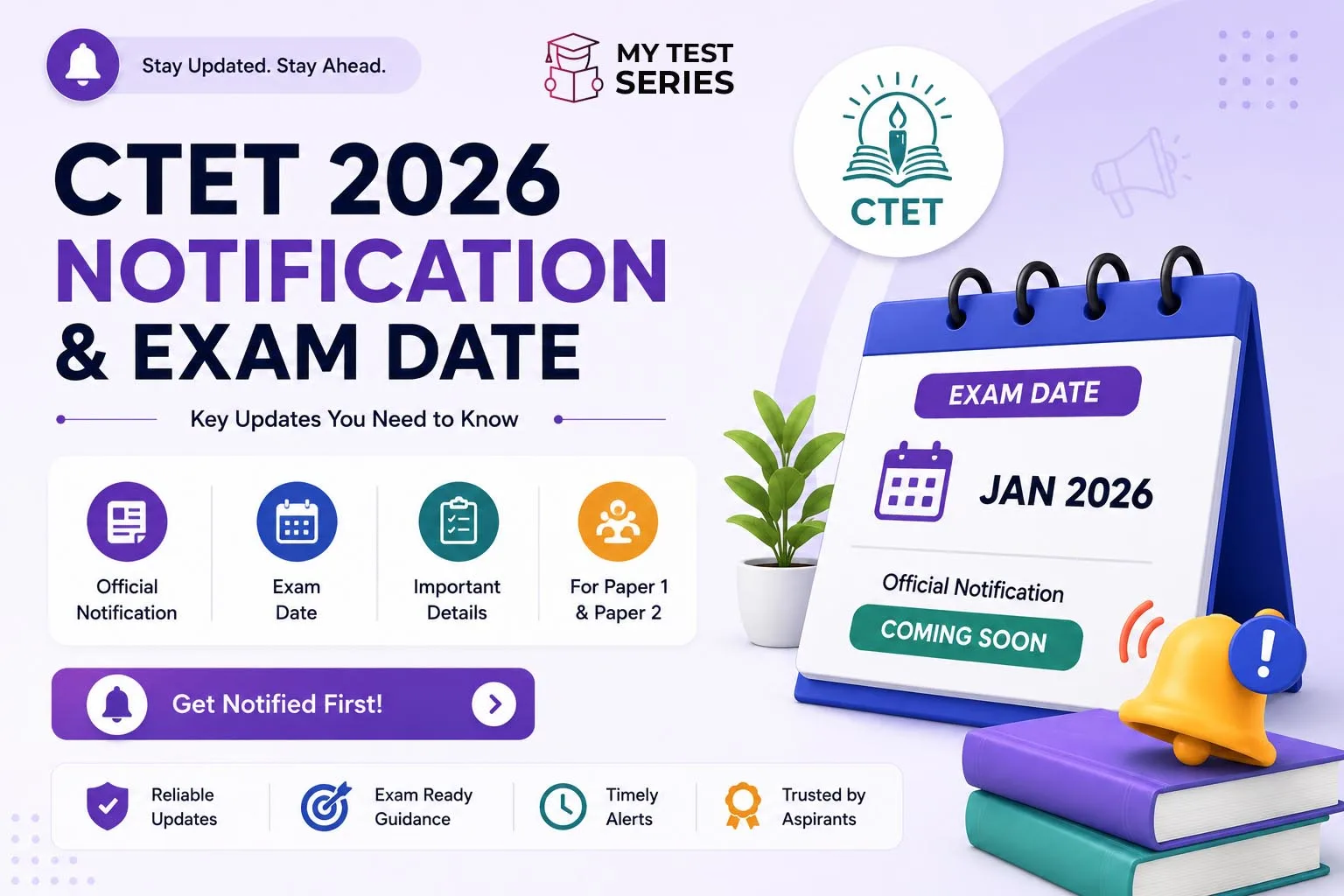
CBSE has officially released the CTET September 2026 notification. Exam scheduled for September 6, 2026. Apply online between May 11 – June 10, 2026. Here is everything you need to know.
The Central Board of Secondary Education (CBSE) officially released the CTET 2026 Notification on May 11, 2026, for the 22nd edition of the Central Teacher Eligibility Test. This year's session is designated CTET September 2026 — and the exam is confirmed for Sunday, September 6, 2026, conducted across 132 cities in India in 27 languages. If you dream of teaching in Kendriya Vidyalayas, Navodaya Vidyalayas, or any central government school, this is your gateway. Read this complete guide carefully — and do not miss the June 10, 2026 application deadline.
CTET 2026 Important Dates — Full Schedule
Below is the complete event-wise schedule for CTET September 2026. Bookmark this page, as we update dates in real time as CBSE releases them.
| Event | Date | Status |
|---|---|---|
| CTET September 2026 Notification Release | May 11, 2026 | LIVE |
| Online Application Window Opens | May 11, 2026 | OPEN |
| Last Date to Submit Application | June 10, 2026 (11:59 PM) | OPEN |
| Application Correction Window (Expected) | Mid June 2026 | SOON |
| City Intimation Slip | August 2026 (Expected) | UPCOMING |
| Admit Card Release | Late August 2026 (Expected) | UPCOMING |
| CTET Exam Date (Paper 1 & Paper 2) | September 6, 2026 (Sunday) | CONFIRMED |
| Alternate Exam Date (if needed) | September 5, 2026 (Saturday) | CONDITIONAL |
| Provisional Answer Key | September 2026 (Expected) | UPCOMING |
| Result Declaration | October 2026 (Tentative) | UPCOMING |
Start Your CTET 2026 Preparation Today
Access free mock tests, subject-wise practice, and full-length papers — all designed for CTET Paper 1 & Paper 2.
📝 Register for Free CTET Practice →What is CTET? Why It Is So Important for Teaching Aspirants
The Central Teacher Eligibility Test (CTET) is a national-level examination conducted by CBSE twice a year. It certifies that a candidate has the minimum academic and pedagogical competency required to teach students in Classes I to VIII in central government schools across India.
Clearing CTET opens the door to teaching positions in prestigious institutions like Kendriya Vidyalaya Sangathan (KVS), Navodaya Vidyalaya Samiti (NVS), Army Public Schools, and numerous state and private schools that recognise CTET as a standard benchmark.
CTET 2026 Eligibility Criteria — Paper 1 & Paper 2
Before filling out the application form, every candidate must confirm they meet the eligibility requirements. There is no age limit for CTET and there is also no restriction on the number of attempts.
📘 Paper 1 Eligibility (Classes 1–5 / Primary Level)
Candidates must satisfy any one of the following conditions:
- Senior Secondary (10+2) with minimum 50% marks + 2-year Diploma in Elementary Education (D.El.Ed)
- Senior Secondary with 45% marks + 2-year D.El.Ed (as per NCTE norms 2002)
- Senior Secondary with 50% marks + 4-year Bachelor of Elementary Education (B.El.Ed)
- Senior Secondary with 50% marks + 2-year Diploma in Special Education
- Graduation + 2-year Diploma in Elementary Education (D.El.Ed)
- Graduation with 50% marks + 1-year B.Ed (eligible if B.Ed from NCTE-recognised institution)
📗 Paper 2 Eligibility (Classes 6–8 / Upper Primary Level)
- Graduation + 2-year Diploma in Elementary Education (D.El.Ed)
- Graduation with 50% marks + 1-year B.Ed from any NCTE-recognised university
- Graduation with 45% marks + 1-year B.Ed (as per NCTE regulations 2002)
- Senior Secondary with 50% marks + 4-year B.El.Ed
- Senior Secondary with 50% marks + 4-year B.A/B.Sc.Ed or B.A.Ed/B.Sc.Ed
- Graduation with 50% marks + 1-year B.Ed (Special Education)
- Post-graduation with 55% marks + 3-year integrated B.Ed–M.Ed (new NCTE addition)
CTET 2026 Application Fee
The fee structure depends on your category and the number of papers you are appearing for. Payment is made online through debit card, credit card, UPI, or net banking.
| Category | Only Paper 1 or Paper 2 | Both Papers |
|---|---|---|
| General / OBC (NCL) | ₹1,000 | ₹1,200 |
| SC / ST / PwD | ₹500 | ₹600 |
How to Apply for CTET 2026 — Step-by-Step Guide
The application process is entirely online at ctet.nic.in. Follow these steps carefully to complete your registration without errors.
Step 1 — Visit the Official Website
Go to ctet.nic.in on your browser. Click on "Apply Online" for CTET September 2026.
Step 2 — New Registration
Click "New Registration." Enter your name, date of birth, mobile number, and email ID. Note the registration number generated.
Step 3 — Fill Application Form
Log in with your credentials. Fill in personal, educational, and communication details. Choose Paper 1, Paper 2, or both. Select your exam city preferences.
Step 4 — Upload Documents
Upload your scanned photograph (JPG, 10–100 KB) and signature (JPG, 3–30 KB). Ensure images are clear and within size limits.
Step 5 — Pay the Fee
Select your payment method (Debit/Credit Card, UPI, Net Banking). Complete payment and save the confirmation receipt.
Step 6 — Download Confirmation Page
After successful payment, download and print the confirmation page. This is your proof of application. Also register for free CTET practice at MyTestSeries.in.
While your application is in progress, start building your preparation with our free mock tests.
🚀 Register Free & Start Practicing →CTET 2026 Exam Pattern & Marking Scheme
Both papers are conducted in offline (pen-and-paper) mode. Each paper has 150 MCQ questions worth 150 marks. Duration is 2 hours 30 minutes per paper. There is no negative marking.
Paper 2 (Classes 6–8): 9:30 AM – 12:00 Noon | Paper 1 (Classes 1–5): 2:00 PM – 4:30 PM
Paper 1 — Classes I to V
Paper 2 — Classes VI to VIII
CTET 2026 Syllabus — Subject-Wise Breakdown
The CTET syllabus is strictly based on the NCERT curriculum. Below are the core topic areas for each subject in both papers.
📚 Child Development & Pedagogy (Both Papers)
- Child Development — Piaget, Vygotsky, Kohlberg theories
- Concept of Inclusive Education and understanding children with special needs
- Learning and Pedagogy — how children think and learn
- Individual differences in learning — gender, social and cultural factors
- Bloom's Taxonomy, Multiple Intelligences (Howard Gardner)
- Assessment — formative vs summative, continuous and comprehensive evaluation
🌿 Environmental Studies (Paper 1)
- Family and Friends — relationships, plants, animals, shelter, water, travel
- Food — types, sources, cooking, health, nutrition
- Things We Make and Do — conservation, environmental concerns
- EVS pedagogy — nature of EVS, aims, approaches, activities, discussion, experimentation
🔬 Mathematics & Science (Paper 2 – Math/Science)
- Mathematics: Number system, algebra, geometry, mensuration, data handling, mathematical reasoning
- Science: Food, materials, the world of the living, moving things and force, natural phenomena, natural resources
- Pedagogical issues: Nature of mathematics/science, remedial teaching, problem-solving
🌍 Social Studies / Social Sciences (Paper 2)
- History, Geography, Political Science, Economics (NCERT Chapters VI–VIII)
- Pedagogy: Developing critical thinking, source-based learning, discussion approach
🔤 English Language & Pedagogy
- Reading comprehension — two unseen passages
- Language acquisition and development theories
- Grammar — tenses, articles, clauses, subject-verb agreement
- Pedagogy — communicative approach, remedial teaching, challenges of teaching English
Qualifying Marks & CTET Certificate Validity
To receive a CTET certificate, you must score above the cut-off in your respective paper. The qualifying marks vary by category:
Out of 150 (60%)
Out of 150 (55%)
The CTET certificate and marksheet 2026 of qualified candidates will be made available on the DigiLocker platform after result declaration.
CTET 2026 Admit Card & Exam Day Tips
The CTET admit card (hall ticket) will be released on the official website ctet.nic.in approximately 2–3 weeks before the exam date. Candidates must download and print the admit card — it will not be sent by post.
📋 Documents to Carry on Exam Day
- Printed CTET admit card 2026 (black-and-white or colour)
- Valid photo ID proof — Aadhaar Card, Voter ID, PAN Card, Passport, Driving Licence
- Two recent passport-size photographs (same as uploaded in the form)
- Blue/black ballpoint pen (no gel pen allowed)
Ready to Crack CTET September 2026?
Join thousands of CTET aspirants already practicing on MyTestSeries.in. Get free full-length mock tests, subject-wise quizzes, and performance analytics.
🎯 Claim Your Free Test Series Now →CTET 2026 Preparation Strategy — Month-by-Month Plan
With the exam on September 6, 2026, and applications open until June 10, 2026, you have roughly 3–4 months of focused preparation. Here is a proven strategy that top rankers follow:
Month 1 (June) — Build Your Foundation
Complete the CTET syllabus subject-by-subject. Start with Child Development & Pedagogy as it has the highest weightage and is consistent across both papers. Read NCERT textbooks for your subject specialisation.
Month 2 (July) — Deep Dive & Notes
Cover Mathematics/EVS (Paper 1) or your chosen Paper 2 subject intensively. Make short revision notes. Solve previous year questions (PYQs) from 2019–2025 for each topic.
Month 3 (August) — Mock Tests & Analysis
Take at least 2–3 full-length mock tests per week. Analyse your performance. Identify weak areas and give them targeted revision. Practice English comprehension and Grammar daily.
Final 2 Weeks (Early September) — Revision Sprint
No new topics. Revise your short notes. Revisit PYQs. Focus on Piaget, Vygotsky, Kohlberg, Bloom's Taxonomy, and multiple intelligences — high-yield CTET topics. Sleep well the night before.
📖 Top Recommended Resources from MyTestSeries.in
Frequently Asked Questions — CTET 2026
These are the most common questions asked by CTET aspirants. Click any question to see the answer.