RRB Nursing Superintendent 2026
RRB Nursing Superintendent Syllabus 2026: Subject-Wise Topics & Weightage
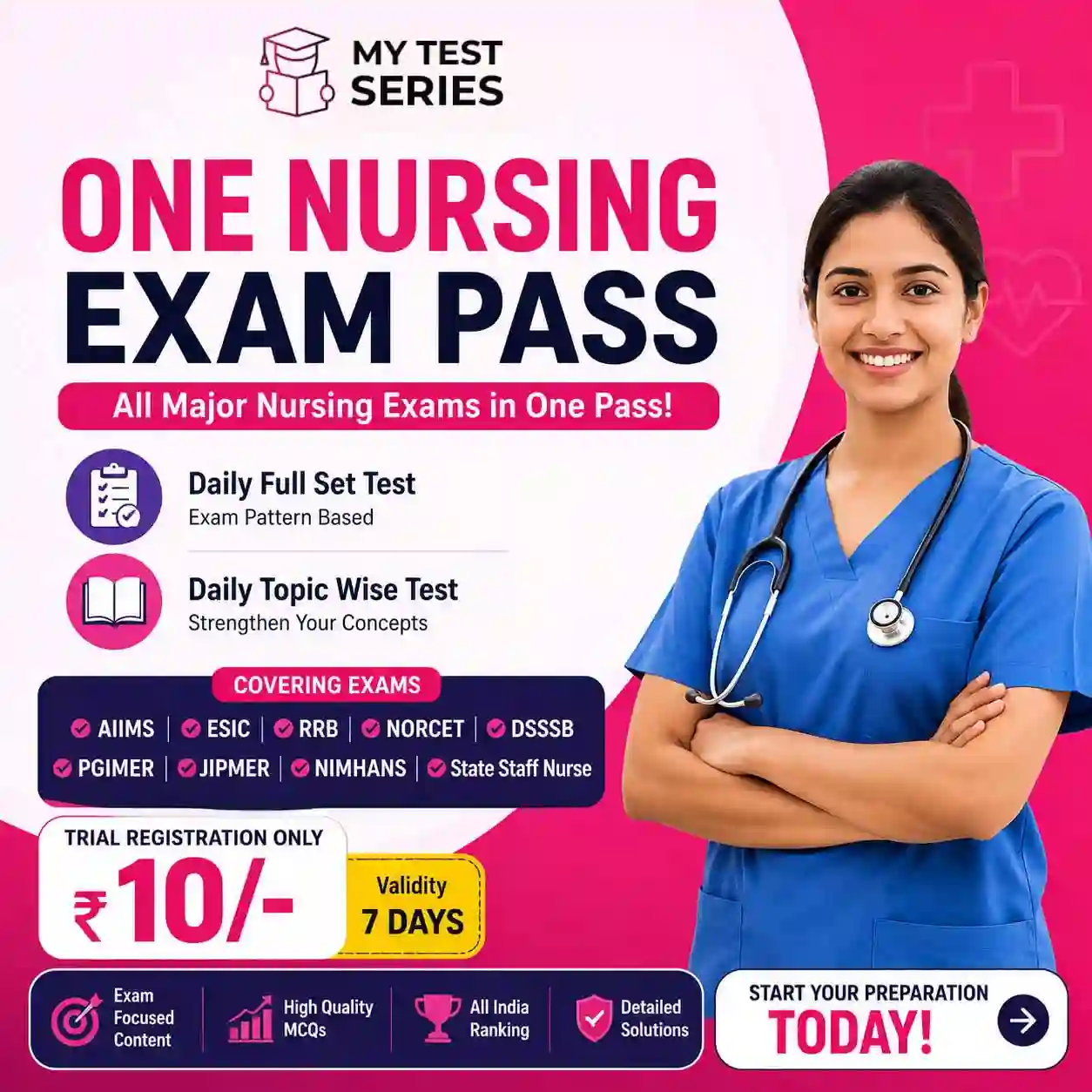
Quick answer: The RRB Nursing Superintendent CBT has 100 questions for 100 marks in 90 minutes, split 70 marks Professional Ability (nursing subjects) and 30 marks General Awareness, Arithmetic, Reasoning & General Science. Within Professional Ability, Medical-Surgical Nursing carries the highest weightage, followed by Community Health and Obstetric & Gynaecological Nursing. There's a 1/3 mark negative marking penalty for every wrong answer, and no deduction for skipped questions.
With 372 Nursing Superintendent vacancies approved — the largest paramedical category in this cycle — and the CEN expected in August–September 2026, this is the moment to lock in your syllabus preparation plan. If you haven't confirmed your candidature yet, start with our RRB Nursing Superintendent Eligibility 2026 guide before diving into the subject-wise breakdown below.
Quick Navigation
- RRB Nursing Superintendent Exam Pattern
- Subject-Wise Weightage (Professional Ability)
- Professional Ability: Full Topic List
- General Awareness, Arithmetic, Reasoning & Science
- Topics Unique to the Superintendent Post
- Qualifying Marks & Cut-Off Context
- How to Prepare by Weightage
- Mistakes to Avoid
- If You're Also Weighing NORCET or ESIC
- FAQs
- Free WhatsApp Alerts
- Related Guides
RRB Nursing Superintendent Exam Pattern
| Component | Detail |
|---|---|
| Total Questions | 100 objective-type (MCQ, single correct option) |
| Total Marks | 100 |
| Duration | 90 minutes (120 minutes for eligible PwBD candidates using a scribe) |
| Professional Ability (Nursing) | 70 questions / 70 marks |
| General Awareness + Arithmetic + Reasoning + General Science | 30 questions / 30 marks |
| Negative Marking | 1/3 mark deducted per wrong answer; no deduction for unattempted questions |
| Selection Stages | CBT → Document Verification → Medical Examination |
Pattern reflects the standard RRB Paramedical CBT structure used in recent cycles; always confirm the exact figures against the official CEN once released.
Subject-Wise Weightage (Professional Ability)
Within the 70-mark Professional Ability section, not every subject is tested equally. Based on commonly reported weightage patterns for this exam:
Bars represent relative weightage, not exact marks, since RRB doesn't publish a fixed marks-per-subject breakdown. Use this as a study-priority guide, not a scoring guarantee — always pair it with full syllabus coverage.
Professional Ability: Full Topic List
Nursing Foundations
Nursing process, vital signs, infection control, basic life support, patient positioning and mobility, documentation, first aid.
Medical-Surgical Nursing
Cardiovascular, respiratory, renal, gastrointestinal, endocrine, and neurological disorders; peri-operative care; wound care; shock and emergency nursing.
Community Health Nursing
Primary healthcare, epidemiology, national health programmes, immunisation schedules, health education, environmental sanitation.
Obstetric & Gynaecological Nursing
Antenatal, intranatal, postnatal care, high-risk pregnancy, family planning, common gynaecological conditions.
Child Health (Paediatric) Nursing
Growth and development, neonatal care, common childhood illnesses, immunisation, paediatric emergencies.
Mental Health Nursing
Common psychiatric disorders, therapeutic communication, crisis intervention.
Pharmacology
Drug classifications, dosage calculation, adverse drug reactions, safe medication administration.
Microbiology
Common pathogens, sterilisation and disinfection principles, hospital-acquired infections.
Nursing Administration
Ward management, staffing, supervision principles, hospital policies — especially relevant given this is a Superintendent-level post.
Nursing Research
Basic research process, evidence-based practice concepts, biostatistics fundamentals.
Practice the Exact 70:30 Pattern
Subject-wise nursing MCQs plus General Awareness, Arithmetic, and Reasoning practice — built around the exact RRB Nursing Superintendent CBT structure.
Start Registration →General Awareness, Arithmetic, Reasoning & General Science
The remaining 30 marks come from a mixed non-technical section — often underestimated, but a high-value, low-time-cost scoring opportunity if prepared systematically:
- General Awareness: Current affairs, static GK, Indian Railways-related awareness, general knowledge of national importance.
- General Arithmetic: Number systems, percentages, ratio and proportion, time and work, time and distance, simple and compound interest, profit and loss, mensuration.
- General Intelligence & Reasoning: Analogies, coding-decoding, series, classification, direction sense, syllogisms.
- General Science: Basic physics, chemistry, and biology at a general secondary-school level, not nursing-specific.
Because this section carries fixed, learnable question types, many candidates find it faster to secure marks here than in scenario-heavy nursing questions — don't leave it for the final week.
Topics Unique to the Superintendent Post
Unlike a general Staff Nurse-level exam, the Nursing Superintendent syllabus places specific emphasis on Nursing Administration — ward management, supervisory principles, staffing, and hospital policy awareness. This reflects the seniority of the post itself: Nursing Superintendent sits at Pay Level 7, above entry-level staff nurse roles, and RRB's question selection leans toward candidates who can demonstrate administrative and leadership-adjacent nursing knowledge, not just bedside clinical recall.
Qualifying Marks & Cut-Off Context
| Category | Minimum Qualifying Marks |
|---|---|
| UR / EWS | 40% |
| OBC (Non-Creamy Layer) | 30% |
| SC | 30% |
| ST | 25% |
| PwBD | 2-mark relaxation over applicable category minimum, where sufficient candidates are unavailable |
Qualifying marks are the minimum floor to be considered for Document Verification — they are not the actual competitive cut-off, which is decided by the number of vacancies and total candidates and typically runs well above the minimum, often in the 65–75% range for general category based on past RRB Paramedical cycles. Aim to comfortably clear the qualifying mark with margin, not just meet it.
How to Prepare by Weightage
- Start with Medical-Surgical Nursing. It carries the heaviest weightage and overlaps directly with what most GNM/BSc Nursing candidates already studied in their core curriculum.
- Layer in Community Health and Obstetric/Gynae Nursing next — both carry strong weightage and are largely fact-recall-friendly, making them efficient to revise.
- Don't skip Nursing Administration just because it feels less "clinical" — it's specifically relevant to this post's seniority level and is often under-revised by candidates focused only on bedside subjects.
- Dedicate consistent daily time to the non-technical section (GA, Arithmetic, Reasoning, Science) rather than leaving it until the final week — it's 30% of the paper and highly practice-responsive.
- Practice under 90-minute timed conditions well before your actual CBT, since 100 questions in 90 minutes leaves little room to freeze on any single question.
Mistakes to Avoid
- Treating all nursing subjects as equal-weight: Spreading revision time evenly across all ten Professional Ability topics instead of prioritising Medical-Surgical and Community Health first.
- Ignoring Nursing Administration: A common blind spot, since it doesn't appear in most other nursing government exams in the same way.
- Under-preparing the non-technical section: Assuming "I'm a nurse, GK/Reasoning isn't my strength" instead of treating it as 30 guaranteed-format marks worth practising.
- Guessing heavily under negative marking: Random attempts on low-confidence questions can pull your score down given the 1/3 mark penalty.
- Waiting for the official CEN to start studying: The core syllabus is stable across RRB Paramedical cycles — there's no need to wait for the notification to begin Medical-Surgical and Community Health revision.
If You're Also Weighing NORCET or ESIC
Many nursing aspirants prepare for RRB Nursing Superintendent alongside other central nursing exams, since the core clinical syllabus overlaps heavily. If you haven't already, check the AIIMS NORCET syllabus and exam pattern and its eligibility criteria to see how much of your RRB prep carries over directly. Our ESIC Nursing Officer vs AIIMS NORCET comparison is a useful third data point if you're weighing multiple government nursing paths at once, and Best Books for AIIMS NORCET 2026 doubles as a strong reference list for RRB's Medical-Surgical and Community Health sections too, since the underlying clinical science doesn't change between exams.
One Test Series, Every Major Nursing Exam
170+ subject-wise tests and full-length mocks covering RRB, AIIMS NORCET, and ESIC patterns — with detailed explanations for every question.
Register Now →Frequently Asked Questions
What is the RRB Nursing Superintendent syllabus 2026?
The syllabus covers Nursing Foundations, Medical-Surgical Nursing, Community Health Nursing, Obstetric & Gynaecological Nursing, Child Health Nursing, Mental Health Nursing, Pharmacology, Nursing Administration, Nursing Research, and Microbiology under Professional Ability, plus General Awareness, Arithmetic, Reasoning, and General Science.
How many questions are in the RRB Nursing Superintendent exam?
100 objective-type questions carrying 100 marks, split 70 marks Professional Ability and 30 marks General Awareness/Arithmetic/Reasoning/Science, to be completed in 90 minutes.
Which subject has the highest weightage in RRB Nursing Superintendent?
Medical-Surgical Nursing generally carries the highest weightage within Professional Ability, followed by Community Health and Obstetric & Gynaecological Nursing. Nursing Administration is a notable differentiator specific to this Superintendent-level post.
Is there negative marking in RRB Nursing Superintendent exam?
Yes. One-third (1/3) mark is deducted for every incorrect answer, with no deduction for unattempted questions.
What is the qualifying percentage for RRB Nursing Superintendent?
Commonly reported as 40% for UR/EWS, 30% for OBC/SC, and 25% for ST, with a 2-mark relaxation for PwBD candidates where needed. Actual competitive cut-offs run well above these minimums.
Join Our Free WhatsApp Community
Get instant CEN alerts, free syllabus PDFs, and daily mock test updates for RRB Nursing Superintendent and other nursing exams:
Related Guides & Test Series You Shouldn't Miss
Related Exam Products
Official sources for verification:
Syllabus, weightage, and exam pattern details in this guide are based on the pattern followed in the most recent RRB Paramedical recruitment cycles and publicly available information as of August 2026. The Railway Recruitment Board may revise specific clauses in the official CEN for the 2026 Nursing Superintendent recruitment. Always confirm the final syllabus and pattern from the official notification before finalising your preparation strategy.