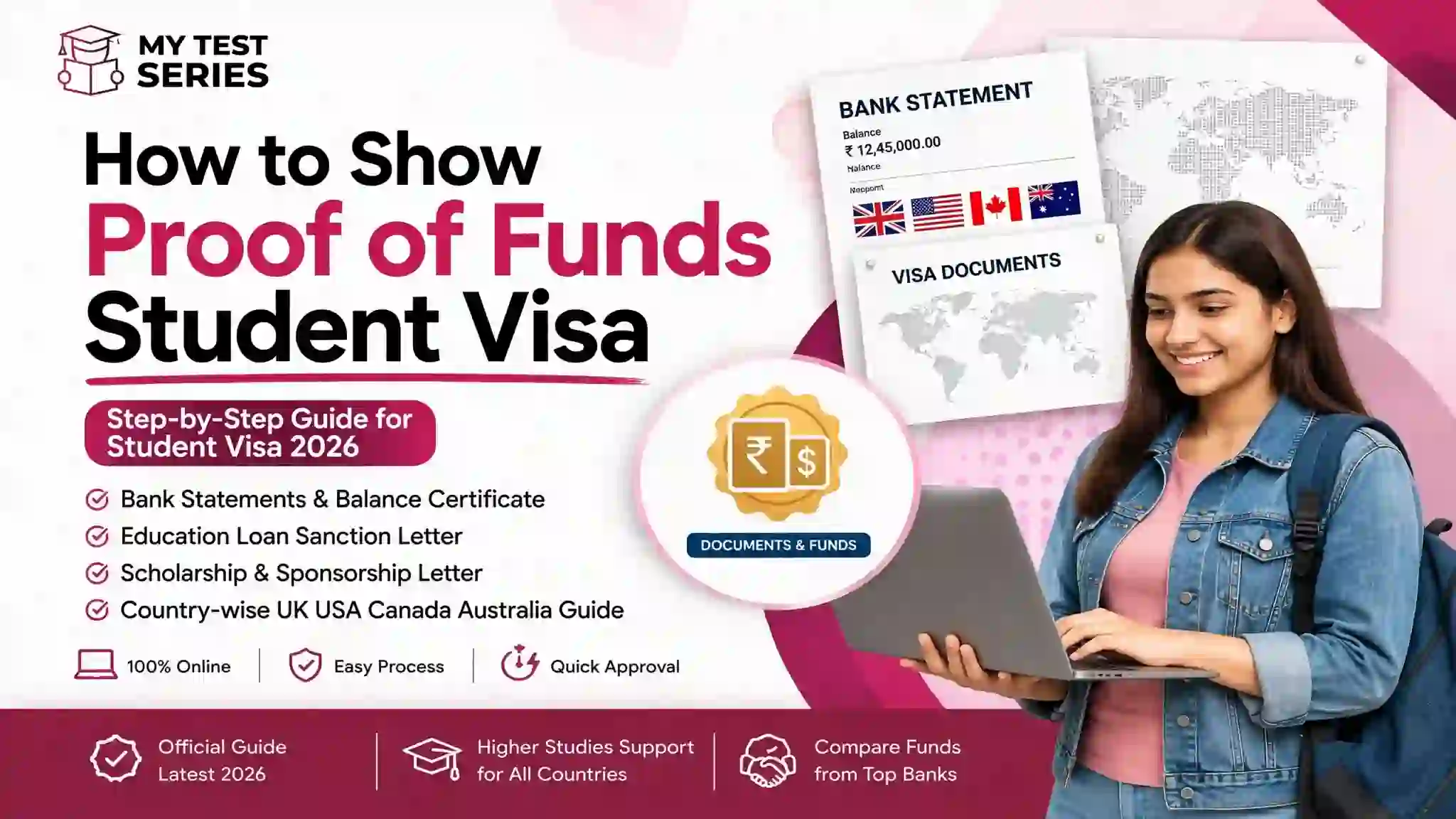
How to Show Proof of Funds (POF) for Student Visas
Planning to study abroad? Before your student visa is approved, you may need to demonstrate that you can pay your tuition fees, living expenses and other required costs. This guide explains how to prepare proof of funds using bank statements, education-loan letters, scholarships, financial sponsorship and other accepted evidence.
If you are planning your overseas education budget, start with our Student Financing Guide India . It explains how education loans, scholarships and other sources of funding can fit into a student-finance plan.
1. What Is Proof of Funds (POF)?
Proof of funds is evidence that you have enough money available to meet the financial requirements associated with your studies abroad. Immigration authorities use the evidence to assess whether you can pay the costs required under the relevant student visa or study-permit rules.
Depending on the country, you may need to show funds for some or all of the following:
- Tuition fees that remain unpaid for the required period.
- Accommodation, food and other living expenses.
- Travel to and from the destination country.
- Expenses for eligible family members travelling with you.
- Other costs specified by the relevant immigration authority.
Proof of funds is not necessarily the same as proof that you are wealthy. Applicants may be able to combine eligible savings, a qualifying education loan, scholarships and financial sponsorship, provided the relevant visa rules permit those sources and the evidence is prepared correctly.
2. How Much Money Do You Need to Show?
There is no single proof-of-funds amount that applies to every student visa. The required amount depends on your destination, course, tuition balance, location, course duration and personal circumstances. Some countries also require additional funds for dependants.
Always check the official immigration website close to your application date. Do not rely on an old blog post, social-media video or another student's previous visa application.
Start with this basic calculation
Estimated proof-of-funds requirement
Required unpaid tuition + required living expenses + applicable travel and dependant costs − funds or payments that the visa rules allow you to deduct.
Some authorities prescribe a specific living-cost amount or a defined period of financial evidence. Others assess a wider set of documents. Your personal budget should also be realistic: meeting the formal minimum does not necessarily mean that your full study budget is covered.
3. Documents You Can Use as Proof of Funds
The documents accepted depend on the destination and your individual application. Common categories include the following.
| Document | What it helps demonstrate | What to check |
|---|---|---|
| Bank statements | Available savings and account activity | Required period, account holder, balance and source of funds |
| Bank balance certificate or letter | Balance confirmed by a financial institution | Whether the authority accepts it alone or also requires statements |
| Education-loan sanction letter | Approved education financing | Eligible lender, amount, conditions and availability date |
| Scholarship letter | Confirmed education funding | Amount, duration, expenses covered and renewal conditions |
| Official sponsorship letter | Funding provided by an eligible organisation or sponsor | Required wording, amount and sponsor eligibility |
| Parent or family financial evidence | Funds available through an eligible family supporter | Relationship evidence, consent letter and account-control rules |
| Tuition payment receipt | Tuition already paid | Whether the amount paid can be deducted from the required funds |
Do not assume that every document listed above is accepted in every country. Check the official instructions for the particular visa category and your application location.
4. How to Show Bank Statements for a Student Visa
Bank statements are commonly used to show that funds are available. However, immigration authorities may set rules about the account, statement period, balance date, ownership and source of money.
Check these details before submitting
- Account holder: Make sure the account belongs to you or an eligible supporter under the applicable rules.
- Statement period: Obtain statements covering the exact period required by the destination country.
- Closing balance: Ensure the documented balance meets the applicable requirement on the relevant date.
- Currency: Check how balances in Indian rupees or another currency are converted for assessment.
- Bank details: Include the bank's name and other details required by the official checklist.
- Source of funds: Be prepared to explain significant deposits if the authority requests it.
- Access to funds: Confirm that the money meets the authority's rules for availability and control.
What if money was recently deposited?
A recent deposit is not automatically proof of wrongdoing. However, a large or unexplained deposit may lead to questions about where the money came from and whether it is genuinely available for your studies. Keep genuine supporting records, such as evidence of a fixed-deposit maturity, a documented transfer, a legitimate asset sale or other relevant source.
Never borrow money temporarily just to create a misleading bank balance, submit altered statements or hide the source of funds. Financial evidence should accurately reflect your circumstances.
5. Can an Education Loan Be Used as Proof of Funds?
An education loan may be accepted as proof of funds if it meets the destination's requirements. The authority may specify who can provide the loan, what the sanction letter must contain and when the money must be available.
A loan approval in principle, an eligibility estimate or a preliminary offer may not meet the same standard as a final sanction letter. Read the official requirements carefully before submitting your evidence.
What should a loan letter contain?
Depending on the destination's rules, a suitable letter may need to identify the student and lender, confirm the approved amount, describe the purpose of the loan and explain when and under what conditions the funds will be released.
For example, UK Student visa financial evidence rules specify conditions for an acceptable student-loan letter, including the amount, the applicant and the availability of funds. Read the current official guidance rather than assuming any bank letter will qualify.
If you are still comparing financing options, see our guide to education loans in India without collateral . It explains how collateral requirements, eligibility and loan terms can differ.
Students considering overseas financing can also read our comparison of Prodigy Finance vs MPOWER Financing . Before relying on an international lender's letter, verify that the destination's visa rules accept that type of loan and the letter meets the required conditions.
6. Using Parents' Money or a Financial Sponsor
Some student visa systems allow applicants to rely on money held by a parent, partner or other eligible supporter. Others prescribe specific sponsor categories or documentary conditions.
If you intend to use a family member's funds, check whether the authority requires some or all of the following:
- Bank statements for the required period.
- A signed letter confirming that the funds are available for your studies.
- Evidence of your relationship with the account holder.
- The sponsor's identity documents.
- Evidence of the sponsor's income or the source of funds, where requested.
- Evidence that the funds are accessible and meet the account requirements.
Do not assume that a relative's bank balance will automatically count toward your application. The rules may distinguish between money you control, money a parent holds for you and a formal sponsorship arrangement.
Scholarships and assistantships
A confirmed scholarship may reduce the amount you need to fund yourself, depending on the destination's rules. Check whether it covers tuition, living costs or both, and whether it applies for the full period required. If the award covers only part of your expenses, prepare evidence for the remaining amount.
Your funding plan may combine savings, a qualifying loan and a scholarship. For a broader overview, use our student financing guide for India .
7. Country-Wise Proof-of-Funds Requirements
The exact amount, acceptable evidence and submission procedure differ across destinations. Use the official links below to check the latest requirements for your application.
United Kingdom (UK)
UK Student visa applicants generally need to demonstrate funds for unpaid course fees and required living costs, unless a specific exemption applies. The rules can include requirements about how long money must be held and how recent the financial evidence must be. The amount also depends on the study location and your circumstances.
Check the official UK Student visa: Money you need guidance. Follow the current rules for the date you apply.
United States (US)
For an F-1 student visa, applicants should be prepared to demonstrate that they can meet the financial costs of their studies. The university may request financial documents before issuing the relevant immigration paperwork, and applicants should follow the institution's instructions as well as the official visa process.
Check the US Department of State's Student Visa information and the instructions provided by your university. Do not assume that a single bank statement format or amount applies to every applicant.
Canada
Canadian study-permit applicants must demonstrate that they have sufficient financial resources for the costs required by the rules, including tuition, living expenses and transportation. Applicants may need to show funds for the first year and explain how they plan to finance the remaining duration of a longer programme.
Review the official Government of Canada guidance on proof of financial support for a study permit . Check the current living-cost requirement for your application date, family size and destination within Canada.
Australia
Australia's student visa financial-capacity requirements can depend on the applicable rules and evidence framework. Applicants may need to demonstrate access to funds for travel, tuition, living costs and accompanying family members, where applicable.
Use the Australian Department of Home Affairs' Education Program Evidence Framework and the current Student visa application guidance to determine which evidence applies to your circumstances.
8. How to Calculate Your Funding Gap
Before preparing documents, calculate the money you need and identify the funding sources that can be counted under the relevant rules. This can help you avoid a shortfall close to your application date.
Illustrative example
Imagine a student has the following estimated first-year costs:
| Expense or funding source | Illustrative amount |
|---|---|
| Tuition remaining to be paid | ₹18,00,000 |
| Living and other eligible expenses | ₹12,00,000 |
| Estimated total costs | ₹30,00,000 |
| Confirmed scholarship | −₹5,00,000 |
| Potential remaining funding gap | ₹25,00,000 |
In this example, the student has a potential funding gap of ₹25 lakh. This is a personal planning illustration, not a statement of any country's official visa threshold. The actual amount that must be demonstrated depends on the destination's rules and which funds or payments can be counted.
If you plan to use an education loan, make sure the loan amount and release schedule match the costs you need to cover. A loan that is approved but not available when required may not solve an immediate proof-of-funds problem.
9. Common Proof-of-Funds Mistakes to Avoid
1. Using outdated financial thresholds
Visa requirements and living-cost figures can change. Check the official government page for your application date rather than using old figures copied from a third-party article.
2. Submitting a loan letter with conditions that do not qualify
Some rules specify how a student loan must be structured and when the funds must become available. Confirm that your letter meets the exact requirements before submission.
3. Ignoring the required holding period
Where the rules require funds to be held for a specified period, a statement showing a sufficient balance on only one day may not be enough. Follow the exact rules for the destination and visa category.
4. Failing to explain the source of a large deposit
Keep genuine evidence of significant transfers or deposits. An unexplained transaction can create questions even when the money is legitimately yours.
5. Forgetting living expenses and dependants
Tuition may not be your only required cost. Check living expenses, travel and any additional amounts required for family members.
6. Assuming a scholarship covers every expense
Read the award letter. If the scholarship pays only tuition, you may still need evidence for accommodation, food, travel and other costs.
7. Submitting inconsistent documents
Names, dates, balances, course details and funding amounts should be consistent across the application. If there is a legitimate difference, prepare an explanation and supporting records.
8. Relying on false or altered documents
Never modify a bank statement, fabricate a sponsorship letter or misrepresent a loan. False information can lead to refusal and may have additional immigration consequences.
10. Education Loans and Related Funding Guides
Proof of funds and education financing are closely connected, but they are not the same thing. A loan helps fund your education; the visa authority determines whether the loan and its supporting documents satisfy the applicable financial-evidence rules.
These related MyTestSeries guides can help you understand different financing options:
- Student Financing Guide India — an overview of loans, scholarships and education funding.
- Education Loans in India Without Collateral — compare collateral-free financing options and eligibility.
- SBI Student Loan vs SBI Scholar Loan — understand differences between two bank loan products.
- How to Apply Through the Vidya Lakshmi Portal — learn about the Indian education-loan application process.
- Education Loans for Medical and Nursing Students — explore financing considerations for healthcare courses.
- Central Sector Interest Subsidy (CSIS) Guide — learn about scheme eligibility and interest subsidy conditions.
- Prodigy Finance vs MPOWER Financing — compare two international student-loan providers.
11. Final Proof-of-Funds Checklist
Use this checklist before uploading your documents or attending a visa appointment.
- ☐ I checked the latest official financial requirements for my destination.
- ☐ I calculated tuition, living costs and other applicable expenses.
- ☐ My evidence covers the required amount and period.
- ☐ My bank statements and account details are clear and authentic.
- ☐ I can explain the source of significant deposits if asked.
- ☐ My education-loan letter meets the applicable requirements.
- ☐ My scholarship or sponsorship evidence states the relevant amount and duration.
- ☐ I included relationship or consent documents where required.
- ☐ My documents are consistent with my passport, admission and visa application.
- ☐ I have checked whether translations or certified documents are needed.
- ☐ I retained copies of everything submitted.
Frequently Asked Questions
1. What is proof of funds for a student visa?
Proof of funds is documentary evidence that you can meet the financial requirements for studying in another country. Depending on the rules, it may include bank statements, an eligible education-loan letter, scholarship evidence or an approved sponsorship arrangement.
2. How much bank balance is required for a student visa?
There is no universal balance. The requirement depends on the destination, tuition fees, living-cost rules, course details and personal circumstances. Always check the official immigration website for your application date.
3. Can I use an education loan as proof of funds?
An education loan may qualify if it meets the destination's rules. The authority may specify the eligible lender, required information in the loan letter and when the funds must be available. A preliminary offer may not be sufficient.
4. Can I show my parents' bank statement?
Some visa systems permit eligible parental funds, subject to requirements such as a consent letter, proof of relationship and evidence of available funds. Check the exact rules for your destination.
5. How many months of bank statements are required?
The required period differs by country and visa category. Some destinations prescribe a specific holding period or statement date. Do not assume that the same number of months applies everywhere.
6. Can a scholarship be used as proof of funds?
A confirmed scholarship may count if it meets the applicable rules. Check the amount, duration and expenses covered. You may need additional evidence for any costs the scholarship does not cover.
7. Can I use a fixed deposit as proof of funds?
This depends on the destination's rules and the conditions of the deposit. Check whether the authority accepts the relevant fixed deposit certificate and whether the funds must be immediately accessible or held in a particular type of account.
8. Does proof of funds guarantee a student visa?
No. Proof of funds is one part of the application. The immigration authority assesses the complete application and may consider other eligibility requirements and supporting documents.
9. Can I combine savings, a loan and a scholarship?
Some visa systems allow applicants to demonstrate funds from multiple eligible sources. You must ensure that each source meets the rules and that the combined evidence covers the required amount.
10. What happens if my proof of funds is insufficient?
Insufficient or unacceptable evidence can lead to additional requests or refusal, depending on the rules and circumstances. Check the requirements carefully before applying, and do not submit misleading documents to fill a shortfall.
Conclusion
Preparing proof of funds is an important part of planning your studies abroad. Start by checking the latest official visa requirements, calculating your financial needs and choosing documents that show the funds are genuine and available under the applicable rules.
If you need an education loan, compare the final loan terms and verify that the lender's documentation can meet your destination's financial evidence requirements. Keep your records organised, explain funding sources clearly and allow enough time to obtain official documents.
For more help planning your finances, return to our Student Financing Guide India and explore the related education-loan guides linked above.
Disclaimer: This article is for educational and informational purposes only. It is not legal, financial, tax or immigration advice. Visa requirements, financial thresholds and accepted documents can change. Verify the current rules with the relevant government authority and, where necessary, a qualified immigration professional.