Central Sector Interest Subsidy Scheme (CSIS): Eligibility, Benefits and Application Guide
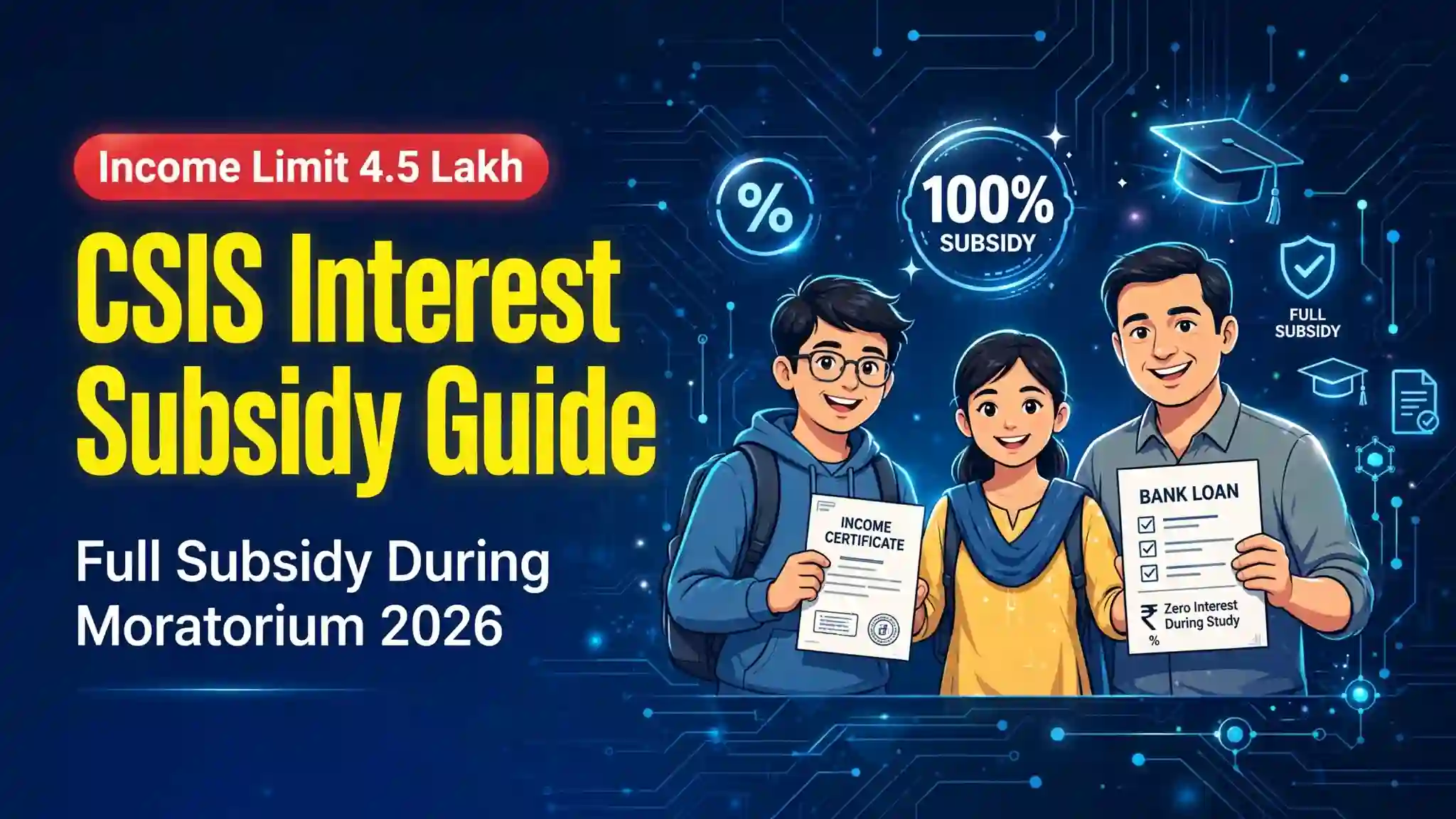
Education loan interest can add a substantial cost to higher education. For eligible students from economically weaker families, the Central Sector Interest Subsidy Scheme (CSIS) can help by covering eligible education-loan interest during the moratorium period.
This guide explains the CSIS scheme in simple English, including the family-income limit, eligible courses and institutions, interest subsidy, required documents, application steps and important differences between CSIS and PM-Vidyalaxmi.
Last reviewed: 28 September 2026 · Always verify current rules with official scheme authorities and your lending bank.
The Central Sector Interest Subsidy Scheme, also known as PM-USP CSIS, provides a full interest subsidy during the eligible moratorium period on qualifying education loans for eligible students pursuing professional or technical higher education in India. The scheme generally requires annual parental/family income of up to ₹4.5 lakh, an eligible course and institution, and a qualifying education loan under the Indian Banks' Association (IBA) Model Education Loan Scheme. The bank and scheme authorities must verify eligibility.
For a broader overview of education loans, scholarships and other ways to fund higher education, start with our Student Financing Guide India.
1. What Is the Central Sector Interest Subsidy Scheme?
The Central Sector Interest Subsidy Scheme is a Government of India initiative under the Pradhan Mantri Uchchatar Shiksha Protsahan (PM-USP) Yojana. It aims to make eligible professional and technical higher education more accessible to students from economically weaker families.
Under CSIS, the government provides an interest subsidy on a qualifying education loan during the eligible moratorium period. This means the scheme can cover the eligible interest during that period, subject to the rules. The student remains responsible for repaying the loan principal and the interest that falls outside the subsidy period.
CSIS is not a scholarship paid directly to a student for everyday expenses. It is an interest-support scheme linked to an eligible education loan. Students must satisfy the scheme's requirements, and the loan must meet the applicable lending and scheme conditions.
Who is it designed for?
Eligible students from families with annual parental/family income up to ₹4.5 lakh pursuing qualifying professional or technical higher education in India.
What does it cover?
Eligible interest during the moratorium period, subject to the scheme rules and the loan being covered under the applicable framework.
Is it a loan waiver?
No. CSIS provides interest support during a specified period. It does not cancel the loan principal.
Is approval automatic?
No. Income, course, institution, loan and documentation conditions must be verified.
For the official scheme details, read the Ministry of Education's CSIS course-eligibility notice and the current PM-USP CSIS scheme guidelines.
2. CSIS Scheme Benefits: What Does the Interest Subsidy Cover?
The main benefit of CSIS is interest support during the eligible moratorium period. For a student who qualifies, this can reduce the interest burden that would otherwise accumulate while they are studying and during the applicable post-course moratorium period.
Key benefits
- Full eligible interest subsidy: The scheme provides 100% subsidy on eligible interest during the moratorium period, subject to its conditions.
- Support during higher education: It is intended for eligible professional and technical courses in India.
- Income-based assistance: The general parental/family income ceiling is ₹4.5 lakh per year.
- Reduced early repayment burden: Eligible interest support can reduce the cost of borrowing during the covered period.
- Works with a qualifying education loan: The loan must meet the applicable IBA Model Education Loan Scheme and CSIS conditions.
What is the moratorium period?
The moratorium period is the period in which regular repayment of the loan principal is deferred under the loan terms. Under CSIS, the covered period is generally the course duration plus one year, subject to the applicable scheme and loan rules.
The exact repayment schedule should be confirmed in the sanction letter. Ask your bank how it records the subsidy, when repayment starts, and how interest is calculated after the moratorium.
3. CSIS Eligibility Criteria and Family-Income Limit
Students should check every eligibility condition before assuming that they will receive the subsidy. Meeting the income limit alone is not enough.
| Eligibility factor | General CSIS requirement | What to verify |
|---|---|---|
| Family income | Annual gross parental/family income up to ₹4.5 lakh | Accepted income certificate and the relevant assessment period |
| Course | Eligible professional or technical course in India | Current course list and applicable course rules |
| Institution | Institution/programme must meet the scheme's recognition or accreditation requirements | NAAC/NBA accreditation, institution status or approval by the relevant regulator, as applicable |
| Education loan | Qualifying loan under the applicable IBA Model Education Loan Scheme | Loan sanction, lender participation and scheme compliance |
| Place of study | Eligible professional or technical higher education in India | Whether the course and institution fall within the scheme's scope |
| Previous subsidy | Scheme restrictions apply to the level of study and prior benefit | Whether CSIS has already been used for an earlier eligible course |
The Ministry of Education's notice dated 25 February 2026 refers to the ₹4.5 lakh income ceiling and lists professional/technical courses at qualifying institutions. Always check the current notice and detailed guidelines for your course and institution before applying.
How is family income verified?
The bank or implementing authority may require an income certificate or other accepted supporting documents. The exact format and issuing authority can depend on the applicable instructions. Obtain the correct certificate before submitting the application and ensure that the income details match the supporting records.
Can students from any state apply?
CSIS is a central government scheme, but the student must still meet the scheme's course, institution, income and loan conditions. Students should check the accepted income-document process with their bank and the relevant authority in their state.
4. Which Courses and Institutions May Be Eligible?
CSIS is intended for eligible professional and technical higher education in India. Eligibility depends on the course and institution meeting the applicable requirements. Do not assume that every degree, college or training programme qualifies.
Depending on the current scheme rules and eligible-course list, professional or technical programmes may include areas such as engineering, medicine, nursing, pharmacy and other recognised professional or technical disciplines. This is an illustrative list, not confirmation that every course or institution in these fields qualifies.
Institution requirements matter
The official scheme notice identifies qualifying institutions or programmes through criteria that can include:
- NAAC-accredited institutions.
- Professional or technical programmes accredited by NBA.
- Institutions of National Importance.
- Centrally Funded Technical Institutions.
- Institutions or programmes outside the NAAC/NBA framework that have approval from the relevant regulatory body, where the scheme allows it.
Use the official CSIS eligible-course notice and ask your lending bank to confirm whether your specific institution and programme qualify.
What about MBBS, BDS and nursing students?
Students pursuing MBBS, BDS, nursing or another healthcare programme should verify the precise course and institution requirements. A course being professionally oriented does not, by itself, guarantee CSIS eligibility.
For a course-specific overview, read our guide to education loan schemes for medical and nursing students.
5. CSIS vs PM-Vidyalaxmi: What Is the Difference?
CSIS and PM-Vidyalaxmi are distinct schemes. They have different eligibility criteria and different forms of interest support. Students should check which scheme applies to their circumstances rather than assuming that the benefits are interchangeable.
| Feature | CSIS | PM-Vidyalaxmi |
|---|---|---|
| Main purpose | Interest subsidy for eligible students from economically weaker families pursuing qualifying professional/technical courses in India | Education-loan access for eligible students admitted on merit to designated Quality Higher Educational Institutions (QHEIs) |
| General income condition | Annual parental/family income up to ₹4.5 lakh | Different income conditions apply to the scheme's interest-subvention benefits |
| Interest support | 100% eligible interest subsidy during the moratorium period, subject to rules | Eligible students may qualify for 3% interest subvention on eligible loans up to ₹10 lakh under the scheme's conditions |
| Institution condition | Eligible professional/technical course and qualifying institution or programme | Admission to a designated QHEI and satisfaction of scheme conditions |
| Collateral and guarantee | Depends on the applicable loan framework and amount; eligible loans up to ₹7.5 lakh may receive CGFSEL guarantee coverage | Eligible scheme loans are collateral-free and guarantor-free under the applicable conditions |
| Principal repayment | The student remains responsible for repaying the principal | The student remains responsible for repaying the principal |
For application steps, read our detailed guide: How to Apply on the Vidya Lakshmi Portal.
Check the official scheme rules
Before applying, confirm the latest eligibility conditions and the process that applies to your education loan.
Visit PM-Vidyalaxmi Portal6. Documents Required for CSIS
The exact document list may vary by bank and application. Prepare the following commonly requested records, then follow the bank's current checklist.
- Education loan application and sanction details.
- Student identity and address proof.
- Admission letter and course details.
- Academic mark sheets and qualifying examination records.
- Official college fee structure and course duration.
- Family-income certificate in the accepted format.
- Parent or guardian identity and financial documents, where requested.
- Institution/course recognition or accreditation details, if requested.
- Bank account information and other forms required by the lender.
- CSIS declaration, application or subsidy-related forms required by the bank.
7. How to Apply for the CSIS Interest Subsidy
CSIS is linked to an eligible education loan. Start by discussing the scheme with the bank handling your education loan and confirm the current application procedure. Do not assume that simply taking an education loan automatically enrols you in CSIS.
- Confirm your course and institution. Check the latest eligible-course notice and institutional requirements.
- Check the family-income condition. Confirm that your annual parental/family income meets the applicable ceiling and obtain accepted proof.
- Apply for an eligible education loan. Discuss the IBA Model Education Loan Scheme and applicable CSIS requirements with a participating bank.
- Tell the bank you want to be considered for CSIS. Ask which forms, declarations and supporting documents are required.
- Submit the required documents. Ensure your income certificate, admission details and loan records are accurate and consistent.
- Ask how the subsidy is processed. Confirm how the bank verifies eligibility and handles the subsidy claim under the current procedure.
- Keep the acknowledgement. Save the application reference, receipts and any communication from the bank.
- Monitor the status. Follow up with the bank if you do not receive an update or if additional documents are requested.
- Review the loan statement. Ask the bank how the subsidy is reflected in the loan account and verify the balance and repayment schedule.
For a broader understanding of loan applications and lender selection, read our guide to education loans without collateral.
Students applying through the PM-Vidyalaxmi portal should also review our step-by-step guide: Vidya Lakshmi Portal application instructions.
8. How Much Can CSIS Save You?
The subsidy depends on the eligible interest charged on the loan during the covered moratorium period. The exact benefit depends on the loan amount, interest rate, disbursement schedule, course duration, repayment terms and the interest eligible under the scheme.
Illustrative example
Suppose a student has a qualifying education loan and the eligible interest accruing during the covered moratorium period totals ₹1,20,000. If the student qualifies for the full CSIS subsidy on that eligible interest, the subsidy could cover that ₹1,20,000.
This example is only for explaining the concept. It is not a guaranteed subsidy amount or a bank quotation. Actual eligible interest and subsidy depend on the sanctioned loan, disbursements, scheme conditions and the implementing bank's calculation.
What CSIS does not necessarily cover
- The principal amount borrowed.
- Interest outside the eligible moratorium period.
- Charges or expenses that are not covered by the scheme.
- Loans, courses or institutions that do not meet the applicable conditions.
Ask the bank for a written explanation of the amount eligible for subsidy, how the subsidy will be credited and what repayment obligation remains after the moratorium.
9. CSIS and Collateral-Free Education Loans
CSIS and collateral-free lending address different issues. CSIS provides eligible interest support during the moratorium period. Collateral rules concern whether an asset must be pledged as security for a loan.
Under the standard Credit Guarantee Fund Scheme for Education Loans (CGFSEL) framework, eligible education loans up to ₹7.5 lakh may receive credit-guarantee coverage, subject to applicable conditions. This can support collateral-free lending. It does not mean every loan above or below that amount automatically qualifies.
Read our detailed article on education loans in India without collateral to understand the difference between collateral, a co-borrower and a third-party guarantee.
10. CSIS vs SBI Education Loan Options
CSIS is a government interest-subsidy scheme, not a bank loan product by itself. Students should compare the terms of their underlying education loan separately, including the interest rate, margin, collateral requirements, moratorium and repayment period.
If you are considering State Bank of India, read our comparison of the SBI Student Loan and SBI Scholar Loan. Confirm current rates and conditions directly with SBI, as lending terms can change.
11. Common CSIS Application Mistakes
- Assuming income alone guarantees eligibility: Course, institution, loan and other conditions also matter.
- Using an unsuitable income certificate: Confirm the required format and issuing authority with the bank.
- Assuming every professional course qualifies: Check the current official eligible-course notice.
- Not asking the bank about CSIS: Confirm the current application and subsidy-claim process.
- Confusing interest subsidy with loan waiver: The principal remains repayable.
- Assuming the subsidy covers all loan interest: CSIS applies to eligible interest during the covered period, not necessarily the entire loan term.
- Ignoring the sanction letter: Read the loan terms and repayment schedule carefully.
- Paying unofficial agents: Contact the bank through its official channels instead of paying someone who promises guaranteed subsidy approval.
12. Practical Checklist Before You Apply
- My course and institution meet the applicable eligibility requirements.
- My annual parental/family income meets the scheme's income condition.
- I have checked the latest CSIS guidelines and eligible-course notice.
- My education loan meets the applicable lending framework.
- I have asked the bank about the CSIS application and claim process.
- I have prepared the accepted income certificate and other documents.
- I understand the moratorium period and the interest covered by CSIS.
- I understand that the loan principal must still be repaid.
- I have saved the application acknowledgement and loan records.
Frequently Asked Questions About CSIS
1. What is the full form of CSIS?
CSIS stands for Central Sector Interest Subsidy Scheme. It is implemented under the PM-USP Yojana and provides eligible interest subsidy on qualifying education loans during the moratorium period.
2. What is the CSIS income limit?
The general annual gross parental/family income ceiling is ₹4.5 lakh. Applicants must also meet the course, institution, loan and other scheme requirements.
3. How much interest subsidy does CSIS provide?
CSIS provides 100% subsidy on eligible education-loan interest during the covered moratorium period, subject to scheme conditions. It does not waive the loan principal or necessarily cover interest for the entire repayment term.
4. What is the CSIS moratorium period?
The covered moratorium period is generally the course duration plus one year, subject to the applicable scheme and loan terms. Confirm the period and repayment start date with the lending bank.
5. Can MBBS and nursing students apply for CSIS?
Students in medicine, nursing and other professional or technical fields should check whether their exact course and institution meet the current CSIS eligibility requirements. The course name alone does not guarantee eligibility.
6. Does CSIS cover education loans for studying abroad?
CSIS is intended for qualifying professional or technical higher education in India. It should not be assumed to cover an overseas education loan.
7. Is CSIS the same as PM-Vidyalaxmi?
No. They are separate schemes with different eligibility criteria and interest-support arrangements. Check each scheme's current rules to determine which may apply to you.
8. Does CSIS waive the education loan?
No. CSIS provides eligible interest subsidy during the covered moratorium period. The student remains responsible for repaying the principal and any amounts not covered by the subsidy.
9. Where can I find the official CSIS eligible-course list?
Check the Ministry of Education's official CSIS eligible-course notice and confirm your course with the lending bank.
10. Will every eligible student automatically receive the subsidy?
No. Students must satisfy the scheme conditions and complete the required process. The bank and implementing authorities verify the application and eligibility.
Official Resources and Further Reading
Use official sources to confirm the latest requirements before submitting an application.
- Ministry of Education: CSIS eligible-course notice — course and institutional eligibility information.
- PM-USP CSIS scheme guidelines — detailed scheme framework.
- Official PM-Vidyalaxmi portal — education-loan application and scheme information.
- Ministry of Education — official higher-education scheme notices and updates.
Final Takeaway
The Central Sector Interest Subsidy Scheme can reduce the cost of an eligible education loan for students from families with annual income up to ₹4.5 lakh. The key is to confirm the course and institution requirements, use a qualifying education loan, submit the correct documents and follow the bank's current subsidy process.
Before borrowing, compare the loan's interest rate, repayment schedule and security requirements. For your wider funding plan, visit our Student Financing Guide India and explore the related education-loan resources linked throughout this article.
Disclaimer: This article is for general educational information and is not financial, legal or lending advice. Scheme guidelines, eligible-course lists and bank procedures may change. Eligibility and subsidy are subject to the current official rules and verification by the bank or implementing authority. Always consult official sources before making a financial decision.