Section 80E Tax Deduction on Education Loan Interest
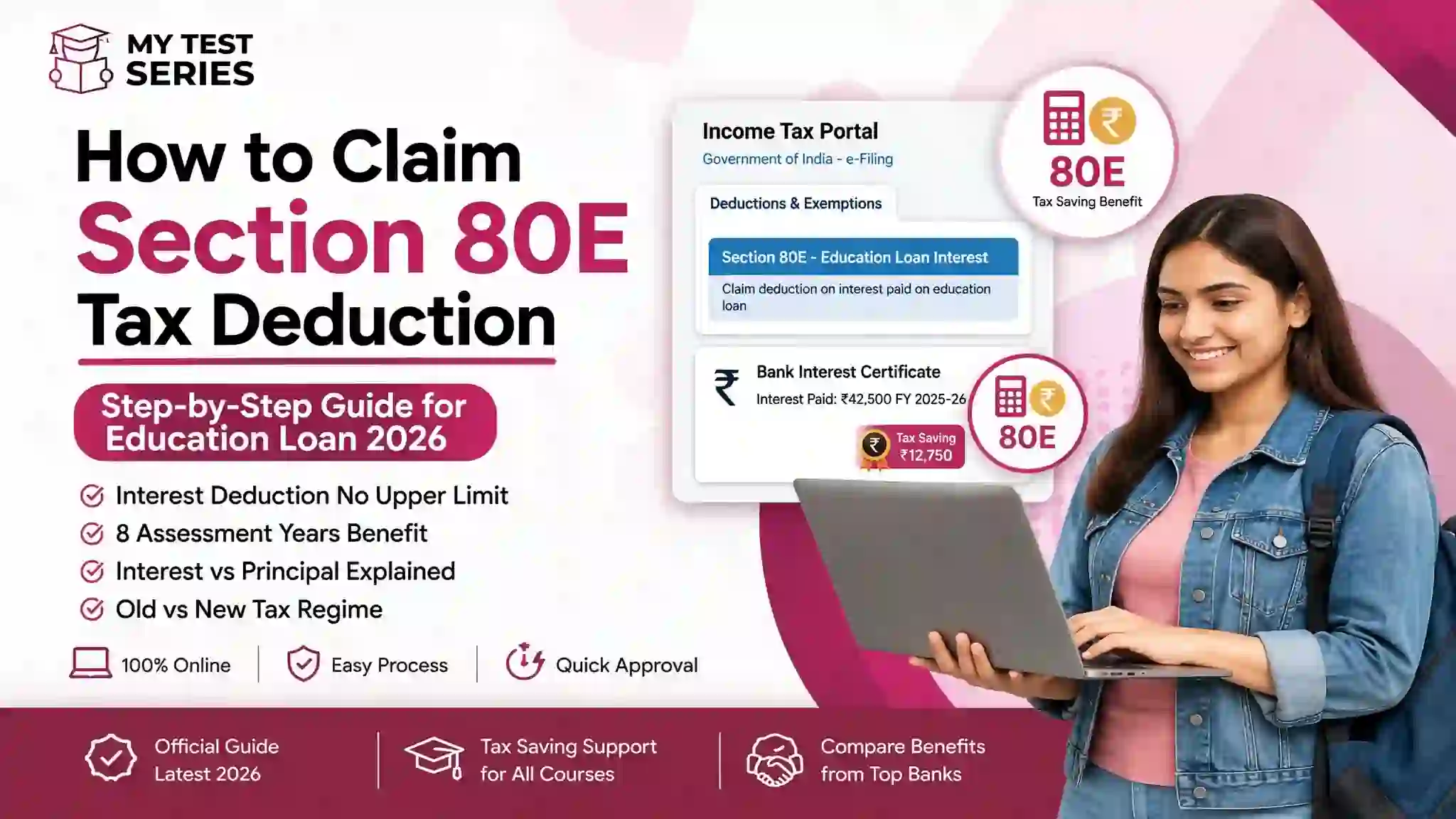
Paying interest on an education loan? Section 80E of the Income-tax Act, 1961 provides an interest deduction for eligible individual taxpayers who meet the prescribed conditions. Learn who can claim it, which loans qualify, how long the deduction lasts, which documents to keep and why your chosen tax regime matters.
Education-loan interest can be a significant expense after graduation. Understanding the tax treatment may help you plan your repayments. For a broader overview of funding choices, start with our Student Financing Guide India .
1. What Is Section 80E?
Section 80E is a provision of the Income-tax Act, 1961 dealing with interest paid on qualifying loans taken for higher education. It is intended to provide tax relief to eligible individual taxpayers who pay interest on an education loan that meets the section's conditions.
The deduction is based on eligible interest paid during the relevant previous year. It is not a flat deduction available to every borrower, and it does not automatically apply to every loan marketed as an education loan.
The provision covers higher education undertaken by the taxpayer or a qualifying relative. Under the familiar Section 80E wording, a qualifying relative includes the taxpayer's spouse, children, or a student for whom the taxpayer is the legal guardian.
For the legal text and conditions, consult the official Income Tax Department page for Section 80E .
2. Who Can Claim the Section 80E Deduction?
The deduction is available to an eligible individual taxpayer who satisfies the conditions in the applicable law. Before claiming it, review the following points.
Eligible taxpayer
Section 80E is framed for an individual. A Hindu Undivided Family (HUF), company or other entity cannot claim the deduction merely because it pays education-loan interest.
Eligible student
The loan must relate to higher education of the taxpayer or a qualifying relative as defined under the applicable provision. The person who claims the deduction must satisfy the legal and payment conditions.
Eligible course
The 1961 Act's Section 80E explanation defines higher education broadly by reference to a course pursued after passing the Senior Secondary Examination or its equivalent from a recognised school, board, university or other authorised institution. The exact legal wording and applicable year should be checked before claiming.
Eligible interest payment
The deduction concerns interest paid from income chargeable to tax during the relevant previous year. Repayment of the principal amount is not deductible under Section 80E.
3. Which Education Loans Qualify?
Under Section 80E of the 1961 Act, the loan must be taken from a qualifying financial institution or an approved charitable institution for higher education. A personal loan from a friend or an informal borrowing arrangement does not automatically qualify simply because the money was used to pay tuition fees.
Before claiming the deduction, ask your lender to confirm the nature of the loan and obtain a year-wise interest certificate.
Check the lender and loan purpose
- Confirm the institution meets the applicable legal definition.
- Keep the sanction letter and loan agreement.
- Confirm that the loan was taken for the qualifying higher-education purpose.
- Obtain a statement separating principal and interest paid.
- Check whether the deduction is available under your tax regime.
If you are still comparing loans, read our guide to education loans in India without collateral . The article explains why lender eligibility, loan terms and security requirements matter when selecting a loan.
You can also review our comparison of SBI Student Loan vs SBI Scholar Loan to understand the differences between two education-finance products. Tax eligibility should still be confirmed separately for the loan you actually take.
4. Does Section 80E Cover Interest or Principal?
Section 80E concerns eligible interest paid on the education loan. It does not provide a deduction for repayment of the principal. This distinction is important because a monthly loan instalment may contain both principal and interest.
| Payment component | Section 80E treatment under the 1961 Act |
|---|---|
| Eligible interest actually paid | May qualify, subject to the section's conditions and applicable tax regime |
| Principal repayment | Not deductible under Section 80E |
| Late payment charge or penalty | Do not treat as deductible interest without confirming its legal treatment |
| Interest not yet paid | Section 80E refers to interest paid; check the applicable law and lender records |
Illustrative example
Suppose an eligible taxpayer pays ₹1,20,000 in total loan instalments during a financial year. The lender's certificate shows that ₹85,000 was interest and ₹35,000 was principal.
If all the Section 80E conditions are met and the taxpayer is using a tax regime in which the deduction is available, the potentially deductible amount would be ₹85,000, not the full ₹1,20,000.
This is a simplified illustration, not tax advice or a statement that every taxpayer can claim the amount. The deduction depends on the actual interest paid, the relevant year and the applicable eligibility rules.
5. What Is the Eight-Assessment-Year Limit?
Section 80E of the Income-tax Act, 1961 allows the deduction for the initial assessment year and the seven assessment years immediately succeeding it, or until the interest is paid in full, whichever happens earlier.
The initial assessment year is generally the assessment year relevant to the previous year in which the taxpayer begins paying interest on the qualifying loan. This is not necessarily the year the loan was sanctioned or the year the student first enrolled.
Example of the time limit
Suppose the first qualifying interest payment is made in financial year 2025–26, corresponding to assessment year 2026–27 under the usual assessment-year system for the 1961 Act. The eight-assessment-year window would begin with AY 2026–27 and continue through AY 2033–34, subject to the applicable law and the earlier completion of interest repayment.
If the qualifying interest is fully paid before the eight-year period ends, the deduction does not continue beyond the year in which the interest has been paid in full.
6. Section 80E: Old Tax Regime vs New Tax Regime
The tax regime you use can determine whether you can claim deductions such as Section 80E. Under the 1961 Act's default new tax regime in Section 115BAC, most Chapter VI-A deductions are not available, apart from specified exceptions. Section 80E is not among the commonly listed exceptions.
The old tax regime may allow Section 80E if the taxpayer meets the conditions. The new regime generally does not permit this deduction under the 1961 Act framework.
| Question | Old tax regime | Default new tax regime under Section 115BAC |
|---|---|---|
| Can eligible education-loan interest qualify under Section 80E? | Generally yes, subject to the conditions and applicable year | Generally no under the 1961 Act framework |
| Is principal repayment deductible under Section 80E? | No | No |
| Should you compare tax regimes? | Yes, compare your overall tax position | Yes, compare your overall tax position |
The regime with the lower tax bill depends on your total income, applicable tax rates, available deductions and other circumstances. Do not choose a regime based on Section 80E alone.
For the relevant year, consult the Income Tax Department's individual tax-return guidance and the official rules applicable to that tax period.
7. How to Calculate the Potential Section 80E Deduction
Begin with the interest actually paid during the relevant financial year, as supported by the lender's records. Then check that the taxpayer, loan, lender, purpose and tax regime meet the conditions.
Potential deduction = eligible interest paid during the relevant previous year, subject to the section's conditions and time limit.
Illustrative interest amounts
| Item | Amount |
|---|---|
| Total instalments paid during the year | ₹2,40,000 |
| Principal component | ₹70,000 |
| Eligible interest component shown by lender | ₹1,70,000 |
| Potential Section 80E deduction | Up to ₹1,70,000, if all conditions are met |
The amount deducted is not the same as the tax saved. A deduction reduces the income used to calculate tax; the actual tax impact depends on the taxpayer's taxable income, applicable tax rates, regime and other rules.
8. Documents to Keep Before Claiming Section 80E
Keep records that establish the loan's purpose, the lender's identity and the interest paid during the year. The precise information required in the tax return can vary by assessment or tax year.
- Education-loan sanction letter.
- Loan agreement and loan account number.
- Year-wise interest certificate from the lender.
- Loan account statement showing principal and interest separately.
- Evidence of the course and the student's relationship to the taxpayer, where relevant.
- Bank records or payment confirmations, if needed.
- Previous tax-return records relevant to the deduction period.
The Income Tax Department's guidance for individual returns lists information such as the lender's name, loan account number, sanction date, total loan amount, outstanding amount at year-end and Section 80E interest. Use the checklist and return utility applicable to the year you are filing.
9. How to Claim the Education Loan Interest Deduction
Step 1: Confirm your tax regime
Check whether Section 80E is available under the regime and law applicable to the relevant year. If you are unsure, consult a qualified tax professional.
Step 2: Request an interest certificate
Ask your lender for a year-wise statement of interest paid. Do not use the total EMI amount as the interest deduction.
Step 3: Verify eligibility
Check the taxpayer, qualifying relative, higher-education purpose, lender conditions and deduction period.
Step 4: Complete the relevant return fields
Use the official Income Tax Department e-filing portal and the applicable return form. Enter the required loan and interest details in the relevant section of the return.
Step 5: Review and retain records
Check the return before submission and keep your supporting documents. Respond accurately if the tax department requests clarification.
If you are arranging an education loan, our guide to applying through the Vidya Lakshmi portal explains another part of the loan application process. Applying for a loan and claiming a tax deduction are separate processes.
10. Education Loans for Overseas Study and Special Courses
The tax treatment of an education loan is separate from the country where the student studies. If you borrow for an overseas programme, check the purpose of the loan, lender eligibility and the applicable tax law rather than assuming that every foreign education loan qualifies.
For overseas funding comparisons, read our article on Prodigy Finance vs MPOWER Financing . These lenders have their own eligibility and loan terms. Do not assume that a loan from an international lender meets the lender requirements in Section 80E without verifying the applicable provision.
If you are preparing for study abroad, see our guide on how to show proof of funds for a student visa . Visa financial evidence and income-tax deductions serve different purposes, so one does not automatically establish the other.
Students pursuing healthcare courses may also find our guide to education loans for medical and nursing students useful when comparing funding options.
11. Section 80E vs Education Loan Interest Subsidy
A tax deduction and an interest subsidy are different forms of financial support. Section 80E concerns eligible interest paid and the tax treatment of that payment. An interest subsidy, where available, is governed by the terms of the particular government scheme and eligible loan.
A borrower should not assume that receiving a subsidy automatically makes the entire interest amount deductible. Check the actual amount paid by you, the lender's certificate and the tax rules that apply.
Read our guide to the Central Sector Interest Subsidy (CSIS) to understand the scheme's eligibility and conditions. The subsidy rules and Section 80E rules should be assessed separately.
For a general overview of collateral-free borrowing, revisit our guide to education loans without collateral in India .
12. Common Mistakes to Avoid
- Claiming principal repayment: Section 80E covers eligible interest, not principal.
- Ignoring the tax regime: Section 80E is generally unavailable under the default new regime framework of Section 115BAC of the 1961 Act.
- Using the full EMI amount: Separate the interest component from principal using the lender's certificate.
- Assuming every lender qualifies: Check the legal definition of an eligible financial institution or approved charitable institution.
- Counting the wrong years: Track the initial assessment year and the eight-year limit correctly.
- Ignoring changes in tax law: Confirm the relevant law, return form and tax regime for the year being filed.
- Assuming the deduction equals the tax saved: The deduction reduces eligible taxable income; the tax impact depends on the overall calculation.
Frequently Asked Questions
1. What is Section 80E of the Income-tax Act?
Section 80E of the Income-tax Act, 1961 provides a deduction for eligible interest paid on a qualifying loan taken for higher education of the taxpayer or a qualifying relative, subject to the conditions and time limit in the section.
2. Is there a maximum limit on the Section 80E deduction?
Section 80E of the 1961 Act does not state a separate rupee ceiling for the eligible interest deduction. The claim remains subject to eligibility, the actual interest paid, the eight-assessment-year limit and the applicable tax regime.
3. Can I claim Section 80E for principal repayment?
No. Section 80E concerns eligible interest paid on the education loan. Principal repayment is not deductible under this section.
4. Can parents claim Section 80E for a child's education loan?
An eligible individual may be able to claim the deduction for interest paid on a qualifying loan for a child's higher education, provided the taxpayer, loan, payment and other conditions are met. The person making the claim should verify the lender's records and applicable tax regime.
5. Can I claim Section 80E under the new tax regime?
Under the default new tax regime governed by Section 115BAC of the Income-tax Act, 1961, Section 80E is generally not available. Check the law and regime applicable to the tax year you are filing.
6. For how many years can I claim Section 80E?
Under Section 80E of the 1961 Act, the deduction can be claimed for the initial assessment year and the seven assessment years immediately following it, or until the interest is paid in full, whichever occurs earlier.
7. Can I claim Section 80E for an overseas education loan?
Do not assume that every overseas education loan qualifies. Check whether the loan and lender satisfy the applicable legal requirements and whether the deduction is available under the relevant tax regime and year.
8. Which documents should I keep for Section 80E?
Keep the loan sanction letter, loan agreement, loan account number, lender's interest certificate, loan account statement and any supporting documents needed to establish the education purpose and qualifying relationship.
9. Does Section 80E apply automatically when I take an education loan?
No. Taking an education loan does not automatically create a deduction. The taxpayer, loan, lender, interest payment, time limit and applicable tax regime must meet the relevant conditions.
10. Is Section 80E still relevant after the Income-tax Act, 2025?
The familiar Section 80E numbering belongs to the Income-tax Act, 1961. For tax periods governed by the Income-tax Act, 2025, check the corresponding provision, transition rules and current return instructions before making a claim.
Conclusion
Section 80E can provide meaningful tax relief to eligible borrowers paying interest on a qualifying education loan under the applicable law and tax regime. The key points are straightforward: the deduction concerns interest rather than principal, the lender and loan must qualify, and the familiar Section 80E provision has an eight-assessment-year limit.
Before filing, confirm the tax regime applicable to you, obtain a year-wise interest certificate and check the official tax guidance for the relevant year. If the tax-law transition or your loan structure makes eligibility unclear, consult a qualified tax professional.
To continue planning your education finances, explore our Student Financing Guide India and the related loan and subsidy guides linked throughout this article.
Disclaimer: This article is for general educational purposes only and is not tax, legal or financial advice. Tax laws, return forms and eligibility rules may change. The Section 80E discussion refers to the Income-tax Act, 1961; verify the law applicable to the relevant tax year and consult a qualified tax professional before claiming a deduction.