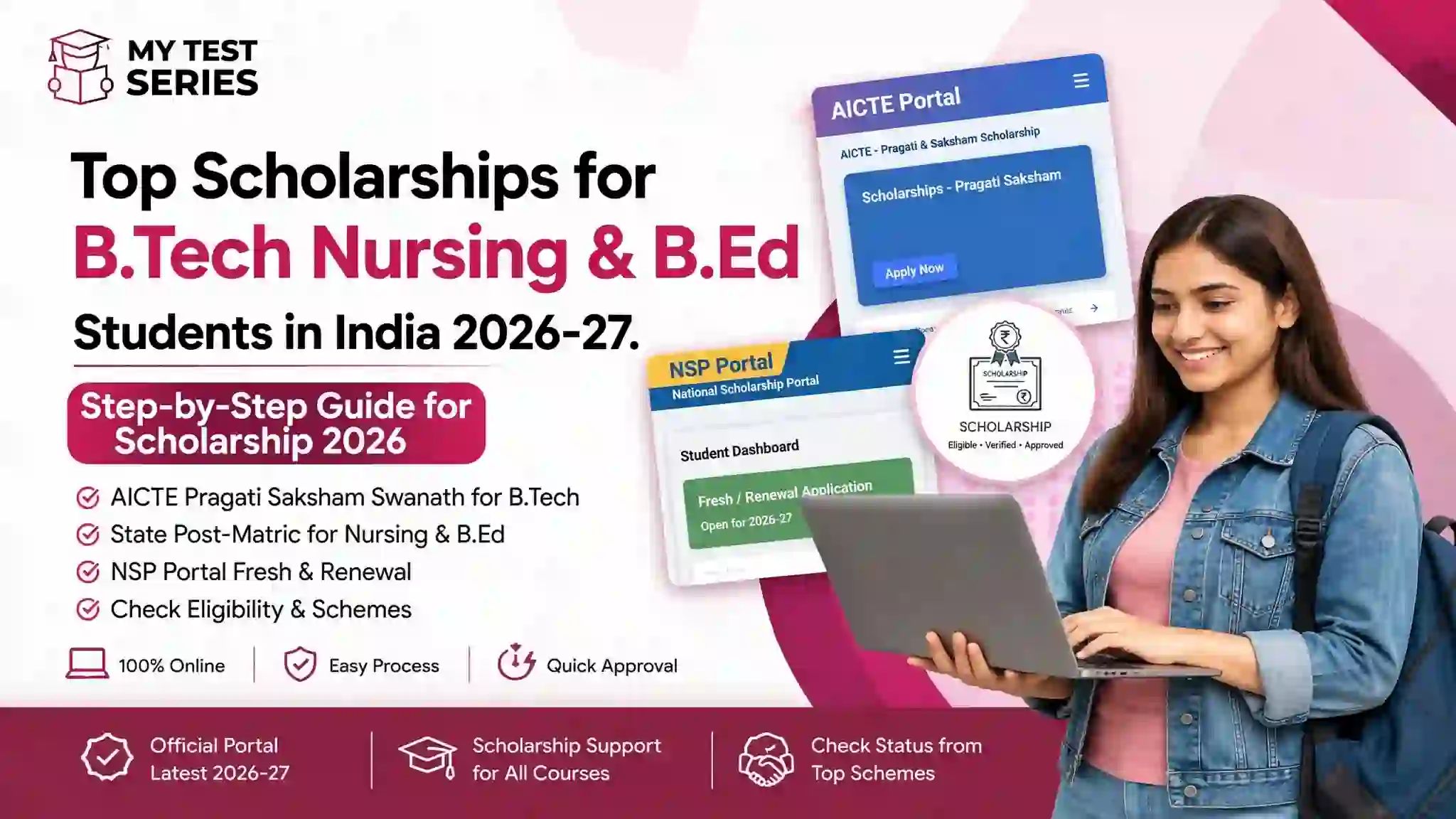
Top Scholarships for B.Tech, Nursing and B.Ed Students in India (2026–27)
Looking for financial assistance for engineering, nursing or teacher-training studies? Several government, state, institutional and private scholarship programmes may help eligible students pay tuition fees and other approved education expenses.
This guide explains scholarships to investigate for B.Tech, Nursing and B.Ed courses, how to check eligibility, which documents to prepare, where to apply and how to avoid common application mistakes.
Explore Official NSP Schemes ↗ Visit AICTE ↗Updated: September 2026. Always verify the latest scheme guidelines and deadlines before applying.
1. Scholarships for B.Tech, Nursing and B.Ed: At a Glance
Scholarships are financial awards provided under specific rules. Depending on the scheme, support may cover tuition fees, a maintenance allowance, a fixed annual amount or another approved education expense. Some awards are based on merit, while others focus on family income, social category, disability status, gender, location or another eligibility condition.
The most suitable scholarship depends on your course, institution, academic record, financial circumstances and state of residence. Start by identifying the schemes for which you may qualify rather than applying indiscriminately.
| Course | Scholarship options to investigate | Where to check |
|---|---|---|
| B.Tech / Engineering | AICTE schemes, NSP-listed scholarships, state awards, institutional merit aid and eligible private scholarships. | AICTE, NSP, state scholarship portal and college. |
| Nursing | State post-matric scholarships, eligible NSP schemes, institution-based aid, minority or disability-related schemes where applicable, and charitable awards. | NSP, state welfare department, nursing college and relevant scholarship provider. |
| B.Ed | State post-matric schemes, applicable category-based awards, university scholarships, merit-cum-means assistance and private awards. | State portal, NSP, university and B.Ed college. |
2. Where to Find Scholarships in India
National Scholarship Portal (NSP)
The National Scholarship Portal brings together scholarship schemes offered by participating government ministries, departments and agencies. It is a useful starting point for students checking central schemes and other scholarships listed on the platform.
For academic year 2026–27, the portal lists multiple schemes with individual application and verification dates. One Time Registration (OTR) is required for NSP scholarship applications. Students must check the scheme-specific rules and follow the portal's current instructions.
Read our dedicated National Scholarship Portal (NSP) guide for OTR, application steps, eligibility, documents, renewal and status tracking.
AICTE scholarships
The All India Council for Technical Education (AICTE) administers or supports scholarship initiatives for eligible students in technical education. Its schemes can have specific conditions relating to admission, institution, course, gender, disability, family circumstances or other criteria.
B.Tech students should investigate whether schemes such as Pragati, Saksham or Swanath are available to them in the relevant academic year. Do not assume that a scheme is open or that the eligibility rules remain unchanged from a previous year.
Check the official AICTE website and the current NSP scheme directory for applicable notices and instructions.
State scholarship portals
State governments may offer post-matric scholarships, merit awards, fee assistance or welfare-based schemes. Eligibility can depend on domicile, family income, category, course and the institution's recognition or registration.
Students should check their state government's official scholarship portal and welfare department notices. Do not assume that a scholarship available in one state is available to students domiciled in another.
College, university and private scholarships
Some institutions provide merit scholarships, fee waivers, need-based assistance or instalment facilities. Trusts, foundations and companies may also offer scholarships for particular courses, communities, locations or academic profiles.
Confirm the scholarship provider, selection rules, award amount, payment method and application deadline. Be cautious of websites or agents demanding a fee in exchange for guaranteed approval.
3. Scholarships for B.Tech and Engineering Students
A B.Tech degree can involve tuition, hostel, transport, laboratory, equipment and examination expenses. Scholarship support may reduce these costs, but students must meet the rules of the particular award.
Option 1: AICTE Pragati Scholarship
Pragati is an AICTE scholarship initiative associated with supporting eligible girl students in technical education. The applicable admission level, institution requirements, number of awards, income conditions and benefit amount must be checked in the current official guidelines.
Before applying, verify that your course and institution are covered and that your admission and other details meet the scheme's requirements. Check whether applications are handled through NSP or another official process for the relevant year.
Option 2: AICTE Saksham Scholarship
Saksham is an AICTE scholarship initiative for eligible students with disabilities pursuing approved technical education. Applicants should check the current disability criteria, required certificate, eligible institutions, course conditions and application process.
Students should rely on the latest official scheme notification rather than an old list of benefits or a previous year's deadline.
Option 3: AICTE Swanath Scholarship
Swanath is a scholarship scheme associated with eligible technical-degree students in specified beneficiary circumstances. Eligibility is limited by the current scheme guidelines and should not be assumed simply because a student is enrolled in a B.Tech programme.
Check the official notification for the relevant academic year to establish whether your personal circumstances, institution and admission meet the criteria.
Option 4: NSP and state scholarships
B.Tech students may also qualify for scholarships listed on NSP or offered by their state government. Depending on the scheme, eligibility can be based on merit, income, category, disability or other conditions.
Some schemes apply only to particular institutions or admission categories. Verify the exact eligibility criteria before submitting an application.
Option 5: College and university merit scholarships
Engineering colleges may provide tuition concessions, merit awards, need-based assistance or financial support from alumni and donors. Ask the college's scholarship or student welfare office for the current policy and whether a separate application is required.
B.Tech scholarship checklist
- Confirm your engineering college and course are eligible.
- Check whether the scholarship is for a specific admission year or study level.
- Review academic, income and beneficiary-group conditions.
- Prepare the required marksheets and admission documents.
- Check the current application deadline and verification process.
- Review restrictions on receiving other financial assistance.
4. Scholarships for Nursing Students
Nursing students may face tuition fees, clinical training costs, books, uniforms, equipment, travel and accommodation expenses. Scholarships and fee assistance can help eligible students manage these costs.
Available support varies according to the nursing qualification, state, institution, family income and other scheme conditions. Students pursuing B.Sc Nursing, GNM, Post Basic B.Sc Nursing or M.Sc Nursing should verify whether the particular programme is covered.
Option 1: State post-matric scholarships
State welfare departments may provide post-matric scholarships to eligible students enrolled in recognised courses. Some schemes consider family income, social category, domicile, academic progression and the type of institution.
Nursing students should check the official state portal and read the course-specific requirements. A scheme that covers one nursing qualification may not necessarily cover every nursing programme.
Option 2: NSP-listed scholarships
Search the NSP directory for schemes relevant to your course and circumstances. Some scholarships focus on particular beneficiary groups rather than nursing alone.
Check the eligible course list, institution conditions, application dates and document requirements. The fact that a nursing college is recognised does not automatically establish eligibility for every scholarship.
Option 3: College-based fee assistance
Ask your nursing college whether it provides merit awards, need-based aid, fee concessions, instalment arrangements or support funded by charitable organisations. Obtain the written conditions, including renewal requirements and any minimum academic performance.
Option 4: Charitable and private scholarships
Some trusts and foundations support students pursuing healthcare and professional courses. These awards may have restrictions relating to income, marks, state, institution, gender or other factors.
Confirm the legitimacy of the provider and the current application window. Never pay an unofficial person who promises guaranteed scholarship selection.
Option 5: Scholarships for eligible beneficiary groups
Students with disabilities, students from eligible reserved categories and other specified groups may have access to schemes under applicable government rules. The exact conditions depend on the award and the responsible authority.
Nursing scholarship checklist
- Confirm your qualification and course duration are eligible.
- Check whether the institution is recognised and covered.
- Review domicile, income and category requirements.
- Prepare marksheets, admission proof and fee details.
- Ask the college about its own scholarship or fee-support policy.
- Check whether renewal depends on academic progression.
5. Scholarships for B.Ed Students
The Bachelor of Education (B.Ed) is a professional teacher-training qualification. Students may need to budget for tuition, examination fees, teaching practice, books, transport and accommodation.
Scholarship availability depends on the state, institution, course recognition, academic record and the applicant's eligibility under the relevant scheme. There is no single national scholarship that automatically covers every B.Ed student.
Option 1: State post-matric scholarships
Students who meet the applicable income, category, domicile and course requirements should check their state's official post-matric scholarship portal.
Confirm that the B.Ed programme and institution are included in the scheme. Also check whether the application must be submitted through a state portal, NSP or another official platform.
Option 2: NSP-listed welfare and merit schemes
Search the National Scholarship Portal for schemes matching your personal and academic circumstances. Depending on the award, eligibility may be limited by beneficiary group, academic performance, income or other criteria.
Read the scheme guidelines carefully, including rules about eligible courses, institutions and receiving other financial assistance.
Option 3: University and college scholarships
B.Ed colleges and universities may provide merit-based awards, fee concessions, need-based assistance or support through alumni and charitable funds.
Contact the college's scholarship or student welfare office. Ask about the application form, selection criteria, renewal conditions and whether the assistance is paid directly or adjusted against fees.
Option 4: Trust and foundation scholarships
Some private organisations support students in professional or higher education, including teacher training. Check whether the award accepts B.Ed students and whether your institution and year of study qualify.
Do not assume that a scholarship described as an education scholarship automatically covers every professional course. The official terms should explicitly support your course or provide an eligible general category.
B.Ed scholarship checklist
- Verify that your B.Ed course and institution meet the scheme rules.
- Check the applicable state, income and category requirements.
- Prepare admission proof and previous examination results.
- Confirm whether teaching practice or other course details are requested.
- Check the deadline, renewal policy and minimum marks requirements.
6. Scholarship Eligibility: What Should You Check?
Eligibility differs from one scholarship to another. Before applying, compare your details with the scheme's official rules.
| Eligibility factor | Questions to ask |
|---|---|
| Course | Does the scheme cover B.Tech, the relevant nursing qualification or B.Ed? |
| Institution | Is the college or university recognised and included in the scheme? |
| Academic performance | Are minimum marks, a qualifying examination or a merit rank required? |
| Family income | Is there an income ceiling, and which certificate is accepted? |
| Category or beneficiary group | Does the scheme have category, disability, gender or other beneficiary conditions? |
| Domicile | Must you be a resident of a particular state or union territory? |
| Admission status | Are there conditions relating to admission year, mode or category? |
| Other assistance | Can the award be combined with another scholarship or fee benefit? |
| Renewal | Must you maintain a minimum attendance, marks or academic progression? |
Do not assume that a scholarship's income limit, amount or marks requirement is the same every year. Use the current official notification for the relevant academic year.
7. Documents Required for Scholarship Applications
Prepare your documents before filling in the application. The exact list depends on the scheme, so use this as a planning checklist rather than a universal requirement.
- Identity details and the documents accepted by the registration process.
- Recent passport-size photograph, if requested.
- Active mobile number and email address.
- Previous examination marksheets or certificates.
- Admission letter, enrolment details or bonafide certificate, where required.
- Current course and institution information.
- Family income certificate, if applicable.
- Caste, category, domicile or disability certificate, where relevant.
- Bank account details and supporting information requested by the scheme.
- Fee receipt or fee structure, where required.
- Previous scholarship details for renewal applications.
- Any additional certificate specified in the current scheme guidelines.
Check documents before uploading
- Make sure your name and other personal details match the required records.
- Check certificate validity and issuing authority requirements.
- Use clear, complete scans in the file format and size accepted by the portal.
- Enter the correct academic year, course and institution.
- Review bank information carefully before submitting.
- Keep copies of your application acknowledgement and submitted documents.
8. How to Apply for Scholarships Online
The process depends on the scholarship provider. NSP applications, state applications and private scholarship applications may use different portals and forms.
Step 1: Identify the relevant scholarship
Search the official NSP directory, the AICTE website where relevant, your state scholarship portal and your college's financial assistance page.
Step 2: Read the current guidelines
Check eligibility, benefits, required documents, selection criteria, deadlines and restrictions on other financial assistance.
Step 3: Complete registration
Create an account through the official application route. For NSP scholarships, follow the portal's current One Time Registration (OTR) instructions.
Step 4: Fill in the application
Enter your personal, academic, course and financial information carefully. Make sure your selected institution and course match your official records.
Step 5: Upload required documents
Attach the documents requested by the form. Check the accepted file formats, size limits and certificate requirements.
Step 6: Review before submission
Check all details before submitting. Correct mistakes while editing is permitted and save the acknowledgement or reference number.
Step 7: Complete verification
Some schemes require verification by the institution, state or another authority. Follow the instructions and respond to any defect or correction request within the permitted period.
Step 8: Track the application
Log in to the relevant official portal to monitor status. Approval and payment may occur only after all applicable verification and sanction stages are complete.
For a step-by-step explanation of NSP registration and application tracking, read our NSP application guide.
9. Scholarship Deadlines, Verification and Payment
Scholarship deadlines are not uniform. One scheme may have a different student application deadline from another, and verification or correction deadlines can also differ.
For academic year 2026–27, the NSP portal lists scheme-specific dates. Check the live scheme page to establish whether applications are open and whether the scheme accepts fresh applications, renewals or both.
How to check the deadline
- Open the official scheme page.
- Confirm the academic year.
- Read the student application closing date.
- Check the correction and verification dates.
- Read any scheme-specific notice or extension announcement.
What if your application is pending?
Check which stage is pending and whether your institution or another authority must take action. If the application is marked defective, read the stated reason and follow the official correction process.
What if payment has not arrived?
First check the application status and any sanction information. If the relevant scheme directs students to a payment-tracking service, use that official service. The Public Financial Management System (PFMS) provides payment-related services for applicable government transactions.
If the issue remains unresolved, contact your institution's scholarship office or the official scheme helpdesk using contact details published by the responsible authority.
10. Can You Receive More Than One Scholarship?
Whether you can receive more than one scholarship depends on the rules of the relevant schemes. Some awards prohibit combining benefits, while others may permit multiple applications or certain combinations of support.
The NSP announcement for 2026–27 states that students may apply for one merit-based scholarship scheme and one or more welfare-based schemes, subject to the eligibility criteria. This should not be interpreted as automatic permission to receive every award at the same time.
Before accepting multiple awards:
- Read the terms of each scholarship.
- Check whether another scholarship must be disclosed.
- Confirm whether duplicate benefits for the same expenses are restricted.
- Ask the relevant authority if the rules are unclear.
- Keep written records of the guidance you receive.
11. Common Scholarship Application Mistakes
Applying without checking course eligibility
A scholarship may support technical degrees but exclude a particular institution or admission category. Confirm that your exact course and college qualify.
Using an old income or category certificate
Some schemes specify the issuing authority, format or validity period. Check the current instructions before uploading a certificate.
Missing the deadline
Track student submission, correction and verification dates. Leave enough time to resolve a document issue.
Entering inconsistent information
Differences in names, dates, marks or institution details can create verification problems. Review your application before final submission.
Assuming the scholarship is guaranteed
Meeting basic eligibility criteria does not guarantee selection. Awards may depend on merit, available funding, ranking, verification or other scheme rules.
Ignoring renewal requirements
Some scholarships require a new application each year and impose academic progression or attendance conditions. Check the renewal process before the next academic session.
Paying an unofficial agent
Use the official application portal and verified support channels. A person who promises guaranteed approval in exchange for money should not be treated as an authorised scholarship provider.
12. What If Your Scholarship Does Not Cover All Education Costs?
A scholarship may cover only part of tuition or provide a fixed amount. Students may need to plan for the remaining tuition, accommodation, books, equipment, travel and living expenses.
Consider these options before taking on additional debt:
- Ask your institution about fee instalments and financial assistance.
- Check whether another compatible scholarship is available.
- Explore eligible state or institutional support.
- Estimate the funding gap after confirmed assistance.
- Compare education loan terms carefully if borrowing is necessary.
Our Student Financing Guide India explains scholarships, education loans and other funding considerations in one place.
Compare loan options only for the remaining gap
If you need to borrow, compare the interest rate, processing fees, repayment period, moratorium, collateral requirements and total repayment cost.
- Education loans in India without collateral
- How to apply through the Vidya Lakshmi / PM-Vidyalaxmi portal
- SBI Student Loan vs SBI Scholar Loan
- Central Sector Interest Subsidy (CSIS) guide
Scholarships and loans are different forms of support. A scholarship usually does not need to be repaid if its conditions are met; an education loan generally does. Interest subsidies may reduce eligible interest costs but do not automatically cancel the loan principal.
Students planning overseas education can also review our guides to Prodigy vs MPOWER overseas loans and proof of funds for student visas. These resources address separate international study-financing requirements.
If you are already repaying an eligible education loan, read our guide to Section 80E and education-loan interest tax deductions. Tax treatment depends on the applicable law, tax year and personal circumstances.
13. Official Scholarship Resources
Use official sources to verify eligibility, application windows and scheme conditions before making financial decisions.
National Scholarship Portal
Search central and other participating scholarship schemes, check the academic year and read the scheme-specific instructions.
Open NSP Schemes ↗All India Council for Technical Education
Check official technical-education information and current scholarship notifications relevant to eligible engineering students.
Open AICTE ↗Ministry of Education
Check government higher-education policy information and relevant scheme announcements from the Ministry.
Open Ministry Website ↗Public Financial Management System
Use the official PFMS website for applicable government payment-related services and guidance.
Open PFMS ↗14. Frequently Asked Questions
Which scholarships are available for B.Tech students in India?
B.Tech students can investigate eligible AICTE schemes, scholarships listed on NSP, state government awards, institutional merit scholarships and private foundation programmes. Availability depends on the current academic year, institution, admission and eligibility conditions.
Are there scholarships for nursing students in India?
Yes. Eligible nursing students may be able to apply for state post-matric scholarships, NSP-listed schemes, college-based fee assistance and private awards. The course, institution, income and beneficiary-group requirements vary by scheme.
Can B.Ed students apply for government scholarships?
B.Ed students may qualify for certain state post-matric schemes, NSP-listed awards or other government assistance, depending on the scheme's course, institution, income, domicile and category rules. Check the official guidelines for your particular course.
Is NSP registration required for scholarships?
One Time Registration (OTR) is required for scholarship applications submitted through NSP under its current process. However, not every scholarship uses NSP; state portals, institutions and private providers may have separate registration procedures.
What is the last date to apply for scholarships in 2026–27?
There is no single deadline for all scholarships. Each scheme has its own application and verification timeline. Check the current official scheme page and any published extension notice before applying.
Can I apply for more than one scholarship?
It depends on the applicable scheme rules. Some schemes restrict simultaneous benefits, while others may allow certain combinations. Read the conditions of each award and disclose other assistance when required.
Can a scholarship cover all college fees?
Not always. Some awards cover specified tuition expenses, while others provide a fixed amount or maintenance support. Check the approved benefits and budget for any remaining fees and living expenses.
Does submitting an application guarantee a scholarship?
No. Submission does not guarantee selection or payment. Applicants must meet the scheme's conditions and complete the required verification and selection process.
What should I do if my scholarship application is defective?
Read the exact defect message, follow the portal's correction instructions and submit the required changes within the permitted period. Contact the institution or official helpdesk if you need further assistance.
15. Final Scholarship Application Checklist
- ☐ I identified scholarships relevant to my course.
- ☐ I checked the official eligibility criteria.
- ☐ I confirmed the institution and course are eligible.
- ☐ I checked the current academic year and deadline.
- ☐ I prepared the required certificates and marksheets.
- ☐ I completed the correct registration process.
- ☐ I reviewed the application before submitting.
- ☐ I saved the acknowledgement or reference number.
- ☐ I know how to track verification and payment status.
- ☐ I checked whether other scholarship benefits are permitted.
Start Your Scholarship Search
Compare the schemes relevant to your course and circumstances. Verify current eligibility, documents and deadlines through official sources before submitting an application.
Check Official NSP Schemes ↗MyTestSeries.in is an independent educational information website. It does not approve scholarships or represent the government.
Disclaimer: Scheme names, eligibility criteria, benefits and deadlines may change. This article is for general educational information and does not replace official scheme guidelines. Confirm all details with the responsible government department, institution or scholarship provider.