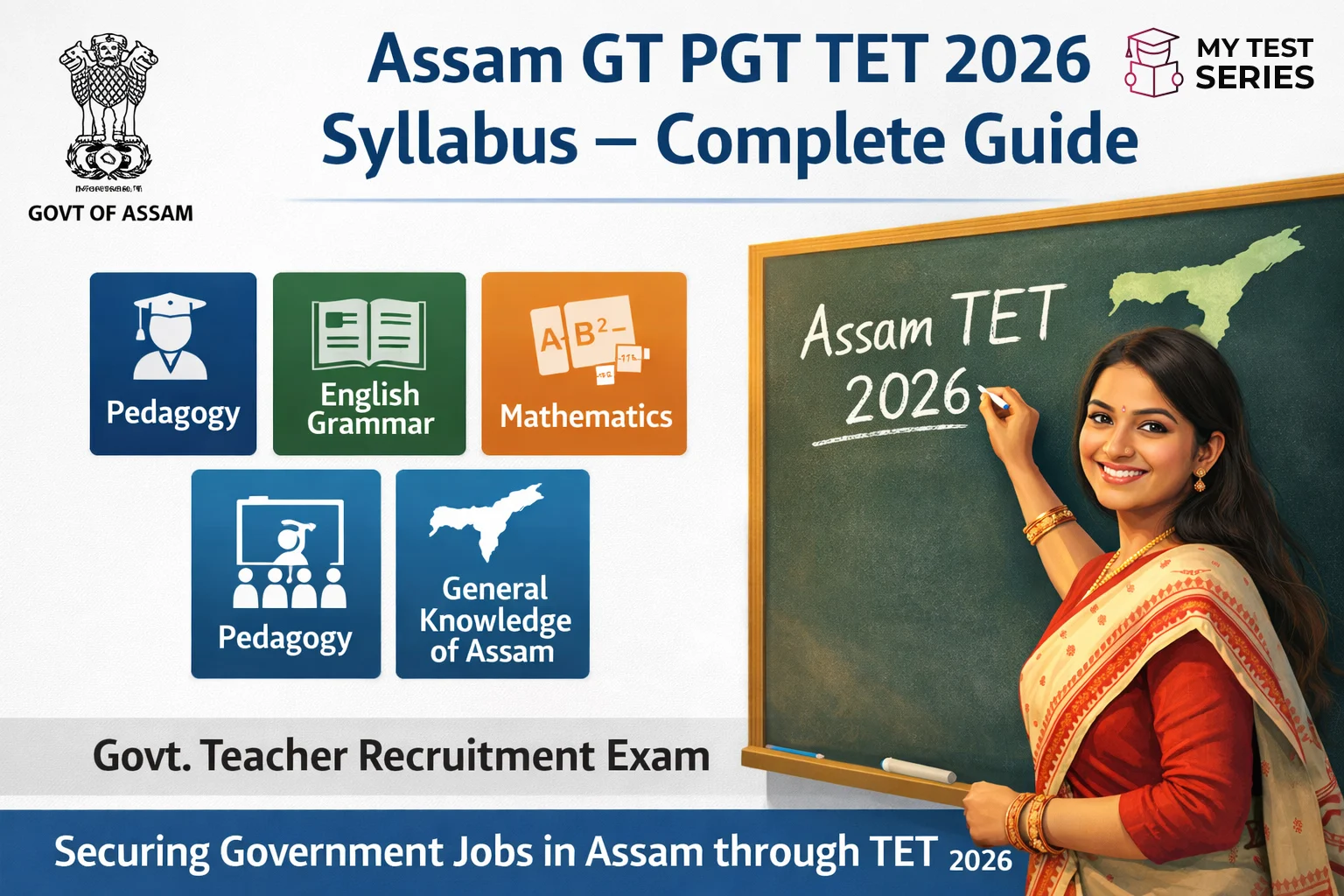
The Assam TET cum Recruitment Test 2026 (often called TCR 2.0 or TET cum GT/PGT Exam) is a key gateway for aspiring teachers in Assam’s secondary and higher secondary schools. Conducted by the Directorate of Secondary Education (DSE), Assam, this exam recruits Graduate Teachers (GT) for high schools (Classes IX-X) and Post Graduate Teachers (PGT) for higher secondary levels (Classes XI-XII) in subjects like Arts, Science, Hindi, Sanskrit, and more.
Whether you’re preparing for Assam GT TET 2026, Assam PGT TET 2026, or the combined TET cum Recruitment Test, understanding the exact syllabus and pattern is crucial for success. The exam remains objective (MCQ-based) with 140 marks total, no negative marking in recent patterns, and focuses on pedagogy, Assam-specific knowledge, language, math, and current affairs.
Note: As of early 2026, the core syllabus breakup aligns with previous cycles (2024-2025), with official notices on madhyamik.assam.gov.in confirming the structure. For any minor 2026 tweaks or fresh notifications, always cross-check the official DSE portal (madhyamik.assam.gov.in) or recent advertisements.
Assam TET cum Recruitment Test 2026 Exam Pattern
| Section | Marks | Importance Level | Question Type |
|---|---|---|---|
| Pedagogy | 50 | Highest (Must-score section) | MCQs |
| About Assam and its People | 35 | Very High | MCQs |
| General English | 30 | Moderate-High | MCQs |
| General Mathematics (Class 10 level) | 15 | Moderate | MCQs |
| General Studies & Current Affairs | 10 | Low-Moderate | MCQs |
| Total | 140 | Full Paper | 140 MCQs (2-3 hours duration) |
Additional weightage may apply from qualifications, experience, or extras like NCC/sports (up to 5-10 marks in merit).
Assam GT PGT TET – Detailed Topic-Wise Syllabus
1. Pedagogy (50 Marks)
| Topic Category | Key Sub-Topics |
|---|---|
| Principles & Maxims of Teaching | General principles, maxims (known to unknown, simple to complex, concrete to abstract), laws of teaching/learning (Thorndike’s: Readiness, Exercise, Effect) |
| Teaching Methods & Techniques | Lecture, demonstration, discussion, project method, collaborative learning |
| Teaching Devices, Skills & Aids | Use of teaching aids, modern tools & technology in classroom |
| Trends in Teaching-Learning Process | Significant modern trends, inclusive practices |
| Educational Objectives & Taxonomy | Bloom’s Taxonomy (Cognitive, Affective, Psychomotor domains) |
| Learning Factors | Role of attention, interest, motivation; individual differences |
| Lesson Planning | Essentials & components of a good lesson/unit plan |
| Educational Psychology | Meaning, nature, classroom implications |
| Personality & Development | Concept of personality, role of family/school |
| Inclusive Education | Children with special needs, disabilities |
| Mental Health & Adjustment | Mental health, hygiene, adjustment mechanisms |
| Intelligence & Creativity | Theories of intelligence, individual differences, creativity |
| Adolescence Psychology | Significance of adolescence, physical/intellectual/social/emotional/moral development, emotional problems, hazards |
| Guidance, Counseling & Others | Guidance & counseling, juvenile delinquency |
2. About Assam and its People (35 Marks)
| Topic Category | Key Sub-Topics |
|---|---|
| History of Assam | Ancient (Varman, Kamarupa), Medieval (Ahom dynasty, Battle of Saraighat), Modern (British rule, freedom movement, post-independence) |
| Geography of Assam | Physical features, rivers (Brahmaputra, Barak), climate, landforms |
| National Parks & Wildlife | Kaziranga, Manas, Dibru-Saikhowa, Nameri, Orang, etc. |
| Administrative Divisions | Districts, sub-divisions, autonomous councils (e.g., BTC) |
| Economy & Industries | Agriculture (rice, jute, tea), tea industry, cottage/small-scale industries, oil & gas (Digboi, Duliajan), natural resources |
| Census & Demographics | 2011 Census data (population, literacy, sex ratio) |
| Polity & Government | Assam government structure, schemes (Orunodoi, Mukhya Mantri Krishi Sa-Sajuli, etc.) |
| Tourism & Culture | Major sites (Majuli, Sualkuchi, Sivasagar), tea tourism |
| Art, Literature & Festivals | Sattriya dance, Bihu (types), Ambubachi Mela, Ali Ai Ligang, Jonbeel Mela; literature (Sankardeva, Bezbaroa); folk traditions |
| Tribes of Assam | Bodo, Mishing, Karbi, Dimasa — customs, festivals |
| Handicrafts & Resources | Muga/eri silk, bell metal, pottery, handloom |
3. General English (30 Marks)
| Topic | Key Areas |
|---|---|
| Sentence Structure | Types (simple, compound, complex), punctuation |
| Grammar Essentials | Determiners (articles, possessives), tenses (all forms), prepositions, degree of comparison |
| Voice & Narration | Active/passive voice, direct/indirect speech (rules & conversions) |
| Vocabulary | Synonyms, antonyms, homonyms, proverbs |
| Other | Gender, one-word substitutions, paragraph coherence |
4. General Mathematics (15 Marks) – Class 10 Level
| Topic Category | Key Sub-Topics |
|---|---|
| Arithmetic & Commercial | Number systems, percentages, profit/loss, SI/CI, ratio/proportion, time & work, speed/distance |
| Algebra | Polynomials, linear/quadratic equations, arithmetic progression, variation |
| Geometry | Triangles (similarity, Pythagoras), circles (tangents), coordinate geometry (distance, area), symmetry, constructions |
| Mensuration | Surface area & volume (cylinder, cone, sphere, combinations) |
| Trigonometry | Ratios, identities, heights & distances |
| Statistics & Probability | Mean/median/mode, basic probability |
5. General Studies & Current Affairs (10 Marks)
| Focus Area | Preparation Tips |
|---|---|
| General Studies | Basic national/international GK, Indian polity basics, Assam-specific facts |
| Current Affairs | Recent events (focus on Assam, Northeast, India), government schemes/policies, sports, awards, environment |
Assam ADRE Mock Test – Complete Online Practice Platform for Smart Preparation
🚀 অসমৰ সকলো চৰকাৰী চাকৰিৰ পৰীক্ষাৰ বাবে Free Telegram Channel
APSC, ADRE, Assam Police, TET, Grade-III & Grade-IV, SCERT PET আদি সকলো
অসম চৰকাৰী পৰীক্ষাৰ Daily MCQ, GK Updates, Free PDF Notes, Previous Year Question,
Exam Strategy একে ঠাইত পাবলৈ এতিয়াই আমাৰ Telegram Channel ত যোগদান কৰক।
স্মাৰ্ট প্ৰস্তুতি আৰম্ভ কৰক আৰু আপোনাৰ সফলতাৰ দিশে আগবাঢ়ক।
📢 এতিয়াই Telegram Channel Join কৰক
⚡ Daily Updates • Free Study Materials • Smart Preparation