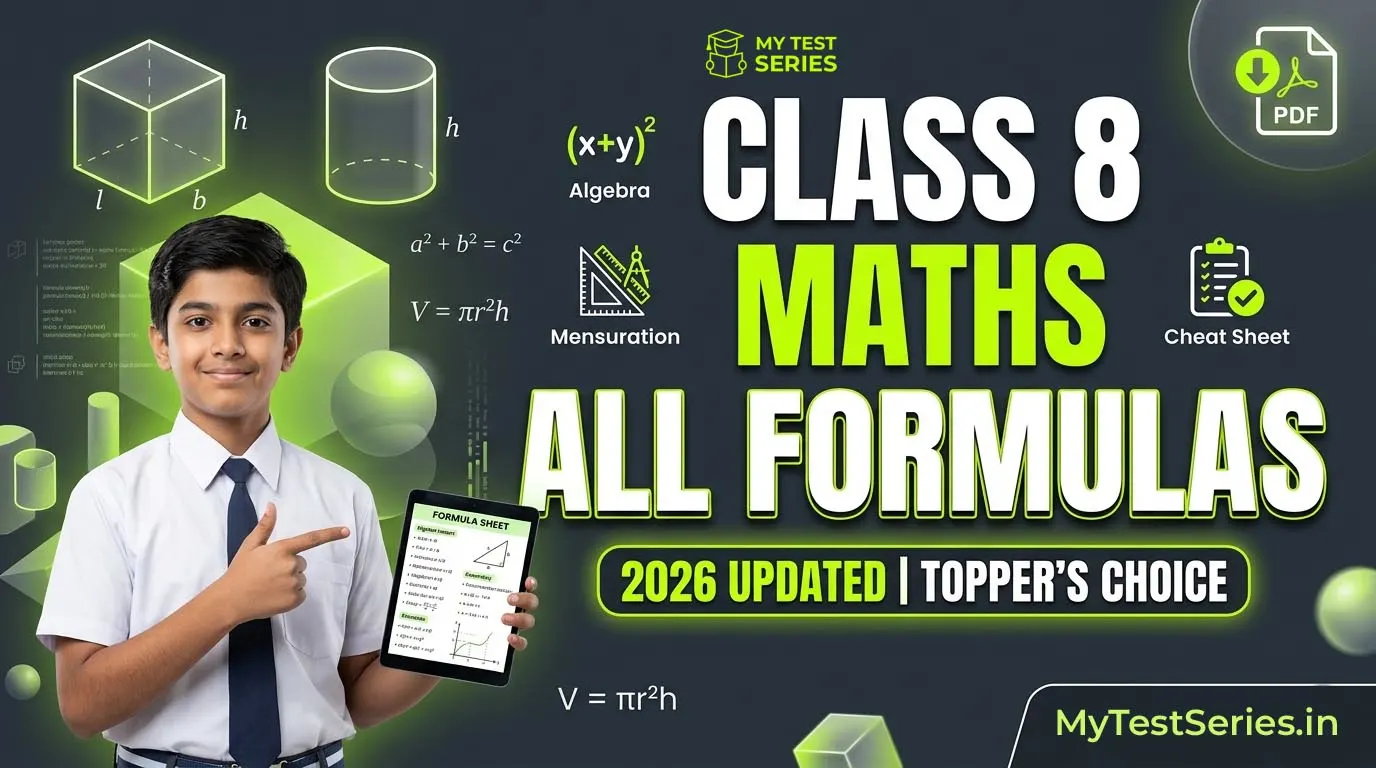
Class 8 Maths: Complete Chapter-wise Formula Sheet | MyTestSeries
Class 8 Maths: Complete Chapter-wise Formula Sheet 2026 | MyTestSeries
📐 CBSE | Class 8 | Formula Sheet
Class 8 Maths: Complete Chapter-wise Formula Sheet 2026
📅 May 8, 2026⏱ 15 min read🔄 Updated for 2026–27 Syllabus🖨 Print-Ready
🖨 Pro tip: Press Ctrl+P (or Cmd+P on Mac) to print or save this formula sheet as a PDF for offline revision.
13
Chapters Covered
80+
Key Formulas Listed
4
Algebraic Identities
7
Laws of Exponents
8+
Mensuration Formulas
There's a moment every Class 8 student knows: it's the night before the Maths exam, your notebook is everywhere, and you're frantically searching for that one formula — the surface area of a cylinder, or was it the lateral surface area? This page was built so that moment never happens again.
This is your complete, chapter-wise Class 8 Maths formula sheet — covering all 13 chapters from the NCERT syllabus (updated for the 2026–27 session), written in a clean format that's easy to read, revise, and remember. Whether you're preparing for a unit test, half-yearly, or annual exam, bookmark this page and keep it open.
Ch 1
Ch 2
Ch 3
Ch 4
Ch 5
Ch 6
Ch 7
Ch 8 ⭐
Ch 9 ⭐
Ch 10
Ch 11
Ch 12
Ch 13
📘 Chapter-wise Formula Sheet
1
Rational Numbers
Properties, Operations, Number Line
+
A rational number is any number expressible as p/q, where p and q are integers and q ≠ 0. This chapter builds the number-sense foundation you'll use throughout Class 8 and beyond.
Property
Addition
Subtraction
Multiplication
Division
Closure
✅ Yes
✅ Yes
✅ Yes
❌ No
Commutative
a+b = b+a ✅
❌ No
a×b = b×a ✅
❌ No
Associative
✅ Yes
❌ No
✅ Yes
❌ No
Distributive
a × (b + c) = (a × b) + (a × c) ✅
Identity
a + 0 = a
—
a × 1 = a
—
Inverse
a + (−a) = 0
—
a × (1/a) = 1
—
Additive Identity
a + 0 = 0 + a = a
Zero is the additive identity for all rational numbers
Multiplicative Identity
a × 1 = 1 × a = a
One is the multiplicative identity
Additive Inverse
a + (−a) = 0
−a is the additive inverse of a
Multiplicative Inverse
a × (1/a) = 1 (a ≠ 0)
1/a is the multiplicative inverse (reciprocal) of a
Rational Numbers Between a and b
n numbers: use (a + b)/2 repeatedly
Or use: a + (b−a)/(n+1), a + 2(b−a)/(n+1) …
💡 Memory Trick: "CARD" — Closure, Associative, commutative (Ring), Distributive. These four properties define how rational numbers behave under all operations.
2
Linear Equations in One Variable
Equations, Solving, Word Problems
+
A linear equation in one variable has exactly one variable with degree 1. The standard form is ax + b = 0. The goal is always to isolate the variable on one side.
Standard Form
ax + b = 0
where a ≠ 0; solution: x = −b/a
Cross Multiplication
If a/b = c/d, then ad = bc
Use when equation involves fractions on both sides
Transposition Rule
ax + b = c → ax = c − b
Move terms across the '=' sign and flip their sign
Golden Rule
LHS = RHS always maintained
Whatever you do to one side, do the same to the other
💡 Word Problem Strategy: Let the unknown quantity = x. Write the equation from the problem statement. Solve for x. Verify by substituting back.
3
Understanding Quadrilaterals
Polygons, Angle Sum, Properties
+
Sum of Interior Angles (Polygon)
Sum = (n − 2) × 180°
n = number of sides; Quadrilateral: (4−2)×180 = 360°
💡 Hierarchy: Square ⊂ Rectangle ⊂ Parallelogram ⊂ Quadrilateral. Every square is a rectangle, but not every rectangle is a square.
4
Data Handling
Mean, Median, Mode, Probability
+
Mean (Average)
Mean = Sum of all observations / Total number of observations
Most commonly tested central tendency formula
Median (Odd n)
Median = [(n+1)/2]ᵗʰ observation
After arranging data in ascending order
Median (Even n)
= [(n/2)ᵗʰ + (n/2 + 1)ᵗʰ] / 2
Average of two middle values
Mode
Value that appears most frequently
A dataset can have no mode, one mode, or multiple modes
Probability
P(E) = Number of favourable outcomes / Total number of outcomes
P(E) always lies between 0 and 1 (inclusive)
Complementary Event
P(E) + P(Ē) = 1 → P(Ē) = 1 − P(E)
P(not E) = 1 − P(E)
5
Squares and Square Roots
Perfect Squares, Properties, Methods
+
Square of a Number
n² = n × n
Squares always end in 0,1,4,5,6, or 9
Sum of First n Odd Numbers
1 + 3 + 5 + … + (2n−1) = n²
Shortcut to verify perfect squares
Pythagorean Triplets (General)
For m > 1: (2m, m²−1, m²+1)
E.g., m=2: triplet is (4, 3, 5)
Square Root via Prime Factorisation
√N = product of one from each prime pair
Group prime factors in pairs; take one from each pair
Square Root of Fraction
√(a/b) = √a / √b
Simplify numerator and denominator separately
💡 Key Fact: A number ending in 2, 3, 7, or 8 can NEVER be a perfect square. Use this to eliminate options instantly in MCQs.
6
Cubes and Cube Roots
Perfect Cubes, Prime Factorisation Method
+
Cube of a Number
n³ = n × n × n
Numbers 1 to 10: 1,8,27,64,125,216,343,512,729,1000
Cube Root
∛N = N^(1/3)
Prime factorise N; group in threes; take one from each group
Cube Root of Fraction
∛(a/b) = ∛a / ∛b
Simplify numerator and denominator separately
Negative Cube Root
∛(−N) = −(∛N)
Cube roots of negative numbers are negative
Perfect Cubes from 1–10: 1, 8, 27, 64, 125, 216, 343, 512, 729, 1000. Memorise these — they come up repeatedly in exams and competitive tests.
7
Comparing Quantities
Percentage, Profit/Loss, SI, CI, GST
+
This is one of the most practically useful chapters in Class 8 Maths — the formulas here connect directly to real life and frequently appear in competitive exams later on.
Percentage
% = (Part / Whole) × 100
Convert fractions to percentage by multiplying by 100
Profit
Profit = SP − CP (when SP > CP)
SP = Selling Price; CP = Cost Price
Loss
Loss = CP − SP (when CP > SP)
Profit %
Profit% = (Profit / CP) × 100
Loss %
Loss% = (Loss / CP) × 100
Selling Price (from Profit%)
SP = CP × (100 + Profit%) / 100
Selling Price (from Loss%)
SP = CP × (100 − Loss%) / 100
Discount
Discount = Marked Price − Sale Price
Discount %
Discount% = (Discount / MP) × 100
Simple Interest (SI)
SI = (P × R × T) / 100
P = Principal, R = Rate%, T = Time (in years)
Amount (SI)
A = P + SI
Compound Interest — Annual
A = P × (1 + R/100)ⁿ
n = number of years; CI = A − P
CI — Half-Yearly
A = P × (1 + R/200)²ⁿ
Rate halved, time doubled for half-yearly compounding
CI — Quarterly
A = P × (1 + R/400)⁴ⁿ
GST (Tax on Sale)
Tax Amount = (Tax% × Bill Amount) / 100
Total amount = Bill Amount + Tax Amount
💡 CI vs SI Shortcut: For 2 years: CI − SI = P × (R/100)². This shortcut saves time in objective questions.
8
Algebraic Expressions and Identities ⭐
High Weightage — The 4 Standard Identities + Operations
+
This is consistently the most challenging and highest-weightage chapter in Class 8 Maths. Master all four identities and you'll unlock a huge portion of Class 9 algebra as well.
📐 The 4 Standard Algebraic Identities
Identity I
(a + b)² = a² + 2ab + b²
Square of Sum
Identity II
(a − b)² = a² − 2ab + b²
Square of Difference
Identity III
(a + b)(a − b) = a² − b²
Difference of Squares
Identity IV
(x + a)(x + b) = x² + (a+b)x + ab
Product of Binomials
Terms and Coefficients
Expression = Terms; Each term has a coefficient
E.g., in 3x² + 5y − 7: terms are 3x², 5y, −7
Like Terms
Same variable(s) with same exponent(s)
3x² and −5x² are like terms; can be added/subtracted
Multiplication of Monomials
aˣ × aʸ = aˣ⁺ʸ (same base)
Multiply coefficients; add exponents of same variable
Key Identity Derivation
(a+b)² = (a+b)(a+b) = a²+ab+ab+b² = a²+2ab+b²
Use the FOIL method to expand any two binomials
💡 Exam Shortcut: To calculate 97² quickly: (100−3)² = 10000 − 600 + 9 = 9409. Use (a−b)² instead of long multiplication. This saves 2–3 minutes per question.
Connection to Class 9: These same four identities are extended in Class 9 to (a+b)³, (a−b+c)², and more advanced factorisation. Mastering them now gives you a head start.
9
Mensuration ⭐
Highest Weightage — 2D & 3D Formulas
+
Mensuration carries the highest marks in Class 8 Maths exams. This chapter extends from Class 7 (triangles, rectangles) to trapezium, rhombus, and 3D shapes — cylinder, cone, and cuboid.
📐 2D Shapes — Area & Perimeter
Shape
Area
Perimeter
Rectangle
l × b
2(l + b)
Square
a²
4a
Triangle
½ × base × height
Sum of 3 sides
Parallelogram
base × height
2(a + b)
Trapezium
½ × (a + b) × h
Sum of 4 sides
Rhombus
½ × d₁ × d₂
4 × side
Circle
πr²
2πr (Circumference)
📦 3D Shapes — Surface Area & Volume
Cuboid — Lateral SA
LSA = 2h(l + b)
l = length, b = breadth, h = height
Cuboid — Total SA
TSA = 2(lb + bh + hl)
Cuboid — Volume
V = l × b × h
Cube — Lateral SA
LSA = 4a²
a = side of cube
Cube — Total SA
TSA = 6a²
Cube — Volume
V = a³
Cylinder — Curved SA
CSA = 2πrh
r = radius, h = height, π ≈ 22/7 or 3.14
Cylinder — Total SA
TSA = 2πr(r + h)
Cylinder — Volume
V = πr²h
💡 Remember the difference: Lateral/Curved SA = only the sides (no top/bottom). Total SA = all faces including top and bottom. In word problems, a "closed container" uses TSA; an "open tank" uses LSA + base only.
10
Exponents and Powers
7 Laws of Exponents + Standard Form
+
Law 1 — Product Rule
aᵐ × aⁿ = aᵐ⁺ⁿ
Same base: add exponents
Law 2 — Quotient Rule
aᵐ ÷ aⁿ = aᵐ⁻ⁿ (m > n, a ≠ 0)
Same base: subtract exponents
Law 3 — Power of a Power
(aᵐ)ⁿ = aᵐⁿ
Multiply the exponents
Law 4 — Power of a Product
aᵐ × bᵐ = (ab)ᵐ
Same exponent: multiply bases
Law 5 — Power of a Quotient
aᵐ ÷ bᵐ = (a/b)ᵐ
Law 6 — Zero Exponent
a⁰ = 1 (a ≠ 0)
Any non-zero number raised to 0 equals 1
Law 7 — Negative Exponent
a⁻ⁿ = 1/aⁿ (a ≠ 0)
Negative exponent = reciprocal with positive exponent
Standard Form (Scientific Notation)
N = a × 10ⁿ (1 ≤ a < 10)
E.g., 384000000 = 3.84 × 10⁸
💡 Common Mistake: aᵐ × bⁿ ≠ (ab)ᵐ⁺ⁿ — Law 4 only works when the exponents are the SAME. Different exponents cannot be combined like this.
11
Direct and Inverse Proportions
Ratio, Proportionality Constants
+
Direct Proportion
x/y = k (constant) → x₁/y₁ = x₂/y₂
As x increases, y increases proportionally
Inverse Proportion
x × y = k (constant) → x₁y₁ = x₂y₂
As x increases, y decreases proportionally
Unitary Method (Direct)
If x₁ → y₁, then x₂ → y₂ = (x₂ × y₁)/x₁
Unitary Method (Inverse)
y₂ = (x₁ × y₁)/x₂
💡 Quick Check: If both quantities go up together or down together → Direct. If one goes up and the other goes down → Inverse. This eliminates confusion in word problems.
12
Factorisation
Common Factors, Identity-Based, Regrouping
+
Common Factor Method
ax + ay = a(x + y)
Take out the HCF from all terms
Using Identity I Reverse
a² + 2ab + b² = (a + b)²
Using Identity II Reverse
a² − 2ab + b² = (a − b)²
Using Identity III Reverse
a² − b² = (a + b)(a − b)
Division of Algebraic Expressions
Dividend = Divisor × Quotient + Remainder
Regrouping Method
ax + bx + ay + by = x(a+b) + y(a+b) = (x+y)(a+b)
Group terms strategically and factor out the common binomial
💡 Strategy: Always check for a common factor first. If none, look for a pattern matching one of the four identities. If still stuck, try regrouping.
13
Introduction to Graphs
Cartesian Plane, Plotting, Linear Graphs
+
Cartesian Plane
Point: (x, y) — (horizontal, vertical)
Origin = (0, 0); x-axis is horizontal; y-axis is vertical
Quadrants
Q1:(+,+), Q2:(−,+), Q3:(−,−), Q4:(+,−)
Linear Equation Graph
y = mx + c (straight line)
m = slope; c = y-intercept; always passes through (0, c)
Direct Proportion Graph
y = kx (passes through origin)
A straight line through origin confirms direct proportion
💡 Graph Reading Tip: In exam, always label both axes with correct units, use uniform scale, and draw a straight/smooth curve as required. Messy graphs lose marks even if the values are correct.
Having formulas is one thing. Converting them into exam marks is another. Here's how top-scoring Class 8 students actually use their formula sheets:
📖
Read NCERT Chapter First
Never memorise a formula before understanding it. Read the NCERT chapter, understand where the formula comes from, then come back to this sheet.
✍️
Write, Don't Just Read
Research confirms that writing formulas by hand improves retention by up to 40% compared to just reading them. Keep a dedicated formula notebook and fill it chapter by chapter.
⏰
Revise Every Sunday
Spaced repetition is the most scientifically proven memory technique. Spend 20 minutes every Sunday reviewing this sheet — cover the right column and recall the formulas from memory.
🧪
Apply in Practice Tests
Knowing a formula and being able to apply it under timed exam conditions are two different skills. Take chapter-wise tests after every chapter to train your formula-application speed.
🔗
Connect Related Formulas
TSA of cylinder = 2πr(r+h). Notice it contains CSA (2πrh) plus two circles (2πr²). Understanding relationships between formulas means you only need to truly memorise a few, and can derive the rest.
🎯
Prioritise High-Weightage Chapters
Chapters 7 (Comparing Quantities), 8 (Algebraic Identities), and 9 (Mensuration) carry the most marks. Master their formulas first, then fill in the rest.
Ready to Test Your Formula Knowledge?
Reading formulas is step one. Applying them in timed, exam-style questions is what actually builds your score. Try our Class 7–10 Maths Practice Test Series — chapter-wise, NCERT-aligned, and available right now.
How many chapters are in Class 8 Maths NCERT 2026?
+
The NCERT Class 8 Maths book (Ganita Prakash) for the 2026–27 session has 13 chapters, updated under the NEP 2020 framework. These cover three broad areas: Arithmetic (Rational Numbers, Comparing Quantities, Direct & Inverse Proportions), Algebra (Linear Equations, Algebraic Expressions & Identities, Factorisation), and Geometry & Measurement (Quadrilaterals, Mensuration, Exponents & Powers, Squares & Square Roots, Cubes & Cube Roots, Introduction to Graphs, Data Handling). The earlier NCERT book had 16 chapters — if your school still uses the old syllabus, please check with your teacher.
What are the four standard algebraic identities in Class 8 Maths?
+
The four standard algebraic identities in Class 8 NCERT Maths are:
(a + b)² = a² + 2ab + b²
(a − b)² = a² − 2ab + b²
(a + b)(a − b) = a² − b²
(x + a)(x + b) = x² + (a + b)x + ab
These identities are used extensively in simplification, expansion, and factorisation — both in Class 8 and in higher classes.
What are the key mensuration formulas in Class 8 Maths?
+
Key mensuration formulas in Class 8 Maths (Chapter 9) include:
Area of Trapezium = ½ × (a + b) × h
Area of Rhombus = ½ × d₁ × d₂
CSA of Cylinder = 2πrh
TSA of Cylinder = 2πr(r + h)
Volume of Cylinder = πr²h
TSA of Cuboid = 2(lb + bh + hl)
Volume of Cuboid = l × b × h
TSA of Cube = 6a² | Volume of Cube = a³
What are the 7 laws of exponents in Class 8 Maths?
+
The 7 laws of exponents in Class 8 NCERT Chapter 10 are:
1. aᵐ × aⁿ = aᵐ⁺ⁿ
2. aᵐ ÷ aⁿ = aᵐ⁻ⁿ
3. (aᵐ)ⁿ = aᵐⁿ
4. aᵐ × bᵐ = (ab)ᵐ
5. aᵐ ÷ bᵐ = (a/b)ᵐ
6. a⁰ = 1 (a ≠ 0)
7. a⁻ⁿ = 1/aⁿ (a ≠ 0)
Which chapters carry the most marks in Class 8 Maths exams?
+
Based on CBSE Class 8 Maths exam patterns, the four highest-weightage chapters are: Mensuration (Chapter 9), Algebraic Expressions & Identities (Chapter 8), Comparing Quantities including Compound Interest (Chapter 7), and Rational Numbers (Chapter 1). Together, these four chapters typically account for more than 50% of total marks in half-yearly and annual examinations. Focus on mastering their formulas and applying them through regular practice tests.
What is the compound interest formula in Class 8 Maths?
+
The compound interest formula from Class 8 Maths Chapter 7 (Comparing Quantities):
Annual: A = P × (1 + R/100)ⁿ
Half-yearly: A = P × (1 + R/200)²ⁿ
Quarterly: A = P × (1 + R/400)⁴ⁿ
CI = Amount − Principal
Here P = Principal, R = Rate% per annum, n = time in years. Compound Interest grows faster than Simple Interest because interest is calculated on accumulated interest, not just the original principal.
How do you find square root using prime factorisation in Class 8?
+
To find square root using prime factorisation in Class 8 Maths Chapter 5: Step 1 — Express the number as a product of prime factors. Step 2 — Group the prime factors in pairs. Step 3 — Take one factor from each pair. Step 4 — Multiply these factors together to get the square root. Example: √576 = √(2×2 × 2×2 × 2×2 × 3×3) = 2 × 2 × 2 × 3 = 24. If any prime factor cannot be paired, the number is NOT a perfect square.
Conclusion: Formula Sheets Work — If You Work Them
A formula sheet is only as powerful as the student using it. The 80+ formulas on this page represent the entire mathematical toolkit of Class 8 — but formulas in memory mean nothing if they can't be deployed correctly under exam pressure.
The path is simple: read each NCERT chapter, understand the concept behind every formula, write the formula by hand, apply it to practice problems, and then test yourself under timed conditions. Repeat this cycle, and Class 8 Maths stops being intimidating — it becomes genuinely enjoyable.
Bookmark this page. Share it with classmates. And when the exam is three days away, come back here, go through every chapter, and walk into that exam hall with confidence.
The MyTestSeries editorial and academic team helps students across India prepare smarter for school, board, and competitive exams. Our formula sheets, study guides, and mock test series are used by thousands of Class 6–12 students every month. Visit mytestseries.in for the full resource library.
Get Daily Free Questions
Practice Faster. Score Higher.
Download Our App
Practice Faster. Score Higher. Install the App Now.