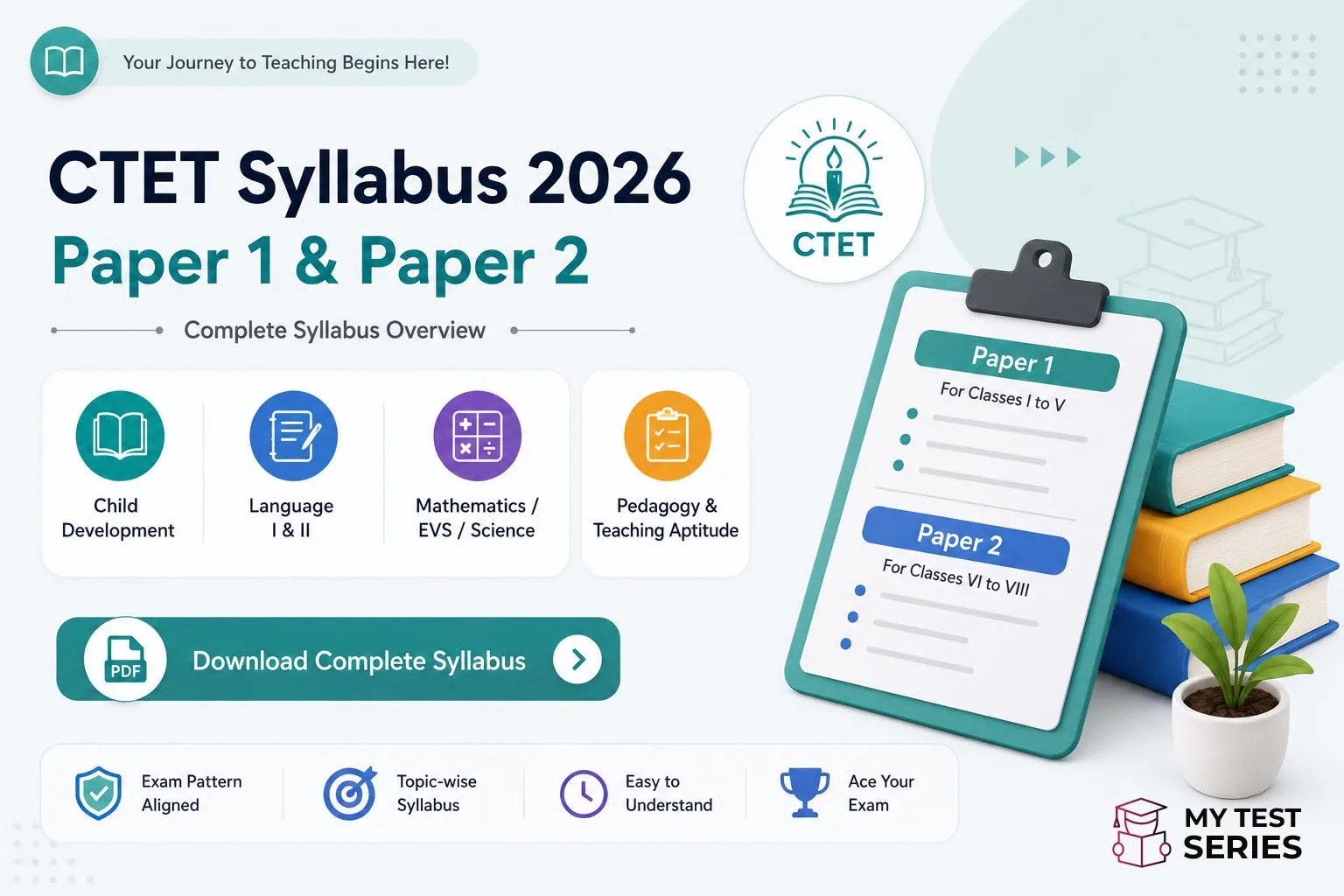
CTET Syllabus 2026 – Paper 1 & Paper 2
Complete Subject-Wise Guide
Everything you need — detailed topic list, exam pattern, marking scheme, best books, and free mock tests — for the CTET exam on 6 September 2026.
1. CTET 2026 – Overview & Key Dates
The Central Teacher Eligibility Test (CTET) is India's most prestigious national-level teacher eligibility exam, conducted by the Central Board of Secondary Education (CBSE). Clearing CTET is mandatory for teaching in central government schools — including Kendriya Vidyalayas, Navodaya Vidyalayas, and Central Tibetan Schools — for Classes I to VIII.
The CTET September 2026 notification was released on 11 May 2026. The exam is scheduled for 6 September 2026 (Sunday), making it a critical milestone for lakhs of teaching aspirants across India. Applications close on 10 June 2026, so if you haven't applied yet, act now.
| Parameter | Details |
|---|---|
| Conducting Body | CBSE (Central Board of Secondary Education) |
| Exam Name | Central Teacher Eligibility Test (CTET) 2026 |
| Notification Released | 11 May 2026 |
| Application Start | 11 May 2026 |
| Application Last Date | 10 June 2026 |
| Correction Window | 15–18 June 2026 |
| Exam Date | 6 September 2026 (Sunday) |
| Paper II Timing | 9:30 AM – 12:00 Noon |
| Paper I Timing | 2:00 PM – 4:30 PM |
| Exam Mode | Offline (OMR-based) |
| Admit Card | ~August 2026 (2–3 weeks before exam) |
| Official Website | ctet.nic.in |
| Helpline | 011-22240112 | ctet.cbse@nic.in |
2. CTET 2026 Exam Pattern – Paper 1 & Paper 2
Understanding the exam structure is your first weapon. Both papers carry 150 MCQs for 150 marks, last 2.5 hours, and have zero negative marking. Here's the complete breakdown:
Paper 1 – Exam Pattern (Classes 1–5, Primary Level)
| Subject | No. of Questions | Marks |
|---|---|---|
| Child Development & Pedagogy | 30 MCQs | 30 |
| Language I (chosen by candidate) | 30 MCQs | 30 |
| Language II (chosen by candidate) | 30 MCQs | 30 |
| Mathematics | 30 MCQs | 30 |
| Environmental Studies (EVS) | 30 MCQs | 30 |
| Total | 150 MCQs | 150 |
Paper 2 – Exam Pattern (Classes 6–8, Upper Primary Level)
| Subject | No. of Questions | Marks |
|---|---|---|
| Child Development & Pedagogy | 30 MCQs | 30 |
| Language I (chosen by candidate) | 30 MCQs | 30 |
| Language II (chosen by candidate) | 30 MCQs | 30 |
| Mathematics & Science OR Social Studies/Science (candidate's choice) | 60 MCQs | 60 |
| Total | 150 MCQs | 150 |
3. CTET Paper 1 Syllabus 2026 – Classes 1 to 5 (Primary Stage)
Paper 1 is for candidates who want to teach Classes 1 to 5. Every subject in Paper 1 has an equal weight of 30 marks. Pay special attention to the pedagogy component in each section — these questions account for roughly 40–50% of the subject marks and are often the deciding factor between pass and fail.
- Concept of development & relationship with learning
- Principles of child development (Piaget, Vygotsky, Kohlberg)
- Influence of heredity & environment
- Socialization processes – social world & children
- Language & thought (Vygotsky's theory)
- Concept of intelligence (Gardner's Multiple Intelligences)
- Individual differences – language, gender, caste, community
- Inclusive education – gifted, learning disabilities, CWSN
- Child as a problem solver & scientific investigator
- Cognition & emotions
- Motivation & learning – intrinsic vs extrinsic
- Assessment for learning vs assessment of learning
- Formative & summative assessment – CCE, portfolios
- Critical perspective of constructivism
- NEP 2020 – key principles and implications
- Reading comprehension – two unseen passages
- Poem comprehension – one unseen poem
- Language acquisition and development
- Principles of language teaching
- Role of listening & speaking – language functions
- Grammar – functional understanding in context
- Challenges of teaching language in diverse classroom
- Language skills: reading, writing, listening, speaking
- Teaching-learning materials – textbooks, multimedia
- Remedial teaching in language
- Evaluation of language comprehension & proficiency
- Comprehension – two unseen prose passages
- Elements of language – phonology, morphology, syntax
- Language learning & acquisition theories
- Role of home language & multilingualism
- Communicative language teaching approach
- Teaching second/third language
- Written form of language – formal writing & creative writing
- Evaluation of language comprehension & proficiency
- Remedial teaching approaches
- Numbers – place value, operations, patterns
- Whole numbers, fractions, decimals, rational numbers
- Geometry – shapes, angles, triangles, quadrilaterals
- Measurement – length, mass, capacity, time, money
- Perimeter, area and volume
- Data handling – bar graphs, pie charts, mean/median/mode
- Patterns and algebra (introduction)
- Mental arithmetic
- Nature of mathematics – logical thinking, problem solving
- Place of mathematics in curriculum
- Community mathematics
- Error analysis – diagnostic and remedial teaching
- Problems of teaching mathematics
- Evaluation through formal & informal methods
- Family & friends – relationships, work, play, animals, plants
- Food – components, sources, preparation & preservation
- Shelter – types of houses, building materials
- Water – sources, conservation, water cycle
- Travel & transport – means of transport, maps
- Things we make & do – handicrafts, local occupations
- Plants – types, uses, habitat, photosynthesis
- Animals – types, adaptation, food chains
- Natural resources – air, water, soil, energy
- Environmental pollution & conservation
- Biodiversity – forests, wildlife, national parks
- EVS & its significance in curriculum
- Environmental education – learning principles
- Scope & relation to science & social science
- Concept mapping, discussion, project, field visits
- CCE – portfolios, observation records
📚 CTET Paper 1 EVS – 50 Must-Know Previous Year Questions
Covers Food, Shelter, Water, Plants, Animals with detailed answers.
4. CTET Paper 2 Syllabus 2026 – Classes 6 to 8 (Upper Primary Stage)
Paper 2 is for candidates aiming to teach Classes 6 to 8. The key difference here is the optional subject section — you must choose either Mathematics & Science OR Social Studies/Social Science based on your teaching specialisation. This section carries 60 marks, making subject choice a high-stakes decision.
- Child development – concepts & principles
- Theories: Piaget (Cognitive), Vygotsky (Socio-Cultural), Kohlberg (Moral)
- Erikson's Psychosocial stages
- Adolescent development – physical, cognitive, social
- Individual differences – ability, aptitude, learning styles
- Gardner's Multiple Intelligences & Howard Gardner's theory
- Motivation – Maslow's Hierarchy of Needs
- Inclusive education – disabilities, gifted learners, CWSN
- NEP 2020 implications for upper primary education
- Learning theories – Behaviourism, Cognitivism, Constructivism
- Formative assessment, portfolios, self/peer assessment
- Problem-solving, critical thinking & creative thinking
- Gender issues – gender as a social construct
- Reading comprehension – 2 unseen prose passages
- Grammar in context – not formal rules
- Language acquisition vs language learning
- Role of first language in second language learning
- Challenges of diverse linguistic backgrounds
- Language across the curriculum
- Teaching language skills at secondary stage
- Evaluation of language – listening, speaking, reading, writing
- Two comprehension passages (prose/poem)
- Elements of language – vocabulary, morphology, syntax
- Communicative language teaching (CLT)
- Teaching English/Hindi as a second/third language
- Multilingualism & its advantages in classroom
- Language and social power dynamics
- Remedial teaching – error correction strategies
- Mathematics (30 marks):
- Number system – rational & irrational numbers
- Algebra – expressions, equations, polynomials
- Geometry – lines, triangles, circles, constructions
- Mensuration – area, surface area, volume
- Statistics & probability
- Patterns, ratio & proportion, exponents
- Data handling – graphs and interpretation
- Maths pedagogy – nature, problem-solving, errors
- Science (30 marks):
- Food – sources, components, nutrition
- Materials – metals, non-metals, fibres, acids/bases
- The world of living – adaptation, reproduction
- Motion, force, pressure, electricity, magnetism
- Light, sound, heat
- Natural phenomena – earthquakes, cyclones, lightning
- Natural resources – air, water, soil, coal, petroleum
- Science pedagogy – inquiry method, 5E model
- History: When, Where and How; early civilisations; Indus Valley; Vedic India; Mauryan, Gupta periods; Medieval India; Modern India; freedom struggle
- Geography: Solar system, globe, maps; India's terrain; drainage system; climate zones; natural vegetation; minerals & resources; human resources
- Social & Political Life: Democracy; government – local, state, central; Parliament; courts; Fundamental Rights & Duties; social justice; gender & caste
- Economics: Markets, money, producers & consumers; poverty; globalisation basics
- Social Science Pedagogy: Nature of SS, critical thinking; inquiry method; constructivist approach; sources – primary & secondary; project work; field visits; ICT in SS; assessment in SS
5. Qualifying Marks & Certificate Validity
CTET is a qualifying exam — you either pass or fail. There is no merit ranking or seat allotment based on CTET score alone. Each school/recruitment board uses the CTET score as an eligibility filter and conducts its own selection process thereafter.
| Category | Minimum Marks Required | Percentage Required |
|---|---|---|
| General / Unreserved (UR) | 90 out of 150 | 60% |
| OBC (Non-Creamy Layer) | 82–83 out of 150 | 55% |
| SC / ST | 82–83 out of 150 | 55% |
| Persons with Disabilities (PwD) | 82–83 out of 150 | 55% |
6. CTET 2026 Preparation Strategy – Subject by Subject
With roughly 3 months remaining until the September 2026 exam, a focused, structured approach is non-negotiable. Here is a proven strategy used by thousands of CTET qualifiers on MyTestSeries:
Phase 1 (Weeks 1–4): Concept Building
- Start with Child Development & Pedagogy — it is 20% of both papers and the highest-yield investment of your time.
- Read NCERT textbooks for Classes 1–8 for your subject area. CTET questions are directly NCERT-based.
- Master the key theorists: Piaget's four stages, Vygotsky's ZPD, Kohlberg's moral levels, Bloom's Taxonomy, Gardner's 8 intelligences.
- Begin building vocabulary and reading comprehension skills for Language I and II daily.
Phase 2 (Weeks 5–9): Practice & Mock Tests
- Solve a minimum of 50 MCQs every day across subjects — MyTestSeries free mock tests are perfectly calibrated to the CTET pattern.
- Attempt at least 2 full-length mock tests per week under timed conditions (150 questions in 150 minutes).
- Review every wrong answer in detail — understanding why you went wrong matters more than the score.
- Focus 60% of your time on pedagogy, 40% on content in each subject.
Phase 3 (Weeks 10–12): Revision & Gap Filling
- Revise all CDP theories using flashcard-style notes — Piaget, Vygotsky, Kohlberg should be second nature.
- Solve CTET Previous Year Papers (2019–2024) — past papers reveal the exact question style and weighting.
- Identify your weakest subject and give it 40% of daily study time in the final 2 weeks.
- Attempt 1 full mock test daily in the final week. Do not study new topics after Day 10 of Phase 3.
7. Best Books for CTET 2026 – Subject-Wise
Choosing the right study material can save you weeks of wasted effort. Based on our analysis of CTET toppers and the complete CTET book comparison on MyTestSeries, here are the most effective resources:
| Subject | Recommended Book | Why Use It |
|---|---|---|
| CDP (Both Papers) | Arihant Child Development & Pedagogy | Best coverage of all theorists, 600+ exam-pattern MCQs, NEP 2020 updated |
| CDP (Deep Theory) | Pearson/Sandeep Kumar – Complete Resource for CDP | Deeper theoretical explanations; ideal if aiming for 28+ out of 30 |
| Mathematics (Paper 1) | Arihant Mathematics for CTET Paper 1 + NCERT Class 1–5 | Strong pedagogy section; concept clarity + 200+ practice questions per chapter |
| Mathematics (Paper 2) | Success Master CTET Paper 2 Math & Science – Arihant | 3000+ MCQs, combined book, excellent for both Maths and Science in one go |
| EVS (Paper 1) | Arihant EVS & Pedagogy + NCERT Class 3–5 Science/EVS | Great concept coverage; topic-aligned with CTET pattern |
| Social Science (Paper 2) | Disha/Arihant Social Studies + NCERT Class 6–8 | Flowcharts, timelines, and PYQs; outstanding pedagogy section |
| English Language | English Language by Geeta Sahni (or Arihant English) | Strong on reading comprehension, grammar-in-context, and pedagogy |
| PYQ Practice | Kiran Prakashan CTET Solved Papers (Last 10 years) | Most trusted for actual exam question patterns and difficulty calibration |
8. Free Mock Tests & Practice Resources on MyTestSeries
Mock tests are not optional — they are the most reliable predictor of your CTET score. Research consistently shows that candidates who take 10+ full-length mock tests before the exam score 15–20% higher than those who only study theory. Here's what MyTestSeries offers, completely free:
🎯 Why Practice on MyTestSeries?
500+ topic-wise MCQs | Full-length Paper 1 & Paper 2 mocks | Instant performance analytics | CDP, Maths, EVS, Science, SST section tests | Real exam interface | Detailed answer explanations
✅ Start Practising Free →Subject-Wise Practice Resources on MyTestSeries
All these resources are available at no cost after a quick one-time registration. Create your free account now →
9. CTET 2026 – Frequently Asked Questions
These are the most-searched questions about CTET 2026 syllabus and exam. If you have more questions, drop them in the comments below or contact us after registering.
What is the CTET 2026 exam date?
The CTET September 2026 exam is on 6 September 2026 (Sunday). Paper II (Classes 6–8) runs from 9:30 AM to 12:00 Noon, and Paper I (Classes 1–5) from 2:00 PM to 4:30 PM. If candidate volume is very high, the exam may extend to 5 September 2026 as well.
What are the subjects in CTET Paper 1?
CTET Paper 1 has five subjects — Child Development & Pedagogy (30 marks), Language I (30 marks), Language II (30 marks), Mathematics (30 marks), and Environmental Studies (30 marks). Total: 150 MCQs for 150 marks.
What are the subjects in CTET Paper 2?
CTET Paper 2 includes Child Development & Pedagogy (30 marks), Language I (30 marks), Language II (30 marks), and either Mathematics & Science OR Social Studies/Social Science (60 marks) as per the candidate's choice.
Is there negative marking in CTET 2026?
No. CTET 2026 carries zero negative marking. Every correct answer earns 1 mark. Wrong answers carry no deduction. This means you should attempt every single question — never leave any blank.
What are the qualifying marks for CTET 2026?
General category candidates need at least 60% (90/150 marks). SC/ST/OBC/PwD candidates need at least 55% (approximately 82–83 marks). The CTET certificate earned is valid for lifetime since the 2021 rule change.
Can I appear for both CTET Paper 1 and Paper 2 together?
Yes, absolutely. Candidates aspiring to teach both primary (Classes 1–5) and upper primary (Classes 6–8) can apply for both papers in the same exam cycle. You pay separate fees for each paper, and they are held in separate shifts on the same day.
How many times can I attempt CTET?
There is no limit on the number of CTET attempts. You can appear as many times as you wish until you qualify. Once you qualify, the certificate is valid for lifetime.
Does CTET certificate work for state government school jobs?
CTET is mandatory only for central government school teaching posts (KVS, NVS, Army Schools, etc.). For state government schools, the respective State TET is required. However, many states also accept CTET scores. Read our detailed comparison: CTET vs State TET – Which is Better?
What is the difficulty level of CTET 2026?
Paper 1 is at the upper primary (Class 6–8) difficulty level for content questions. Paper 2 content questions are at Class 6–8 to senior secondary level. However, the pedagogy questions in both papers require a strong understanding of educational psychology and teaching methods, which many candidates underestimate.
Is the CTET 2026 syllabus different from previous years?
The core syllabus structure remains consistent, but CBSE updates procedural details and sometimes minor topic emphases with each notification. The 2026 syllabus notably includes NEP 2020 principles in the CDP section. Always download the official syllabus PDF from ctet.nic.in and cross-reference with our guide above.
🛒 CTET 2026 Test Series & Study Products
Accelerate your CTET preparation with these high-value resources — all accessible after your free registration on MyTestSeries:
CTET Paper 1 – Complete Mock Test Series
CTET Paper 2 – Math & Science / Social Science Series
CTET Both Papers – Combined Preparation Bundle
Child Development & Pedagogy – Master Series
Ready to Crack CTET 2026? 🎯
Join thousands of teaching aspirants already practising on MyTestSeries. Free mock tests, topic-wise MCQs, performance tracking — everything you need, at zero cost.
🚀 Register Free – Start TodayNo credit card required · Access 500+ practice questions instantly