CTET Cut Off 2026 &
Passing Marks — Complete
Category-Wise Guide
Exactly how many marks do you need to pass CTET? This is the question every aspirant asks right after the exam. Get the definitive, CBSE-verified answer — category-wise qualifying scores, year-by-year trends, pass percentages, section-wise strategy and everything else you need to clear CTET 2026 with confidence.
What Is CTET Cut Off? Understanding the Basics
Before anything else, let's settle a confusion that trips up thousands of candidates: CTET does not have a competitive cut off. Unlike entrance exams or government job written tests where cut offs fluctuate based on vacancies and the number of applicants, CTET follows a fixed minimum qualifying mark system set by the National Council for Teacher Education (NCTE) and administered by CBSE.
This means the passing threshold is decided before the exam — not after. Whether five lakh or twenty-five lakh candidates appear, the qualifying mark stays the same (unless CBSE exercises its authority to revise it). Once you meet or exceed this minimum score, you receive a CTET eligibility certificate that is now valid for your entire lifetime.
This structure makes CTET uniquely aspirant-friendly — your success depends entirely on your own performance, not on the performance of others. That said, scoring well above the cut off significantly improves your chances during actual job selection at KVS, NVS, and state institutions.
CTET Cut Off 2026 — Official Category-Wise Marks
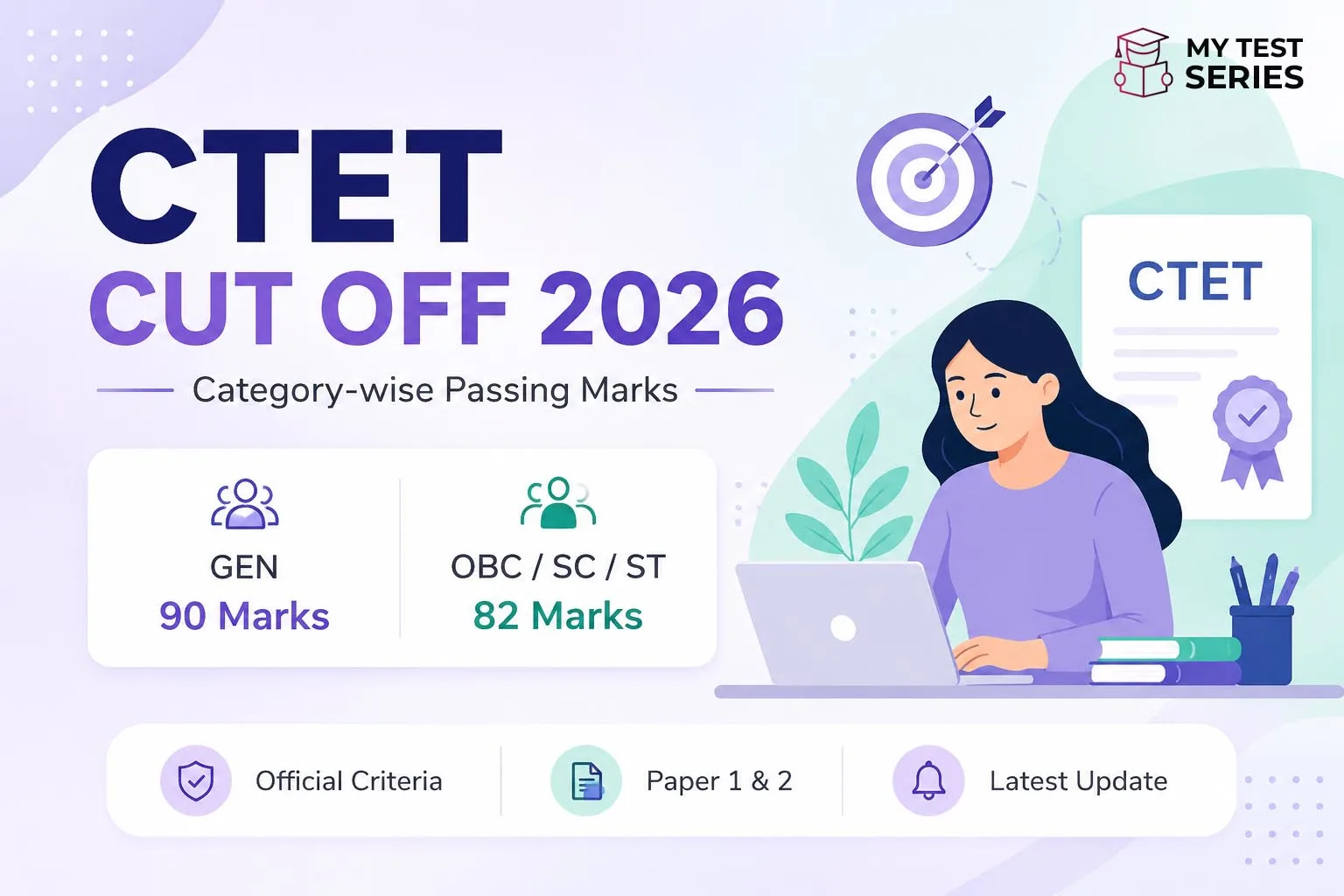
CBSE, in accordance with NCTE guidelines, has defined the following minimum qualifying marks for CTET 2026. These are identical for both Paper 1 (Classes 1–5) and Paper 2 (Classes 6–8):
| Category | Minimum % Required | Passing Marks (out of 150) | Marks Gap (8 marks less) |
|---|---|---|---|
| General / Unreserved (UR) General | 60% | 90 Marks | — |
| OBC (Non-Creamy Layer) Reserved | 55% | 82 Marks | 8 marks relaxation |
| SC (Scheduled Caste) Reserved | 55% | 82 Marks | 8 marks relaxation |
| ST (Scheduled Tribe) Reserved | 55% | 82 Marks | 8 marks relaxation |
| PwD (Differently Abled) Reserved | 55% | 82 Marks | 8 marks relaxation |
| Transgender Reserved | 55% | 82 Marks | 8 marks relaxation |
How Is Your Score Calculated?
The CTET exam carries 150 marks total — 150 questions, each worth 1 mark. There is no negative marking. Your raw score is simply the number of questions you answered correctly.
- Correct Answer: +1 mark
- Wrong Answer: 0 marks (no penalty)
- Unattempted: 0 marks (never leave blank — always guess)
Cut Off for Paper 1 vs Paper 2 — Are They Different?
One of the most common questions from CTET aspirants: "Is the cut off different for Paper 1 and Paper 2?" The clear answer is No. Both papers carry the same qualifying threshold.
- General: 90/150 (60%)
- SC/ST/OBC/PwD: 82/150 (55%)
- Feb 2026 Pass Rate: 33.69%
- Feb 2026 Qualified: 3,58,937
- General: 90/150 (60%)
- SC/ST/OBC/PwD: 82/150 (55%)
- Feb 2026 Pass Rate: 18.56%
- Feb 2026 Qualified: 3,46,738
If you're appearing for both papers (which is allowed), you must clear each independently. Clearing Paper 1 does not automatically qualify you for Paper 2, and vice versa.
CTET Exam Pattern & Marks Distribution
Understanding how marks are distributed across sections helps you plan where to invest your preparation time and how to target the cut off smartly.
Paper 1 — Classes 1 to 5 (150 Marks)
Paper 2 — Classes 6 to 8 (150 Marks)
| Feature | Paper 1 (Classes 1–5) | Paper 2 (Classes 6–8) |
|---|---|---|
| Mode | Offline (OMR-based) | |
| Duration | 2.5 Hours (150 Minutes) | |
| Total Questions | 150 MCQs | |
| Total Marks | 150 Marks | |
| Marking Scheme | +1 for correct, 0 for wrong/blank | |
| Negative Marking | None | |
| Sections | 5 sections (30 marks each) | 4 sections (30+30+30+60) |
| Language Options | 20+ language options for Language I & II | |
Section-Wise Score Strategy to Clear CTET Cut Off
Crossing 90 marks (General) or 82 marks (Reserved) in 150 questions is absolutely achievable — if you know where to invest your time. Here is a practical section-wise target framework:
Target Score Blueprint — Paper 1 (General Category, Target: 105+)
| Section | Total Marks | Safe Target Score | Difficulty Level |
|---|---|---|---|
| Child Development & Pedagogy | 30 | 22–25 | Moderate (Theory-heavy) |
| Language I | 30 | 22–26 | Moderate to Easy |
| Language II | 30 | 22–26 | Easy to Moderate |
| Mathematics | 30 | 20–25 | Moderate (Concept-based) |
| Environmental Studies | 30 | 22–25 | Easy to Moderate |
| Total Target | 150 | 108–127 | — |
Target Score Blueprint — Paper 2 (General Category, Target: 105+)
| Section | Total Marks | Safe Target Score | Priority Level |
|---|---|---|---|
| Child Development & Pedagogy | 30 | 22–25 | 🔴 High Priority |
| Language I | 30 | 22–26 | 🟡 Medium Priority |
| Language II | 30 | 22–26 | 🟡 Medium Priority |
| Subject (Maths/Science/SST) | 60 | 42–50 | 🔴 Highest Priority |
| Total Target | 150 | 108–127 | — |
🎯 Stop Reading. Start Practising.
The CTET cut off is 90 marks. Our mock tests tell you your current score — and what to do next. Join free today.
✅ Register Free at MyTestSeries.inYear-Wise CTET Cut Off Trends (2017–2026)
Here is the complete historical record of CTET qualifying marks across all sessions. This data is crucial for understanding whether the bar is likely to change in September 2026:
| Year / Session | General Cut Off | OBC Cut Off | SC Cut Off | ST Cut Off |
|---|---|---|---|---|
| 2026 (Feb) Latest | 90 / 150 | 82 / 150 | 82 / 150 | 82 / 150 |
| 2024 (Dec) | 90 / 150 | 82 / 150 | 82 / 150 | 82 / 150 |
| 2024 (Jul) | 90 / 150 | 82 / 150 | 82 / 150 | 82 / 150 |
| 2023 (Aug) | 90 / 150 | 82 / 150 | 82 / 150 | 82 / 150 |
| 2022 (Dec) | 90 / 150 | 82 / 150 | 82 / 150 | 82 / 150 |
| 2021 (Jan) | 87 / 150 | 85 / 150 | 80 / 150 | 80 / 150 |
| 2019 (Dec) | 87 / 150 | 85 / 150 | 80 / 150 | 80 / 150 |
| 2019 (Jul) | 90 / 150 | 82.5 / 150 | 82.5 / 150 | 82.5 / 150 |
| 2018 | 90 / 150 | 85 / 150 | 80 / 150 | 80 / 150 |
| 2017 | 87 / 150 | 85 / 150 | 80 / 150 | 80 / 150 |
Visual Trend — General Category Cut Off Over the Years
CTET Pass Percentage — Historical Data & Analysis
CTET has a reputation for having a low pass percentage — typically between 12% to 34% depending on the session and paper. Understanding these numbers helps set realistic expectations and motivates smarter preparation.
CTET February 2026 — Official Statistics
| Paper | Appeared (Feb 2026) | Qualified (Feb 2026) | Pass % |
|---|---|---|---|
| Paper 1 Classes 1–5 | 10,65,410 | 3,58,937 | 33.69% |
| Paper 2 Classes 6–8 | 18,67,428 | 3,46,738 | 18.56% |
| Combined | 23,24,625 | 5,97,061 | 25.68% |
Year-Wise Pass Percentage Comparison
| Year / Session | Paper 1 Pass % | Paper 2 Pass % | Qualified Candidates |
|---|---|---|---|
| Feb 2026 Latest | 33.69% | 18.56% | 5,97,061 |
| Dec 2024 | 24.17% | 12.31% | 2,78,277 |
| Jul 2024 | ~28% | ~16% | 3,66,279 |
| Jan 2024 | ~22% | ~12% | 2,38,878 |
| 2022 (Dec) | ~25% | ~14% | ~5.8L |
| 2021 (Jan) | ~27% | ~15% | 6,54,299 |
Factors That Determine CTET Cut Off
While the CTET qualifying marks are generally fixed, CBSE reserves the right to adjust them. Here are the factors it considers:
- NCTE Regulations: The National Council for Teacher Education prescribes the base percentage (60% for General, 55% for Reserved). CBSE follows this as the primary benchmark.
- Difficulty Level of Paper: If the question paper is notably harder than usual, CBSE can lower the qualifying marks slightly (as seen in some 2021 sessions where it was 87 for General).
- Number of Candidates Appeared: Higher candidate volumes increase competition in downstream job selections, but do not directly affect the CTET cut off since it is a qualifying, not a selective, exam.
- CBSE's Discretion: The board has the authority to revise the minimum qualifying marks at any session. This has happened rarely, but candidates should always check the official notification.
- Normalization Procedure: When the exam is conducted in multiple shifts, CBSE may apply normalization to balance difficulty variation between sets, which can affect final scores.
What Happens After You Clear the CTET Cut Off?
Clearing CTET is the gateway — not the destination. Here is what happens once you cross the qualifying mark:
-
1Result Declared on ctet.nic.in CBSE releases the result PDF. You can check your scorecard and qualifying status using your roll number and password on the official portal.
-
2Mark Sheet & Certificate on DigiLocker Your CTET digital marksheet and eligibility certificate are uploaded to DigiLocker linked to the mobile number used during application.
-
3Certificate Is Lifetime Valid Since 2021, the CTET certificate has no expiry. You never need to retake the exam just to renew eligibility.
-
4Apply for Teaching Positions Use your CTET certificate to apply for teacher vacancies at KVS, NVS, DSSSB, state government schools, private CBSE schools, and all institutions that recognise CTET scores.
-
5Higher Score = Better Job Prospects Though all pass certificates look the same, institutions often shortlist based on CTET score during interviews and selection rounds. A score of 120+ significantly boosts your profile. Keep improving with free practice tests at MyTestSeries.in.
| Organisation | CTET Paper Required | Posts Available |
|---|---|---|
| Kendriya Vidyalaya Sangathan (KVS) | Paper 1 & 2 | PRT, TGT positions |
| Navodaya Vidyalaya Samiti (NVS) | Paper 1 & 2 | PGT, TGT, PRT |
| DSSSB Delhi | Paper 1 & 2 | Primary & Upper Primary |
| State Government Schools (many) | Paper 1 & 2 | Varies by state |
| Private CBSE-Affiliated Schools | Paper 1 & 2 | Subject & Class Teacher |
| Army Schools & Central Institutions | Paper 2 mainly | TGT-level posts |
For a full career pathway comparison, read: CTET vs State TET — Which is Better for Teaching Jobs in India?
Proven Tips to Score Well Above the CTET Cut Off
Knowing the cut off is step one. Crossing it comfortably is step two. Here are the preparation strategies that consistently work for CTET toppers:
Master CDP First — 30 Marks, High Return
Child Development & Pedagogy has the most predictable questions. Topics like Piaget, Vygotsky, Kohlberg and Inclusive Education repeat every year. Score 24–28 here reliably. Read our Piaget's Theory guide.
Attempt All 150 Questions — Zero Penalty
There is no negative marking. Never leave a question blank. Use the elimination method to narrow down options even when unsure. This alone can add 5–10 bonus marks.
Time Management: 1 Minute Per Question
With 150 questions and 150 minutes, you have exactly 1 minute per question. Practice under timed conditions regularly. Take full-length mocks at MyTestSeries.in.
NCERT Is Your Bible — Class 1 to 8
All content questions in both papers are based on NCERT textbooks from Classes 1–8. For Paper 2, content linkages can go up to Senior Secondary level. Revise NCERT thoroughly.
Solve Previous Year Papers — 2018 to 2026
CTET has a recognisable question pattern that repeats. Solving the last 8–10 years' papers gives you real exam exposure and helps spot high-frequency topics. Read our Science PYQ Analysis.
Analyse Mock Test Performance Weekly
Taking a mock test without analysing it is wasted effort. After every test, spend equal time reviewing wrong answers, identifying weak sections, and reworking those topics before the next test.
Language Sections — Score Easy Marks
Language I and Language II together carry 60 marks. For most candidates, these are the easiest marks to score. Grammar, comprehension, and pedagogy of language follow a clear pattern.
Paper 2 Subject: 60 Marks — Non-Negotiable
For Paper 2, your subject section is the make-or-break factor. If you score below 35/60 in the subject, clearing the overall cut off becomes very difficult. Prioritise subject mastery above all else.
Frequently Asked Questions — CTET Cut Off & Passing Marks 2026
🏆 Your CTET 90+ Journey Starts Today
Join 50,000+ CTET aspirants on MyTestSeries.in. Free full-length mocks, CDP notes, previous year papers and performance analytics — all in one place.
🎯 Register Free — Start Practising Now🎯 CTET & Teaching Exam Preparation Resources
Everything you need to score above the cut off — available free at MyTestSeries.in:
CTET Full Mock Test Series
Paper 1 & 2 | Free + Premium- 150-question full-length mocks (timed)
- Section-wise & topic-wise tests
- Detailed solutions with explanations
- Score vs cut off tracking
- Previous year papers (2018–2026)
CDP Master Series
Guaranteed 22–28/30 Marks- Piaget, Vygotsky, Kohlberg notes
- Inclusive Education & RTE coverage
- Learning Theories with PYQ bank
- Constructivism & NEP 2020 topics
- High-frequency question patterns
CTET Paper 2 Science Pack
Classes 6–8 | 60 Marks Section- NCERT-based content (Class 6–8)
- Science pedagogy questions
- Previous year SAQ bank
- Biology, Chemistry, Physics splits
- Chapter-wise practice tests
UPTET 2026 Preparation Pack
Hindi Medium | State TET- UPTET Paper 1 & 2 mock tests
- Hindi medium study material
- UPTET + Super TET coverage
- Previous year question bank
- Score tracking & analytics
Official External Resources
- CTET Official Website — ctet.nic.in (Results, Admit Cards, Answer Keys, Notifications)
- NCTE Official Website — ncte.gov.in (Teacher Education Norms & Qualifying Marks Guidelines)
- CBSE Official — cbse.gov.in
- DigiLocker — digilocker.gov.in (Download CTET Certificate & Marksheet)