UAE Nursing & Healthcare Licensing
DHA Exam for Nurses: Syllabus, Pattern & Eligibility; DHA Nursing Exam Practice Questions (MCQs)
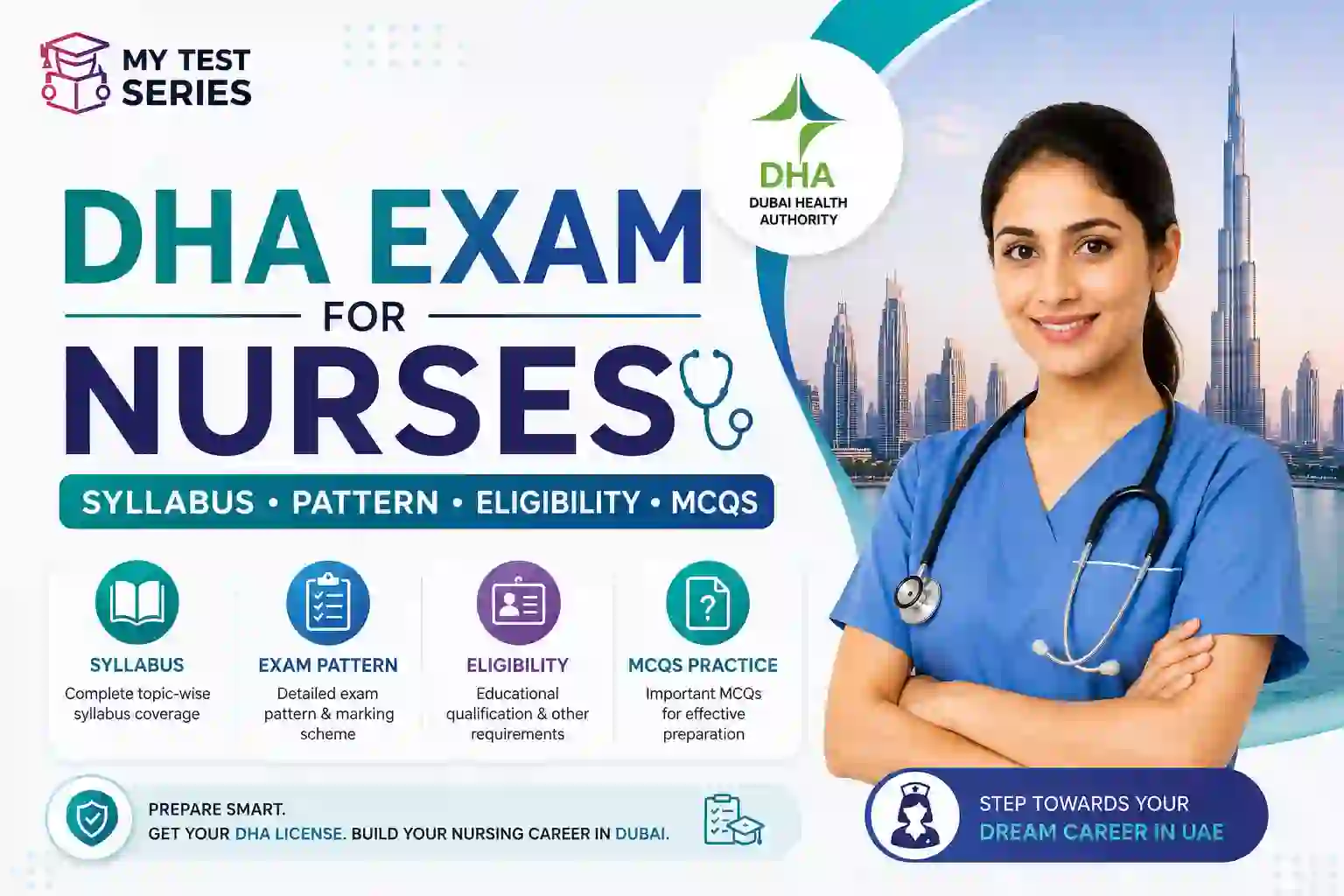
Quick answer: The DHA nursing exam is a 150-question, computer-based Prometric test covering Medical-Surgical Nursing, Community Health, Obstetrics, Paediatrics, Psychiatric Nursing, Pharmacology, and Fundamentals of Nursing, with roughly 165 minutes to finish, a passing score around 60%, and no negative marking. Eligibility runs through DHA's PQR framework and generally needs a GNM/B.Sc Nursing qualification, active nursing council registration, and clinical experience.
If you already know you need a DHA license, this guide skips the general orientation and goes straight into what nurses specifically need to know: the exact subject-wise syllabus, the eligibility rules that apply to GNM and B.Sc Nursing candidates, and — because reading a syllabus list rarely tells you how the exam actually feels — 20 free practice MCQs spanning every major subject, with explanations. For the bigger picture on Sheryan registration, DataFlow, and fees, our DHA Exam: Complete Guide covers the full process end-to-end.
Quick Navigation
- DHA Nursing Exam Syllabus (Subject-Wise)
- DHA Nursing Exam Pattern
- DHA Nursing Exam Eligibility Criteria
- Where the Marks Actually Come From
- How to Prepare Subject by Subject
- 20 Free DHA Nursing Exam Practice MCQs
- Mistakes That Cost Nurses Marks
- Why Your NORCET/ESIC Prep Already Helps
- FAQs
- Free WhatsApp Alerts
- Related Guides
DHA Nursing Exam Syllabus (Subject-Wise)
The DHA nursing syllabus is built around the same core clinical curriculum every GNM or B.Sc Nursing programme already covers, with an added layer of UAE-specific patient-safety and regulatory content. Here's what's actually tested:
Medical-Surgical Nursing
Cardiovascular, respiratory, renal, gastrointestinal, endocrine, and neurological disorders; peri-operative care; wound management; shock and emergency nursing.
Community & Public Health Nursing
Primary healthcare principles, epidemiology, immunisation schedules, national and international health programmes, health promotion.
Obstetric & Gynaecological Nursing
Antenatal, intranatal and postnatal care, high-risk pregnancy, labour stages, postpartum haemorrhage, newborn assessment.
Paediatric Nursing
Growth and development milestones, neonatal care, common paediatric illnesses, immunisation, paediatric emergency care.
Psychiatric / Mental Health Nursing
Common psychiatric disorders, therapeutic communication, crisis intervention, medication management in psychiatric care.
Pharmacology & Medication Safety
Drug classifications, dosage calculation, adverse drug reactions, high-alert medications, safe administration practices.
Fundamentals of Nursing & Patient Safety
Nursing process, vital signs, infection control, basic life support, patient positioning, documentation standards.
Professional Ethics & UAE Regulations
Scope of practice, patient rights, confidentiality, DHA-specific healthcare regulation and reporting requirements.
Every question in every subject leans toward applied, scenario-based clinical reasoning rather than textbook definitions — a question is far more likely to describe a patient situation and ask what you'd do next than to ask you to define a term.
DHA Nursing Exam Pattern
| Component | Detail |
|---|---|
| Total Questions | ~150 Multiple-Choice Questions |
| Duration | ~165 minutes (approx. 3 hours) |
| Passing Score | ~60% (indicative, confirm in your Sheryan dashboard) |
| Negative Marking | None — attempt every question |
| Delivery Mode | Computer-Based Test (CBT) via Prometric |
| Result Format | Pass / Fail only — no numeric score shown |
For the exam pattern of other DHA-licensed professions (doctors, dentists, pharmacists, allied health), see the full profession-wise breakdown in our DHA Exam Complete Guide.
DHA Nursing Exam Eligibility Criteria
DHA sets nurse eligibility under its Professional Qualification Requirement (PQR) framework. In general:
- Qualification: GNM (3-year diploma) or B.Sc Nursing (4-year degree) from a recognised institution.
- Registration: Active State Nursing Council or Indian Nursing Council registration, in good standing.
- Experience: Historically around 2 years of post-qualification clinical experience — relaxed for some recent graduates under the updated PQR, so it's worth re-checking even if you didn't qualify a year or two ago.
- Category: Registered Nurse eligibility differs from nursing-assistant or practical-nurse categories, which sit under a separate, lower-tier bracket.
We've mapped this in more depth — including how eligibility differs for doctors, pharmacists, dentists, physiotherapists, and technicians — in DHA License Eligibility Criteria 2026. If you're still unsure whether your specific role even needs a DHA license in the first place, start with Who Needs a DHA License to Work in Dubai/UAE?.
Where the Marks Actually Come From
Not every subject carries equal weight. Based on the syllabus structure, nurses preparing for DHA should expect Medical-Surgical Nursing and Community Health Nursing to dominate the paper, followed closely by Obstetrics, Paediatrics, and Pharmacology. Fundamentals of Nursing and Professional Ethics tend to appear as shorter, scenario-based questions spread throughout rather than as a separate block. If your revision time is limited, weight your final weeks toward Medical-Surgical and Pharmacology first — that's where the highest concentration of scenario-based questions typically sits.
How to Prepare Subject by Subject
- Medical-Surgical Nursing: Focus on emergency and critical-care scenarios — shock types, post-op complications, ICU basics — since these generate the most applied-reasoning questions.
- Community Health: Revise national and international immunisation schedules and epidemiological principles; these questions are often fact-recall rather than scenario-based, so they're high-value, low-effort marks.
- Obstetrics & Paediatrics: Drill labour-stage recognition, newborn assessment (APGAR-style reasoning), and common paediatric emergencies.
- Pharmacology: Practice dosage calculations under time pressure and memorise high-alert medication protocols — this subject rewards speed as much as knowledge.
- Fundamentals & Ethics: Don't skip this section assuming it's "easy" — scenario questions here often test judgement under ambiguous instructions, which trips up otherwise well-prepared candidates.
Practice the Same Subjects
Medical-Surgical, Community Health, Obstetrics, Paediatrics, and Pharmacology — the exact subjects DHA tests — are covered in daily topic-wise and full-set tests on MyTestSeries.
Start Registration →20 Free DHA Nursing Exam Practice MCQs
These sample questions mirror the scenario-based style of the actual DHA nursing exam. Tap "Show Answer" under each question to reveal the correct option and a short explanation — try answering before you peek.
Fundamentals of Nursing
1. A nurse is about to administer medication and notices the patient's name band is missing. What should the nurse do first?
- Administer the medication since the patient is in the correct bed
- Verify patient identity using at least two identifiers before proceeding
- Ask a colleague to confirm the patient's name verbally
- Delay administration until the end of the shift
Show Answer →
Correct: B. Patient safety protocols require at least two identifiers (e.g., name and date of birth or MRN) before any medication administration, regardless of familiarity with the patient or bed number.
2. Which vital sign parameter is the earliest and most sensitive indicator of clinical deterioration in adult patients?
- Blood pressure
- Respiratory rate
- Temperature
- Pulse oximetry
Show Answer →
Correct: B. Respiratory rate changes typically precede measurable drops in blood pressure or oxygen saturation, making it the earliest warning sign in most deterioration scoring systems.
3. The most effective single measure for preventing healthcare-associated infections is:
- Wearing gloves for all patient contact
- Hand hygiene at the correct moments
- Isolating all admitted patients
- Administering prophylactic antibiotics
Show Answer →
Correct: B. Hand hygiene, performed at the WHO's "5 moments," remains the single most effective and evidence-based infection-control measure, more impactful than routine glove use or blanket antibiotic use.
Medical-Surgical Nursing
4. A post-operative patient develops sudden shortness of breath, tachycardia, and chest pain on the third post-op day. The nurse should first suspect:
- Wound infection
- Pulmonary embolism
- Anxiety reaction
- Constipation
Show Answer →
Correct: B. Sudden dyspnoea, tachycardia, and chest pain in the early post-op period is a classic presentation of pulmonary embolism and requires immediate escalation, not reassurance.
5. In a patient with suspected hypovolemic shock, which finding would the nurse expect first?
- Bradycardia
- Increased urine output
- Tachycardia and cool, clammy skin
- Hypertension
Show Answer →
Correct: C. Compensatory tachycardia and peripheral vasoconstriction (cool, clammy skin) are early signs of hypovolemic shock, occurring before blood pressure drops significantly.
6. A diabetic patient presents with confusion, tremors, and sweating. Blood glucose reads 48 mg/dL. The priority nursing action is:
- Administer insulin
- Give a fast-acting oral glucose source if the patient can swallow safely
- Encourage the patient to rest
- Recheck glucose after 2 hours
Show Answer →
Correct: B. This presentation is hypoglycaemia, not hyperglycaemia. Immediate fast-acting glucose is required; insulin would worsen the emergency.
7. Which position is most appropriate for a patient experiencing acute respiratory distress?
- Supine, flat
- Trendelenburg
- High Fowler's position
- Left lateral
Show Answer →
Correct: C. High Fowler's position (nearly upright) maximises lung expansion and diaphragm movement, easing the work of breathing.
Community Health Nursing
8. Primary prevention in public health refers to:
- Early detection of disease through screening
- Actions taken to prevent disease before it occurs
- Rehabilitation after illness
- Treatment of an existing disease
Show Answer →
Correct: B. Primary prevention (immunisation, health education) aims to stop disease before onset. Screening is secondary prevention; rehabilitation is tertiary.
9. Which of the following best describes "herd immunity"?
- Immunity passed from mother to newborn
- Indirect protection from infection when a large percentage of a population is immune
- Immunity acquired after natural infection only
- Immunity that lasts for life without booster doses
Show Answer →
Correct: B. Herd immunity protects even unvaccinated individuals when enough of the population is immune, slowing or stopping disease transmission.
Obstetric & Gynaecological Nursing
10. A postpartum patient reports heavy vaginal bleeding with a soft, boggy uterus on palpation. The nurse's first action should be:
- Call the physician and wait for orders
- Perform fundal massage
- Administer oral fluids
- Reposition the patient and reassess in one hour
Show Answer →
Correct: B. A boggy uterus indicates uterine atony, the leading cause of postpartum haemorrhage. Fundal massage is the immediate first-line nursing action to stimulate contraction.
11. During labour, late decelerations on a fetal heart rate monitor most commonly indicate:
- Umbilical cord compression
- Uteroplacental insufficiency
- Normal fetal head compression
- Maternal anxiety
Show Answer →
Correct: B. Late decelerations, occurring after the peak of a contraction, are associated with reduced blood flow to the placenta and require prompt clinical evaluation.
Paediatric Nursing
12. At what age would a nurse typically expect an infant to achieve head control while prone?
- 1 month
- 3–4 months
- 8 months
- 12 months
Show Answer →
Correct: B. Head control in prone position is typically achieved by 3–4 months as part of normal gross motor development.
13. A febrile 18-month-old suddenly develops jerking movements and loses consciousness for under a minute. This most likely represents:
- Epileptic seizure disorder
- Febrile seizure
- Breath-holding spell
- Meningitis
Show Answer →
Correct: B. Brief generalised seizures associated with rapid fever rise in young children are classic febrile seizures, common and usually self-limiting, though they still require assessment to rule out other causes.
Psychiatric / Mental Health Nursing
14. Which nursing communication technique is most therapeutic when a patient expresses suicidal thoughts?
- Changing the subject to avoid distress
- Directly and calmly asking about the intent and plan
- Reassuring the patient nothing bad will happen
- Leaving the room to inform the family first
Show Answer →
Correct: B. Direct, calm, non-judgemental questioning about suicidal ideation is a core, evidence-based nursing skill; avoiding the topic can miss a safety risk.
Pharmacology & Medication Safety
15. A physician orders 500 mg of a drug, available as 250 mg per 5 mL. How many mL should the nurse administer?
- 5 mL
- 10 mL
- 15 mL
- 20 mL
Show Answer →
Correct: B. (500 mg ÷ 250 mg) × 5 mL = 10 mL.
16. Which class of medication requires the nurse to monitor for signs of respiratory depression most closely?
- Antibiotics
- Opioid analgesics
- Antihistamines
- Antacids
Show Answer →
Correct: B. Opioids depress the central respiratory drive and are classified as high-alert medications requiring close respiratory monitoring.
17. Before administering an IV potassium chloride infusion, the nurse's most important safety check is to:
- Confirm it is never given as a rapid IV push
- Warm the solution before infusion
- Give it via intramuscular route instead
- Mix it with any available IV fluid
Show Answer →
Correct: A. Undiluted or rapid IV push potassium chloride can cause fatal cardiac arrhythmias; it must always be properly diluted and infused slowly via pump.
Professional Ethics & Patient Safety
18. A conscious, competent adult patient refuses a recommended treatment. The nurse's most appropriate action is to:
- Administer the treatment anyway for the patient's benefit
- Respect the patient's autonomy while documenting the refusal and informing the physician
- Ask a family member to override the decision
- Discharge the patient immediately
Show Answer →
Correct: B. Competent adult patients have the right to refuse treatment. The nurse's role is to respect autonomy, ensure informed understanding, document clearly, and notify the physician.
19. Which action best demonstrates patient confidentiality in daily nursing practice?
- Discussing case details in a public elevator
- Sharing patient information only with those directly involved in care, on a need-to-know basis
- Posting anonymised case details on social media for learning purposes
- Leaving patient charts open at the nurses' station
Show Answer →
Correct: B. Confidentiality requires sharing information strictly on a need-to-know basis with the care team, regardless of how the information is anonymised or where it's discussed.
20. Documentation of nursing care should be:
- Completed at the end of the shift from memory
- Factual, timely, and completed as close to the event as possible
- Written only when an incident occurs
- Optional if verbal handover was given
Show Answer →
Correct: B. Legal and professional standards require documentation to be factual, objective, and recorded as close to real time as possible — not reconstructed later from memory.
Want 500+ More Questions Like These?
These 20 MCQs are a sample. Get daily full-set tests and topic-wise practice covering every DHA nursing subject, with detailed explanations for each answer.
Register Now →Mistakes That Cost Nurses Marks
- Reading questions as recall instead of scenario: Many candidates look for the textbook-correct answer instead of the safest immediate action in the scenario described — DHA rewards the latter.
- Skipping dosage-calculation practice: Pharmacology math questions are a common, avoidable point-loss when candidates haven't drilled calculations under time pressure.
- Leaving questions unanswered: With no negative marking, every blank answer is a guaranteed zero for that question — always mark something before time runs out.
- Under-preparing Community Health: It's often treated as "less important" than Medical-Surgical, but it contains high-value, fact-based questions that are easier to secure with focused revision.
Why Your NORCET/ESIC Prep Already Helps
If you've been preparing for Indian government nursing recruitment, you're closer to DHA-ready than you might think. The AIIMS NORCET syllabus and exam pattern covers nearly the same core subjects — Medical-Surgical, Community Health, Obstetrics, Paediatrics, and Pharmacology — just with a different exam format. If you've already reviewed the AIIMS NORCET eligibility criteria or compared ESIC Nursing Officer vs AIIMS NORCET as career paths, that same clinical foundation transfers directly into DHA prep. Our Best Books for AIIMS NORCET 2026 list also works well as DHA revision material, since the tested subjects barely change across these exams.
Still deciding which UAE authority even applies to you? Read DHA vs HAAD vs MOH vs DHCC: Full Comparison before you start DataFlow, and if you're not yet sure DHA is the right license for your role at all, start with What Is the DHA Exam? Full Overview.
Frequently Asked Questions
What is the syllabus for the DHA nursing exam?
Fundamentals of Nursing, Medical-Surgical Nursing, Community & Public Health Nursing, Obstetric & Gynaecological Nursing, Paediatric Nursing, Psychiatric/Mental Health Nursing, Pharmacology & Medication Safety, and Professional Ethics with UAE healthcare regulations. Medical-Surgical and Community Health typically carry the heaviest weightage.
How many questions are in the DHA nursing exam?
Typically around 150 multiple-choice questions to be completed in roughly 165 minutes, with a passing score around 60% and no negative marking.
What is the eligibility criteria for the DHA nursing exam?
Generally a GNM diploma or B.Sc Nursing degree from a recognised institution, active State/Indian Nursing Council registration, and post-qualification clinical experience — historically around two years, relaxed for some recent graduates under the updated PQR.
Is there negative marking in the DHA nursing exam?
No. There's no negative marking, so nurses should attempt every question rather than leaving any blank.
Where can I practice DHA nursing exam MCQs for free?
MyTestSeries offers free subject-wise nursing MCQ practice, previous-pattern mock tests, and detailed explanations covering the same core subjects tested in the DHA nursing exam, through the One Nursing Exam Pass test series.
Join Our Free WhatsApp Community
Get exam alerts, free syllabus PDFs, and daily mock test updates for nursing and other competitive exams — choose your preferred language:
Related Guides & Test Series You Shouldn't Miss
Related Exam Products
Official sources for verification:
- Dubai Health Authority – official website
- Sheryan – DHA online licensing portal & self-assessment tool
- DataFlow Group – Primary Source Verification
- Prometric – exam scheduling
This guide, including the practice MCQs, is prepared for informational and study purposes using publicly available information as of August 2026. It is original content, not sourced from any copyrighted question bank. DHA's syllabus, exam pattern, and eligibility rules change periodically — always confirm the latest details in your official Sheryan account before making payments or booking your exam.