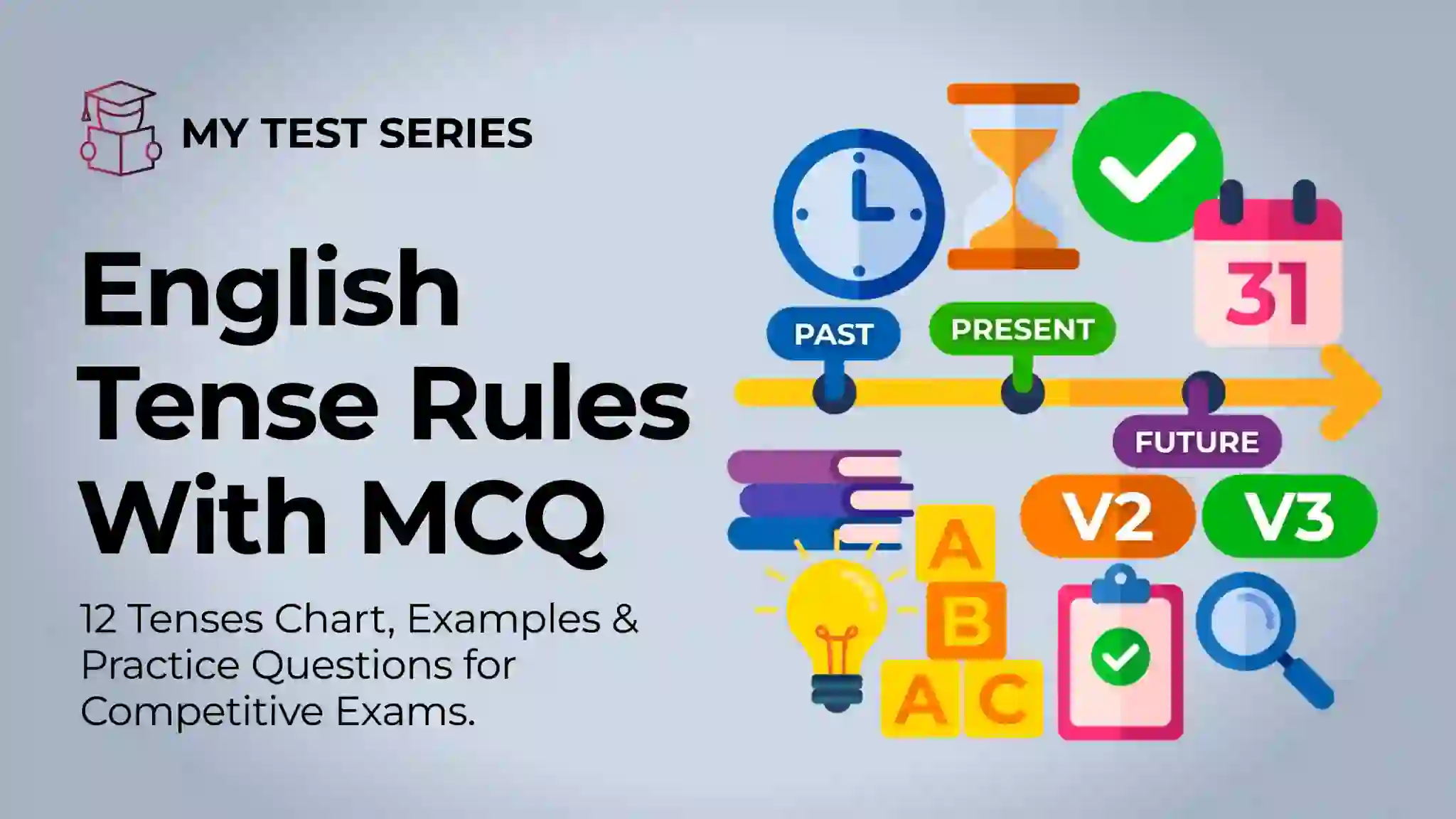
Tense Rules with Examples and MCQ
Learn English Tense Rules in a simple, exam-focused way with formulas, examples, tense charts, common mistakes, quick tricks and MCQ practice. This complete guide covers the traditional 12-tenses framework and is useful for TET, CTET, WB TET, Panchayat, WBP, WBPSC and other competitive examinations.
Tense is the grammatical system used to show the time and aspect of an action, event or state. In traditional competitive-exam grammar, English is commonly studied through 12 tense forms: Present, Past and Future, each divided into Simple, Continuous, Perfect and Perfect Continuous.
The most effective way to learn tense is to understand the meaning first, then learn the structure, practise examples and finally solve mixed MCQs.
What is Tense in English Grammar?
Tense tells us how an action or state is related to time. In competitive English grammar, tense questions usually test whether the learner can select the correct verb form according to the meaning and structure of the sentence.
For example:
Tense questions may appear as fill-in-the-blanks, error spotting, sentence correction, transformation or direct MCQs. Therefore, simply memorising a tense chart is not enough. You should understand when and why a particular form is used.
Important Note: The Traditional 12-Tense Framework
Competitive-exam books commonly teach English through a 12-tenses framework: four forms each for Present, Past and Future. This is extremely useful for examination preparation.
However, modern grammar descriptions are more nuanced. For example, Cambridge notes that English does not have a single inflected “future tense” form; future time can be expressed using several constructions such as will, be going to, the present continuous and the present simple.
12 Tenses in English Grammar: Complete Chart
The easiest way to understand the system is to divide it into three time groups and four aspects.
| Time | Simple | Continuous | Perfect | Perfect Continuous |
|---|---|---|---|---|
| Present | Present Simple | Present Continuous | Present Perfect | Present Perfect Continuous |
| Past | Past Simple | Past Continuous | Past Perfect | Past Perfect Continuous |
| Future | Future Simple | Future Continuous | Future Perfect | Future Perfect Continuous |
Usually focuses on facts, habits, completed events or straightforward future decisions/predictions.
Focuses on an action in progress around a particular time.
Connects an earlier action with a later reference point.
Emphasises duration or ongoing activity up to a reference point.
Present Tense Rules with Examples
Present tense forms are used for present-time meanings, habits, general truths, actions happening around now, completed actions connected to the present and activities continuing up to the present.
1. Present Simple Tense
Present Simple is commonly used for habits, routines, general truths, facts, permanent situations and scheduled events.
Affirmative: Subject + V1 / V1+s/es + Object Negative: Subject + do/does + not + V1 + Object Interrogative: Do/Does + Subject + V1 + Object?I read English newspapers every day.
She reads English newspapers every day.
They do not play football on Sunday.
Does he work here?
2. Present Continuous Tense
Present Continuous generally describes an activity happening around the present time or a temporary situation.
Affirmative: Subject + am/is/are + V-ing + Object Negative: Subject + am/is/are + not + V-ing + Object Interrogative: Am/Is/Are + Subject + V-ing + Object?I am preparing for the examination.
She is reading a book.
They are playing cricket.
Are you studying now?
3. Present Perfect Tense
Present Perfect commonly connects a past action or event with the present. It can describe a completed action with present relevance, life experience or an action within an unfinished time period.
Affirmative: Subject + has/have + V3 + Object Negative: Subject + has/have + not + V3 + ObjectI have finished my homework.
She has completed the test.
They have visited Delhi.
I saw him yesterday. ✓
I have seen him yesterday. ✗
4. Present Perfect Continuous Tense
This form emphasises an activity that started in the past and continues up to the present or has a present connection, especially when duration is important.
Subject + has/have + been + V-ing + ObjectI have been studying for three hours.
She has been working here since 2022.
They have been waiting for the bus.
Since usually introduces a starting point, while for generally introduces a duration.
I have lived here for six years.
Past Tense Rules with Examples
Past tense forms describe events, actions or states associated with an earlier time. The exact form depends on whether the action was simple, in progress, completed before another past event or continuing for a period before a past reference point.
5. Past Simple Tense
Past Simple is commonly used for completed actions or events in the past.
Affirmative: Subject + V2 + Object Negative: Subject + did not + V1 + Object Interrogative: Did + Subject + V1 + Object?I visited Kolkata last week.
She completed the assignment yesterday.
They did not attend the class.
Did you see him?
Did he go? ✓
Did he went? ✗
6. Past Continuous Tense
Past Continuous describes an action that was in progress at a particular time in the past.
Subject + was/were + V-ing + ObjectThey were playing football at 5 p.m.
She was cooking when the guests arrived.
7. Past Perfect Tense
Past Perfect is used when we want to show that one past event happened before another past event.
Subject + had + V3 + ObjectHere, the train leaving happened earlier than our reaching the station.
8. Past Perfect Continuous Tense
Past Perfect Continuous emphasises the duration of an activity that continued up to a particular point in the past.
Subject + had + been + V-ing + ObjectThe activity of studying continued for a period before the later past event—the examination beginning.
Future Tense Rules and Future-Time Expressions
In competitive-exam grammar, future forms are commonly grouped into four traditional categories. In actual English, however, future time can be expressed in several ways.
9. Future Simple
Subject + will + V1 + ObjectShe will come tomorrow.
They will complete the work.
Will can be used for predictions, decisions made at the moment of speaking, promises and other future meanings depending on context.
10. Future Continuous
Subject + will be + V-ing + ObjectIt describes an activity that will be in progress around a future time.
11. Future Perfect
Subject + will have + V3 + ObjectThe action is viewed as completed before a specified future point.
12. Future Perfect Continuous
Subject + will have been + V-ing + ObjectThis form focuses on duration continuing up to a future reference point.
Will vs Be Going To
| Form | Common Use | Example |
|---|---|---|
| will | Prediction, spontaneous decision, promise | I will help you. |
| be going to | Plan/intention or prediction based on present evidence | It is going to rain. |
| Present Continuous | Arranged future event | I am meeting my teacher tomorrow. |
| Present Simple | Timetables and schedules | The train leaves at 7 p.m. |
Tense Signal Words: Quick Revision Chart
Signal words can provide useful clues, but they should never replace understanding the meaning of the complete sentence.
| Tense/Form | Common Clues | Example |
|---|---|---|
| Present Simple | always, usually, often, every day | He usually walks to school. |
| Present Continuous | now, at present, currently | She is studying now. |
| Present Perfect | already, just, yet, ever, never | He has already finished. |
| Present Perfect Continuous | since, for, all day | She has been working since morning. |
| Past Simple | yesterday, ago, last week | He visited us yesterday. |
| Past Continuous | while, at that time | He was sleeping when I called. |
| Past Perfect | before, after, by the time | The train had left before we arrived. |
| Past Perfect Continuous | for, since, before | He had been waiting for an hour. |
| Future Simple | tomorrow, next week, soon | She will come tomorrow. |
| Future Continuous | this time tomorrow | I will be travelling this time tomorrow. |
| Future Perfect | by, by then, by next year | She will have finished by Monday. |
| Future Perfect Continuous | for + duration + future point | He will have been working for ten years. |
Most Common Tense Errors in Competitive Exams
Incorrect: Did you went there?
Correct: Did you go there?
Since generally introduces a starting point.
For generally introduces a duration.
Use Past Simple for a completed action with a definite finished past-time expression.
He, she and it normally take the -s/-es form in affirmative Present Simple sentences.
When one past action clearly happened before another, check whether Past Perfect is required.
Some verbs describing states are not normally used in continuous forms in their usual meanings. Always consider meaning and context.
Common Error Examples
✅ I met him yesterday.
✅ She did not go to school.
✅ He knows the answer.
✅ I have been living here since 2020.
Why Tense Is Important for Competitive Exams
Tense is frequently connected with other grammar areas. A question may appear to test tense but also require knowledge of subject-verb agreement, auxiliaries, verb forms, reported speech or sentence structure.
For example, MyTestSeries's existing Panchayat English resource groups Tense with Voice, Narration, Articles, Prepositions and Subject-Verb Agreement as important grammar areas.
Its WB Upper Primary TET English resource also places Tense and Time alongside Prepositions, Subject-Verb Concord, Voice and Narration.
This means that Tense should ideally be studied as part of a connected grammar system rather than as an isolated chapter.
How to Solve Tense MCQ Questions Quickly
Look for past, present or future reference.
Ask whether the action is simple, ongoing, completed or continuing for duration.
Confirm whether the subject is singular or plural.
Check do, does, did, am, is, are, was, were, has, have, had and will.
Confirm whether V1, V2, V3 or V-ing is required.
Make sure the complete sentence makes logical sense.
Tense MCQ Practice — 25 Important Questions
Try to solve these questions without checking the answers first. The answer and a short explanation are provided after each question.
1. She _____ to school every day.
Answer: B) goes
Present Simple is used for a regular habit. “She” takes the third-person singular form.
2. They _____ football now.
Answer: C) are playing
“Now” indicates an action in progress, so Present Continuous is appropriate.
3. I _____ my homework yesterday.
Answer: C) completed
“Yesterday” refers to a finished past time, so Past Simple is used.
4. He _____ here since 2020.
Answer: C) has been living
“Since 2020” indicates an activity continuing from a past starting point to the present.
5. When I arrived, they _____ dinner.
Answer: B) were having
The dinner activity was in progress when another past event occurred.
6. The train _____ before we reached the station.
Answer: C) had left
The train leaving happened before our arrival, so Past Perfect is suitable.
7. By next month, she _____ the course.
Answer: C) will have completed
“By next month” indicates completion before a future point.
8. Did you _____ him yesterday?
Answer: B) meet
After “did”, the main verb takes the base form V1.
9. She _____ the book already.
Answer: A) has read
“Already” commonly indicates a completed action with present relevance.
10. I _____ him for five years.
Answer: C) have known
“Know” is generally a stative verb, so Present Perfect is natural here.
11. When the teacher entered, the students _____.
Answer: B) were talking
The activity was in progress at the time of the teacher's entry.
12. He _____ before I called him.
Answer: B) had left
Leaving happened before another past event.
13. We _____ for two hours before the bus arrived.
Answer: C) had been waiting
The sentence emphasises duration before a past event.
14. Listen! Someone _____ at the door.
Answer: C) is knocking
“Listen!” suggests an action happening around the present moment.
15. The sun _____ in the east.
Answer: B) rises
A general truth is normally expressed in Present Simple.
16. She _____ to Kolkata tomorrow.
Answer: C) is going
Present Continuous can express a planned or arranged future event.
17. I _____ this movie before.
Answer: B) have seen
The sentence describes past experience without a specified finished time.
18. He _____ English for three hours.
Answer: C) has been studying
“For three hours” highlights duration continuing up to the present.
19. By 8 p.m., they _____ the work.
Answer: A) will have finished
Completion before a future reference point requires Future Perfect.
20. She _____ when I entered the room.
Answer: B) was sleeping
The sleeping activity was in progress when the past event occurred.
21. He _____ his work yet.
Answer: A) has not finished
“Yet” commonly occurs with Present Perfect in this type of sentence.
22. I _____ him last Sunday.
Answer: B) met
“Last Sunday” is a completed past-time expression.
23. By the time we arrived, the meeting _____.
Answer: C) had started
The meeting started before our arrival.
24. This time tomorrow, I _____ for Delhi.
Answer: C) will be travelling
“This time tomorrow” suggests an action in progress at a future time.
25. She _____ here since morning.
Answer: A) has been waiting
“Since morning” indicates a continuing activity from a starting point.
12 Tenses: One-Minute Revision Table
| No. | Tense | Basic Formula | Core Idea |
|---|---|---|---|
| 1 | Present Simple | V1 / V1+s/es | Habit, fact, general truth |
| 2 | Present Continuous | am/is/are + V-ing | Action in progress |
| 3 | Present Perfect | has/have + V3 | Past action with present connection |
| 4 | Present Perfect Continuous | has/have been + V-ing | Duration up to present |
| 5 | Past Simple | V2 | Completed past action |
| 6 | Past Continuous | was/were + V-ing | Past action in progress |
| 7 | Past Perfect | had + V3 | Earlier of two past actions |
| 8 | Past Perfect Continuous | had been + V-ing | Duration before past point |
| 9 | Future Simple | will + V1 | Future prediction/decision etc. |
| 10 | Future Continuous | will be + V-ing | Future action in progress |
| 11 | Future Perfect | will have + V3 | Completed before future point |
| 12 | Future Perfect Continuous | will have been + V-ing | Duration up to future point |
Related English Grammar & Competitive Exam Resources
Use these related MyTestSeries resources to build a connected preparation path. The links below are selected from currently published pages so the article does not depend on unpublished future URLs.
Return to the main English Grammar pillar for the complete topic roadmap.
Open English Grammar Hub →Bengali notes covering Tense together with Active-Passive Voice and Direct-Indirect Narration.
Read Tense, Voice & Narration →Practise Tense, Voice, Narration, Articles, Prepositions and other English sections through exam-oriented questions.
Practise Panchayat English →English grammar, vocabulary and comprehension practice for Panchayat examination preparation.
Open English Practice →Tense and Time, Prepositions, Subject-Verb Concord, Voice and Narration are connected with the wider TET English preparation.
View TET English Guide →Learn how grammar connects with language teaching, grammar-in-context, LSRW skills and English pedagogy.
Read English Pedagogy →Helpful for understanding grammar teaching and language pedagogy alongside content preparation.
Read CTET English Pedagogy →Check how Tense, Parts of Speech, Voice, Narration, Articles and Prepositions fit into WBP English preparation.
View WBP English Topics →Connect your Tense preparation with the wider English syllabus, including Grammar, Vocabulary, Comprehension and Sentence Correction.
View Panchayat Syllabus →After completing the theory, test your English preparation in a complete exam-oriented mock environment.
Take Free Mock Test →Tense Preparation for TET, Panchayat, WBP and Other Exams
For TET: Tense should be studied together with grammar-in-context, sentence structure and language teaching concepts. MyTestSeries also maintains a separate English Language Teaching & Pedagogy hub for this purpose.
For Panchayat exams: Combine Tense with Articles, Prepositions, Subject-Verb Agreement, Voice, Narration, Vocabulary and Sentence Correction.
For WBP preparation: Tense is one part of the broader English area, alongside Parts of Speech, Sentence Correction, Error Spotting, Articles, Prepositions, Voice and Direct/Indirect Speech.
For general competitive English: Use this page as the theory layer and then move to topic-wise MCQs, error spotting and full mock tests.
Learn the Rule → Practise the MCQ → Fix the Error
Regular practice is more useful than trying to memorise every tense formula in a single sitting. Register free and continue your preparation with MyTestSeries study resources and practice tests.
Related Exam Preparation Products
Full-length tests, topic-wise practice, previous-year questions, English, Bengali, Mathematics, GK, Reasoning and Current Affairs.
Explore Gram Panchayat Test Series →Practice resources for CTET, WB TET and other State TET examinations, including English and related subjects.
Explore TET Test Series →English grammar, vocabulary, sentence structure, comprehension, Voice, Narration and other WBP preparation areas.
Explore WB Police Preparation →English grammar, sentence structure, vocabulary and other examination preparation resources.
Explore Clerkship Mock Test →Trusted External English Grammar References
For deeper grammar study, these established reference resources can be used alongside this exam-focused guide.
Grammar explanations and learning resources from the British Council.
Visit British Council Grammar →Detailed grammar reference including tense and verb-related topics.
Visit Cambridge Grammar →University-level writing and grammar reference materials.
Visit Purdue OWL Grammar →Frequently Asked Questions About English Tense
What is Tense in English Grammar?
Tense is the grammatical system used to express how an action, event or state relates to time. Competitive-exam grammar traditionally organises English tense into Present, Past and Future with Simple, Continuous, Perfect and Perfect Continuous forms.
What are the 12 Tenses in English Grammar?
The traditional 12 are Present Simple, Present Continuous, Present Perfect, Present Perfect Continuous, Past Simple, Past Continuous, Past Perfect, Past Perfect Continuous, Future Simple, Future Continuous, Future Perfect and Future Perfect Continuous.
Which tense is used with yesterday?
A completed action associated with a definite finished past time such as “yesterday” is normally expressed using Past Simple.
What is the difference between Since and For?
“Since” generally introduces a starting point, such as since Monday or since 2020. “For” generally introduces a duration, such as for two hours or for five years.
What comes after Did?
In standard affirmative/negative/interrogative Past Simple structures, “did” is followed by the base form of the main verb. For example: “Did you go?” rather than “Did you went?”
Which tense is used with By the time?
“By the time” often introduces a reference point against which an earlier completed action is expressed. In many past-time sentences, Past Perfect is used for the earlier action.
Is Future Tense really a tense in English?
Competitive-exam grammar traditionally teaches four Future forms. In modern grammatical description, English does not have a single future-tense inflection comparable to its present and past forms. Future time is expressed using several constructions, including will, be going to, the present continuous and the present simple.
How can I improve my Tense MCQ score?
Learn the meaning and formula of each tense, practise sentence examples, identify signal words, solve error-spotting questions and then attempt mixed MCQs under time pressure. Maintain a short error notebook for mistakes you repeatedly make.
Is Tense important for TET and government examinations?
Tense is a core English grammar area and is often studied alongside Subject-Verb Agreement, Articles, Prepositions, Voice, Narration and Sentence Correction. The exact importance varies by examination, so candidates should always follow the latest official syllabus.
Continue Your English Grammar Preparation
Complete the Tense chapter, practise the MCQs, revise your errors and then move to Voice, Narration, Articles, Prepositions and Subject-Verb Agreement.