NEP 2020 Explained in Simple Terms: 5+3+3+4 Structure, Key Changes & Benefits 2026
India’s education system is going through one of the biggest transformations in decades. The National Education Policy (NEP) 2020 was introduced to modernize the Indian education system, make learning more practical, and prepare students for the future.
The policy replaces the old 10+2 education structure with a new 5+3+3+4 model that focuses on early childhood learning, skill development, and flexible education pathways.
In this guide, we will explain NEP 2020 in simple terms, including the 5+3+3+4 structure, key changes, benefits, and how it will impact students by 2026.
What is NEP 2020?
The National Education Policy 2020 is a comprehensive reform plan for India’s education system. It was approved by the Government of India in July 2020 to transform both school education and higher education.
The main aim of NEP 2020 is to make education:
- More skill-based and practical
- Focused on conceptual understanding
- Accessible to all students
- Aligned with global education standards
- Flexible for students to choose subjects
NEP 2020 is expected to be fully implemented across India gradually, with many reforms becoming visible by 2025–2026.
Why Was the New Education Policy Introduced?
The previous education structure (10+2 system) had been in place for more than 30 years. Over time, several problems became evident:
- Too much focus on rote learning
- Lack of skill-based education
- Limited flexibility in choosing subjects
- Insufficient focus on early childhood education
- Less emphasis on critical thinking and creativity
To address these challenges and prepare students for the modern world, the government introduced NEP 2020.
The New 5+3+3+4 Education Structure Explained
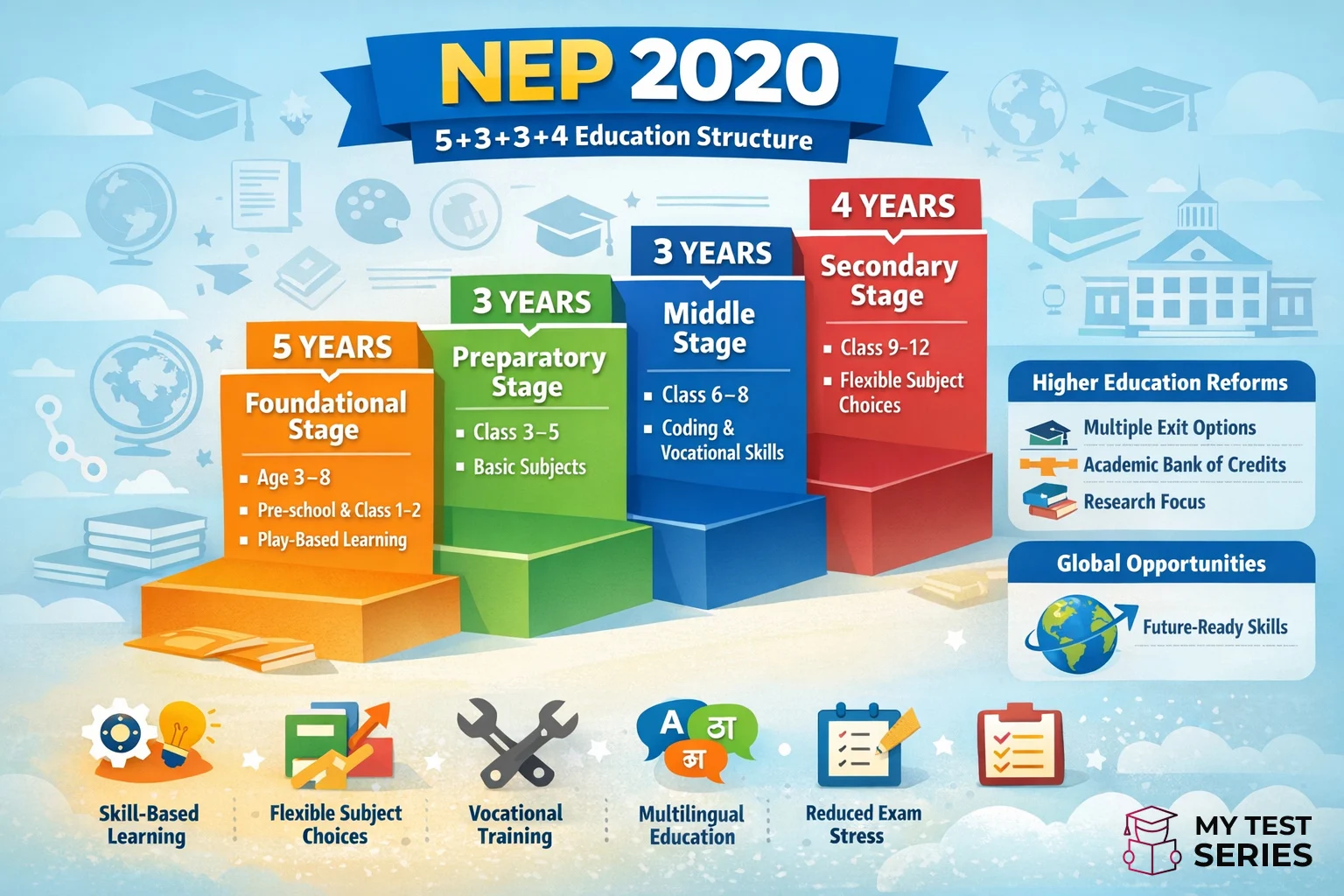
The most important change introduced by NEP 2020 is the new 5+3+3+4 school education structure. This model replaces the old 10+2 system.
The new structure is designed according to the cognitive development stages of children.
New Structure Overview
- 5 Years: Foundational Stage
- 3 Years: Preparatory Stage
- 3 Years: Middle Stage
- 4 Years: Secondary Stage
1. Foundational Stage (5 Years)
The first stage of the new education structure focuses on early childhood care and education.
This stage includes:
- 3 years of pre-school / Anganwadi
- Class 1 and Class 2
Children in this stage are typically between 3 and 8 years old.
Key Focus Areas
- Play-based learning
- Activity-based teaching
- Language development
- Basic numeracy and literacy
The goal is to build strong learning foundations instead of pushing academic pressure too early.
2. Preparatory Stage (3 Years)
The preparatory stage includes:
- Class 3
- Class 4
- Class 5
This stage focuses on interactive classroom learning while gradually introducing formal subjects.
Main Learning Areas
- Language development
- Mathematics
- Science basics
- Art and creativity
- Physical education
Teaching methods will continue to be activity-based and engaging to maintain student interest.
3. Middle Stage (3 Years)
The middle stage covers:
- Class 6
- Class 7
- Class 8
At this level, students start learning subjects in a more structured way.
Key Highlights
- Introduction of coding
- Exposure to vocational education
- Internships with local industries
- Development of analytical thinking
This stage helps students discover their interests and develop practical skills.
4. Secondary Stage (4 Years)
The final stage includes:
- Class 9
- Class 10
- Class 11
- Class 12
This stage focuses on deep learning, flexibility, and career preparation.
Major Features
- Students can choose subjects freely
- No strict separation between Arts, Science, and Commerce
- Focus on critical thinking
- Preparation for higher education
For example, a student can study Physics + Music + Economics together.
Major Changes Introduced by NEP 2020
NEP 2020 brings several important changes to India’s education system.
1. Flexible Subject Choices
Students will no longer be restricted to fixed streams like Science or Commerce. They can choose subjects based on their interests.
2. Coding from Class 6
Programming and computational thinking will be introduced early to prepare students for the digital age.
3. Vocational Training
Students will learn practical skills such as carpentry, gardening, electrical work, and other vocational skills.
4. Multilingual Education
Students will be encouraged to learn in their mother tongue or regional language until Class 5.
5. Reduced Exam Pressure
Board exams will become easier and focus more on conceptual understanding rather than memorization.
Benefits of NEP 2020 for Students
The National Education Policy aims to make education more meaningful and effective.
1. Strong Learning Foundation
Early childhood education ensures that students develop essential learning skills at a young age.
2. Skill-Based Learning
Students will learn practical skills along with academic subjects.
3. Greater Career Flexibility
Students can explore different fields before choosing a career path.
4. Reduced Academic Pressure
The focus shifts from rote learning to understanding concepts.
5. Better Global Opportunities
NEP 2020 aims to align India’s education system with international standards.
Implementation of NEP 2020 by 2026
The implementation of the National Education Policy is being done in phases across India. While some reforms started immediately after the policy announcement, many structural changes are gradually being introduced in schools and universities.
By 2025–2026, several major reforms are expected to become fully operational.
Major NEP 2020 Developments by 2026
- Adoption of the 5+3+3+4 education structure in most schools
- Integration of early childhood education into formal schooling
- Introduction of coding and vocational training from Class 6
- New assessment and examination patterns
- More multidisciplinary higher education programs
- Digital learning platforms expansion
The goal is to create a modern education system that focuses on creativity, skill development, and innovation.
How NEP 2020 Changes Higher Education
The National Education Policy does not only reform school education; it also introduces major changes in college and university education.
1. Multidisciplinary Education
Students can study subjects from different disciplines instead of focusing on only one specialized stream.
For example:
- Engineering student learning philosophy
- Science student studying music
- Commerce student learning data science
This approach encourages holistic education.
2. Multiple Exit Options in Degree Programs
NEP 2020 introduces flexible exit options in undergraduate programs.
New Undergraduate Exit Structure
- 1 Year Completed – Certificate
- 2 Years Completed – Diploma
- 3 Years Completed – Bachelor’s Degree
- 4 Years Completed – Bachelor’s Degree with Research
This allows students to leave and rejoin education without losing their academic progress.
3. Academic Bank of Credits (ABC)
The Academic Bank of Credits system allows students to store their academic credits digitally.
If a student changes colleges or takes a break from studies, their earned credits remain saved and can be used later to complete their degree.
Changes in Board Exams
One of the major concerns in the Indian education system has been the high pressure associated with board exams.
NEP 2020 aims to reduce this pressure by making examinations more flexible.
Key Board Exam Reforms
- Exams will test conceptual understanding
- Students may have the option to take exams multiple times in a year
- Objective and descriptive assessments will be balanced
- Focus on application-based learning
This approach encourages students to understand subjects deeply rather than memorizing information.
Focus on Digital Education
Another important aspect of NEP 2020 is the expansion of digital learning infrastructure.
The policy supports the use of technology in education to improve accessibility and quality.
Key Digital Initiatives
- Online learning platforms
- Digital classrooms
- Virtual laboratories
- Educational apps and e-learning content
These tools can help students from rural and remote areas access quality education.
Impact of NEP 2020 on Competitive Exams
The National Education Policy is expected to influence the structure of many competitive exams in the future.
Since the focus of the policy is on conceptual understanding and analytical thinking, entrance examinations may also shift toward testing deeper knowledge and problem-solving skills.
Students preparing for competitive exams should focus on:
- Conceptual clarity
- Analytical thinking
- Practical application of knowledge
- Interdisciplinary learning
This change will help create a generation of students who are better prepared for real-world challenges.
Challenges in Implementing NEP 2020
Although NEP 2020 is an ambitious reform, implementing such a large transformation across a diverse country like India comes with several challenges.
1. Teacher Training
Teachers need proper training to adopt new teaching methods and digital tools.
2. Infrastructure Development
Many schools need improved infrastructure to support new learning systems.
3. Digital Divide
Access to digital education is still limited in some rural areas.
4. Policy Coordination
Education is a joint responsibility of central and state governments, so coordination is essential for smooth implementation.
Despite these challenges, the long-term benefits of NEP 2020 are expected to outweigh the difficulties.
Future of Indian Education After NEP 2020
The National Education Policy aims to make India a global knowledge hub by improving the quality of education and encouraging innovation.
Over the next decade, the policy is expected to:
- Improve learning outcomes
- Increase enrollment in higher education
- Promote research and innovation
- Enhance skill development
- Strengthen India’s global education ranking
If implemented effectively, NEP 2020 could transform India’s education system into one that focuses on creativity, critical thinking, and lifelong learning.
The National Education Policy 2020 represents one of the most significant reforms in India’s education system in recent decades.
By replacing the traditional 10+2 system with the 5+3+3+4 structure, the policy emphasizes early childhood education, skill development, flexible subject choices, and conceptual learning.
Although the transition may take time, the long-term vision of NEP 2020 is to create a modern education system that prepares students for the rapidly changing global environment.
By 2026 and beyond, the policy is expected to bring meaningful improvements to both school and higher education across India.
Frequently Asked Questions
What is the 5+3+3+4 education system?
The 5+3+3+4 system divides school education into four stages: Foundational (5 years), Preparatory (3 years), Middle (3 years), and Secondary (4 years).
What replaced the 10+2 education system?
The National Education Policy 2020 replaced the 10+2 system with the new 5+3+3+4 structure.
When will NEP 2020 be fully implemented?
Implementation is gradual, but many reforms are expected to be fully adopted by 2025–2026.
What are the main benefits of NEP 2020?
The policy promotes flexible subject choices, skill-based learning, reduced exam pressure, and stronger early childhood education.
Does NEP 2020 allow students to choose subjects freely?
Yes. Students can select subjects across different streams instead of being limited to Science, Commerce, or Arts.
📚 Explore More NEP 2020 Guides
If you want to understand the New Education Policy 2020 in detail, explore these complete guides:
-
➤ NEP 2020 vs Old 10+2 System – Major Differences Explained
-
➤ NEP 2020 Higher Education Reforms – Multidisciplinary Degrees & GER 50%
-
➤ NEP 2020 Vocational Education From Class 6 – Skills & Internships
-
➤ How NEP 2020 Has Changed School Education in India (2026 Guide)
-
➤ NEP 2020 Explained – Understanding the 5+3+3+4 Education Structure