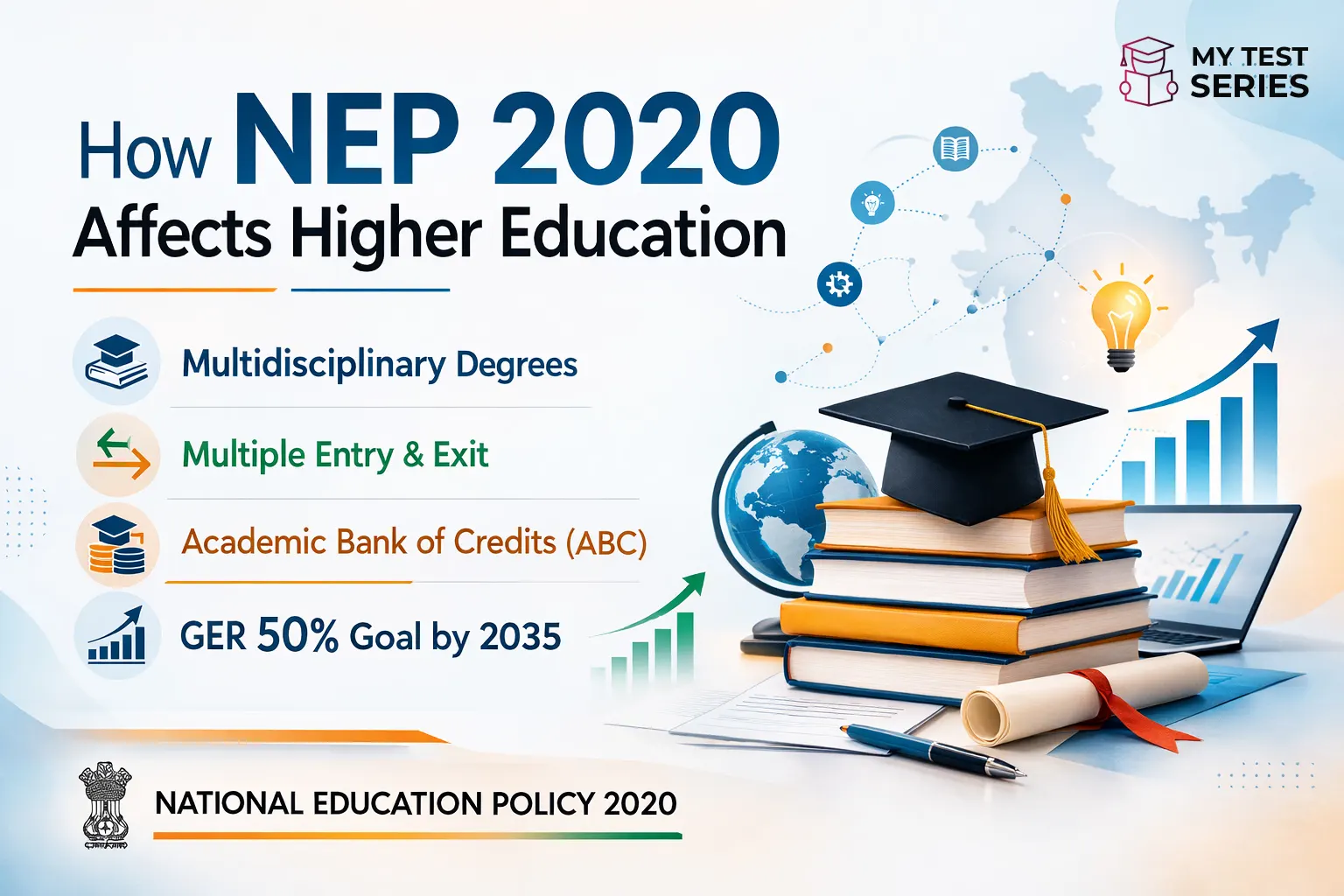
How NEP 2020 Affects Higher Education: Multidisciplinary Degrees, Multiple Entry/Exit & GER 50% Goal
📑 Table of Contents
- What is NEP 2020?
- Major Changes in Higher Education Under NEP 2020
- Understanding Multidisciplinary Education
- The Four-Year Undergraduate Program
- Multiple Entry and Exit System Explained
- Academic Bank of Credits (ABC)
- Goal of 50% Gross Enrolment Ratio (GER)
- National Research Foundation (NRF)
- Benefits of NEP 2020 for Students
- Challenges in Implementing NEP 2020
- Future of Higher Education in India
- Conclusion
- Frequently Asked Questions
India’s education system is going through one of the biggest transformations in its history. The
National Education Policy (NEP) 2020 has introduced a series of reforms designed to make
higher education more flexible, accessible, and globally competitive.
For decades, the Indian higher education system followed a rigid structure where students had limited
freedom to explore subjects across disciplines. Dropping out of college meant losing academic progress
entirely. But NEP 2020 aims to change this scenario by introducing multidisciplinary learning,
multiple entry and exit options, and a goal of achieving 50% Gross Enrolment Ratio (GER) by 2035.
These reforms are expected to reshape universities, colleges, and student career paths in India.
In this article, we will explain in simple terms how NEP 2020 affects higher education and what these
changes mean for students, parents, and institutions in 2026 and beyond.
What is NEP 2020?
The National Education Policy 2020 is India’s first education policy of the 21st century.
It replaced the earlier National Policy on Education 1986. The policy was approved by the
Government of India in July 2020 with the aim of transforming the education system from school level to
higher education.
The policy focuses on several major objectives:
- Improving quality and accessibility of education
- Encouraging interdisciplinary learning
- Promoting research and innovation
- Increasing Gross Enrolment Ratio in higher education
- Reducing dropout rates
- Making Indian universities globally competitive
Among all reforms, the changes introduced in higher education are considered the most
significant because they directly impact millions of students entering universities every year.
Major Changes in Higher Education Under NEP 2020
| Reform | Previous System | NEP 2020 System |
|---|---|---|
| Degree Structure | Rigid single-discipline degrees | Multidisciplinary programs allowed |
| Exit Options | No exit flexibility | Multiple entry and exit options |
| Credits | Credits locked within university | Academic Bank of Credits introduced |
| Enrollment Target | GER around 26% | Target 50% GER by 2035 |
| Research Focus | Limited research support | National Research Foundation created |
These reforms are designed to make higher education more flexible and aligned with global education systems.
Understanding Multidisciplinary Education
One of the biggest shifts introduced by NEP 2020 is the concept of
multidisciplinary education.
Traditionally, Indian universities required students to study within a single discipline.
For example, a student pursuing a BSc degree could rarely take subjects from humanities or arts.
NEP 2020 breaks this barrier and allows students to combine subjects from different streams.
Examples of Multidisciplinary Combinations
| Main Field | Additional Subjects |
|---|---|
| Engineering | Economics, Public Policy |
| Commerce | Data Science, Statistics |
| Physics | Philosophy, Artificial Intelligence |
| History | Political Science, Sociology |
This approach encourages students to develop a broader skill set and prepares them for
modern careers that require knowledge from multiple fields.
Many top universities around the world already follow multidisciplinary education models,
and NEP 2020 aims to bring Indian higher education closer to these global standards.
The Four-Year Undergraduate Program
NEP 2020 proposes a flexible four-year undergraduate program with multiple exit options.
Students can complete their degree based on how long they study.
| Duration | Qualification |
|---|---|
| 1 Year | Certificate |
| 2 Years | Diploma |
| 3 Years | Bachelor’s Degree |
| 4 Years | Bachelor’s Degree with Research |
The four-year degree with research is particularly important for students who want to pursue
higher studies or academic careers.
This structure provides students with greater flexibility and reduces the risk of losing years
of education if they need to leave college for personal or financial reasons.
📚 Explore More NEP 2020 Guides
If you want to understand the New Education Policy 2020 in detail, explore these complete guides:
➤ NEP 2020 vs Old 10+2 System – Major Differences Explained
➤ NEP 2020 Higher Education Reforms – Multidisciplinary Degrees & GER 50%
➤ NEP 2020 Vocational Education From Class 6 – Skills & Internships
➤ How NEP 2020 Has Changed School Education in India (2026 Guide)
➤ NEP 2020 Explained – Understanding the 5+3+3+4 Education Structure
Multiple Entry and Exit System Explained
Earlier, if a student dropped out of college after one or two years, the years spent studying
were often wasted because no formal qualification was awarded.
NEP 2020 introduces a multiple entry and exit system where students receive
certificates based on the number of years completed.
How It Works
- Students can exit after completing one year and receive a certificate.
- Students exiting after two years receive a diploma.
- After three years, they earn a bachelor’s degree.
- Students completing four years receive a research-oriented degree.
If a student decides to continue education later, they can re-enter the system and continue
from where they left off.
This system is especially helpful for working professionals or students facing financial constraints.
Academic Bank of Credits (ABC)
To support the multiple entry and exit system, NEP 2020 introduces the
Academic Bank of Credits (ABC).
The Academic Bank of Credits is a digital platform where students’ academic credits are stored
securely. These credits can be transferred between universities and institutions.
Benefits of Academic Bank of Credits
- Students can change universities without losing credits.
- Learning becomes more flexible.
- Online courses and traditional courses can be combined.
- Students can accumulate credits over time.
This system is similar to credit transfer systems used in many international universities.
Goal of 50% Gross Enrolment Ratio (GER)
Another major objective of NEP 2020 is increasing the
Gross Enrolment Ratio (GER) in higher education to 50% by 2035.
Gross Enrolment Ratio refers to the percentage of students enrolled in higher education
compared to the total eligible population in the 18–23 age group.
GER Growth Target
| Year | GER |
|---|---|
| 2018 | 26.3% |
| 2020 | 27% |
| Target 2035 | 50% |
Achieving this target requires opening new universities, expanding online learning,
and improving access to education in rural areas.
National Research Foundation (NRF): Boosting Research in India
Research has always been an essential pillar of higher education. However, compared to many
developed nations, India’s research output has historically been lower. To address this issue,
NEP 2020 proposes the creation of the National Research Foundation (NRF).
The NRF aims to promote a strong culture of research and innovation across universities and colleges.
It will provide funding, mentorship, and infrastructure support for research projects across disciplines.
Key Functions of NRF
- Funding high-quality research projects
- Encouraging interdisciplinary research
- Supporting young researchers and scholars
- Promoting collaboration between universities and industries
- Improving India’s global research ranking
The NRF is expected to play a major role in transforming Indian universities into
research-driven institutions.
Institutional Restructuring of Higher Education
Another significant reform under NEP 2020 is the restructuring of higher education institutions.
The policy aims to move away from the fragmented system of small colleges affiliated with large universities.
Instead, institutions will gradually be transformed into large multidisciplinary universities or
autonomous colleges.
Three Types of Higher Education Institutions
| Institution Type | Main Focus |
|---|---|
| Research Universities | Focus on research and doctoral programs |
| Teaching Universities | Focus on undergraduate and postgraduate teaching |
| Autonomous Degree-Granting Colleges | Independent institutions offering degree programs |
This restructuring aims to improve academic quality, governance, and institutional autonomy.
Global Universities in India
NEP 2020 also encourages top international universities to establish campuses in India.
This initiative aims to provide Indian students with access to world-class education without
leaving the country. It will also encourage academic collaboration between Indian and global institutions.
Potential Benefits
- Access to international-level education within India
- Reduced cost of studying abroad
- Improved global rankings of Indian higher education
- Increased academic exchange programs
- Better research collaborations
Many global institutions have already expressed interest in establishing campuses in India
under this policy framework.
Expansion of Online and Digital Education
NEP 2020 recognizes the growing importance of digital learning in modern education systems.
The COVID-19 pandemic also accelerated the adoption of online education worldwide.
To support digital learning, the policy encourages universities to integrate
online courses, hybrid learning models, and digital platforms.
Digital Education Initiatives
- Expansion of online degree programs
- Use of digital platforms for teaching and assessment
- Development of virtual laboratories
- Promotion of Massive Open Online Courses (MOOCs)
- Integration of technology in higher education classrooms
These initiatives aim to make higher education more accessible and flexible for students across India.
Benefits of NEP 2020 for Students
The reforms introduced under NEP 2020 offer several advantages for students pursuing higher education.
| Benefit | Impact on Students |
|---|---|
| Flexible Degree Structure | Students can choose their pace of learning |
| Multidisciplinary Learning | Students gain knowledge from multiple fields |
| Multiple Exit Options | Students receive qualifications even if they leave early |
| Credit Transfer | Students can move between universities easily |
| Research Opportunities | More funding and support for research careers |
These reforms aim to create a more student-centered education system that supports diverse
learning paths and career goals.
Challenges in Implementing NEP 2020
Although NEP 2020 introduces ambitious reforms, implementing these changes across a vast
and diverse country like India presents several challenges.
Major Challenges
- Infrastructure gaps in many universities
- Shortage of trained faculty members
- Financial constraints for institutions
- Need for digital infrastructure in rural areas
- Complex transition from the old system to the new framework
Successful implementation will require coordinated efforts from the government, universities,
educators, and policymakers.
Future of Higher Education in India
If implemented effectively, NEP 2020 has the potential to transform India’s higher education
landscape significantly.
The introduction of multidisciplinary education, flexible degree programs, research funding,
and digital learning could make Indian universities more competitive globally.
Over the next decade, India may witness a shift toward innovation-driven education systems
that prepare students for emerging careers in technology, research, entrepreneurship,
and public policy.
The goal of achieving a 50% Gross Enrolment Ratio will also ensure that a
larger section of India’s youth has access to higher education opportunities.
Conclusion
The National Education Policy 2020 represents a bold attempt to reshape India’s
higher education system. By introducing multidisciplinary degrees, flexible learning pathways,
and research-focused institutions, the policy aims to align Indian education with global standards.
The multiple entry and exit system, supported by the Academic Bank of Credits, gives students
greater flexibility in managing their educational journeys. At the same time, the push toward
increasing the Gross Enrolment Ratio to 50% highlights the government’s commitment to expanding
access to higher education.
While challenges remain in implementation, the long-term vision of NEP 2020 is clear:
to create a dynamic, inclusive, and future-ready higher education system for India.
Frequently Asked Questions (FAQs)
1. What is multidisciplinary education under NEP 2020?
Multidisciplinary education allows students to study subjects from different streams
such as science, arts, commerce, and technology within a single degree program.
2. What is the multiple entry and exit system?
It allows students to leave a degree program after completing certain years and receive
a certificate, diploma, or degree based on the duration of study.
3. What is the Academic Bank of Credits?
It is a digital platform that stores students’ academic credits and allows them to
transfer credits between institutions.
4. What is the GER target under NEP 2020?
The policy aims to increase the Gross Enrolment Ratio in higher education to 50% by 2035.
5. Will foreign universities open campuses in India?
Yes, NEP 2020 allows top international universities to establish campuses in India
to improve global collaboration and education quality.