NEP 2020 vs 10+2 system : Major Differences Every Parent & Student Should Know in 2026
NEP 2020 vs 10+2 system : India’s education system is undergoing one of the biggest transformations in decades. For nearly 35 years, the 10+2 education system shaped the schooling structure for millions of students. However, with the introduction of the National Education Policy (NEP) 2020, India is moving toward a more flexible, skill-based, and multidisciplinary education model.
As we move further into 2026, many parents and students are still trying to understand how the NEP 2020 system differs from the traditional 10+2 model.
What exactly has changed? How will it affect school education, career choices, and learning outcomes?
In this detailed guide, we explain the major differences between NEP 2020 and the old 10+2 education system, helping parents and students clearly understand the new structure, benefits, and long-term impact.
Understanding the Old 10+2 Education System
Before the introduction of NEP 2020, India’s education system followed a simple structure known as the 10+2 system.
The structure looked like this:
- 10 years of general schooling (Primary + Secondary)
- 2 years of higher secondary education
Students typically studied a fixed set of subjects until Class 10. After that, they had to choose between three major streams:
- Science
- Commerce
- Arts/Humanities
While this system served India for decades, education experts increasingly criticized it for being rigid, exam-focused, and lacking skill-based learning.
What is NEP 2020?
The National Education Policy (NEP) 2020 is a comprehensive reform introduced by the Government of India to modernize the education system.
It replaces the outdated structure with a more flexible, multidisciplinary, and skill-oriented framework.
The policy aims to:
- Improve learning quality
- Encourage creativity and critical thinking
- Reduce rote memorization
- Promote skill-based education
- Increase Gross Enrolment Ratio (GER) to 50% by 2035
One of the most significant changes introduced by NEP 2020 is the replacement of the 10+2 system with the new 5+3+3+4 structure.
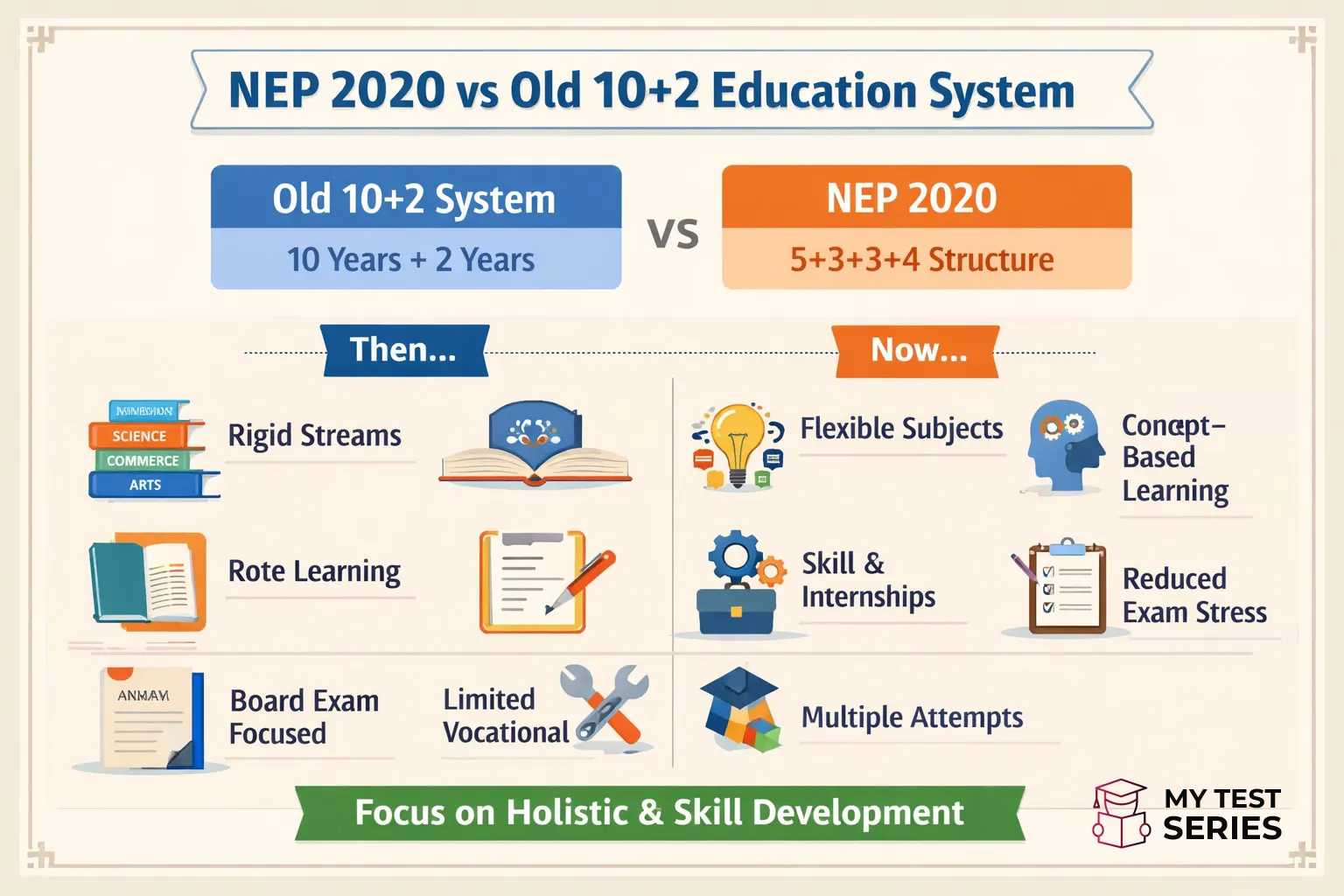
NEP 2020 vs 10+2 system : Quick Comparison
| Feature | Old 10+2 System | NEP 2020 System |
|---|---|---|
| Education Structure | 10 years schooling + 2 years higher secondary | 5+3+3+4 curricular structure |
| Early Childhood Education | Not formally included | Includes preschool education |
| Learning Style | Rote memorization | Concept-based learning |
| Subject Choice | Limited subject streams | Flexible multidisciplinary choices |
| Vocational Education | Minimal focus | Vocational training from Class 6 |
| Assessment System | Board exam focused | Competency-based assessment |
| Skill Development | Limited emphasis | Strong focus on practical skills |
| Technology Integration | Limited digital education | Strong digital learning integration |
📚 Explore More NEP 2020 Guides
If you want to understand the New Education Policy 2020 in detail, explore these complete guides:
➤ NEP 2020 vs Old 10+2 System – Major Differences Explained
➤ NEP 2020 Higher Education Reforms – Multidisciplinary Degrees & GER 50%
➤ NEP 2020 Vocational Education From Class 6 – Skills & Internships
➤ How NEP 2020 Has Changed School Education in India (2026 Guide)
➤ NEP 2020 Explained – Understanding the 5+3+3+4 Education Structure
The New 5+3+3+4 Education Structure Explained
The biggest structural change under NEP 2020 is the introduction of the 5+3+3+4 curricular framework.
This model aligns education with the cognitive development stages of children.
Stage 1: Foundational Stage (5 Years)
| Age Group | Classes |
|---|---|
| 3–6 years | Preschool / Anganwadi |
| 6–8 years | Class 1–2 |
This stage focuses on:
- Play-based learning
- Language development
- Basic numeracy skills
- Social and emotional growth
The major difference from the old system is that early childhood education is now formally integrated.
Stage 2: Preparatory Stage (3 Years)
| Age Group | Classes |
|---|---|
| 8–11 years | Class 3–5 |
Students begin structured learning in subjects such as:
- Mathematics
- Science
- Arts
- Languages
Teaching methods remain activity-based and interactive.
Stage 3: Middle Stage (3 Years)
| Age Group | Classes |
|---|---|
| 11–14 years | Class 6–8 |
This stage introduces several modern learning elements:
- Vocational education
- Internships
- Coding and computational thinking
- Project-based learning
Students can explore practical skills such as:
- Carpentry
- Gardening
- Electric work
- Local crafts
This is one of the biggest improvements compared to the old 10+2 system, where vocational learning was largely absent.
Stage 4: Secondary Stage (4 Years)
| Age Group | Classes |
|---|---|
| 14–18 years | Class 9–12 |
This stage allows students to choose subjects more freely instead of rigid streams.
For example, students may choose combinations like:
- Physics + Music
- Mathematics + Political Science
- Biology + Fine Arts
This multidisciplinary flexibility was not possible under the traditional 10+2 system.
Major Differences Between NEP 2020 vs 10+2 system
1. Inclusion of Early Childhood Education
One of the most significant reforms in NEP 2020 is the inclusion of Early Childhood Care and Education (ECCE).
| Old System | NEP 2020 |
|---|---|
| Formal education started at age 6 | Education begins at age 3 |
| Preschool not integrated | Preschool included in curriculum |
Research shows that 90% of brain development occurs before age 6, making this reform extremely important.
2. Flexible Subject Selection
Under the traditional system, students had to choose rigid streams after Class 10.
NEP 2020 removes these restrictions.
| Old System | NEP 2020 |
|---|---|
| Science / Commerce / Arts streams | No fixed streams |
| Limited subject combinations | Flexible multidisciplinary choices |
This flexibility allows students to pursue interdisciplinary learning.
3. Vocational Education from Class 6
Another groundbreaking reform under NEP 2020 is the introduction of vocational education from Class 6.
| Old 10+2 System | NEP 2020 |
|---|---|
| Vocational courses rarely offered | Vocational training mandatory exposure |
| No internships | Internships with local professionals |
This change aims to reduce the gap between education and employability.
4. Assessment System Reform
Traditional education heavily relied on board exam performance.
| Old System | NEP 2020 |
|---|---|
| Exam-centric evaluation | Competency-based assessment |
| Marks-focused learning | Concept-based understanding |
| Single high-pressure exams | Multiple assessment methods |
NEP 2020 introduces formative assessments, peer evaluations, and project-based evaluations.
5. Reduced Board Exam Pressure
One of the most welcomed reforms under NEP 2020 is the attempt to reduce the extreme pressure associated with board examinations.
For decades, students under the 10+2 system faced enormous stress due to a single high-stakes board exam determining their academic future.
The new policy aims to make board exams easier, flexible, and more application-based.
Students will have the opportunity to appear for board exams multiple times if needed.
| Old 10+2 System | NEP 2020 Approach |
|---|---|
| One high-pressure final board exam | Multiple opportunities to improve scores |
| Memory-based questions | Application and competency-based questions |
| Marks-focused evaluation | Skill and understanding-based assessment |
This change is expected to significantly reduce student anxiety and promote meaningful learning.
Advantages of NEP 2020 Over the Old 10+2 System
The new education framework brings several long-term benefits for students, parents, and the overall education ecosystem in India.
1. Holistic Development of Students
Unlike the traditional system, which primarily focused on academic marks, NEP 2020 emphasizes the overall development of students.
Students are encouraged to participate in:
- Sports
- Arts and music
- Skill-based learning
- Creative activities
- Critical thinking exercises
This ensures that children develop not only academically but also socially and emotionally.
2. Multidisciplinary Learning
The removal of rigid streams allows students to explore multiple subjects across different disciplines.
For example, a student interested in both science and music can now pursue both subjects simultaneously.
This approach reflects modern global education trends followed by top universities worldwide.
3. Better Preparation for Future Careers
The modern job market demands skills such as:
- Problem-solving
- Creativity
- Digital literacy
- Adaptability
NEP 2020 integrates these elements directly into the curriculum through:
- Project-based learning
- Coding education
- Vocational training
- Internship opportunities
As a result, students become better prepared for future career challenges.
4. Focus on Conceptual Learning
Under the traditional system, students often memorized information to score marks in exams.
NEP 2020 aims to shift education toward conceptual understanding and analytical thinking.
Teachers are encouraged to focus on:
- Understanding concepts
- Solving real-world problems
- Collaborative learning
- Practical experimentation
This approach significantly improves learning quality.
5. Increased Use of Technology
Technology plays a crucial role in the NEP 2020 framework.
The government has introduced initiatives such as:
- Digital classrooms
- Online learning platforms
- Virtual labs
- Digital content libraries
These tools help expand access to quality education across rural and urban areas.
Challenges in Implementing NEP 2020
While the new policy offers many benefits, implementing such a massive reform across a diverse country like India also presents several challenges.
1. Infrastructure Requirements
Many schools, particularly in rural areas, may lack the infrastructure needed for:
- Digital learning tools
- Modern classrooms
- Vocational training facilities
Upgrading educational infrastructure will require significant investment.
2. Teacher Training
Teachers play a crucial role in implementing NEP reforms.
However, many educators will need training in:
- New teaching methods
- Digital education tools
- Competency-based assessment techniques
Large-scale teacher training programs are therefore essential for successful implementation.
3. Curriculum Transition
Transitioning from the old education structure to the new system requires:
- Updated textbooks
- Revised curriculum frameworks
- New assessment models
This process takes time and coordination across states and education boards.
How NEP 2020 Will Shape the Future of Education in India
NEP 2020 represents a long-term vision for transforming India’s education system.
By 2030 and beyond, the policy aims to achieve several key goals:
- Universal access to quality school education
- Increased Gross Enrolment Ratio in higher education
- Global competitiveness of Indian universities
- Skill-based and innovation-driven learning
If implemented effectively, NEP 2020 could position India as a global leader in education and innovation.
What Parents Should Know About NEP 2020
Parents play a vital role in helping children adapt to the new education system.
Here are some important things parents should understand:
- The focus will shift from marks to learning outcomes
- Students will have more flexibility in subject choices
- Skill development will become equally important as academics
- Learning methods will become more interactive and practical
Parents should encourage children to explore their interests rather than focusing solely on traditional academic achievements.
Conclusion
The introduction of the National Education Policy 2020 marks a historic shift in India’s education system.
While the traditional 10+2 structure served the country for decades, it was increasingly unable to meet the needs of a rapidly changing world.
NEP 2020 brings a modern approach to education by emphasizing flexibility, skill development, and holistic learning.
The transition from the 10+2 system to the 5+3+3+4 structure ensures that students receive education aligned with their cognitive development stages.
Although challenges remain in implementation, the long-term benefits of NEP 2020 could transform the future of education in India.
For parents and students, understanding these changes is essential to fully benefit from the opportunities offered by the new education system.
Frequently Asked Questions (FAQs)
What replaced the 10+2 education system in India?
The 10+2 system has been replaced by the 5+3+3+4 structure under the National Education Policy 2020.
Does NEP 2020 remove science, commerce, and arts streams?
Yes. NEP 2020 removes rigid streams and allows students to choose multidisciplinary subject combinations.
When will NEP 2020 be fully implemented?
The implementation is gradual and expected to continue throughout the 2020s, with many reforms visible by 2030.
Is vocational education compulsory in NEP 2020?
Students will receive exposure to vocational education from Class 6, including internships and skill-based learning.
How does NEP 2020 reduce exam stress?
The new policy introduces competency-based assessments and allows multiple attempts in board examinations.