Best Education Loans in India Without Collateral (2026)
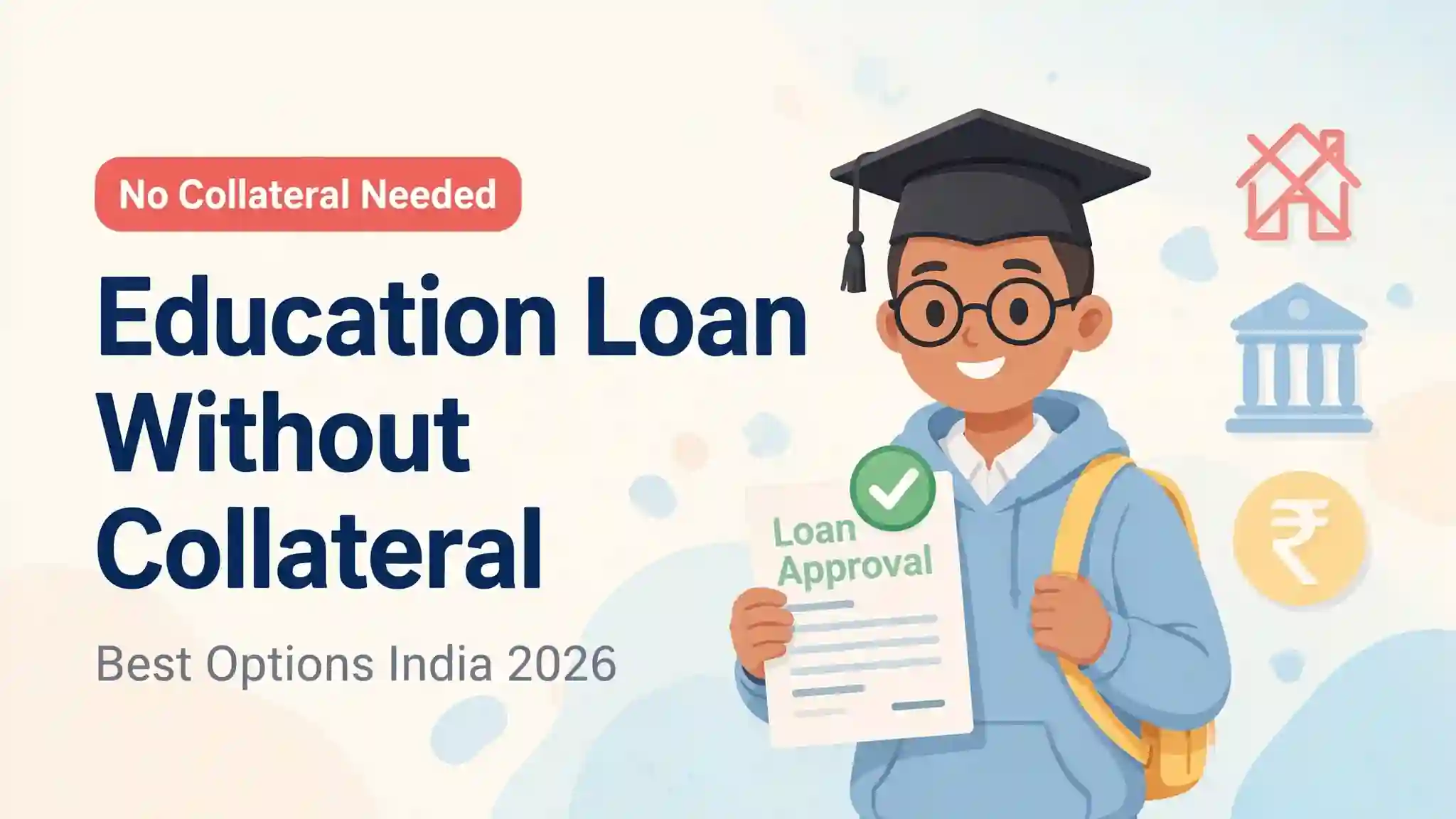
Planning to pursue college, a professional degree or higher studies but worried about arranging property or other security? An education loan without collateral may help you finance your education without pledging a house, land or fixed deposit.
In this guide, learn about collateral-free education loans in India, the PM-Vidyalaxmi scheme, government credit guarantees, eligibility, documents, interest subsidies and repayment.
Visit PM-Vidyalaxmi Portal Read the Student Financing GuideBefore choosing a loan, explore our broader Student Financing Guide for India . It can help you consider education loans alongside scholarships and other ways to fund your studies.
What Is an Education Loan Without Collateral?
A collateral-free education loan is a loan for eligible educational expenses that does not require the borrower to pledge an asset such as residential property, land or a fixed deposit as security.
Depending on the loan product, a parent or guardian may still need to become a joint borrower. A joint borrower is not the same as a third-party guarantor, and neither arrangement should be confused with collateral. Always read the lender's conditions before signing.
Eligible expenses may include:
- College or university tuition fees.
- Hostel and other approved accommodation expenses.
- Examination, library and laboratory fees.
- Books, study materials and required equipment.
- A laptop or other approved course-related equipment.
- Other education-related costs permitted under the scheme.
The expenses covered and the amount sanctioned depend on the lender, course, institution, fee structure and applicable scheme rules.
Education Loan Options in India Without Collateral
There is no single loan that is suitable for every student. Your options depend on your institution, course, required amount, family income and the bank's lending policy.
1. PM-Vidyalaxmi
Designed for students admitted on merit to eligible Quality Higher Educational Institutions. Eligible students can seek loans without collateral or a third-party guarantee. Separate conditions apply to interest subsidies.
Check the official portal →2. Bank education loans under CGFSEL
Eligible education loans up to ₹7.5 lakh may receive credit-guarantee coverage under CGFSEL, allowing collateral-free lending subject to scheme and bank requirements.
Ministry of Education →3. Bank-specific student loan schemes
Public-sector and other banks offer education loan products with different interest rates, course conditions, margins and security requirements. Compare the written terms rather than the headline rate.
See SBI education loan rates →4. Skill and vocational education loans
Students taking eligible vocational, technical or skill-development courses may find dedicated loan products. Course recognition and lender-specific limits are important.
See a skill-loan example →Quick comparison
| Option | Collateral position | What to check |
|---|---|---|
| PM-Vidyalaxmi | Collateral-free for eligible students | QHEI list, admission route, bank terms and subsidy eligibility |
| CGFSEL-supported education loan | Eligible loans up to ₹7.5 lakh can be collateral-free | Scheme coverage, course approval and joint-borrower conditions |
| Other bank education loans | Depends on product and loan amount | Security threshold, interest rate, margin and fees |
| Skill or vocational loan | Some schemes do not require collateral | Approved training provider, eligible course and loan cap |
This table summarises broad scheme features, not a promise of approval. Individual banks may apply scheme-specific eligibility and documentation requirements. Confirm the latest rules with the official lender.
PM-Vidyalaxmi Scheme: Eligibility and Benefits
PM-Vidyalaxmi is a central government initiative intended to make higher education financing more accessible. It provides a framework through which eligible students admitted on merit to designated QHEIs can apply for collateral-free and guarantor-free education loans.
- Eligible students at designated QHEIs can apply without pledging collateral or providing a third-party guarantee under the scheme.
- The sanctioned amount depends on eligible education costs and the lending bank's assessment; do not assume every applicant will receive the full amount requested.
- Students with annual family income up to ₹8 lakh may qualify for 3% interest subvention on eligible loans up to ₹10 lakh, subject to the scheme's conditions and annual beneficiary limits.
- A separate interest-support arrangement exists for eligible students from families with annual income up to ₹4.5 lakh under the applicable Central Sector Interest Subsidy Scheme (CSIS) rules.
Interest subvention reduces eligible interest costs; it does not mean that the loan principal is waived. Subsidy eligibility is separate from loan approval and depends on the scheme conditions.
Before applying, verify whether your institution and admission category qualify. The scheme does not automatically cover every college, management-quota admission or course.
Check Eligibility and ApplyWho Can Apply for a Collateral-Free Education Loan?
Eligibility differs between schemes and lenders, but banks commonly assess the following factors:
- Nationality: Many Indian bank schemes require the applicant to be an Indian citizen.
- Admission: Proof of admission to an eligible recognised institution and course.
- Academic record: Previous examination results and other academic requirements.
- Course eligibility: The course must meet the bank's or scheme's requirements.
- Financial assessment: Course costs, family circumstances and the proposed repayment plan.
- Co-borrower requirements: A parent or guardian may need to join the loan application.
How much education loan can you get without collateral?
Under the standard CGFSEL framework, eligible loans up to ₹7.5 lakh can receive collateral-free treatment, subject to applicable requirements. PM-Vidyalaxmi has a different framework for eligible QHEIs and should not be treated as having the same universal loan ceiling.
Some banks also offer collateral-free products above ₹7.5 lakh for particular institutions, courses or borrower categories. These are lender-specific arrangements, not a guarantee available to every student.
The amount you can borrow is not necessarily the maximum advertised by a bank. A lender may assess your actual fee requirement, approved costs, future earning potential and repayment capacity.
Education Loan Interest Rates and Subsidies
There is no single interest rate for every collateral-free education loan in India. Rates can differ by bank, scheme, institution, loan amount and borrower category. Floating rates may also change over the repayment period.
For example, SBI publishes product-wise education loan rates and concessions on its official website. Treat its published rates as an example of one lender's terms, not as a market-wide rate or a quote for your own application.
Check SBI's latest official education loan interest rates before comparing offers.
Understand these four costs
- Interest rate: The annual rate charged on the outstanding loan.
- Processing and other fees: Application, portal, documentation or third-party charges, if applicable.
- Margin: The portion of eligible expenses you must fund yourself, if required.
- Moratorium-period interest: Interest may accrue during study and the permitted repayment holiday. Check whether it must be paid during this period or is added to the outstanding balance.
Documents Required for an Education Loan Without Collateral
Prepare your documents before submitting the application. The bank may request additional documents based on the course, scheme and applicant.
- Completed education loan application form.
- Identity and address proof, as accepted by the bank.
- Recent photographs, if required.
- Class 10 and 12 mark sheets or other academic transcripts.
- Entrance examination scorecard, where applicable.
- Admission letter and official fee structure.
- Course duration and institution details.
- Income proof of the parent, guardian or co-borrower, where requested.
- Bank statements or other financial records, if requested.
- Income certificate and other supporting documents for an interest subsidy, if applicable.
- Cost estimates for hostel, books, equipment or other eligible expenses.
Use the lender's official checklist. Do not submit original documents or sensitive financial information to an unverified agent or website.
How to Apply for an Education Loan Without Collateral
- Confirm your admission. Obtain the official admission letter and fee schedule.
- Check the institution's eligibility. For PM-Vidyalaxmi, check the current QHEI list and admission conditions. For other loans, check the bank's approved-course rules.
- Estimate the amount required. Add tuition, accommodation and other eligible costs, then subtract scholarships or funds already available.
- Compare suitable loan products. Check collateral rules, interest rates, processing fees, margin, moratorium and repayment tenure.
- Prepare your documents. Keep academic, admission and financial records ready.
- Submit the application. Use the official PM-Vidyalaxmi portal where applicable, or apply through the lender's authorised channel.
- Review the sanction letter. Check the approved amount, interest rate, disbursement conditions, repayment terms and any co-borrower obligations.
- Track disbursement. Confirm when and how the bank will release funds, including whether payments go directly to the institution.
Official application portal: PM-Vidyalaxmi. Application submission does not guarantee sanction.
Education Loan Repayment: EMI, Moratorium and Planning
A moratorium is a permitted period during which regular principal repayment may be deferred. It commonly covers the course period plus an additional period specified by the lender or scheme. It does not automatically mean that interest stops accruing.
Before accepting a loan, ask the bank:
- When will interest begin to accrue?
- Must interest be paid during the course?
- Will unpaid interest be added to the principal?
- When will the first EMI fall due?
- Can you make partial or full prepayments, and are any charges applicable?
- What happens if your course or employment start date changes?
Illustrative EMI example
Suppose you borrow ₹5,00,000 at an illustrative annual interest rate of 9% and repay it through 10 years of monthly instalments after the repayment period begins. If the rate remains unchanged and the entire ₹5,00,000 is the repayment principal, the EMI would be approximately ₹6,334 per month.
This is only an illustration, not a loan offer. It excludes any interest accrued during the study period, fees, changes in floating rates and other lender-specific charges. Your actual EMI may differ.
Borrow only what you reasonably need. Consider likely starting income, essential living costs and a financial buffer before committing to a long repayment schedule.
Common Mistakes to Avoid
- Assuming every course qualifies: Check the current approved institution and course criteria.
- Confusing collateral with a co-borrower: A collateral-free loan can still require a parent or guardian as joint borrower.
- Ignoring interest during study: Understand how the moratorium affects the outstanding balance.
- Choosing only by interest rate: Compare fees, repayment terms, margin and total borrowing cost.
- Assuming a subsidy is automatic: Verify family-income limits, beneficiary rules and other conditions.
- Applying through unofficial agents: Use official bank and government channels and protect your personal data.
- Borrowing more than necessary: Include only eligible costs and consider scholarships or personal contributions.
Can You Reduce the Amount You Need to Borrow?
An education loan is only one way to fund higher education. Before borrowing, check whether you qualify for scholarships, fee concessions, institutional financial aid or government support.
- Ask your college about merit-based and need-based scholarships.
- Check government scholarship eligibility and application deadlines.
- Ask the institution about instalment-based fee payment.
- Check whether an eligible interest subsidy applies to your loan.
- Compare the net amount you need after confirmed financial support.
For a broader overview of ways to plan education expenses, read the Student Financing Guide India .
Frequently Asked Questions
1. Can I get an education loan in India without collateral?
Yes. Eligible students can apply through schemes such as PM-Vidyalaxmi or eligible bank loans covered by CGFSEL. Approval depends on the institution, course, amount requested and applicable bank and scheme conditions.
2. What is the collateral-free education loan limit in India?
Under the standard CGFSEL framework, eligible loans up to ₹7.5 lakh can be collateral-free. PM-Vidyalaxmi has separate eligibility and lending provisions for designated QHEIs. Some banks may offer other collateral-free products under their own policies.
3. Is a guarantor required for a collateral-free education loan?
It depends on the scheme and product. PM-Vidyalaxmi provides collateral-free and guarantor-free loans to eligible students under its rules. Other products may require a parent or guardian as a joint borrower, so check the sanction conditions.
4. Can I get an education loan without collateral for studying abroad?
Some lenders offer overseas education loans without collateral for selected institutions, courses or borrower categories. Eligibility, loan limits and interest rates vary. Do not assume that the domestic CGFSEL limit applies to every overseas course.
5. Does PM-Vidyalaxmi provide an interest subsidy?
Eligible students with annual family income up to ₹8 lakh may qualify for 3% interest subvention on eligible loans up to ₹10 lakh, subject to the scheme's conditions and beneficiary limits. Separate provisions may apply under CSIS for eligible lower-income families.
6. Do I need to pay interest while studying?
Interest may accrue during the course and moratorium. Whether it must be paid immediately or is added to the outstanding loan depends on the lender and applicable terms. Ask for a written repayment schedule.
7. What documents are needed for a collateral-free education loan?
Common documents include identity and address proof, academic certificates, admission letter, fee structure and financial records requested by the bank. An income certificate may be needed for certain subsidies. The lender's official checklist takes precedence.
8. Does applying guarantee that my education loan will be approved?
No. Applying through a government portal or a bank does not guarantee approval. The application is assessed against the scheme's rules, institution and course eligibility, documents and the bank's lending requirements.
9. Where can I compare official education loan information?
Start with the PM-Vidyalaxmi portal, the Ministry of Education and the Reserve Bank of India's education-loan FAQs. Then compare the latest terms published by the bank you intend to approach.
Official Resources and Further Reading
Use these primary sources to verify current eligibility, scheme rules and lender terms.
- PM-Vidyalaxmi official portal — application information and scheme access.
- Reserve Bank of India: Education Loan FAQs — regulatory background and general education-loan information.
- Ministry of Education, Government of India — official education policies and scheme information.
- SBI education loan interest rates — lender-specific published rates and product conditions.
Final Checklist Before You Apply
- Confirm that your institution and course are eligible.
- Check whether PM-Vidyalaxmi or CGFSEL provisions apply.
- Compare the interest rate, fees, margin and repayment period.
- Understand the co-borrower and moratorium conditions.
- Check your eligibility for scholarships or interest subsidies.
- Read the sanction letter carefully before accepting the loan.
The right borrowing decision starts with understanding the total cost, not just the amount offered. Confirm all terms directly with the authorised lender before making a commitment.
Continue planning with our Student Financing Guide for India .
Disclaimer: This article is for general educational information and is not financial, legal or lending advice. Scheme rules, rates, eligibility, interest subsidies and bank policies may change. Information was prepared for a September 2026 update; confirm current terms through official government and lender sources before applying. Approval and disbursement remain subject to the applicable assessment.