Metals and Non-Metals Class 10 Notes: Reactivity Series, Properties & Reactions
Understand the physical and chemical properties of metals and non-metals, the reactivity series, displacement reactions, ionic compounds, extraction of metals, corrosion and important exam questions.
These revision notes complement the Class 10 Chemistry Complete Guide. Use the explanations, balanced equations, solved examples and revision tables to build conceptual understanding before practising exam questions.
1. What Are Metals and Non-Metals?
Elements are often classified as metals, non-metals and metalloids according to their physical and chemical properties. Metals are widely used in buildings, electrical wiring, machinery, transport and utensils. Non-metals are important in air, water, fuels, fertilisers and living organisms.
Metals
Metals generally conduct heat and electricity, can be shaped into sheets or wires, and tend to lose electrons during chemical reactions.
Examples: Iron (Fe), copper (Cu), aluminium (Al), zinc (Zn) and sodium (Na).
Non-metals
Non-metals generally conduct heat and electricity poorly and, when solid, are often brittle. They commonly gain or share electrons in reactions.
Examples: Oxygen (O), nitrogen (N), sulphur (S), carbon (C) and chlorine (Cl).
These are general trends, not universal rules. The exceptions are particularly important in examination questions.
2. Physical Properties of Metals and Non-Metals
| Property | Metals (generally) | Non-metals (generally) |
|---|---|---|
| Lustre | Shiny when freshly cut or polished | Usually dull |
| Malleability | Can be beaten into sheets | Solid forms are usually brittle |
| Ductility | Can be drawn into wires | Generally not ductile |
| Conductivity | Usually good conductors of heat and electricity | Usually poor conductors |
| Sonority | Usually produce a ringing sound when struck | Generally non-sonorous |
| Physical state | Mostly solids at room temperature | May be solids, liquids or gases |
Important exceptions to remember
- Mercury: a metal that is liquid at ordinary room temperature.
- Bromine: a non-metal that is liquid at ordinary room temperature.
- Graphite: a form of carbon that conducts electricity.
- Iodine: a non-metal with a lustrous appearance.
- Sodium and potassium: soft metals that can be cut with a knife, but must never be handled casually because they react vigorously with water and moisture.
3. Chemical Properties of Metals
3.1 Reaction with oxygen
Many metals react with oxygen to form metal oxides. Most common metal oxides are basic, although some are amphoteric.
Magnesium burns with a bright white flame and forms magnesium oxide.
Aluminium oxide forms a protective layer that helps prevent further corrosion of the underlying metal.
3.2 Reaction with water
Different metals react with water at different rates. The products depend on the metal and the reaction conditions.
| Metal | Typical behaviour |
|---|---|
| Potassium and sodium | React very vigorously with cold water. |
| Calcium | Reacts with cold water, producing hydrogen. |
| Magnesium | Reacts slowly with cold water and more readily with hot water or steam. |
| Iron | Reacts with steam under suitable conditions. |
| Copper, silver and gold | Do not normally react with water under ordinary conditions. |
3.3 Reaction with dilute acids
Metals above hydrogen in the reactivity series generally displace hydrogen from dilute, non-oxidising acids. Metals below hydrogen, such as copper and silver, do not normally release hydrogen from dilute hydrochloric acid.
The reaction produces a salt and hydrogen gas. Nitric acid is an important exception because it is an oxidising acid and usually does not produce hydrogen in the usual metal-acid reactions studied at this level.
3.4 Reaction with salt solutions
A more reactive metal can displace a less reactive metal from its salt solution.
Iron displaces copper from copper sulphate solution. The blue solution changes towards pale green, and copper is deposited.
3.5 Reaction with chlorine
Metals can react with chlorine to form metal chlorides.
Sodium transfers electrons to chlorine, forming sodium chloride, an ionic compound.
4. Chemical Properties of Non-Metals
Non-metals often react with oxygen to form oxides. Many non-metal oxides are acidic, although neutral oxides also exist.
Carbon dioxide and sulphur dioxide are examples of acidic oxides. In suitable conditions, they react with bases to form salts and water.
Non-metals can also form covalent compounds by sharing electrons. The type of bonding depends on the elements and their electronic structures.
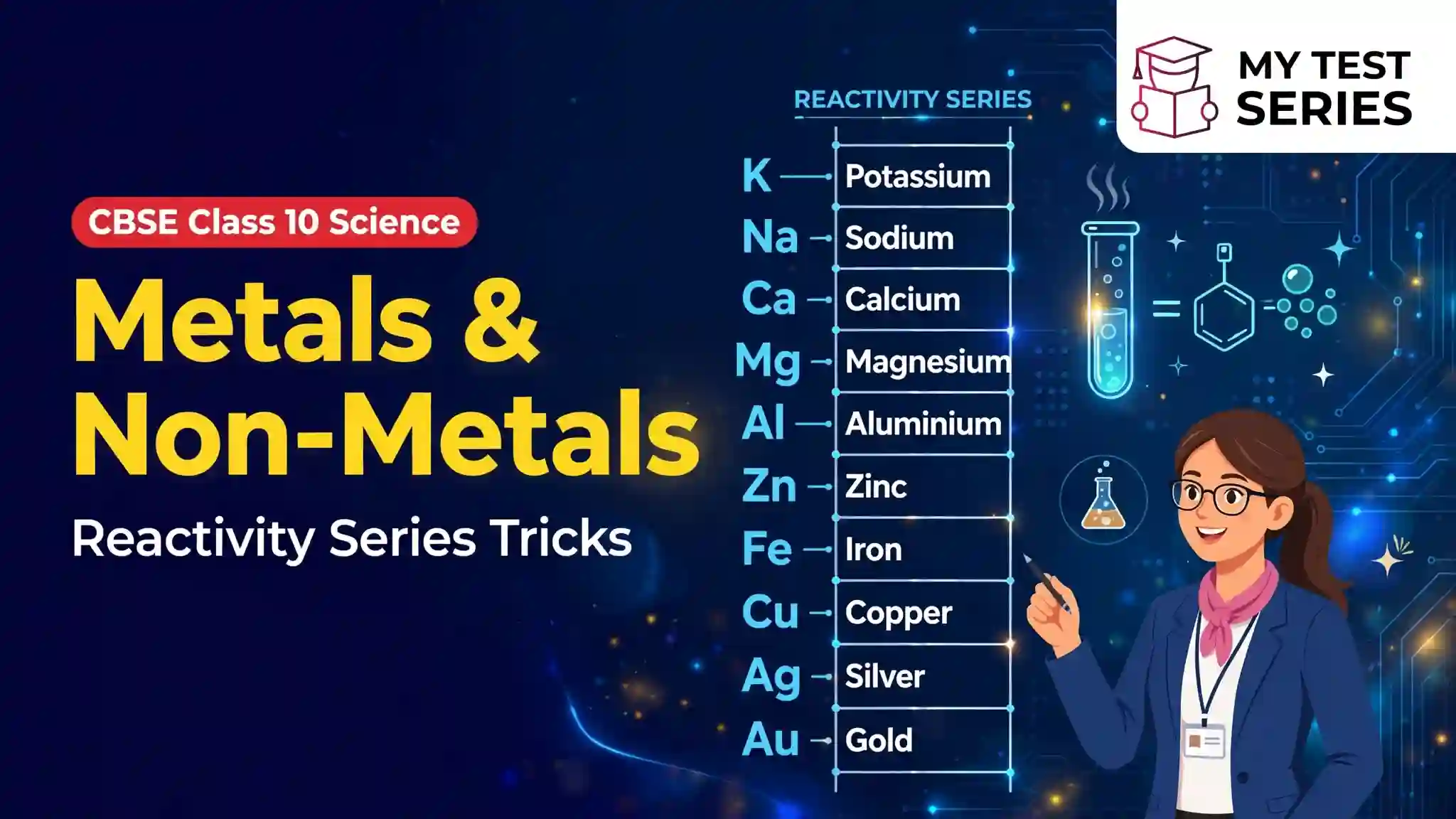
5. Reactivity Series of Metals Explained
The reactivity series arranges metals from more reactive to less reactive. It helps predict reactions with water, acids and salt solutions, and gives clues about how a metal can be extracted from its ore.
Hydrogen is included as a reference point even though it is not a metal. The series is a simplified school-level arrangement; the exact behaviour of a reaction also depends on conditions and the substances involved.
| Position | Metal | General implication |
|---|---|---|
| Very high | K, Na, Ca | Highly reactive; react readily with water. |
| High | Mg, Al | Reactive metals; extraction often requires electrolysis. |
| Moderate | Zn, Fe, Pb | Can often be extracted from oxides by reduction. |
| Low | Cu, Hg, Ag | Less reactive; extraction depends on the ore and metal. |
| Very low | Au | Often found in native form. |
How to memorise the series
- Learn the sequence in small groups instead of memorising the entire line at once.
- Remember that hydrogen separates metals that generally release hydrogen from dilute acids from those that do not.
- Practise displacement questions by comparing the positions of two metals.
- Connect the upper part of the series with extraction by electrolysis and the middle part with reduction.
6. Displacement Reactions: Rules and Examples
A displacement reaction occurs when a more reactive element replaces a less reactive element in a compound.
Example 1: Zinc and copper sulphate
Zinc is above copper in the reactivity series, so the reaction occurs under suitable conditions.
Example 2: Copper and zinc sulphate
Copper is less reactive than zinc and cannot displace zinc from zinc sulphate solution.
Example 3: Iron and copper sulphate
Iron displaces copper. This is a standard example of a displacement reaction.
Quick prediction method
7. Formation of Ionic Compounds
Ionic compounds form when oppositely charged ions attract one another. In sodium chloride, sodium loses an electron to form Na⁺, while chlorine gains an electron to form Cl⁻.
Sodium atom
Electronic configuration: 2, 8, 1
It loses one electron to form Na⁺.
Chlorine atom
Electronic configuration: 2, 8, 7
It gains one electron to form Cl⁻.
The electrostatic attraction between Na⁺ and Cl⁻ forms ionic sodium chloride.
Properties of ionic compounds
- Usually crystalline solids at room temperature.
- Generally have high melting and boiling points.
- Conduct electricity when molten or dissolved in water, if their ions are free to move.
- Generally do not conduct electricity in the solid state because their ions are fixed in position.
- Many are soluble in water, although solubility varies between compounds.
8. Amphoteric Oxides
An amphoteric oxide reacts with both acids and bases. Aluminium oxide and zinc oxide are important examples in Class 10 Chemistry.
Aluminium oxide with an acid
Zinc oxide with an acid
Zinc oxide with a base
The last equation represents the simplified school-level reaction forming sodium zincate. Conditions and the form of zincate species can vary in aqueous chemistry.
9. Extraction of Metals from Their Ores
Most metals occur naturally in minerals. A mineral from which a metal can be extracted economically is called an ore. The extraction method depends largely on the metal's reactivity and the nature of its ore.
Step 1: Concentration of ore
Unwanted earthy materials, called gangue, are removed using a suitable physical or chemical process.
Step 2: Convert the ore into a suitable form
Many ores are converted into oxides before reduction.
- Roasting: heating a sulphide ore strongly in excess air.
- Calcination: heating a carbonate ore or hydrated ore in limited or no air, as appropriate.
Step 3: Reduce the oxide
Reduction removes oxygen from the metal oxide to produce the metal.
Carbon reduces zinc oxide under suitable high-temperature conditions.
Step 4: Refine the metal
The crude metal may need further purification. Electrolytic refining is one method used for certain metals, including copper.
Extraction method and reactivity
| Reactivity | Typical extraction approach | Examples |
|---|---|---|
| Highly reactive | Electrolysis of suitable molten compounds | Sodium, aluminium |
| Moderately reactive | Reduction of suitable oxides using carbon or carbon monoxide | Iron, zinc |
| Less reactive | May occur in native form or be extracted using simpler reduction methods | Gold; some copper ores |
These are broad categories, not a universal recipe for every ore. Industrial extraction also depends on ore chemistry, energy requirements, environmental controls and economics.
10. Corrosion and Its Prevention
Corrosion is the gradual deterioration of a metal due to chemical or electrochemical reactions with its environment.
Rusting of iron
Iron rusts in the presence of oxygen and moisture. Rust is hydrated iron(III) oxide, often represented in a simplified form as Fe₂O₃·xH₂O.
Both oxygen and water are important for ordinary rusting. Salts can accelerate corrosion.
How can corrosion be prevented?
- Painting: creates a barrier against air and moisture.
- Oiling or greasing: protects the metal surface.
- Galvanisation: coats iron or steel with zinc.
- Electroplating: deposits a protective metal layer.
- Alloying: can improve corrosion resistance, as in stainless steel.
11. Alloys: Composition and Uses
An alloy is a material made by combining a metal with one or more other elements. Alloying can improve strength, hardness, durability or corrosion resistance.
| Alloy | Main constituents | Common use |
|---|---|---|
| Brass | Copper and zinc | Fittings, instruments and decorative items |
| Bronze | Copper and tin | Statues, bearings and decorative objects |
| Stainless steel | Iron with chromium and usually other elements | Utensils, equipment and corrosion-resistant components |
| Solder | Composition varies; traditional solder uses tin and lead | Joining metal components; lead-free formulations are also used |
Alloys are often used because their properties are more suitable for a particular purpose than those of the pure metal alone.
Prepare for Class 10 with Regular Practice
Explore the MyTestSeries Class 10 Mathematics Foundation 7-Day Demo. Check the product page for the current access details, selected tests, solutions and performance-analysis features.
12. Solved Examples: Reactivity Series and Metals
Example 1: Will zinc displace copper from copper sulphate?
Example 2: Will copper displace zinc from zinc sulphate?
Copper is below zinc in the reactivity series. Therefore, copper cannot displace zinc from zinc sulphate solution under ordinary conditions.
Answer: No reaction is expected.
Example 3: Why is sodium extracted by electrolysis?
Sodium is highly reactive and its compounds are very stable. Carbon reduction is not a suitable method for extracting sodium from its compounds, so electrolysis of a suitable molten compound is used.
Example 4: Why does aluminium resist corrosion?
Aluminium forms a thin, adherent oxide layer on its surface. This layer helps protect the metal beneath it from further attack.
Example 5: An element loses two electrons to form X²⁺. What can you infer?
The element forms a positive ion by losing two electrons. This behaviour is typical of many metals. Its exact identity cannot be determined from this information alone.
Example 6: Write the reaction between magnesium and oxygen.
The balanced equation shows two magnesium atoms reacting with one oxygen molecule to form two formula units of magnesium oxide.
13. Common Exam Mistakes to Avoid
- Memorising the reactivity series in the wrong order.
- Assuming every metal reacts with dilute hydrochloric acid.
- Forgetting that hydrogen is a reference point, not a metal in the series.
- Predicting that a less reactive metal can displace a more reactive metal.
- Confusing roasting with calcination.
- Claiming that all metal oxides are basic; aluminium oxide and zinc oxide are amphoteric.
- Forgetting to balance equations.
- Assuming solid ionic compounds conduct electricity just as their molten forms do.
- Confusing galvanisation with electroplating in general.
- Writing that rusting requires only oxygen or only water.
14. Important Questions with Answers
Q1. What is the reactivity series?
It is an arrangement of metals in decreasing order of chemical reactivity. It helps predict displacement reactions and the general method used to extract metals.
Q2. Why is copper used in electrical wiring?
Copper is a good conductor of electricity and is ductile, so it can be drawn into wires.
Q3. Why is sodium stored under kerosene?
Sodium reacts vigorously with oxygen and moisture. Keeping it away from air and water reduces the risk of a dangerous reaction.
Q4. Why do ionic compounds have high melting points?
Strong electrostatic attractions between oppositely charged ions require considerable energy to overcome.
Q5. Why do ionic compounds conduct electricity when molten?
In the molten state, their ions can move and carry electric charge.
Q6. What is an amphoteric oxide? Give two examples.
An amphoteric oxide reacts with both acids and bases. Aluminium oxide (Al₂O₃) and zinc oxide (ZnO) are examples.
Q7. What is corrosion?
Corrosion is the gradual deterioration of a metal through chemical or electrochemical reactions with its surroundings.
Q8. What is galvanisation?
Galvanisation is the process of coating iron or steel with zinc to protect it from corrosion.
Q9. Why are highly reactive metals extracted by electrolysis?
Their compounds are very stable, and common reducing agents such as carbon cannot readily extract these metals. Electrolysis is used for suitable molten compounds.
Q10. What is an alloy?
An alloy is a material made by combining a metal with one or more other elements to obtain useful properties.
15. One-Minute Revision Table
| Concept | Remember |
|---|---|
| Metal + oxygen | Usually metal oxide |
| Metal + dilute acid | Salt + hydrogen for suitable metals |
| Metal + salt solution | Displacement if the free metal is more reactive |
| Ionic bonding | Electrostatic attraction between oppositely charged ions |
| Amphoteric oxides | Al₂O₃ and ZnO |
| Highly reactive metals | Often extracted by electrolysis |
| Corrosion prevention | Painting, oiling, galvanisation and suitable alloys |
| Brass | Copper + zinc |
| Bronze | Copper + tin |
Get study resources, exam-preparation updates and learning content through the MyTestSeries WhatsApp Channel.
Join the WhatsApp Channel →17. Frequently Asked Questions
What is the reactivity series in Class 10?
Which metals are at the top of the reactivity series?
Why does zinc displace copper from copper sulphate?
What are amphoteric oxides?
How are highly reactive metals extracted?
What is the difference between roasting and calcination?
How can rusting be prevented?
Why do ionic compounds conduct electricity when molten?
What is the difference between metals and non-metals?
18. Official Textbook and Curriculum References
Use the current textbook and official curriculum alongside these notes. Check your school's prescribed syllabus for the topics assessed in your examination.
- NCERT CIET — Science Class X chapter resources
- CBSE Academic — Curriculum 2026–27
- NCERT official website
Curriculum coverage can change between academic sessions. Refer to the current official syllabus rather than relying on older question lists.
19. Conclusion: How to Master Metals and Non-Metals
Start with the physical properties and their exceptions. Next, learn the reactivity series and use it to predict displacement reactions. Then connect the series to ionic bonding, extraction methods and corrosion prevention.
Finally, practise writing balanced equations without looking at the notes. Explaining why a reaction occurs is more useful than memorising an equation alone.