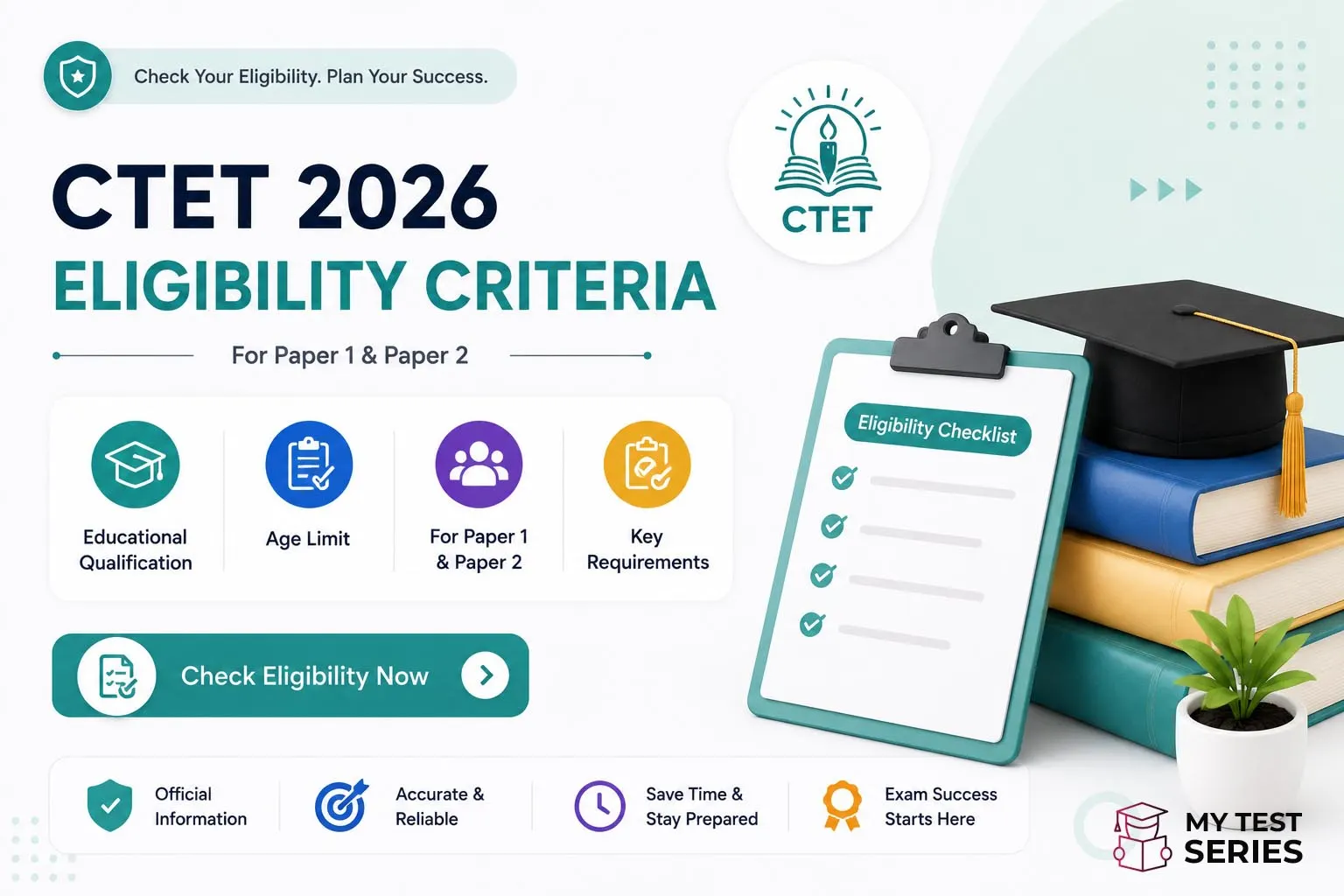
CTET Eligibility Criteria 2026:
Complete Guide for Paper 1 & Paper 2
Planning to become a teacher in India? The CTET (Central Teacher Eligibility Test) is your first step. Before you fill the form, you must confirm that you meet every eligibility condition — one missed requirement can get your application cancelled. This complete guide covers age limit, educational qualification, NCTE norms, reservation benefits, qualifying marks, and everything you need to apply with confidence.
What is CTET? A Quick Overview
The Central Teacher Eligibility Test (CTET) is a national-level examination conducted by the Central Board of Secondary Education (CBSE). It is the mandatory eligibility gateway for candidates who wish to teach in central government schools — primarily Kendriya Vidyalayas (KVS), Navodaya Vidyalayas (NVS), and other CBSE-affiliated institutions across India.
Clearing CTET does not guarantee a teaching job, but it is a mandatory qualification for applying to thousands of teaching posts in government and private schools that follow NCTE norms. CTET is held twice a year (typically February and September), and as of recent guidelines, the certificate is now valid for a lifetime.
Whether you're a fresh graduate or an experienced professional, CTET opens doors to some of the most prestigious teaching positions in India. But first — you need to make sure you actually qualify to sit for the exam. Read on to understand every layer of the eligibility criteria.
CTET Eligibility Criteria 2026 – At a Glance
Before diving into specifics, here is a snapshot of all the major parameters that define who can and who cannot appear for CTET 2026:
| Eligibility Parameter | Requirement |
|---|---|
| Conducting Body | Central Board of Secondary Education (CBSE) |
| Exam Name | Central Teacher Eligibility Test (CTET) |
| Nationality | Indian Citizen |
| Minimum Age | 18 Years |
| Upper Age Limit | No upper age limit |
| Paper 1 (Classes 1–5) | 12th + D.El.Ed / B.El.Ed / B.Ed (NCTE approved) |
| Paper 2 (Classes 6–8) | Graduation + B.Ed / D.El.Ed / B.El.Ed (NCTE approved) |
| Minimum Marks (General) | 50% in qualifying examination |
| Minimum Marks (Reserved) | 45% in qualifying examination |
| Qualifying Marks (General) | 60% in CTET (90/150) |
| Qualifying Marks (SC/ST/OBC/PwD) | 55% in CTET (82–83/150) |
| Number of Attempts | Unlimited |
| Certificate Validity | Lifetime (since 2021) |
| Final Year Students | Eligible to apply |
Nationality Requirement for CTET 2026
Only Indian citizens are eligible to apply for the Central Teacher Eligibility Test. This rule directly aligns with the central government's recruitment policies for teaching positions in KVS, NVS, and other government-run schools.
- Candidates must be Indian citizens as per the NCTE and CBSE guidelines.
- Candidates of other nationalities must fulfil specific conditions laid down by NCTE.
- Valid proof of Indian nationality may be required during document verification at time of appointment.
This is a foundational criterion — failing to meet this automatically disqualifies a candidate from applying.
Age Limit for CTET 2026
One of the most frequently asked questions among aspirants is about the age restriction. Here is the definitive answer:
The minimum age requirement to apply for CTET 2026 is 18 years (some sources cite 17; the official CBSE information bulletin for the September 2026 session specifies 18 years). Crucially, there is no upper age limit — whether you are 25 or 55, you are welcome to sit for the exam.
Is There Any Age Relaxation?
Since there is no upper age limit, age relaxation as such does not apply to CTET. Age-related relaxations are relevant to appointment processes at individual institutions (KVS, NVS, etc.) and not to the CTET exam itself.
Educational Qualification for CTET Paper 1 (Classes 1–5)
CTET Paper 1 is for candidates who aspire to teach Classes 1 to 5 (Primary Level). The following are the accepted educational qualifications as per NCTE norms:
| # | Qualification Pathway | Minimum Marks | Category |
|---|---|---|---|
| 1 | Senior Secondary (12th) + 2-year Diploma in Elementary Education (D.El.Ed), final year appearing | 50% in 12th | General |
| 2 | Senior Secondary (12th) + 2-year D.El.Ed (as per NCTE Regulations 2002) | 45% in 12th | Reserved |
| 3 | Senior Secondary (12th) + 4-year Bachelor of Elementary Education (B.El.Ed), final year appearing | 50% in 12th | General |
| 4 | Senior Secondary (12th) + 4-year B.A/B.Sc.Ed or B.A.Ed/B.Sc.Ed | 50% in 12th | General |
| 5 | Graduation + 2-year D.El.Ed (final year appearing) | 50% in Graduation | General |
| 6 | Post-Graduation (any discipline) + 3-year integrated B.Ed–M.Ed | 55% in PG | General |
Additional Conditions for Paper 1 Eligibility
- Degree or diploma must be recognised by NCTE.
- Special Education diplomas must be accredited by the Rehabilitation Council of India (RCI).
- D.Ed (Special Education) holders must additionally complete a 6-month NCTE-approved Special Programme in Elementary Education.
- Candidates in their final year of a qualifying degree/diploma are eligible to apply.
Educational Qualification for CTET Paper 2 (Classes 6–8)
CTET Paper 2 is for candidates who wish to teach Classes 6 to 8 (Upper Primary Level). This requires a graduation-level qualification combined with a teacher training programme.
| # | Qualification Pathway | Minimum Marks | Category |
|---|---|---|---|
| 1 | Graduation + 2-year Diploma in Elementary Education (D.El.Ed), final year appearing | 50% in Graduation | General |
| 2 | Graduation + 1-year B.Ed (NCTE recognised), appeared or appearing | 50% in Graduation | General |
| 3 | Graduation + 1-year B.Ed (as per NCTE norms) | 45% in Graduation | Reserved |
| 4 | Senior Secondary (12th) + 4-year B.El.Ed, final year appearing | 50% in 12th | General |
| 5 | Senior Secondary (12th) + 4-year B.A/B.Sc.Ed or B.A.Ed/B.Sc.Ed | 50% in 12th | General |
| 6 | Graduation + 1-year B.Ed (Special Education) | 50% in Graduation | General |
| 7 | Post-Graduation (any discipline) + 3-year integrated B.Ed–M.Ed | 55% in PG | General |
Minimum Qualifying Marks for CTET 2026
Qualifying CTET means scoring above the CBSE-prescribed minimum in the actual exam. This is different from the minimum percentage required in your educational qualifications. Here is what you need to score to receive your CTET certificate:
| Category | Minimum % Required | Minimum Marks (Out of 150) |
|---|---|---|
| General / Unreserved | 60% | 90 Marks |
| SC / ST / OBC (Non-Creamy Layer) | 55% | 82–83 Marks |
| Differently Abled (PwD) | 55% | 82–83 Marks |
| Transgender | 55% | 82–83 Marks |
Is There a CTET Merit/Rank List?
No. CTET is a qualifying exam, not a ranking exam. CBSE does not release a merit list. All candidates who score at or above the minimum qualifying marks receive a CTET Pass Certificate. The actual appointment to a teaching post happens through separate recruitment drives by KVS, NVS, DSSSB, state governments, and private schools.
Want to make sure you comfortably cross the qualifying mark? Start practicing now with topic-wise and full-length CTET tests at MyTestSeries.in.
Reservation & Relaxation in CTET 2026
The CBSE and NCTE do not provide reservation in terms of the eligibility criteria for CTET — meaning all candidates must meet the basic age and qualification requirements. However, two important relaxations exist:
1. Relaxation in Educational Qualification Marks
| Category | General Requirement | Relaxed Requirement |
|---|---|---|
| SC / ST / OBC-NCL / PwD | 50% in qualifying exam | 45% in qualifying exam |
2. Relaxation in CTET Exam Qualifying Marks
As noted earlier, reserved category candidates need to score only 55% (82–83 marks out of 150) in the actual CTET, compared to 60% for general candidates.
3. Application Fee Relaxation
| Category | One Paper | Both Papers |
|---|---|---|
| General / OBC (Creamy Layer) | ₹1,000 | ₹1,200 |
| SC / ST / PwD | ₹500 | ₹600 |
Number of Attempts — No Limit!
This is one of the most candidate-friendly aspects of CTET. There is absolutely no restriction on the number of times you can appear for the exam. Whether you are attempting CTET for the first time or the tenth, you are eligible.
- No upper limit on the number of CTET attempts.
- Candidates can attempt every session to improve their score.
- Only the highest valid score (the most recently passed certificate) is used for appointments.
- CTET can be taken while you are still completing your qualifying degree (final year students eligible).
CTET Certificate Validity — Now Lifetime!
In a landmark change announced in 2021, the Government of India extended CTET certificate validity from seven years to lifetime validity. This means once you clear CTET, you never need to appear again just to renew your certificate.
This change removed a significant burden from lakhs of teachers and aspirants who had previously passed CTET but couldn't secure a government post within seven years. Today, your certificate remains your credential for a lifetime of teaching opportunities.
For a deeper understanding of how CTET compares with state-level examinations, read our guide: CTET vs State TET — Which is Better for Your Teaching Career?
How to Apply for CTET 2026 — Step by Step
Once you have confirmed your eligibility, here is exactly how to complete the CTET 2026 registration process:
-
1Confirm Eligibility Double-check your nationality, age, and educational qualification against the criteria listed in this guide before you begin.
-
2Visit the Official CTET Website Go to ctet.nic.in and click on "Apply Online" for CTET September 2026.
-
3Fill the Online Application Form Enter personal details, educational qualifications, select Paper 1, Paper 2, or both, and choose exam city preference.
-
4Upload Documents Upload your recent photograph (passport size), signature, and ID proof in the specified format and size.
-
5Pay the Application Fee Pay online via credit/debit card or net banking. General: ₹1,000 (one paper) / ₹1,200 (both papers). SC/ST/PwD: ₹500 / ₹600.
-
6Submit & Save Confirmation Submit the form and save the confirmation page. Download and print the application receipt for future reference.
-
7Start Your Preparation Register free at MyTestSeries.in and begin preparing with topic-wise mock tests, previous year papers, and expert notes.
- Application Start Date: May 11, 2026
- Application Last Date: June 10, 2026
- Exam Date: September 6, 2026 (Sunday)
- Official Website: ctet.nic.in
Subject-Specific Eligibility Notes for CTET
The minimum educational qualifications listed above apply to teachers of Languages, Social Studies/Social Science, Mathematics, and Science. However, a few subject areas have additional rules:
| Subject Area | Additional Norm |
|---|---|
| Physical Education | Must adhere to NCTE rules specifically for PE instructors |
| Art Education | Norms set by state governments and school managements |
| Home Science | Norms set by state governments and school managements |
| Work Education & Craft | Norms set by state governments and school managements |
| Special Education (D.Ed) | Must additionally complete 6-month NCTE-approved Special Programme in Elementary Education |
It is always the candidate's responsibility to verify their eligibility. Admission to the exam does not guarantee eligibility. Final verification happens at the time of appointment.
Career Opportunities After Clearing CTET 2026
Clearing CTET unlocks the door to some of the most stable, respected, and well-paying government teaching jobs in India. Here is what you can do after you have your CTET certificate in hand:
| Organisation | Applicable Paper | Posts Available |
|---|---|---|
| Kendriya Vidyalaya Sangathan (KVS) | Paper 1 & 2 | PRT (Primary), TGT |
| Navodaya Vidyalaya Samiti (NVS) | Paper 1 & 2 | PGT, TGT, PRT |
| DSSSB (Delhi) | Paper 1 & 2 | Primary & Upper Primary Teachers |
| State Government Schools | Paper 1 & 2 | Varies by state |
| Private CBSE Schools | Paper 1 & 2 | Subject Teacher, Class Teacher |
| Army Schools & Other Central Institutions | Paper 2 (mostly) | TGT-level posts |
Also explore UPTET 2026 preparation resources on MyTestSeries.in — because qualifying both CTET and your state TET dramatically improves your job prospects.
Frequently Asked Questions (FAQs) About CTET Eligibility 2026
Here are the most commonly asked questions about CTET eligibility, answered directly and clearly:
🎯 Start Your CTET & Teaching Exam Preparation Today
MyTestSeries.in offers free and premium resources for CTET, UPTET, and all major state-level teacher eligibility tests. Here is what you can access right now:
CTET Full Mock Test Series
Paper 1 & Paper 2 | Free Access Available- Full-length tests (150 questions)
- Chapter-wise topic tests
- Previous year papers (2018–2025)
- Detailed answer explanations
- Performance analytics & rank
Child Development & Pedagogy (CDP)
CTET Paper 1 & 2 | High Weightage Topics- Piaget, Vygotsky, Kohlberg notes
- Inclusive Education & RTE guides
- Learning Theories with PYQs
- CDP topic-wise practice sets
- 30 marks guaranteed with right prep
UPTET 2026 Preparation Pack
Hindi Medium | State Level TET- UPTET Paper 1 & Paper 2 tests
- Hindi medium study material
- UPTET previous year questions
- Super TET preparation included
- Free mock test access
CTET Science (Paper 2) Special
Classes 6–8 | Subject + Pedagogy- Science content & pedagogy notes
- Previous year paper analysis
- Short-answer question (SAQ) bank
- Biology, Chemistry, Physics split
- Exam-oriented mock tests
Official & Trusted External Resources
For authoritative CTET information, always cross-verify with these official sources:
- CTET Official Website — ctet.nic.in (Applications, Results, Admit Cards)
- NCTE Official Website — ncte.gov.in (NCTE Recognition Norms & TET Guidelines)
- CBSE Official Website — cbse.gov.in
- KVS Recruitment Portal — kvsangathan.nic.in