Digestive System Notes for GNM, BSc & Nursing Officer Exams (2026): Diagram, Enzymes, Hormones & MCQs
One of the highest-weightage Medical-Surgical Nursing topics across RRB, AIIMS NORCET, ESIC and state nursing exams — organ-by-organ notes, labelled diagram, enzyme & hormone tables, and practice MCQs in one place.
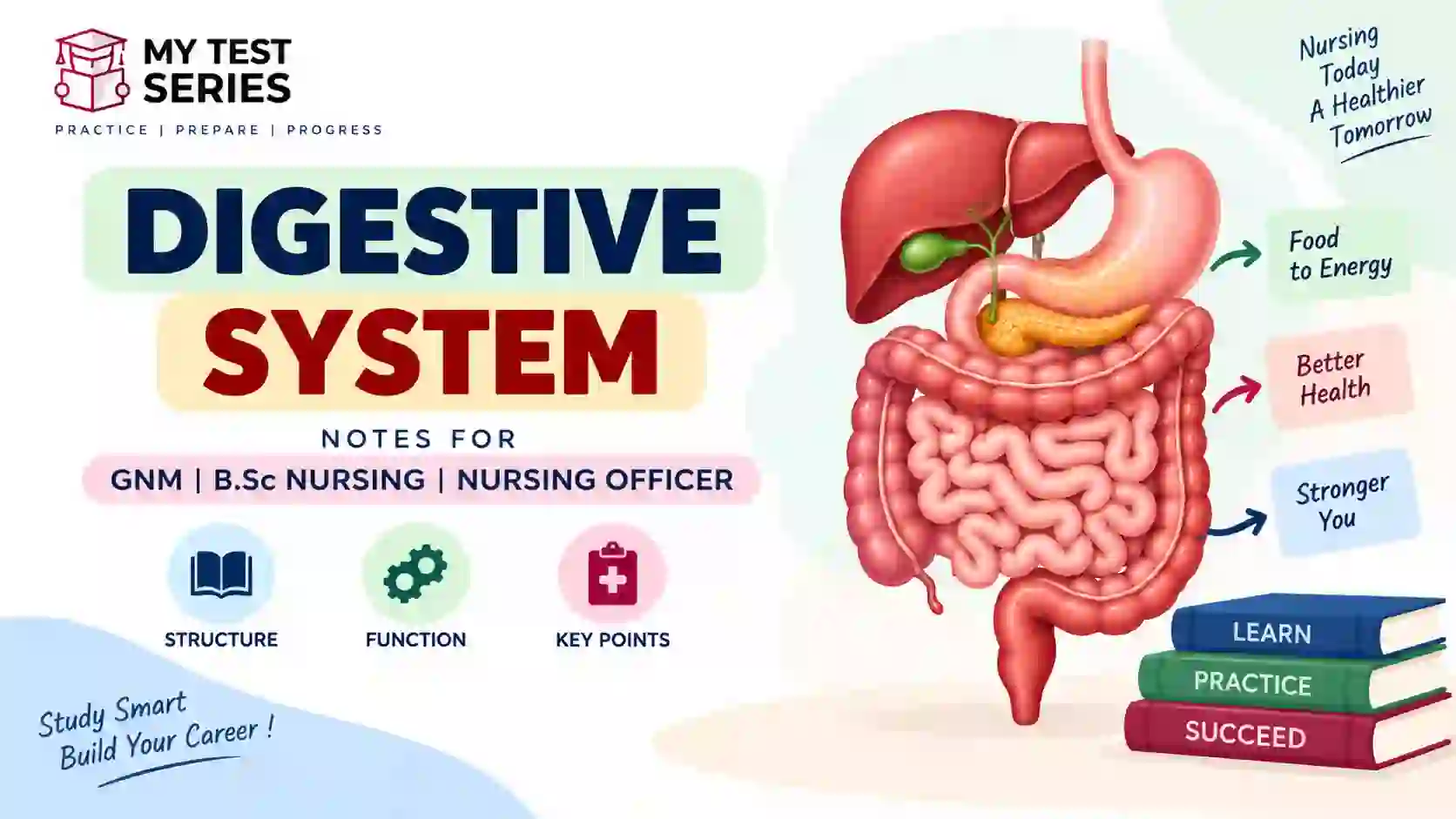
The human digestive system consists of the gastrointestinal (GI) tract — mouth, pharynx, oesophagus, stomach, small intestine and large intestine — along with three accessory organs: the liver, gallbladder and pancreas. Digestion breaks food into carbohydrates, proteins and fats using enzymes like salivary amylase, pepsin, trypsin and lipase, aided by hormones such as gastrin, secretin and cholecystokinin (CCK). In nursing exams, Medical-Surgical Nursing questions on the digestive system most frequently target the stomach's HCl secretion, pancreatic enzymes, bile flow, and GI disorders like peptic ulcer, cirrhosis and pancreatitis.
If you're preparing for GNM, BSc Nursing, Nursing Officer, RRB Nursing Superintendent, AIIMS NORCET or ESIC exams, the digestive system is a topic you cannot afford to skim — it consistently appears in Medical-Surgical Nursing and Anatomy & Physiology sections, and it also forms the clinical foundation for questions on nutrition, GI disorders, and post-operative nursing care. This guide organises the entire system the way exam papers actually test it: structure first, function next, then the clinical disorders nurses are expected to manage.
What This Guide Covers
- Why This Topic Matters for Nursing Exams
- Digestive System Diagram (Labelled)
- Mouth & Salivary Glands
- Pharynx & Oesophagus
- Stomach
- Small Intestine
- Large Intestine
- Liver, Gallbladder & Pancreas
- Digestive Enzymes Table
- Digestive Hormones Table
- Common GI Disorders & Nursing Points
- Rapid Revision One-Liners
- Practice MCQs
- FAQs
- Related Nursing Exam Guides
Why the Digestive System Is a High-Weightage Topic
Across almost every nursing recruitment exam in India, Anatomy & Physiology and Medical-Surgical Nursing together carry the largest share of Professional Ability marks — and the digestive (gastrointestinal) system is consistently one of the top three body systems tested, alongside cardiovascular and renal.
| Exam | Section | Typical Focus Area |
|---|---|---|
| RRB Nursing Superintendent | Professional Ability (70 marks) | Organ function, GI disorders, nursing administration angle |
| AIIMS NORCET | Medical-Surgical Nursing | Pathophysiology, post-op GI nursing care |
| ESIC Nursing Officer | Professional Knowledge | Enzymes, hormones, disorders & treatment |
| GNM / BSc Nursing (University) | Anatomy & Physiology | Structure, function, diagrams |
Practising notes isn't enough — test yourself under real exam conditions.
Subject-wise MCQs and full-length mocks covering RRB, AIIMS NORCET & ESIC patterns.
Digestive System Diagram (Labelled)
Before memorising individual functions, fix this sequence in your mind — every exam question ultimately traces back to where an organ sits in this pathway:
Mouth & Salivary Glands
Digestion begins mechanically and chemically the moment food enters the mouth. Mastication (chewing) breaks food into smaller particles, while three pairs of salivary glands — parotid, submandibular and sublingual — secrete saliva containing salivary amylase (ptyalin), which begins breaking starch into maltose.
- Saliva also contains mucus (lubrication), lysozyme (antibacterial action) and a small amount of lingual lipase.
- The tongue aids in taste, chewing, and forming the food bolus for swallowing (deglutition).
- Average adult saliva production: roughly 1–1.5 litres per day.
Pharynx & Oesophagus
The pharynx is a shared passage for food and air; the epiglottis folds over the trachea during swallowing to prevent aspiration. The oesophagus is a muscular tube (~25 cm in adults) that moves the bolus to the stomach purely through peristalsis — no digestion occurs here.
- Upper oesophageal sphincter (UES): prevents air entry during breathing.
- Lower oesophageal sphincter (LES) / cardiac sphincter: prevents reflux of gastric acid into the oesophagus — its weakening is the key mechanism behind GERD.
Stomach
The stomach is a J-shaped muscular organ divided into the fundus, body, antrum and pylorus, lined internally by folds called rugae that allow expansion. It performs both mechanical churning and major chemical digestion.
| Cell Type | Secretion | Function |
|---|---|---|
| Parietal cells | HCl & Intrinsic Factor | Acidifies stomach (pH 1.5–3.5); intrinsic factor enables Vitamin B12 absorption in ileum |
| Chief cells | Pepsinogen | Converted to active pepsin by HCl; begins protein digestion |
| Mucous neck cells | Mucus & bicarbonate | Protects stomach lining from self-digestion |
| G cells (antrum) | Gastrin | Stimulates further HCl secretion and gastric motility |
Exam tip: Loss of intrinsic factor (e.g., after gastrectomy) is a classic cause of Vitamin B12 deficiency / pernicious anaemia — a favourite link-the-concept question.
Small Intestine
The small intestine is roughly 6–7 metres long and is where the majority of digestion and nearly all nutrient absorption occurs, thanks to finger-like projections called villi and microvilli that massively increase surface area.
| Part | Approx. Length | Key Feature |
|---|---|---|
| Duodenum | ~25 cm | Receives bile (via sphincter of Oddi) and pancreatic juice; site of most chemical digestion |
| Jejunum | ~2.5 m | Primary site of nutrient absorption; thick, well-vascularised walls |
| Ileum | ~3.5 m | Absorbs Vitamin B12 and bile salts; connects to large intestine at the ileocaecal valve |
Large Intestine
The large intestine (~1.5 m) includes the caecum, appendix, ascending/transverse/descending/sigmoid colon, rectum and anus. It does not absorb nutrients in any significant way — its main jobs are water/electrolyte reabsorption and stool formation.
- Gut flora (normal bacterial flora) synthesise Vitamin K and some B-complex vitamins here.
- Mass peristaltic movements push contents toward the rectum, usually 2–3 times a day (often post-meal — the gastrocolic reflex).
- The internal anal sphincter is involuntary (smooth muscle); the external anal sphincter is voluntary (skeletal muscle) — a common physiology MCQ.
Liver, Gallbladder & Pancreas (Accessory Organs)
Liver
The largest gland in the body, made up of functional units called hepatocytes arranged into lobules. Beyond digestion, the liver detoxifies drugs and toxins, stores glycogen and fat-soluble vitamins (A, D, E, K), and synthesises plasma proteins including albumin and clotting factors. For digestion specifically, hepatocytes continuously produce bile, which emulsifies fats.
Gallbladder
A small pear-shaped sac beneath the liver that stores and concentrates bile. On stimulation by CCK (after a fatty meal), it contracts and releases bile through the cystic and common bile ducts into the duodenum.
Pancreas
A dual-function gland:
- Exocrine function: acinar cells secrete pancreatic juice containing amylase, lipase, trypsinogen, chymotrypsinogen and bicarbonate (to neutralise acidic chyme entering the duodenum).
- Endocrine function: Islets of Langerhans — beta cells secrete insulin, alpha cells secrete glucagon — regulating blood glucose (directly relevant to diabetes-related nursing questions).
One test series, every major nursing exam.
170+ subject-wise tests covering RRB, AIIMS NORCET and ESIC syllabus with detailed explanations.
Digestive Enzymes at a Glance
| Enzyme | Produced By | Acts In | Function |
|---|---|---|---|
| Salivary amylase | Salivary glands | Mouth | Starch → maltose |
| Pepsin | Chief cells (as pepsinogen) | Stomach | Proteins → peptides (needs acidic pH) |
| Pancreatic amylase | Pancreas | Duodenum | Starch → maltose |
| Trypsin & Chymotrypsin | Pancreas | Small intestine | Proteins → peptides |
| Lipase | Pancreas | Small intestine | Fats → fatty acids + glycerol |
| Maltase, Sucrase, Lactase | Intestinal brush border | Small intestine | Disaccharides → monosaccharides |
Digestive Hormones at a Glance
| Hormone | Secreted By | Main Function |
|---|---|---|
| Gastrin | G cells, stomach antrum | Stimulates HCl secretion & gastric motility |
| Secretin | Duodenum | Stimulates pancreatic bicarbonate release; inhibits gastric acid |
| Cholecystokinin (CCK) | Duodenum | Stimulates gallbladder contraction & pancreatic enzyme release |
| Gastric Inhibitory Peptide (GIP) | Duodenum | Inhibits gastric secretion; stimulates insulin release |
| Motilin | Small intestine | Stimulates GI motility between meals |
Common GI Disorders & Nursing Points
| Disorder | Brief Cause | Nursing Priority |
|---|---|---|
| GERD | Weak lower oesophageal sphincter | Elevate head of bed; avoid late/heavy meals |
| Peptic Ulcer Disease | H. pylori infection / NSAID overuse | Monitor for bleeding (melena, haematemesis); pain-food relationship |
| Gastritis | Alcohol, NSAIDs, stress, infection | Bland diet; monitor hydration and pain |
| Cirrhosis | Chronic liver damage (alcohol, hepatitis) | Monitor for ascites, jaundice, bleeding risk |
| Cholelithiasis (Gallstones) | Bile composition imbalance | Low-fat diet; watch for post-fatty-meal pain |
| Acute Pancreatitis | Gallstones, alcohol use | NPO status, pain management, monitor amylase/lipase |
| Inflammatory Bowel Disease | Autoimmune (Crohn's/Ulcerative Colitis) | Monitor bowel pattern, hydration, nutrition |
| Intestinal Obstruction | Adhesions, hernia, tumour | NPO, NG decompression, monitor bowel sounds |
Rapid Revision One-Liners
- Longest part of the GI tract by length: small intestine (~6–7 m).
- Only enzyme active in an acidic environment among the major ones listed: pepsin.
- Vitamin B12 absorption requires intrinsic factor (from parietal cells) and occurs in the ileum.
- Bile is produced by the liver but stored/concentrated in the gallbladder.
- Pancreas is both an exocrine and endocrine gland — insulin comes from beta cells of the Islets of Langerhans.
- Largest gland in the human body: liver.
- Sphincter of Oddi controls entry of bile + pancreatic juice into the duodenum.
- Normal gastric pH range: 1.5–3.5 (highly acidic).
Practice MCQs
Q1. Which cells in the stomach secrete hydrochloric acid?
Show Answer
Q2. Which hormone stimulates gallbladder contraction after a fatty meal?
Show Answer
Q3. Which vitamin is synthesised by normal bacterial flora in the large intestine?
Show Answer
Q4. The sphincter of Oddi regulates the entry of which secretions into the duodenum?
Show Answer
Q5. Which enzyme begins carbohydrate digestion in the mouth?
Show Answer
Q6. Which part of the small intestine is the primary site of nutrient absorption?
Show Answer
Frequently Asked Questions
What is the digestive system and why is it important for nursing exams?
The digestive system is the group of organs — mouth, oesophagus, stomach, small and large intestines, plus the liver, gallbladder and pancreas — that break down food and absorb nutrients. It's a high-weightage nursing exam topic because it links Anatomy & Physiology with Medical-Surgical Nursing, appearing in both structural (diagram-based) and clinical (disorder-based) questions.
Which accessory organs support digestion without food passing through them?
The liver, gallbladder and pancreas. Food never physically passes through these organs — they release secretions (bile, digestive enzymes, bicarbonate) into the duodenum to assist digestion.
What is the normal pH of gastric juice?
Gastric juice is strongly acidic, typically in the range of pH 1.5 to 3.5, mainly due to hydrochloric acid secreted by parietal cells.
Which hormones regulate the digestive process?
The main digestive hormones are gastrin (stimulates HCl secretion), secretin (stimulates pancreatic bicarbonate release), cholecystokinin or CCK (stimulates gallbladder contraction and pancreatic enzyme release), gastric inhibitory peptide (GIP), and motilin.
What are the most commonly asked GI disorders in nursing exams?
GERD, peptic ulcer disease, gastritis, cirrhosis, cholelithiasis (gallstones), acute pancreatitis, inflammatory bowel disease, and intestinal obstruction are frequently tested, usually alongside their nursing management priorities.
Related Nursing Exam Guides
Preparing for a central or state-level nursing exam alongside your anatomy revision? These guides on MyTestSeries.in cover eligibility, syllabus and career comparisons for the exams where Digestive System questions are most frequently asked:
Related Exam Products
One Nursing Exam Pass — AIIMS, ESIC, RRB & NORCET Test Series
170+ subject-wise tests and full mocks with detailed explanations for every question.
View Test Series →Browse All Test Series
Explore every exam category MyTestSeries covers — RRB, WBCS, WBSSC, CTET, ADRE & more.
View All Test Series →Official & Reference Sources
- NIDDK (National Institute of Diabetes and Digestive and Kidney Diseases, NIH) — U.S. government reference on digestive diseases
- MedlinePlus — Digestive System — National Library of Medicine patient & student resource
- NCBI Bookshelf — Physiology, Digestion (StatPearls) — peer-reviewed physiology reference
These notes are compiled for exam-revision purposes and summarise widely accepted nursing anatomy & physiology concepts. Always cross-check clinical specifics against your prescribed textbook and the official syllabus of the exam you are appearing for.
Share this guide: WhatsApp • Facebook • X (Twitter)