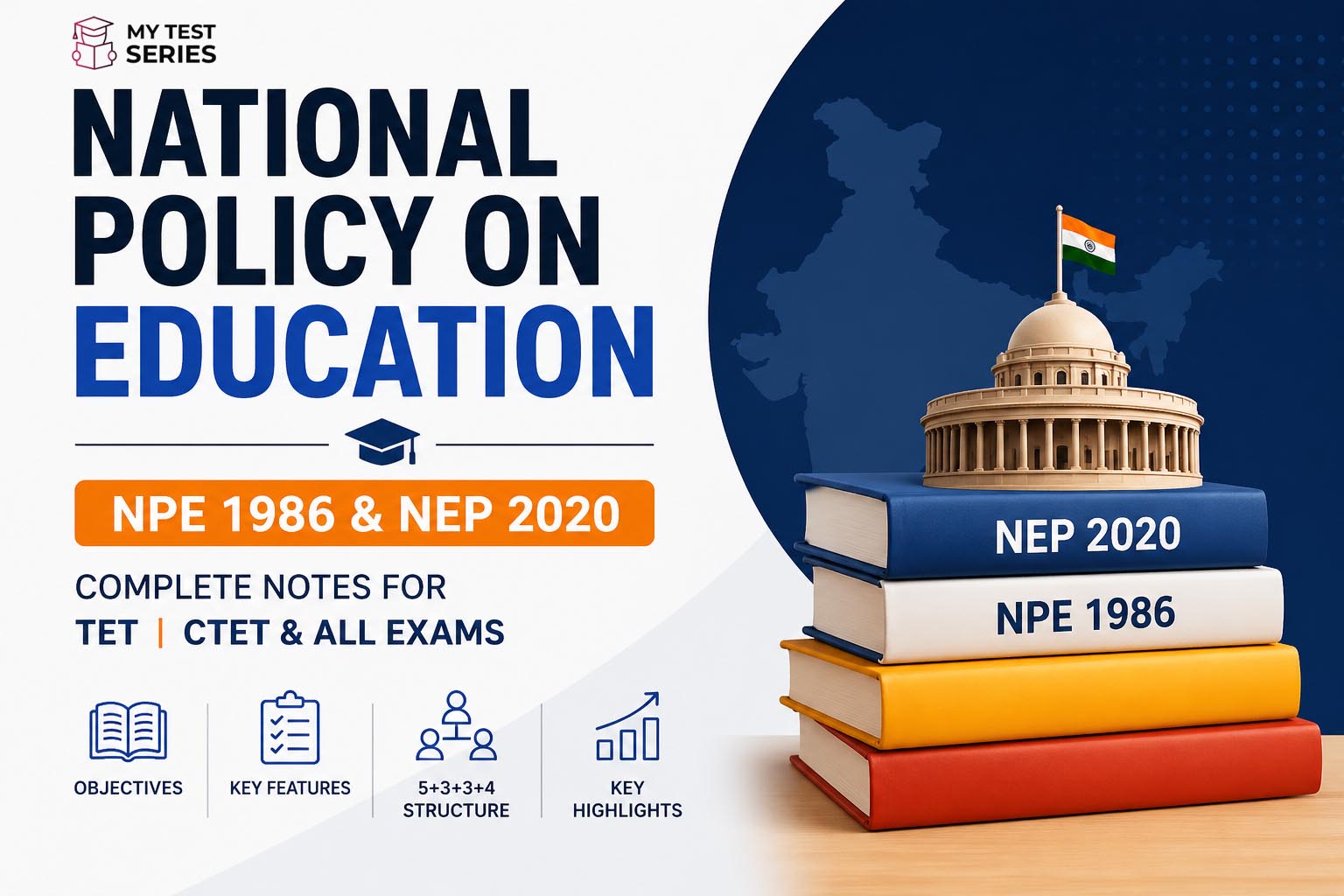
National Policy on Education (1986) Notes for TET

National Policy on Education — 1986
India's second comprehensive education policy · Modified in 1992 (Ramamurti & Janardhana Reddy Reviews)
NPE 1986 Rajiv Gandhi Era Equality & Access Operation Blackboard Navodaya Vidyalayas
1. Background & Context
AspectDetail
Preceded byNPE 1968 (based on Kothari Commission 1964–66) — first post-independence national education policy
Why needed?NPE 1968 remained largely unimplemented. By 1980s, massive inequalities persisted — gender gap, rural–urban divide, caste-based exclusion. Education system needed a comprehensive overhaul.
Immediate contextRajiv Gandhi government; "Challenge of Education" document (1985) — a diagnostic paper that exposed failures of Indian education
Announced byPrime Minister Rajiv Gandhi, May 1986
Based onNational debate, state consultations, and the 1985 document "Challenge of Education: A Policy Perspective"
Modified1992 — after Ramamurti Committee Review (1990) and Janardhana Reddy Committee (1991–92); called Programme of Action (POA) 1992
Replaced byNEP 2020 (National Education Policy 2020)
Structure of document12 chapters covering all levels from early childhood to higher education and technical education
NPE 1986 was the most comprehensive education policy document India had produced — covering every level from pre-primary to adult education — and the first to explicitly address equity, gender, and social justice as central educational concerns.
2. Core Philosophy & Guiding Principles
Education for equality: Education is the most powerful instrument for equalizing opportunities and reducing social disparities — of caste, gender, region, religion, and language.
National system of education: A common educational structure (10+2+3) and a national curricular framework across all states — unity in diversity without uniformity.
Child-centred education: The child must be placed at the centre of all educational planning. Rote learning, fear, and corporal punishment must be eliminated.
Education as investment: Education is not a welfare expenditure but a productive investment in human capital and national development.
Modernization with values: Education must simultaneously foster scientific temper, technological capability, and Indian cultural values and traditions.
Decentralization: Planning and management of education must be decentralized to districts and community levels — not top-down from Delhi or state capitals.
Role of women: Education of women is not just a right but a national imperative — central to development, population control, and democratic participation.
3. Educational Structure Endorsed
StageClassesAgeKey Feature
Pre-primary / ECCEPre-Class I3–6 yrsIntegrated Child Development Services (ICDS); Anganwadis; holistic care
PrimaryI–V6–11 yrsUniversal access; mother tongue medium; no detention; activity-based
Upper PrimaryVI–VIII11–14 yrsSUPW; science; maths; social studies; vocational orientation begins
SecondaryIX–X14–16 yrsVocational diversification; three-language formula; board examination
Higher SecondaryXI–XII16–18 yrsPart of school system (not university); specialization streams
UndergraduateDegree18–21 yrs3-year degree; autonomous colleges encouraged
Postgraduate & ResearchPG / PhD21+ yrsResearch emphasis; IITs/IIMs as centres of excellence
NPE 1986 formally endorsed and universalized the 10+2+3 pattern across all Indian states and union territories — completing what Radhakrishnan and Mudaliar Commissions had first proposed.
4. Major Programmes & Schemes Launched
A. Operation Blackboard (1987): The most famous programme launched under NPE 1986. Aimed at providing minimum essential facilities to all primary schools — at least two teachers (one female), two classrooms, basic furniture, blackboards, maps, charts, and teaching-learning materials. Addressed the shocking reality that lakhs of primary schools had no building, no blackboard, no toilet, and single-teacher setups. Directly improved physical infrastructure of primary schools nationwide.
B. Navodaya Vidyalayas (Jawahar Navodaya Vidyalayas — JNVs): Residential central schools set up in every district — one per district — to provide quality education to talented rural children irrespective of economic background. Fully funded by Central Government; free education, boarding, and lodging. Admission by competitive entrance test (JNVST). Aimed to break the rural–urban quality divide. The concept of parity of quality with urban elite schools for rural talent. Currently over 650 JNVs across India — one of the most successful outcomes of NPE 1986.
C. Kendriya Vidyalayas (KVs) — expanded: Already existing, but NPE 1986 reinforced their role as model schools implementing the national curriculum, NCERT textbooks, and three-language formula. Expanded network and strengthened as demonstrators of the national education system.
D. Vocationalization of Secondary Education: Launched a Centrally Sponsored Scheme of Vocationalization — 25% of students at the +2 level to be in vocational streams by 1990 (target never met). Vocational courses introduced in agriculture, health, paramedics, business, electronics, and home science. Built directly on Mudaliar Commission's diversified curriculum idea.
E. SUPW (Socially Useful Productive Work): Formally introduced as a compulsory part of school curriculum from primary to secondary level. Community service, craft, gardening, first aid, and productive activities integrated into school timetables. Aimed at instilling dignity of labour and connecting education to life.
F. Non-Formal Education (NFE) programme: For children who could not attend formal schools — working children, girls in conservative areas, children in remote regions. Flexible timing, locally adapted curriculum, part-time learning centres. Precursor to the Open School movement and eventually the National Institute of Open Schooling (NIOS).
G. National Open School (NOS) — now NIOS: Established in 1989 under NPE 1986 to provide flexible, open, and distance secondary education to dropouts, adults, and out-of-school learners. Offered equivalency with formal board examination certificates. Now the National Institute of Open Schooling (NIOS) — world's largest open school with over 35 lakh registered learners.
H. District Institutes of Education and Training (DIETs): One DIET per district — to provide pre-service and in-service teacher training at the elementary level. Previously, teacher training was centralized and inadequate. DIETs brought teacher education to the district level, enabling contextual, locally relevant training. A landmark institutional creation of NPE 1986.
I. National Literacy Mission (NLM) — 1988: Launched to achieve total literacy among 15–35 year age group. Used Total Literacy Campaigns (TLCs) at district level with volunteer instructors. Led to Saakshar Bharat Mission later. Adult literacy recognized as inseparable from school education reform.
J. Mahila Samakhya Programme: Education for women's equality — a programme for education and empowerment of women in rural areas, especially from disadvantaged communities. Focused on building self-confidence, awareness, and literacy among women. Implemented through women's collectives (sanghas). Ran in several states from 1988 onward.
K. Minimum Levels of Learning (MLL): Defined minimum learning competencies for each class (I–VIII). Shifted focus from inputs (textbooks, teachers) to learning outcomes. Every child must achieve the MLL for their class before promotion. Precursor to learning outcome frameworks used today.
5. Stage-wise Key Recommendations
Early Childhood Care & Education (ECCE)
Holistic development: ECCE recognized as a crucial foundation — not just pre-school preparation but holistic nutrition, health, social, and cognitive development. Integration with ICDS (Anganwadis) for 0–6 age group.
Play-based learning: No formal academic instruction before age 6. Learning through play, activity, and exploration only.
Elementary Education (Classes I–VIII)
Universal elementary education (UEE): Every child 6–14 years in school — a constitutional commitment (later enshrined in RTE 2009). NPE 1986 set this as a primary national mission.
Child-centred pedagogy: Activity-based, joyful learning. Eliminate fear, corporal punishment, and rote learning. Teachers as facilitators, not disciplinarians.
Mother tongue medium: First language of instruction should be the child's mother tongue at primary level.
No-detention policy: No child to be detained (failed) up to Class V — learning should be assured, not enforced by fear of failure.
Free textbooks and mid-day meals: Recommended as incentives for enrolment and retention — especially for girls and disadvantaged groups.
Secondary Education (Classes IX–XII)
Vocationalization: 25% of +2 students to be diverted to vocational streams. Multiple vocational courses introduced.
Three-language formula: Reaffirmed and to be implemented strictly — regional language + Hindi (or another Indian language) + English.
Value education: Explicit inclusion of values — national integration, democratic citizenship, environmental awareness, scientific temper.
Pace-setting schools: Navodaya Vidyalayas to act as models of quality for the surrounding district schools — a pace-setting function.
Higher Education
Autonomous colleges: Selected colleges to be granted academic autonomy — design own courses, conduct own exams — reducing over-dependence on affiliating universities.
Delinking degrees from jobs: A radical (and unimplemented) proposal to stop requiring degrees as qualifications for many government jobs — letting competence replace credentials.
Centres of advanced study: Selected universities and departments to be developed as centres of excellence in research.
6. Education for Equality — Equity Provisions
Women's education
Special focus on girl child education. Incentives — free books, uniforms, scholarships. Women's hostels. Mahila Samakhya. Gender-sensitive curriculum. Female teacher recruitment drive especially in primary schools.
SC/ST education
Pre-matric and post-matric scholarships. Residential schools (ashram shalas) for tribal children. Removal of social barriers to access. Reservation in teacher training and higher education strengthened.
Minorities
Respect for minority languages and cultural identity. Urdu and other minority languages to be taught where numbers justify. National trust to promote harmony.
Disabled children
Education for children with disabilities to be integrated into mainstream schools wherever feasible — an early articulation of inclusive education in Indian policy.
Adult education
National Literacy Mission; total literacy for 15–35 age group. Education not confined to school-going age — a lifelong right.
Rural & remote areas
Non-formal education centres in remote areas. JNVs to bring quality to rural districts. Incentives for teachers posting in rural areas.
7. Teacher Education & Professional Development
DIETs (District Institutes of Education and Training): One per district — the most important institutional innovation for elementary teacher education. Pre-service and in-service training, action research, curriculum development at district level.
CTEs (Colleges of Teacher Education): Upgraded existing colleges to serve as secondary-level teacher training institutions — one per state or division.
IASEs (Institutes of Advanced Study in Education): At university level — for advanced teacher training, research in education, and curriculum development.
NCTE (National Council for Teacher Education): Strengthened; later given statutory status in 1993 to regulate teacher education institutions and set standards — directly under NPE 1986's mandate.
In-service training: Every teacher to receive periodic in-service training. Previously, training ended with initial qualification. NPE 1986 introduced the concept of continuous professional development for teachers.
Teacher status and pay: Recommended improving service conditions, pay, and social status of teachers. Teaching should attract talented, motivated individuals.
8. National Curriculum Framework Concept
NPE 1986 called for a National Curriculum Framework (NCF) — a common core curriculum across all states while allowing flexibility for local/regional content. NCERT was assigned to develop this framework. Led to NCF 1988, NCF 2000, and the landmark NCF 2005.
Common core + local flexibility: A national core of content (national history, science, mathematics, values) to be taught in all schools — but states to add local culture, language, and context around this core.
NCERT's role: Develop model textbooks, syllabi, and curriculum frameworks. States could adapt but not ignore. NCERT textbooks became de facto national standard.
Value education integrated: Moral, environmental, and constitutional values not as a separate subject but woven into all subjects and school activities.
Environmental education: First time environmental awareness was explicitly mandated as an integral part of school curriculum at all levels — a landmark provision.
Science and mathematics: Special emphasis — Science and mathematics to be compulsory up to Class X. SUPW to include science-related activities.
9. Technology in Education
Educational technology: NPE 1986 was the first Indian education policy to explicitly recognize educational technology (radio, TV, satellite) as a tool for reaching remote learners and improving quality.
EDUSAT (concept): Satellite-based educational broadcasting proposed — led eventually to the EDUSAT satellite (2004) and Gyan Darshan TV channel.
Computers in schools: Computer literacy programme for secondary schools — a pioneering provision given that this was 1986 and personal computers had just become available. Computer Literacy and Studies in Schools (CLASS) project launched.
Distance education: IGNOU established (1985) and strengthened under NPE 1986. Open and distance learning recognized as equal in status to formal education.
10. Impact on Schools — Direct & Long-term
Physical infra
Operation Blackboard transformed primary school infrastructure. Between 1987–2002, crores of rupees were spent equipping primary schools with classrooms, blackboards, furniture, and teaching materials. While the ideal was not fully met, millions of schools received basic facilities for the first time — directly improving learning conditions.
Quality access
Navodaya Vidyalayas changed rural education permanently. JNVs demonstrated that world-class schooling could be provided to rural talent. Over 650 JNVs now produce students who compete with urban elite school graduates in IIT-JEE, NEET, and other national examinations — a direct realization of NPE 1986's equity vision.
Teacher quality
DIETs revolutionized elementary teacher training. Before DIETs, teacher training was centralized and generic. The district-level DIET model brought training closer to the ground, enabled in-service refresher courses, and produced teachers contextually prepared for local schools. DIET network (one per district) remains the backbone of elementary teacher education.
Curriculum
NCERT framework and textbooks standardized curriculum. The National Curriculum Framework process initiated by NPE 1986 led to NCERT developing landmark textbooks — especially after NCF 2005. Schools across India, whether under CBSE, state boards, or others, began converging around a common curriculum spine.
Girls' schooling
Female enrolment rose substantially. Free textbooks, uniforms, scholarships, and midday meals — all implemented under NPE 1986's mandate — drove dramatic increases in girl child enrolment in primary and secondary schools. Mahila Samakhya and literacy campaigns transformed women's educational participation in rural areas.
Voc. education
Vocationalization scheme — partially successful. Vocational courses at +2 level were introduced in most states. However, the target of 25% enrolment in vocational streams was never achieved — social stigma against non-academic streams persisted. The scheme laid the groundwork for later vocational education reforms under NSDC and NEP 2020.
Open learning
NIOS gave second chance to millions. National Open School (now NIOS), established 1989, enabled school dropouts, working adolescents, and adults to complete secondary and senior secondary education through flexible open learning. Currently the world's largest open school — a direct and lasting impact of NPE 1986.
Environment
Environmental education entered school curriculum. NPE 1986's mandate for environmental education led to its inclusion across subjects — ecology chapters in science, environmental studies as a separate subject at primary level (EVS — Environmental Studies, Classes III–V), and school-level activities like nature walks and conservation projects.
Computers
Computer literacy in schools initiated. The CLASS project and subsequent computer schemes began introducing computers into secondary schools from the late 1980s. This was foundational — by the 2000s, ICT in schools became a massive national programme. NPE 1986 was the first policy to envision it.
SC/ST access
Tribal and dalit enrolment improved. Ashram shalas, residential schools, pre-matric scholarships, and targeted interventions under NPE 1986 led to measurable improvement in SC/ST enrolment at primary and secondary levels — though dropout rates remained high, especially at secondary level.
11. Modifications of 1992 (POA 1992)
Review CommitteeYearKey Finding / Change
Acharya Ramamurti Committee1990Found NPE 1986 insufficiently attentive to social justice; criticized commercialization of education; recommended free and compulsory education as a fundamental right
Janardhana Reddy Committee1991–92Government-appointed review; accepted some Ramamurti recommendations; led to POA 1992
Programme of Action 19921992Revised implementation plans; strengthened UEE targets; added focus on quality; MLL (Minimum Levels of Learning) operationalized; District Primary Education Programme (DPEP) framework prepared
The 1992 modification did not replace NPE 1986 but refined its implementation strategy. DPEP (District Primary Education Programme, 1994) — India's largest primary education improvement initiative funded by World Bank — was its direct outcome.
12. Criticisms of NPE 1986
Implementation gap: Gap between vision and reality was enormous. Targets like 25% vocationalization, Operation Blackboard coverage, and total literacy were not achieved on schedule.
Centralization despite decentralization rhetoric: Despite calling for decentralization, the policy was heavily top-down in design and implementation.
Privatization concern: 1992 modification opened space for private schools — critics argued this led to commercialization of education and growth of fee-charging private schools at the expense of government schools.
Vocational education failure: Vocationalization at +2 remained stigmatized and underfunded — the 25% target was nowhere achieved.
Higher education neglect: University education received far less attention than schools — overcrowding, under-funding, and politicization of campuses were not addressed.
Delinking degrees from jobs: This bold recommendation was never implemented — a politically sensitive area that successive governments avoided.
13. PG Exam Quick-Recall Table
PointKey Fact
Year1986 (modified 1992)
PM who announced itRajiv Gandhi
Preceded byNPE 1968 (Kothari Commission)
Succeeded byNEP 2020
Diagnostic document"Challenge of Education" — 1985
Structure endorsed10+2+3 universalized across India
Most famous programmeOperation Blackboard (1987)
Quality school for ruralJawahar Navodaya Vidyalayas (JNVs)
Teacher training bodyDIETs — one per district
Open schoolingNational Open School (NOS) → now NIOS (est. 1989)
Computer schemeCLASS (Computer Literacy and Studies in Schools)
Women's programmeMahila Samakhya
Literacy missionNational Literacy Mission (1988)
Vocationalization target25% of +2 students (never achieved)
Curriculum frameworkNational Curriculum Framework — led to NCF 1988, 2000, 2005
Review committeesRamamurti (1990); Janardhana Reddy (1991–92)
Post-1992 outcomeDPEP (District Primary Education Programme, 1994)
Key concept coinedMinimum Levels of Learning (MLL)
Environmental educationFirst policy to mandate it across all school stages
Replaced byNEP 2020
14. Key Quotes from NPE 1986
"Education is the most important single factor in achieving a just social order and promoting national development."
"The new policy will lay special emphasis on the removal of disparities and to equalise educational opportunity by attending to the specific needs of those who have been denied equality so far."
"The child must be the focus of the education system. The aim of education is the all-round development of the child."
"Education is a unique investment in the present and the future."
National Policy on Education 1986 (modified 1992) · MyTestSeries
What is National Policy on Education? National Policy on Education is a government framework that guides the development of education in India from primary to higher levels.
When was NEP 2020 introduced? NEP 2020 was approved on 29 July 2020 by the Government of India.
What is the 5+3+3+4 structure? It is the new education system under NEP 2020 replacing the old 10+2 system.
What are the main features of NPE 1986? It focused on equal education, women empowerment, and modernization of education.
What is the difference between NPE 1986 and NEP 2020? NPE 1986 focused on access and equality, while NEP 2020 focuses on flexibility, skill development, and holistic learning.

Get Daily Free Questions

Practice Faster. Score Higher.

Download Our App

Practice Faster. Score Higher. Install the App Now.