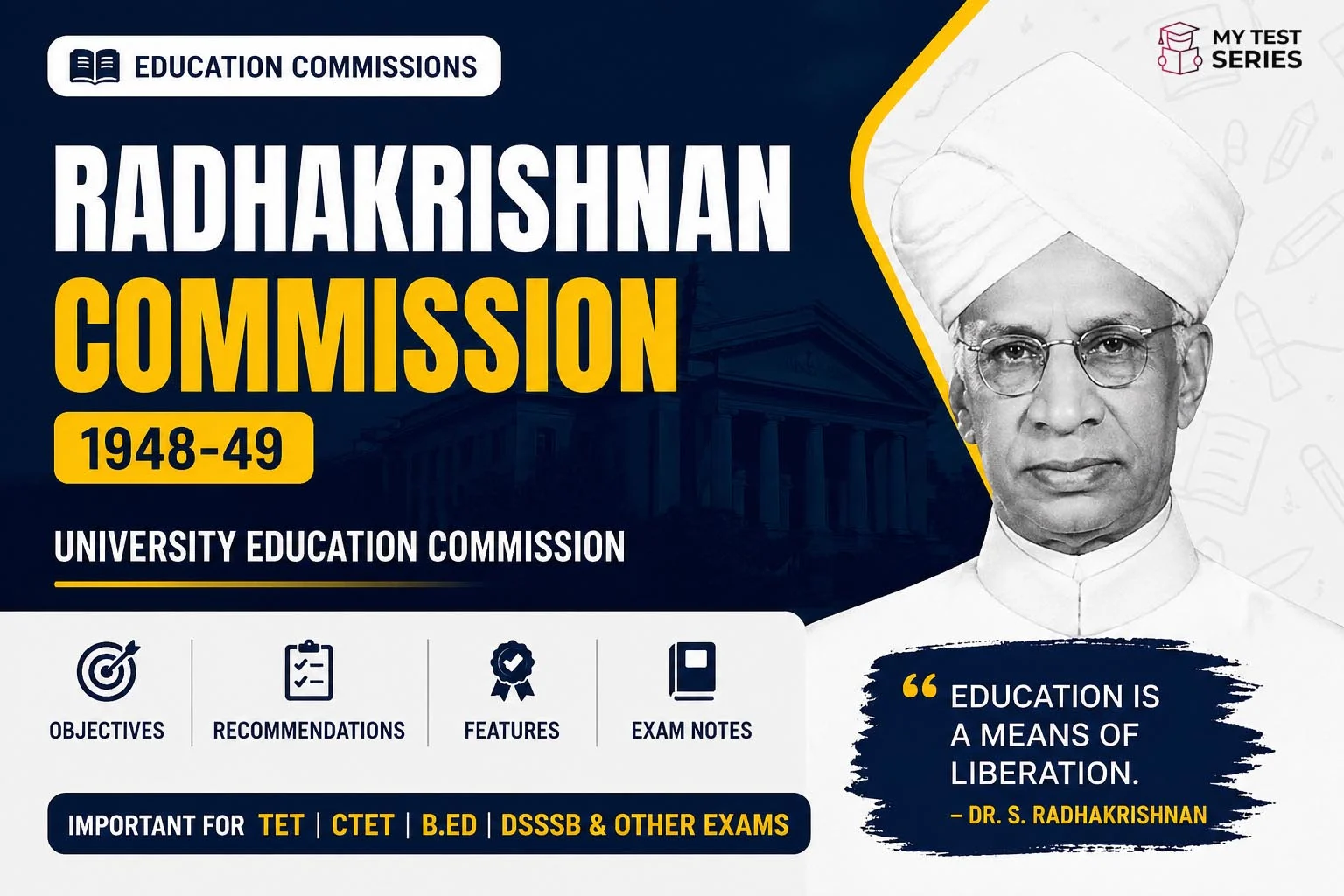
Radhakrishnan Commission (1948–49)
University Education Commission · India’s first post-independence higher education inquiry
Higher Education
UGC Foundation
National Integration
| Aspect |
Detail |
| Formal name |
University Education Commission |
| Set up by |
Government of India, Ministry of Education |
| Appointed |
November 1948 |
| Report submitted |
August 1949 |
| Chairperson |
Dr. Sarvepalli Radhakrishnan (then Vice-Chancellor, BHU; later 2nd President of India) |
| Members |
10 members including Indian and foreign educationists (e.g. Arthur E. Morgan, James F. Duff, Zakir Husain) |
| Context |
Post-independence need to reconstruct higher education; expansion from British colonial university model |
The commission was asked to report on:
Indian university education
Present condition & needs
Further development
Conformity with national requirements
The Commission was to suggest measures to make Indian universities meet the needs of a democratic, socialist, and secular republic while maintaining world-class academic standards.
A. Aims of University Education
Universities must transmit and advance knowledge, develop character, foster democratic citizenship, and promote cultural values. Education must produce good human beings, not just technically qualified persons.
B. Medium of Instruction
English to continue for a few years as the medium of higher education, but regional languages should gradually replace it. Hindi not to be imposed on non-Hindi states. Each university to decide its own language policy.
C. University Grants Commission (UGC)
Recommended creation of a statutory UGC on the model of the UK UGC to coordinate, determine, and maintain standards of higher education and distribute central grants. (UGC formally established 1953; statutory 1956.)
D. Three-Year Degree Course
Intermediate (10+2) education should be detached from universities. Proposed a 10+2+3 structure. The two-year Intermediate course should be attached to higher secondary schools, freeing universities for genuine higher education.
E. Rural Universities
Recommended establishment of rural universities on the model of Gandhian thought (Shri Niketan model) to serve village communities. Higher education must address rural and agricultural needs.
F. Religious & Moral Education
Recommended teaching of religion and ethics to promote moral values and character. Favored a course on “The Religion of the Spirit” — spiritual values transcending sects — not sectarian religion.
G. Teacher’s Status & Pay
Teaching is the noblest profession. Teachers should be adequately paid, enjoy academic freedom, and be selected purely on merit. Dedicated a whole chapter to the teacher as the key to educational reform.
H. Residential Character
Universities should be residential and teaching institutions. Affiliating universities with hundreds of colleges are a major problem. Small, autonomous, residential universities are preferred for quality.
I. Women’s Education
Equal educational opportunities for women. Recommended women’s colleges and special attention to the education of girls who had been left behind. Co-education where feasible.
J. Agriculture & Vocational Education
Agricultural universities to be set up to promote rural economy. Technical and vocational education must be strengthened and linked to industry and national development.
| Stage |
Duration |
Structure |
| Primary |
Classes I–V (6 yrs) |
Universal, compulsory |
| Secondary |
Classes VI–X (4 yrs) |
Diversified, includes vocational |
| Higher Secondary / Intermediate |
Classes XI–XII (2 yrs) |
To be detached from universities, attached to schools |
| Undergraduate (Degree) |
3 years |
University level, post-HSC |
| Postgraduate & Research |
2 yrs + PhD |
Advanced specialisation |
This 10+2+3 framework was revolutionary. It took decades for India to fully implement it (Kothari Commission 1964–66 re-endorsed it; most states adopted it by the 1980s).
Academic freedom: Universities must be free from political interference. Autonomy is essential for intellectual growth.
Affiliating system: Strongly criticized the affiliating university system. Recommended limiting affiliated colleges and eventually converting them to autonomous institutions.
Standards body: Advocated for a UGC to act as buffer between government and universities — ensuring accountability without direct state control.
Examinations: Criticized external examination system as harmful. Recommended internal assessment and semester-based continuous evaluation.
Research: Urged creation of postgraduate schools and research institutes. National development depends on advancing knowledge, not just transmitting it.
UGC established (1953/1956)
The most direct implementation. UGC Act 1956 gave statutory status — still the apex body for higher education in India.
10+2+3 structure
The pattern recommended is the structural foundation of Indian education today, re-endorsed by Kothari Commission and New Education Policy.
First commission on HE
The first major policy document on higher education in independent India. Set the tone for all subsequent commissions (Mudaliar, Kothari, etc.).
Language policy debate
Its nuanced stand on language (no Hindi imposition, gradual regional transition) influenced the language policy discourse for decades.
Idealistic: Recommendations were too idealistic and philosophical, lacking operational detail for a resource-scarce nation.
Elitist orientation: Focus on quality residential universities was seen as neglecting mass access to higher education.
Religious education controversy: Recommendation of religious/moral education was opposed as conflicting with India’s secular constitution.
English bias: Despite recommending regional languages, retaining English in the medium-term was criticized as favouring elites.
Slow implementation: Many key recommendations (rural universities, restructuring affiliating colleges) were never fully implemented.
“A university stands for humanism, for tolerance, for reason, for the adventure of ideas and for the search for truth.” — Radhakrishnan Commission Report
“The teacher is the most important person in the educational system and in fact in society.”
“Teachers should be the best minds in the country.”
| Point |
Key Fact |
| Year of appointment |
1948 |
| Year of report |
1949 |
| Chairman |
Dr. S. Radhakrishnan |
| Also known as |
University Education Commission |
| Most important outcome |
Recommendation for UGC (set up 1953; statutory 1956) |
| Structural change |
10+2+3 pattern; detach Intermediate from university |
| Language medium |
English to continue; regional languages to gradually replace |
| Other key member |
Zakir Husain (later 3rd President of India) |
| Related to |
Post-independence reconstruction of Higher Education |
| Focused on |
University education only (not primary/secondary) |
| Referred to next by |
Mudaliar Commission (1952–53) for Secondary Education |
| Model for rural univ. |
Rabindranath Tagore’s Shriniketan / Gandhian philosophy |
FAQ SECTION
What is the Radhakrishnan Commission?
The Radhakrishnan Commission (1948–49), also known as the University Education Commission, was established by the Government of India under the chairmanship of Dr. Sarvepalli Radhakrishnan to reform higher education in India after independence.
When was the Radhakrishnan Commission formed?
The commission was formed in 1948 and submitted its report in 1949 to improve the structure and quality of university education in India.
What were the main objectives of the Radhakrishnan Commission?
The main objectives were to improve higher education standards, promote research, develop democratic values, and align education with national needs.
What are the key recommendations of the Radhakrishnan Commission?
The commission recommended:
Establishment of the University Grants Commission (UGC)
Improvement in teaching standards
Emphasis on research and development
Introduction of general education along with specialized courses
Better teacher training and salary structure
Why is the Radhakrishnan Commission important for TET/CTET exams?
It is important because questions related to Indian education commissions frequently appear in TET, CTET, and other teaching exams.
What is another name for the Radhakrishnan Commission?
It is also known as the University Education Commission (1948–49).
What was the impact of the Radhakrishnan Commission?
The commission laid the foundation for modern higher education in India and led to the establishment of important institutions like the University Grants Commission.
Radhakrishnan Commission 1948–49 · MyTestSeries