Triangles Class 10: Theorems, Proofs & Solved Examples (2026 Guide)

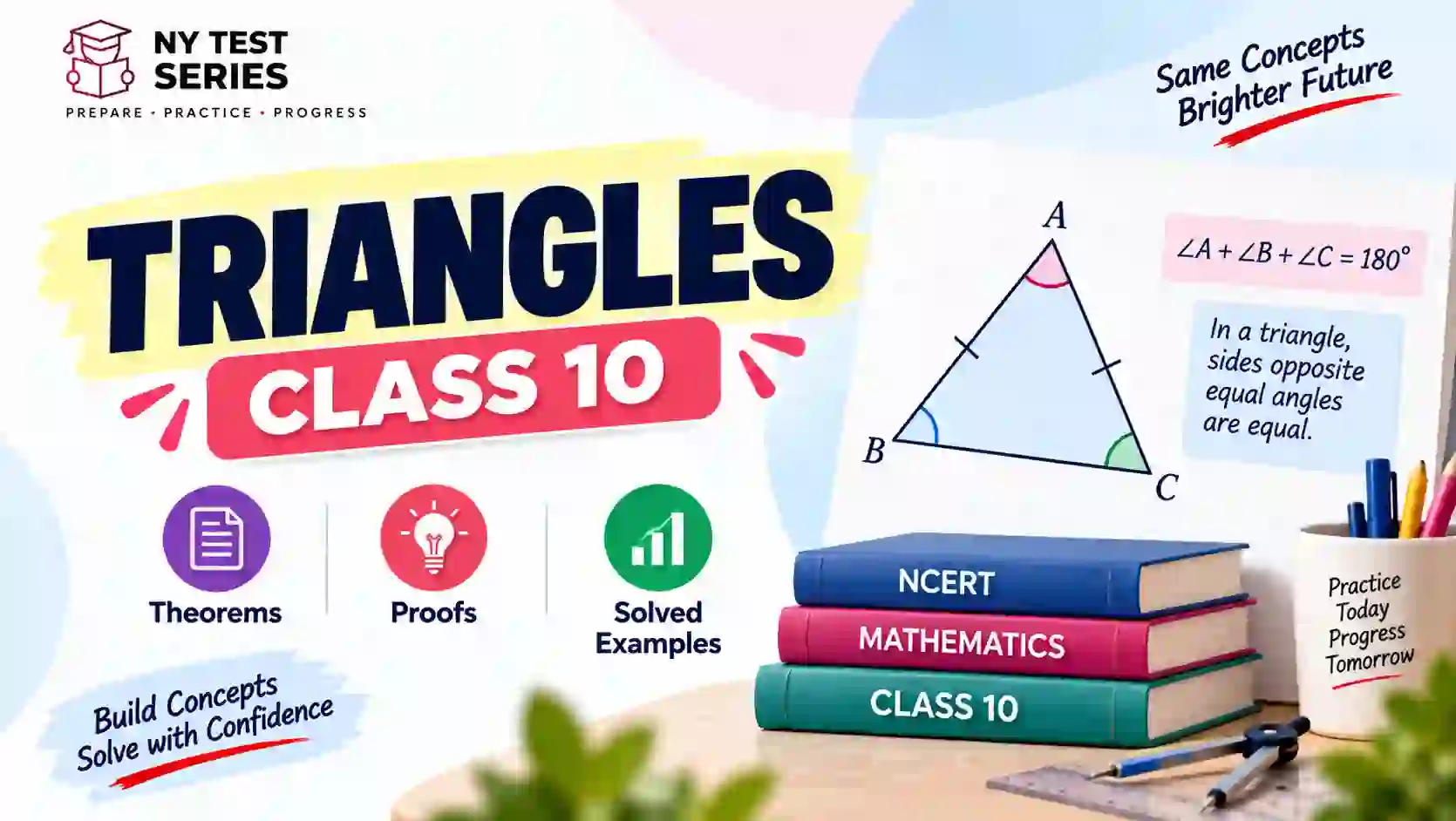
Triangles is where Class 10 Geometry stops being about single shapes and starts being about relationships between shapes. Two triangles that look completely different in size can still be "the same" in every way that matters mathematically — same angles, proportional sides — and that single idea, similarity, is what this entire chapter is built around.
This guide covers every theorem in the chapter — the Basic Proportionality Theorem, the three similarity criteria, the areas-of-similar-triangles theorem, and the Pythagoras theorem — each with a worked example, followed by the exact mistakes that quietly cost marks: mismatched ratios, forgetting to square a ratio, and misidentifying the hypotenuse.
📋 Table of Contents
- What Makes Triangles Similar?
- Basic Proportionality Theorem (Thales Theorem)
- Similarity Criteria — AA, SSS, SAS
- Areas of Similar Triangles Theorem
- Pythagoras Theorem & Its Converse
- 6 Fully Solved Examples
- Common Mistakes Students Make
- Quick Formula Recap Table
- How to Revise This Chapter Effectively
- Frequently Asked Questions
- Related Test Series & Practice Sets

1. What Makes Triangles Similar?
Similar triangles have exactly the same shape but not necessarily the same size — their corresponding angles are equal, and their corresponding sides are in the same ratio (proportional). This is different from congruent triangles, which are similar triangles with a side ratio of exactly 1:1 — identical in both shape and size.
2. Basic Proportionality Theorem (Thales Theorem)
This theorem — and its converse — is one of the most frequently tested ideas in the chapter, because it lets you either find an unknown length once you know a line is parallel to a side, or confirm that a line is parallel just by checking a ratio.
3. Similarity Criteria — AA, SSS, SAS
| Criterion | Condition |
|---|---|
| AA (Angle-Angle) | Two pairs of corresponding angles are equal (the third pair is automatically equal too) |
| SSS (Side-Side-Side) | All three pairs of corresponding sides are in the same ratio |
| SAS (Side-Angle-Side) | Two pairs of corresponding sides are proportional, and the angle between them is equal |
Theorems are easy to read but easy to misapply under pressure. Practise proof-based questions with the 7-Day Demo Test Series — instant, explained solutions after every attempt.
4. Areas of Similar Triangles Theorem
5. Pythagoras Theorem & Its Converse
Interestingly, the Class 10 proof of the Pythagoras theorem uses similar triangles: dropping a perpendicular from the right angle to the hypotenuse creates two smaller triangles, both similar to the original — and comparing their side ratios leads directly to c² = a² + b².
6. Six Fully Solved Examples
Example 1 — Basic Proportionality Theorem
In triangle ABC, DE ∥ BC, with AD = 1.5 cm, DB = 3 cm, and AE = 1 cm. Find EC.
Example 2 — Converse of BPT
In triangle ABC, AD = 5.7 cm, DB = 9.5 cm, AE = 3.6 cm, and EC = 6 cm. Is DE ∥ BC?
Since the ratios are equal, by the converse of BPT, DE is parallel to BC.
Example 3 — AA Similarity
In triangles ABC and PQR, ∠A = ∠P and ∠B = ∠Q. If AB = 6 cm, BC = 8 cm, and PQ = 3 cm, find QR.
6/3 = 8/QR → QR = (8 × 3)/6 = 4 cm
Example 4 — Areas of Similar Triangles
Two similar triangles have corresponding sides in the ratio 4:9. Find the ratio of their areas.
Example 5 — Pythagoras Theorem
The two legs of a right triangle measure 6 cm and 8 cm. Find the hypotenuse.
Example 6 — Word problem (ladder, converse application)
A 10 m ladder is placed against a wall so that its foot is 6 m from the base of the wall. How high up the wall does the ladder reach?
h² = 10² − 6² = 100 − 36 = 64 → h = √64 = 8 m
7. Common Mistakes Students Make
Get daily Class 10 Maths practice questions and exam alerts straight to your phone — join the free MyTestSeries WhatsApp Channel.
Join Channel →8. Quick Formula Recap Table
| Concept | Formula / Condition |
|---|---|
| Basic Proportionality Theorem | DE ∥ BC ⟹ AD/DB = AE/EC |
| AA similarity | Two pairs of equal corresponding angles |
| SSS similarity | All three pairs of sides proportional |
| SAS similarity | Two side pairs proportional + included angle equal |
| Areas of similar triangles | Area ratio = (side ratio)² |
| Pythagoras Theorem | c² = a² + b² (c = hypotenuse) |
9. How to Revise This Chapter Effectively
📖 Draw every triangle problem before solving it. Labelling vertices, marking the parallel line or right angle, and writing known lengths directly on the sketch prevents almost every mismatched-ratio mistake.
✍️ Learn the similarity criteria as a checklist, not a name. Before writing "AA" or "SSS," confirm out loud exactly which angles or sides you've actually verified.
🧮 Practise the areas-of-similar-triangles theorem separately from the side-ratio ones. The squaring step is easy to forget precisely because it looks so similar to the linear BPT ratio.
🎯 For Pythagoras problems, identify the hypotenuse first, before writing any equation. It's always the longest side, opposite the right angle — get this right and the rest is direct substitution.
🔁 Revisit this page before your unit test. Bookmark it, and use the Quick Formula Recap Table (Section 8) as your final five-minute revision before the exam.
📚 Also Useful on MyTestSeries
- Arithmetic Progressions Class 10 — Formulas, Concepts & Shortcuts
- Quadratic Equations Class 10 — Formulas, Tricks & Practice
- Pair of Linear Equations in Two Variables — Class 10 Full Guide
- Polynomials Class 10 — Complete Notes with Solved Examples
- Real Numbers Class 10 — Formulas, Solved Examples & Common Mistakes
- Class 10 Mathematics Foundation Online Test Series — chapter-wise, topic-wise & full-syllabus mocks
- CBSE & ICSE Blog — All Study Guides & Exam Updates
🌐 Trusted External References
- NCERT Official Website — download the official Class 10 Maths textbook
- CBSE Academic — official syllabus & sample papers
- Similarity (Geometry) — Wikipedia — broader mathematical background
- Pythagorean Theorem — Wikipedia — history and alternative proofs
10. Frequently Asked Questions
What is the Basic Proportionality Theorem (Thales Theorem)?
What are the criteria for similarity of triangles?
What is the theorem on areas of similar triangles?
What is the Pythagoras Theorem?
What is the difference between similar and congruent triangles?
What are the most common mistakes in Class 10 Triangles?
Conclusion: One Idea, Many Theorems
Every theorem in this chapter is really an extension of one idea: proportional relationships between shapes reveal deep structural truths. The Basic Proportionality Theorem, the similarity criteria, the areas theorem, and even the Pythagoras theorem all trace back to comparing ratios carefully and correctly.
Rework the six solved examples above without checking the answers first, sketch every triangle problem before writing an equation, and always double-check which segments or sides actually correspond before applying a ratio. That habit — sketch, label, then calculate — is what turns theorem knowledge into consistent exam marks.
11. Related Test Series & Practice Sets
 Class 10 Maths Foundation Series
Tags: Triangles Class 10, Basic Proportionality Theorem, Similar Triangles, AA SSS SAS Similarity, Areas of Similar Triangles, Pythagoras Theorem, CBSE 2026, NCERT Class 10 Maths Chapter 6