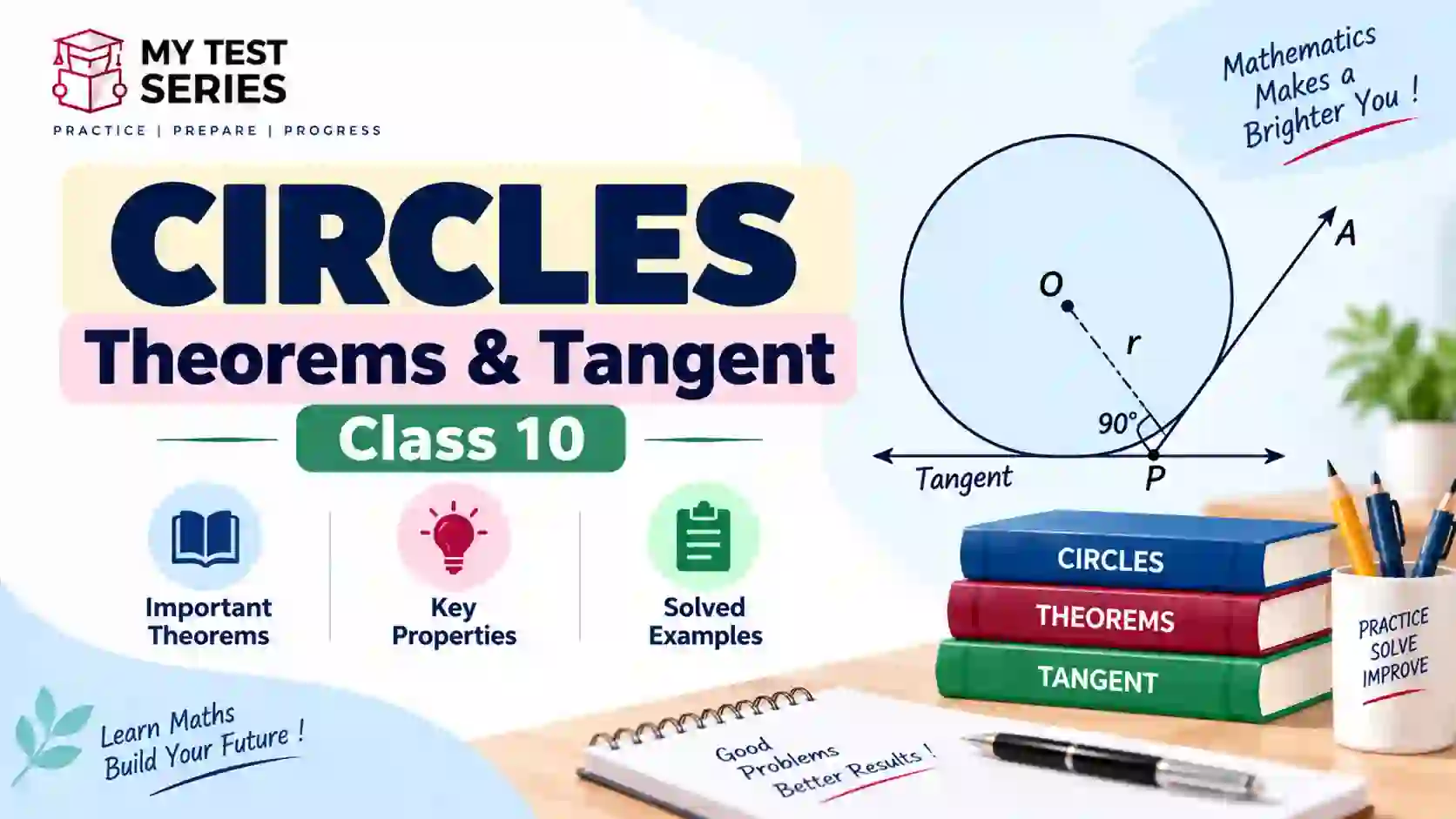
Circles Class 10: Theorems & Tangent Properties Explained (2026 Guide)

Circles is one of the shortest chapters in Class 10 Maths — just two formal theorems — but it's deceptively rich in applications. Nearly every problem in this chapter is really the same right triangle in disguise: a radius, a tangent, and the line joining an external point to the center, related through one simple fact — the tangent is always perpendicular to the radius at the point where it touches.
This guide explains both theorems clearly, shows how they combine to prove that tangents from an external point are always equal in length, and works through six solved examples — including the classic circumscribed-quadrilateral problem — followed by the specific mistakes that quietly cost marks.
📋 Table of Contents
- What Is a Tangent? Tangent vs Secant
- Theorem 1 — Tangent Perpendicular to Radius
- Theorem 2 — Equal Tangent Lengths
- Circumscribed Quadrilaterals
- 6 Fully Solved Examples
- Common Mistakes Students Make
- Quick Formula Recap Table
- How to Revise This Chapter Effectively
- Frequently Asked Questions
- Related Test Series & Practice Sets

1. What Is a Tangent? Tangent vs Secant
A tangent to a circle is a straight line that touches the circle at exactly one point — called the point of contact — without ever crossing into the circle's interior. This is different from a secant, which intersects the circle at two distinct points.
| Point's Position | Number of Tangents Possible |
|---|---|
| Inside the circle | 0 (no tangent can be drawn) |
| On the circle | 1 (exactly one tangent, at that point) |
| Outside the circle | 2 (always equal in length — see Theorem 2) |
2. Theorem 1 — Tangent Perpendicular to Radius
3. Theorem 2 — Equal Tangent Lengths
This follows directly from Theorem 1: triangles OAP and OBP both have a right angle (at A and B respectively), share the hypotenuse OP, and have equal radii OA = OB — so by the RHS congruence rule, the triangles are congruent, which makes PA = PB.
Just two theorems, but dozens of ways they get combined in exam questions. Practise recognising the pattern with the 7-Day Demo Test Series — instant, explained solutions after every attempt.
4. Circumscribed Quadrilaterals
5. Six Fully Solved Examples
Example 1 — Finding the angle at the center
Two tangents PA and PB are drawn from an external point P to a circle with center O, such that ∠APB = 80°. Find ∠AOB.
Sum of angles in a quadrilateral = 360°: ∠AOB = 360° − 90° − 90° − 80° = 100°
Example 2 — Length of a tangent
Find the length of the tangent drawn from an external point 25 cm from the center of a circle of radius 7 cm.
PA² = PO² − OA² = 25² − 7² = 625 − 49 = 576 → PA = √576 = 24 cm
Example 3 — Two concentric circles
A chord of a larger circle (radius 5 cm) touches a smaller, concentric circle (radius 3 cm). Find the length of the chord.
Half the chord = √(5² − 3²) = √(25−9) = √16 = 4 cm. Full chord length = 8 cm.
Example 4 — Circumscribed quadrilateral
Quadrilateral ABCD circumscribes a circle, with AB = 6 cm, BC = 7 cm, and CD = 4 cm. Find AD.
Example 5 — Proving equal tangent lengths
P is an external point, and PA, PB are tangents to a circle with center O, touching at A and B. Prove that PA = PB.
By RHS congruence, △OAP ≅ △OBP. Therefore PA = PB (corresponding parts of congruent triangles).
Example 6 — Finding the angle between a tangent and the line to the center
Two tangents PA and PB are drawn from point P to a circle with center O, such that ∠APB = 60°. Find ∠AOP.
In right triangle OAP: ∠OAP = 90°, ∠APO = 30°, so ∠AOP = 180° − 90° − 30° = 60°
6. Common Mistakes Students Make
Get daily Class 10 Maths practice questions and exam alerts straight to your phone — join the free MyTestSeries WhatsApp Channel.
Join Channel →7. Quick Formula Recap Table
| Concept | Formula / Rule |
|---|---|
| Tangent ⊥ radius | OP ⊥ tangent line at point of contact P |
| Equal tangent lengths | PA = PB (tangents from external point P) |
| Tangent length formula | PA² = PO² − r² (r = radius) |
| Circumscribed quadrilateral | AB + CD = BC + AD |
| Tangent count | 0 (inside), 1 (on circle), 2 (outside) |
| OP bisects ∠APB | By congruence of △OAP and △OBP |
8. How to Revise This Chapter Effectively
📖 Draw the OAPB quadrilateral by default for any two-tangent problem. Labelling the center, both points of contact, and the external point immediately reveals two right angles and often makes the rest of the problem obvious.
✍️ Learn the RHS congruence justification by heart. Right angle, hypotenuse, one pair of equal sides — this exact phrase is expected whenever you're asked to prove PA = PB.
🧮 Check that a quadrilateral genuinely circumscribes a circle before using the opposite-sides rule. The question should say all four sides touch the circle — don't assume it.
🎯 Treat every tangent-length question as a Pythagoras question first. Identify the right angle, name the hypotenuse, and the rest is direct substitution.
🔁 Revisit this page before your unit test. Bookmark it, and use the Quick Formula Recap Table (Section 7) as your final five-minute revision before the exam.
📚 Also Useful on MyTestSeries
- Applications of Trigonometry (Heights & Distances) — Class 10 Guide
- Introduction to Trigonometry — Class 10 Formulas & Identities Cheat Sheet
- Coordinate Geometry Class 10 — Formulas & Problem-Solving Tricks
- Triangles Class 10 — Theorems, Proofs & Solved Examples
- Arithmetic Progressions Class 10 — Formulas, Concepts & Shortcuts
- Class 10 Mathematics Foundation Online Test Series — chapter-wise, topic-wise & full-syllabus mocks
- CBSE & ICSE Blog — All Study Guides & Exam Updates
🌐 Trusted External References
- NCERT Official Website — download the official Class 10 Maths textbook
- CBSE Academic — official syllabus & sample papers
- Tangent Lines to Circles — Wikipedia — broader mathematical background
- Circle — Wikipedia — general properties and history
9. Frequently Asked Questions
What is a tangent to a circle?
What is the relationship between a tangent and the radius at the point of contact?
Are the two tangents drawn from an external point equal in length?
How many tangents can be drawn to a circle from a given point?
What are the most common mistakes in Class 10 Circles?
Conclusion: Two Theorems, One Right Triangle
Every result in this chapter — the angle-sum trick in OAPB, the tangent-length formula, the circumscribed-quadrilateral rule — comes back to the same right angle between a tangent and its radius. Once that single fact is second nature, spotting the right triangle in any Circles question becomes almost automatic.
Rework the six solved examples above without checking the answers first, always name the congruence criterion when proving equal tangent lengths, and default to drawing the OAPB quadrilateral whenever two tangents from the same external point appear. That habit is what turns two short theorems into consistent exam marks.
10. Related Test Series & Practice Sets
 Class 10 Maths Foundation Series
Tags: Circles Class 10, Tangent to a Circle, Tangent Perpendicular to Radius, Equal Tangent Lengths, Circumscribed Quadrilateral, CBSE 2026, NCERT Class 10 Maths Chapter 10