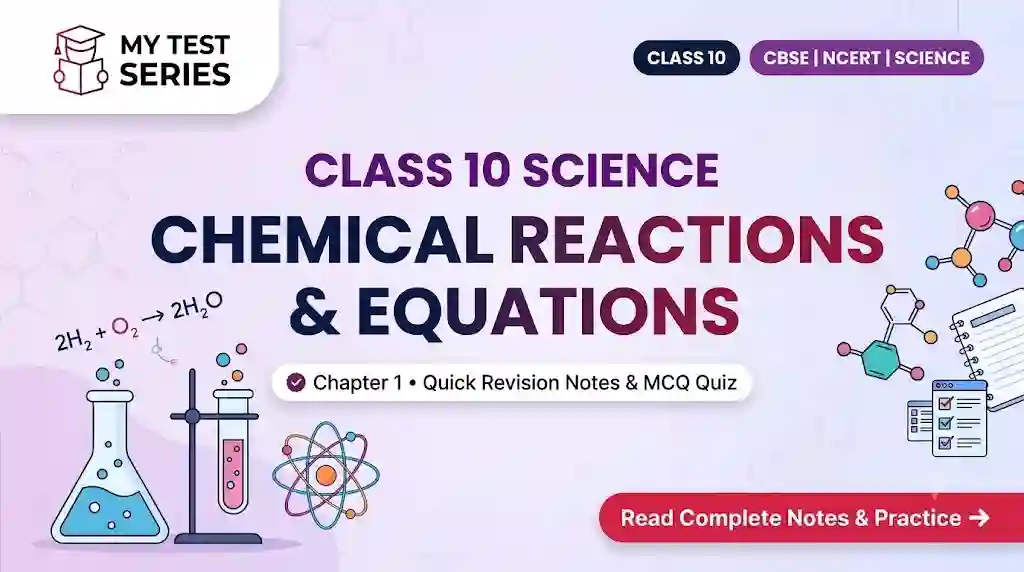
Chemical Reactions and Equations — Class 10 Notes, Types & Balancing Tricks
Chemical reactions are happening around us all the time — iron rusts, food cooks, fuels burn, plants make food and medicines react inside our bodies. In Class 10 Chemistry, the chapter Chemical Reactions and Equations teaches you how to recognise these changes, represent them using equations and balance those equations correctly.

Test Your Class 10 Preparation for 7 Days
Reading notes is useful. Testing what you actually remember is even better. The MyTestSeries Class 10 Mathematics Foundation demo gives students a 7-day opportunity to experience selected tests, detailed solutions and performance analysis before purchasing the complete series.
7-day demo • Selected tests • Detailed solutions • Performance analysis
Try the 7-Day Demo →1. What Is a Chemical Reaction?
A chemical reaction occurs when one or more substances change into new substances. The starting substances are called reactants, while the substances formed are called products.
The important point is that a chemical reaction produces substances with new chemical properties. This is different from a simple physical change, such as cutting paper or melting ice.
| Term | Meaning | Example |
|---|---|---|
| Reactant | Substance present at the beginning of the reaction | Hydrogen and oxygen |
| Product | New substance formed after the reaction | Water |
| Chemical reaction | Process in which new substances are formed | 2H₂ + O₂ → 2H₂O |
2. What Is a Chemical Equation?
A chemical equation is a short symbolic representation of a chemical reaction. Instead of writing the names of substances repeatedly, we use their chemical formulae.
2H₂ + O₂ → 2H₂O
The arrow points from reactants to products. The substances written on the left side are reactants, while those on the right side are products.
Word equation vs chemical equation
| Type | Example |
|---|---|
| Word equation | Magnesium + Oxygen → Magnesium oxide |
| Chemical equation | 2Mg + O₂ → 2MgO |
3. Signs of a Chemical Reaction
How can you tell that a chemical reaction has taken place? Look for observable changes. The most common signs include:
- Change in colour
- Change in temperature
- Evolution of a gas
- Formation of a precipitate
- Change in state
- Emission or absorption of energy
For example, when zinc reacts with dilute hydrochloric acid, hydrogen gas is produced:
The bubbles indicate the formation of a gas.
4. How to Balance a Chemical Equation
Balancing a chemical equation means making the number of atoms of every element equal on both sides of the equation.
This follows the law of conservation of mass: matter is not created or destroyed during a chemical reaction.
Example: Hydrogen and oxygen
Start with the unbalanced equation:
Count the atoms:
| Element | Left side | Right side |
|---|---|---|
| Hydrogen | 2 | 2 |
| Oxygen | 2 | 1 |
Oxygen is not balanced. Put coefficient 2 before H₂O:
Now oxygen is balanced, but hydrogen is not. Put coefficient 2 before H₂:
Now both elements have equal numbers of atoms on both sides. Therefore, the equation is balanced.
Never change chemical formulae while balancing
This is one of the most important Class 10 rules. You may change the coefficients, but you must not change the small numbers inside chemical formulae.
Correct: Put an appropriate coefficient before H₂O.
5. Types of Chemical Reactions
Class 10 questions commonly ask you to identify a reaction from its equation. The major types are:
| Reaction type | General pattern | Easy way to recognise it |
|---|---|---|
| Combination | A + B → AB | Two or more reactants form one product |
| Decomposition | AB → A + B | One compound breaks into simpler substances |
| Displacement | A + BC → AC + B | A more reactive element replaces another |
| Double displacement | AB + CD → AD + CB | Ions exchange partners |
| Redox | Oxidation + reduction | Oxidation and reduction occur together |
6. Combination Reaction
In a combination reaction, two or more substances combine to form a single product.
Magnesium and oxygen combine to form magnesium oxide.
Another important example is:
7. Decomposition Reaction
A decomposition reaction is the opposite of a combination reaction. One compound breaks down into two or more simpler substances.
Three common forms of decomposition
| Type | Energy supplied | Example |
|---|---|---|
| Thermal decomposition | Heat | CaCO₃ → CaO + CO₂ |
| Electrolytic decomposition | Electricity | 2H₂O → 2H₂ + O₂ |
| Photochemical decomposition | Light | 2AgCl → 2Ag + Cl₂ |
8. Displacement Reaction
In a displacement reaction, a more reactive element displaces a less reactive element from its compound.
Zinc is more reactive than copper, so zinc displaces copper from copper sulphate.
9. Double Displacement Reaction
In a double displacement reaction, two compounds exchange their ions or partners to form two new compounds.
Here, barium sulphate forms as an insoluble solid called a precipitate.
Therefore, this is also an example of a precipitation reaction.
10. Oxidation and Reduction
Oxidation and reduction are two fundamental ideas in Class 10 Chemistry. They can often be recognised using oxygen, hydrogen or electron-transfer concepts.
Oxidation
Oxidation can involve:
- Addition of oxygen
- Removal of hydrogen
- Loss of electrons
Reduction
Reduction can involve:
- Removal of oxygen
- Addition of hydrogen
- Gain of electrons
11. What Is a Redox Reaction?
A reaction in which oxidation and reduction occur simultaneously is called a redox reaction.
Copper(II) oxide loses oxygen and is reduced to copper, while hydrogen gains oxygen and is oxidised to water.
Because oxidation and reduction occur together, the reaction is a redox reaction.
12. Exothermic and Endothermic Reactions
Exothermic reaction
An exothermic reaction releases energy, usually in the form of heat, to the surroundings.
Examples include:
- Combustion of fuels
- Respiration
- Many neutralisation reactions
Endothermic reaction
An endothermic reaction absorbs energy from the surroundings.
Photosynthesis is a common biological example in which light energy is absorbed.
| Feature | Exothermic | Endothermic |
|---|---|---|
| Energy | Released | Absorbed |
| Surroundings | May become warmer | May become cooler |
| Example | Combustion | Photosynthesis |
13. Corrosion
Corrosion is the gradual destruction of a metal due to its reaction with substances in the environment.
The most familiar example is the rusting of iron. Iron reacts with oxygen and moisture over time to form hydrated iron oxide, commonly called rust.
How can corrosion be prevented?
- Painting
- Oiling or greasing
- Galvanisation
- Electroplating
- Using corrosion-resistant alloys
14. Rancidity
Rancidity refers to the unpleasant change in the smell and taste of food containing fats and oils due to oxidation.
It can be reduced by:
- Keeping food in airtight containers
- Refrigeration
- Adding suitable antioxidants
- Using nitrogen-filled packaging for some foods
15. Chemical Equation Balancing Tricks for Class 10
Balancing becomes much easier if you follow the same order every time. Avoid randomly adding numbers to both sides.
Trick 1: Write correct formulae first
Before balancing, make sure every reactant and product has the correct chemical formula.
Trick 2: Count atoms
Make a small atom-count table if the equation looks complicated.
Trick 3: Balance elements one at a time
Usually begin with the element that appears in the fewest compounds. Leave hydrogen and oxygen until later when they occur in several compounds.
Trick 4: Use coefficients, never subscripts
A coefficient changes the number of molecules. A subscript changes the chemical identity of the substance.
Trick 5: Recheck everything
Count every atom again after balancing. Do not assume an equation is balanced just because the numbers look neat.
Example: Iron and water
Count Fe, O and H on both sides. Each element has the same number of atoms, so the equation is balanced.
16. Common Mistakes Students Make
- Changing subscripts instead of coefficients.
- Forgetting to count atoms after balancing.
- Writing an incorrect chemical formula.
- Confusing combination with decomposition.
- Calling every reaction involving oxygen a combustion reaction.
- Confusing oxidation with combustion.
- Forgetting that redox reactions involve oxidation and reduction together.
- Ignoring state symbols or reaction conditions when they are given.
17. One-Minute Revision Table
| Concept | Remember This | Example |
|---|---|---|
| Chemical reaction | New substances are formed | 2H₂ + O₂ → 2H₂O |
| Combination | Many reactants → one product | 2Mg + O₂ → 2MgO |
| Decomposition | One compound → simpler substances | CaCO₃ → CaO + CO₂ |
| Displacement | More reactive element replaces less reactive element | Zn + CuSO₄ → ZnSO₄ + Cu |
| Double displacement | Ions exchange partners | Na₂SO₄ + BaCl₂ → BaSO₄ + 2NaCl |
| Oxidation | Oxygen gain / hydrogen loss / electron loss | Cu → Cu²⁺ + 2e⁻ |
| Reduction | Oxygen loss / hydrogen gain / electron gain | Cu²⁺ + 2e⁻ → Cu |
| Exothermic | Energy is released | Combustion |
| Endothermic | Energy is absorbed | Photosynthesis |
| Corrosion | Gradual deterioration of metals | Rusting of iron |
| Rancidity | Oxidation of fats and oils | Stale oily food |
18. Class 10 Exam Practice Questions
Question 1
What type of reaction is represented by 2H₂ + O₂ → 2H₂O?
Answer: Combination reaction.
Question 2
Why should chemical equations be balanced?
Answer: To obey the law of conservation of mass, so that the number of atoms of every element is equal on both sides.
Question 3
What happens when zinc is placed in copper sulphate solution?
Answer: Zinc displaces copper: Zn + CuSO₄ → ZnSO₄ + Cu.
Question 4
What is the difference between oxidation and reduction?
Answer: Oxidation may involve gain of oxygen, loss of hydrogen or loss of electrons. Reduction may involve loss of oxygen, gain of hydrogen or gain of electrons.
Question 5
What is rancidity?
Answer: Rancidity is the undesirable change in smell and taste of fats and oils caused mainly by oxidation.
Finished the Notes? Now Test Yourself.
Use a real online test environment to check speed, accuracy, weak areas and problem-solving ability instead of only rereading notes.
Start the 7-Day Demo →20. Official Chemistry & Education References
For textbook-level verification, students should also consult authoritative educational sources.
- NCERT — National Council of Educational Research and Training
- CBSE Academic — Curriculum and Academic Resources
- DIKSHA — Digital Learning Resources
21. Frequently Asked Questions
What is a chemical reaction in Class 10?
A chemical reaction is a process in which one or more substances change into new substances with different chemical properties.
What is a chemical equation?
A chemical equation is a symbolic representation of a chemical reaction using chemical formulae and coefficients.
Why do we balance chemical equations?
Chemical equations are balanced so that the number of atoms of every element is the same on the reactant and product sides, consistent with conservation of mass.
What are the main types of chemical reactions?
The main Class 10 types are combination, decomposition, displacement, double displacement and redox reactions. Energy-based classification also includes exothermic and endothermic reactions.
What is a combination reaction?
A combination reaction occurs when two or more substances combine to form a single product. For example, 2Mg + O₂ → 2MgO.
What is a decomposition reaction?
A decomposition reaction occurs when one compound breaks down into two or more simpler substances. For example, CaCO₃ → CaO + CO₂.
What is a displacement reaction?
A displacement reaction occurs when a more reactive element replaces a less reactive element from its compound. For example, Zn + CuSO₄ → ZnSO₄ + Cu.
What is oxidation?
At Class 10 level, oxidation can be understood as addition of oxygen, removal of hydrogen or loss of electrons, depending on the reaction.
What is reduction?
Reduction can involve removal of oxygen, addition of hydrogen or gain of electrons.
What is corrosion?
Corrosion is the gradual deterioration of a metal due to reactions with substances in its environment. Rusting of iron is a familiar example.
What is rancidity?
Rancidity is the undesirable change in smell and taste of fats and oils caused mainly by oxidation.
What is the easiest trick for balancing chemical equations?
First write the correct formulae, count each element, then adjust only the coefficients until every element has the same number of atoms on both sides. Never change subscripts during balancing.
22. Final Revision Strategy
Do not try to memorise this entire chapter as disconnected definitions. Start with the basic idea of reactants and products, learn how equations are represented, practise balancing, and then identify reaction types from their patterns.
For quick revision, remember these five patterns:
Decomposition: AB → A + B
Displacement: A + BC → AC + B
Double displacement: AB + CD → AD + CB
Redox: Oxidation + Reduction together
The best way to turn these notes into exam performance is to solve questions immediately after revision. Check not only whether your answer is correct, but also whether you can explain why the reaction belongs to a particular category.
Continue Your Class 10 Practice
MyTestSeries provides online practice designed around chapter-wise preparation, test-taking and performance review.
Try the Class 10 7-Day Demo →Educational note: This article is intended as a Class 10 study and revision resource. Students should follow their prescribed textbook, school instructions and current board curriculum for examination-specific requirements.