Probability Class 10: Concepts, Formulas & Tricky Questions Explained (2026)

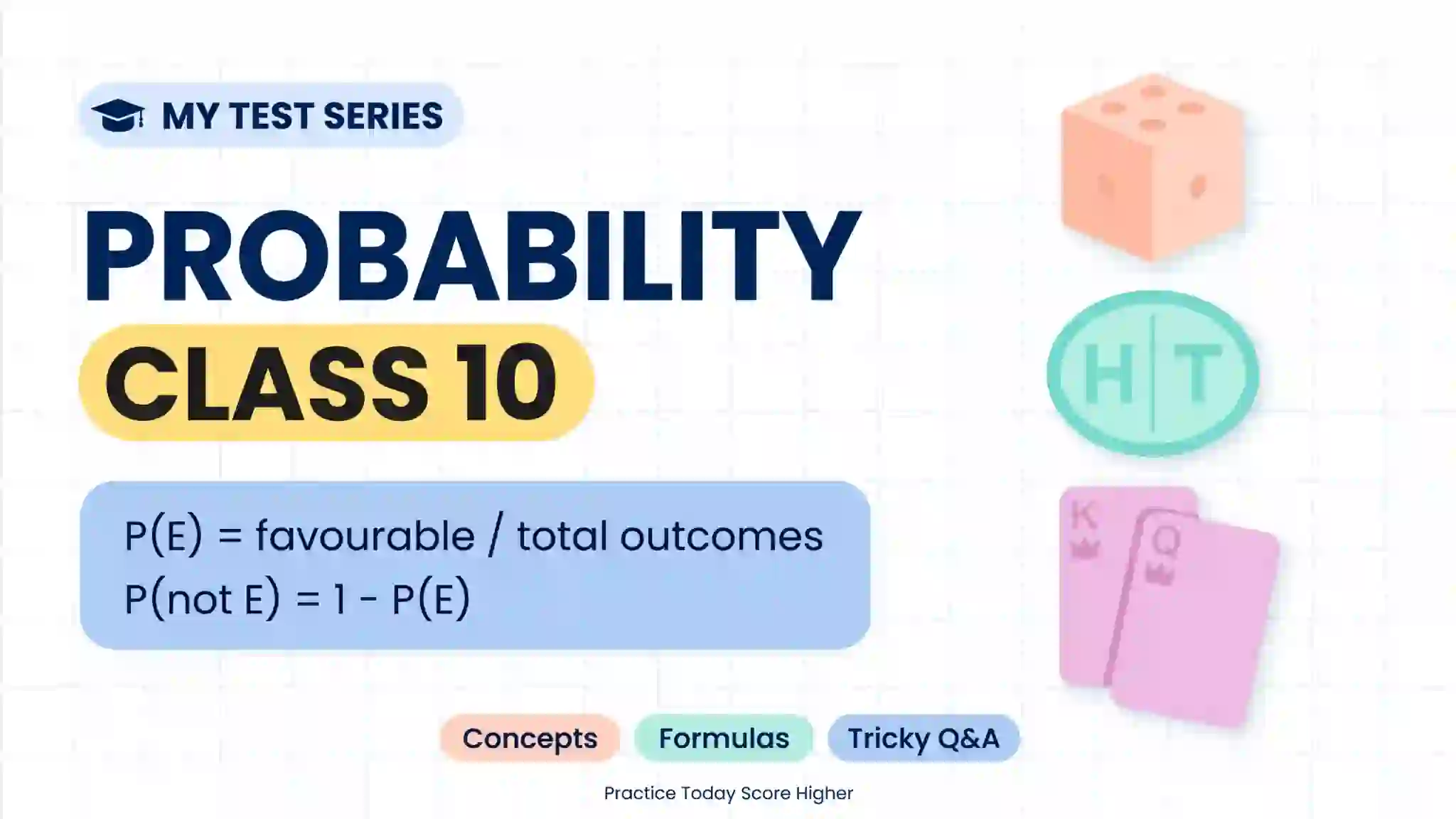
Class 10 Probability rests on one formula and one rule — the rest of the chapter is about counting outcomes correctly, which turns out to be where almost every mistake actually happens. Nobody loses marks because they forgot the formula; they lose marks because they miscounted how many outcomes a dice roll, a card draw, or a coin toss actually has.
This guide explains the classical probability formula and the complement rule clearly, shows the standard outcome counts for dice, coins, and cards that every question in this chapter relies on, and works through six solved examples — including the two-dice sum problem that trips up more students than any other single question type — followed by the mistakes that quietly cost marks.
📋 Table of Contents

1. The Classical Probability Formula
2. The Complement Rule
3. Standard Outcome Counts (Dice, Coins, Cards)
| Experiment | Total Outcomes |
|---|---|
| Tossing one coin | 2 (Head, Tail) |
| Tossing two coins | 4 (HH, HT, TH, TT) |
| Rolling one die | 6 (1 through 6) |
| Rolling two dice together | 36 (6 × 6, not 6 + 6) |
| Drawing one card from a standard deck | 52 (13 ranks × 4 suits) |
4. Six Fully Solved Examples
Example 1 — Basic classical probability
A die is thrown once. Find the probability of getting a prime number.
P(prime) = 3/6 = 1/2
Example 2 — Two coins, "at least one" condition
Two coins are tossed together. Find the probability of getting at least one head.
P(at least one head) = 3/4
Example 3 — Cards
A card is drawn at random from a well-shuffled deck of 52 playing cards. Find the probability that it is a king.
P(king) = 4/52 = 1/13
Example 4 — Using the complement rule
If P(E) = 0.6, find P(not E).
Example 5 — Word problem (bag of balls)
A bag contains 5 red balls and 8 black balls. A ball is drawn at random. Find the probability that it is red.
P(red) = 5/13
Example 6 — Two dice, "sum equals" condition
Two dice are thrown together. Find the probability that the sum of the numbers on the two dice is 8.
P(sum = 8) = 5/36
5. Common Mistakes Students Make
Get daily Class 10 Maths practice questions and exam alerts straight to your phone — join the free MyTestSeries WhatsApp Channel.
Join Channel →6. Quick Formula Recap Table
| Concept | Formula / Value |
|---|---|
| Classical probability | P(E) = favourable outcomes / total outcomes |
| Range of probability | 0 ≤ P(E) ≤ 1 |
| Complement rule | P(not E) = 1 − P(E) |
| Sure event | P(E) = 1 |
| Impossible event | P(E) = 0 |
| Two dice — total outcomes | 36 |
7. How to Revise This Chapter Effectively
📖 List, don't estimate. For any "at least," "sum equals," or "at most" question, physically write out the sample space or the favourable outcomes rather than trying to count them in your head — this is the single biggest source of avoidable errors in this chapter.
✍️ Memorise the four standard outcome counts cold: 2 (one coin), 4 (two coins), 6 (one die), 36 (two dice) — these show up in almost every question.
🧮 Reach for the complement rule whenever "not," "at least one," or "except" appears in the wording. It's often far faster than counting the direct event.
🎯 Always check your final answer lies between 0 and 1. This ten-second habit catches most counting mistakes before you submit an answer.
🔁 Revisit this page before your unit test. Bookmark it, and use the Quick Formula Recap Table (Section 6) as your final five-minute revision before the exam.
📚 Also Useful on MyTestSeries
- Statistics Class 10 — Mean, Median, Mode Shortcuts & Examples
- Surface Areas and Volumes — Class 10 Formula Sheet & Examples
- Circles Class 10 — Theorems & Tangent Properties Explained
- Applications of Trigonometry (Heights & Distances) — Class 10 Guide
- Introduction to Trigonometry — Class 10 Formulas & Identities Cheat Sheet
- Coordinate Geometry Class 10 — Formulas & Problem-Solving Tricks
- Class 10 Mathematics Foundation Online Test Series — chapter-wise, topic-wise & full-syllabus mocks
- CBSE & ICSE Blog — All Study Guides & Exam Updates
🌐 Trusted External References
- NCERT Official Website — download the official Class 10 Maths textbook
- CBSE Academic — official syllabus & sample papers
- Probability — Wikipedia — broader mathematical background
- Sample Space — Wikipedia — extended theory beyond the Class 10 syllabus
8. Frequently Asked Questions
What is the formula for probability in Class 10?
What is the range of possible values for probability?
What is the complement rule in probability?
How many total outcomes are there when two dice are thrown together?
What are the most common mistakes in Class 10 Probability?
Conclusion: One Formula, Careful Counting
Probability in Class 10 doesn't ask for anything beyond one formula and one rule — the real skill being tested is careful, systematic counting. Every "tricky" question in this chapter is tricky specifically because it hides an easy-to-miss outcome or an easy-to-miscount total, not because the underlying mathematics is hard.
Rework the six solved examples above without checking the answers first, physically list outcomes rather than estimating them for anything beyond the simplest questions, and always finish by checking your answer sits between 0 and 1. That habit — list, calculate, verify — is what turns this short chapter into consistently full marks.
9. Related Test Series & Practice Sets
 Class 10 Maths Foundation Series
Tags: Probability Class 10, Classical Probability Formula, Complement Rule, Probability of Dice, Probability of Cards, CBSE 2026, NCERT Class 10 Maths Probability