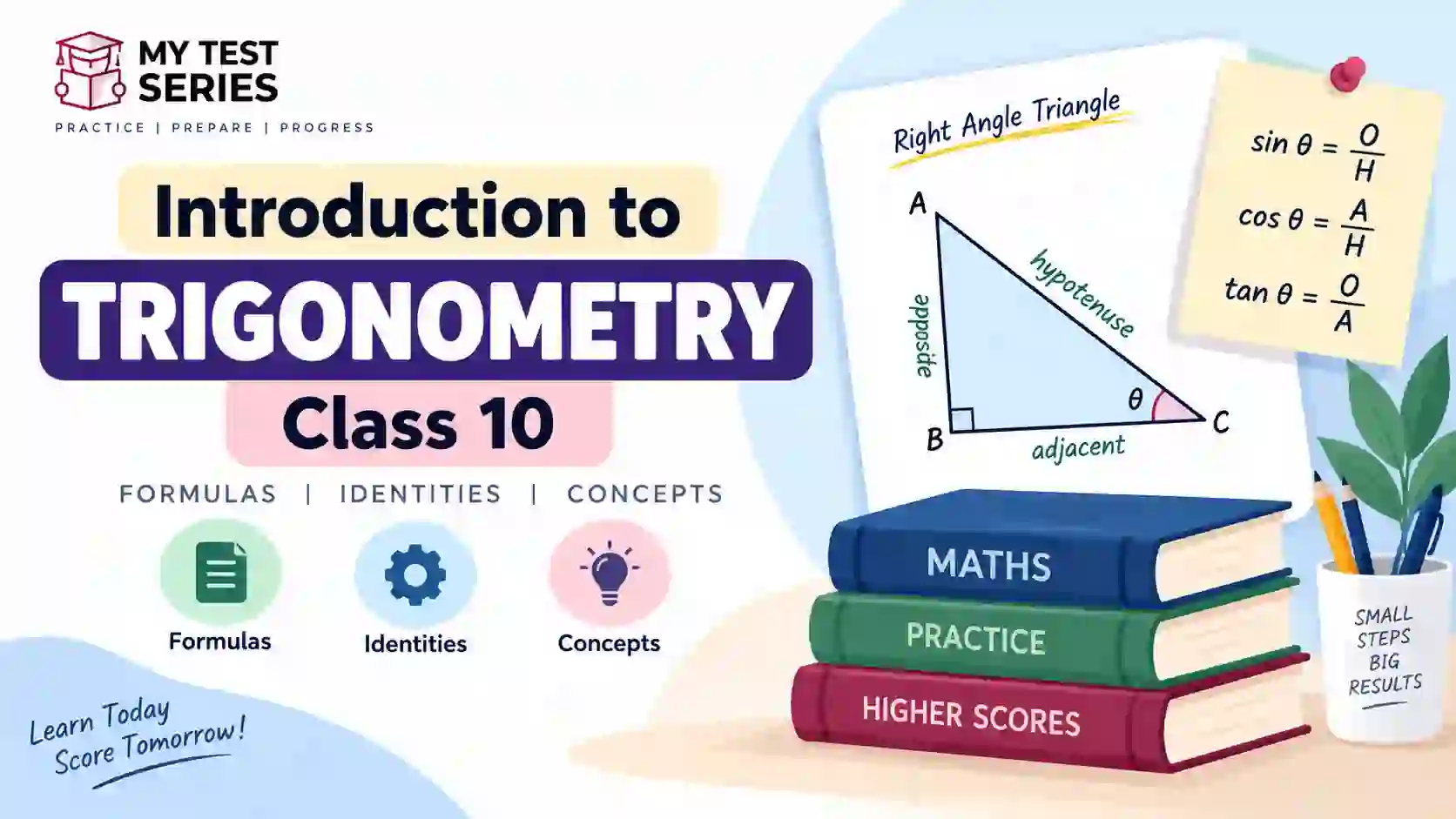
Introduction to Trigonometry — Class 10 Formulas & Identities Cheat Sheet (2026)

Trigonometry can feel like a sudden shift after Coordinate Geometry — new symbols, a table of "special" angles to memorise, and identities that look intimidating at first glance. But underneath all of it is one simple picture: a right triangle, an angle, and three ratios between its sides. Everything else in this chapter — the reciprocal ratios, the identities, the complementary angle rules — is built directly on top of that one picture.
This cheat sheet lays out every ratio, the full standard angle table, all three Pythagorean identities, and the complementary angle relationships — each with a worked example — followed by the specific mistakes that quietly cost marks: side mix-ups, reciprocal errors, and misapplied identities.
📋 Table of Contents
- The Six Trigonometric Ratios
- Standard Angle Table (0°–90°)
- The Three Pythagorean Identities
- Complementary Angle Relationships
- 6 Fully Solved Examples
- Common Mistakes Students Make
- Quick Formula Recap Table
- How to Revise This Chapter Effectively
- Frequently Asked Questions
- Related Test Series & Practice Sets

1. The Six Trigonometric Ratios
Picture a right triangle with one acute angle θ. Relative to θ, the three sides are: the hypotenuse (opposite the right angle), the opposite side (opposite θ itself), and the adjacent side (next to θ, not the hypotenuse). Six ratios can be formed from these three sides:
cosecθ = 1/sinθ secθ = 1/cosθ cotθ = 1/tanθ Also: tanθ = sinθ/cosθ, and cotθ = cosθ/sinθ — both follow directly from the definitions above.
2. Standard Angle Table (0°–90°)
| θ | 0° | 30° | 45° | 60° | 90° |
|---|---|---|---|---|---|
| sinθ | 0 | 1/2 | 1/√2 | √3/2 | 1 |
| cosθ | 1 | √3/2 | 1/√2 | 1/2 | 0 |
| tanθ | 0 | 1/√3 | 1 | √3 | Not defined |
The reciprocal ratios follow directly: cosecθ, secθ, and cotθ are just 1 divided by sinθ, cosθ, and tanθ respectively at each angle. Note cosecθ is undefined at 0°, and secθ is undefined at 90° — exactly where their reciprocal partner equals zero.
3. The Three Pythagorean Identities
1 + tan²θ = sec²θ
1 + cot²θ = cosec²θ All three follow from applying the Pythagoras theorem to the same right triangle — divide through by hypotenuse², adjacent², or opposite² respectively to get each version.
Ratios, identities, and a full angle table to memorise — practice is what makes them automatic. Try the 7-Day Demo Test Series for instant, explained solutions after every attempt.
4. Complementary Angle Relationships
cot(90°−θ) = tanθ sec(90°−θ) = cosecθ cosec(90°−θ) = secθ Applies only when the two angles genuinely add up to 90° — the "co-" in cosine, cosecant, and cotangent literally stands for "complement."
5. Six Fully Solved Examples
Example 1 — Finding all ratios from one given ratio
If sinθ = 3/5, find the values of all other trigonometric ratios of θ.
Adjacent = √(5² − 3²) = √(25−9) = √16 = 4.
cosθ = 4/5, tanθ = 3/4, cosecθ = 5/3, secθ = 5/4, cotθ = 4/3
Example 2 — Evaluating an expression using the angle table
Evaluate: 2tan²45° + cos²30° − sin²60°.
= 2(1)² + (√3/2)² − (√3/2)² = 2 + 3/4 − 3/4 = 2
Example 3 — Proving an identity
Prove that (sinθ + cosθ)² + (sinθ − cosθ)² = 2.
= 2sin²θ + 2cos²θ = 2(sin²θ + cos²θ) = 2(1) = 2 (using sin²θ+cos²θ=1) ✅
Example 4 — Using the complementary angle rule
Evaluate: sin63° / cos27°.
So sin63°/cos27° = sin63°/sin63° = 1
Example 5 — Using a Pythagorean identity
If tanθ = 12/5, find the value of secθ.
secθ = √(169/25) = 13/5
Example 6 — Evaluating a mixed expression
Evaluate: (sin45° + cos45°) / (sec45° + cosec45°).
Numerator = 1/√2 + 1/√2 = 2/√2 = √2. Denominator = √2 + √2 = 2√2.
Result = √2 / 2√2 = 1/2
6. Common Mistakes Students Make
Get daily Class 10 Maths practice questions and exam alerts straight to your phone — join the free MyTestSeries WhatsApp Channel.
Join Channel →7. Quick Formula Recap Table
| Concept | Formula |
|---|---|
| Basic ratios | sinθ=opp/hyp, cosθ=adj/hyp, tanθ=opp/adj |
| Reciprocal ratios | cosecθ=1/sinθ, secθ=1/cosθ, cotθ=1/tanθ |
| Quotient identities | tanθ=sinθ/cosθ, cotθ=cosθ/sinθ |
| Pythagorean identity 1 | sin²θ + cos²θ = 1 |
| Pythagorean identity 2 | 1 + tan²θ = sec²θ |
| Pythagorean identity 3 | 1 + cot²θ = cosec²θ |
| Complementary angles | sin(90°−θ)=cosθ, tan(90°−θ)=cotθ, sec(90°−θ)=cosecθ |
8. How to Revise This Chapter Effectively
📖 Derive the angle table instead of memorising it blindly. The 30°-60°-90° and 45°-45°-90° triangles generate every value in the table — knowing where the numbers come from makes them far harder to forget.
✍️ Say the three identities out loud, grouped by which ratio pair they connect. sin-cos, tan-sec, cot-cosec — this grouping mirrors how they're derived and makes recall much faster under time pressure.
🧮 Practise identity proofs by working from the more complex side toward the simpler one. Example 3 above shows this — expand, simplify, and land on the Pythagorean identity rather than guessing the path backward.
🎯 Double-check any complementary angle question by confirming the two angles genuinely sum to 90° before applying the shortcut — this single check prevents Mistake 4 above.
🔁 Revisit this page before your unit test. Bookmark it, and use the Quick Formula Recap Table (Section 7) as your final five-minute revision before the exam.
📚 Also Useful on MyTestSeries
- Coordinate Geometry Class 10 — Formulas & Problem-Solving Tricks
- Triangles Class 10 — Theorems, Proofs & Solved Examples
- Arithmetic Progressions Class 10 — Formulas, Concepts & Shortcuts
- Quadratic Equations Class 10 — Formulas, Tricks & Practice
- Pair of Linear Equations in Two Variables — Class 10 Full Guide
- Class 10 Mathematics Foundation Online Test Series — chapter-wise, topic-wise & full-syllabus mocks
- CBSE & ICSE Blog — All Study Guides & Exam Updates
🌐 Trusted External References
- NCERT Official Website — download the official Class 10 Maths textbook
- CBSE Academic — official syllabus & sample papers
- Trigonometric Functions — Wikipedia — broader mathematical background
- List of Trigonometric Identities — Wikipedia — identities beyond the Class 10 syllabus
9. Frequently Asked Questions
What are the six trigonometric ratios?
What are the three Pythagorean trigonometric identities?
What are the standard trigonometric ratio values for 0°, 30°, 45°, 60°, and 90°?
What is the relationship between trigonometric ratios of complementary angles?
What are the most common mistakes in Class 10 Trigonometry?
Conclusion: One Triangle, Every Formula
Every formula in this chapter traces back to the same right triangle and the same angle θ. The six ratios describe its sides, the three identities describe how those ratios relate to each other through Pythagoras, and the complementary angle rules describe what happens when you look at the triangle from its other acute angle. Once that single picture is solid, the rest of the chapter is substitution and simplification.
Rework the six solved examples above without checking the answers first, derive the standard angle table from the 30-60-90 and 45-45-90 triangles rather than memorising it cold, and always rationalise your final surd. That combination is what turns a page of formulas into consistent exam marks.
10. Related Test Series & Practice Sets
 Class 10 Maths Foundation Series
Tags: Introduction to Trigonometry Class 10, Trigonometric Ratios, Trigonometric Identities, Standard Angle Table, Complementary Angles, CBSE 2026, NCERT Class 10 Maths Chapter 8