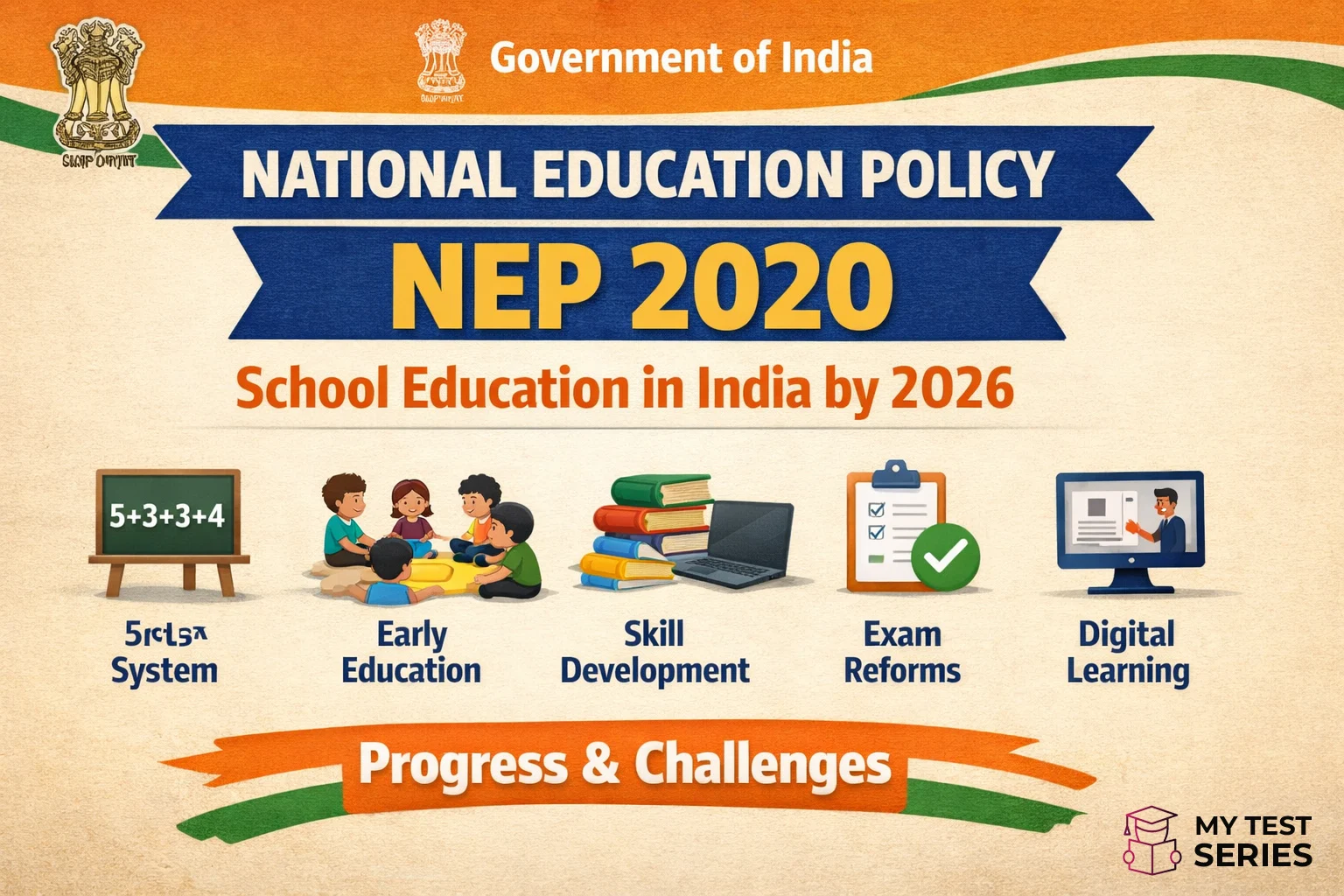
How NEP 2020 changes in school education : Progress & Reality Check in 2026
NEP 2020 changes in school education – India’s education system is going through one of the biggest transformations in its history. The National Education Policy (NEP) 2020 introduced a new vision for learning that aims to make education more flexible, skill-based, and future-ready.
Before NEP 2020, the Indian school education system followed a structure that many experts considered outdated. Students often focused on memorizing information rather than understanding concepts or developing practical skills. Recognizing these challenges, the Government of India launched NEP 2020 to reshape the entire education ecosystem—from early childhood education to higher education.
Now in 2026, six years after the policy announcement, many schools and state governments have started implementing various reforms. But an important question remains: Has NEP 2020 truly transformed Indian school education, or are there still challenges in implementation?
In this article, we explore the major changes introduced by NEP 2020, how schools have adopted them, and the real progress seen across India by 2026.
Why NEP 2020 Was Introduced
For decades, India followed an education policy that had not changed significantly since 1986. Over time, several gaps became visible in the system:
- Heavy focus on rote learning
- Lack of emphasis on skill development
- Limited flexibility in subject choices
- Insufficient focus on early childhood education
- Exam-centric learning culture
NEP 2020 was designed to address these problems and create a modern education system aligned with global standards. The policy emphasizes conceptual understanding, creativity, critical thinking, and multidisciplinary learning.
NEP 2020 changes in school education : The 5+3+3+4 System
One of the biggest reforms introduced by NEP 2020 is the replacement of the traditional 10+2 school system with a new 5+3+3+4 curriculum structure. This change reorganizes school education based on children’s developmental stages.
| Old System (10+2) | New NEP Structure (5+3+3+4) | Age Group | Focus Area |
|---|---|---|---|
| Primary | Foundational Stage (5 Years) | 3–8 Years | Play-based learning and early childhood development |
| Upper Primary | Preparatory Stage (3 Years) | 8–11 Years | Activity-based learning and basic subjects |
| Secondary | Middle Stage (3 Years) | 11–14 Years | Conceptual learning in sciences, mathematics, and social sciences |
| Higher Secondary | Secondary Stage (4 Years) | 14–18 Years | Multidisciplinary and flexible subject choices |
This new structure recognizes that learning patterns differ at each stage of a child’s development. By integrating pre-school education into the formal education system, NEP 2020 ensures that foundational literacy and numeracy are developed early.
Focus on Early Childhood Care and Education
One of the most revolutionary aspects of NEP 2020 is the emphasis on Early Childhood Care and Education (ECCE). Research shows that nearly 85% of brain development occurs before the age of six.
Earlier, preschool education in India was largely unregulated and inconsistent. Under NEP 2020, Anganwadi centers and pre-schools are now integrated into the formal education framework.
By 2026, several states have begun redesigning their preschool curriculum to include:
- Play-based learning
- Storytelling and activity-based teaching
- Language development programs
- Early numeracy and literacy skills
This shift ensures that children enter primary school with a stronger foundation for learning.
Multidisciplinary Learning and Flexible Subjects
Another major change introduced by NEP 2020 is the removal of rigid subject streams. Previously, students had to choose between Science, Commerce, or Arts in higher secondary school.
Now, students can combine subjects based on their interests. For example, a student can study:
- Physics with Economics
- Mathematics with Music
- Computer Science with Political Science
This flexibility encourages creativity and allows students to explore diverse career paths rather than being restricted by traditional academic divisions.
Shift from Rote Learning to Conceptual Understanding
For many years, the Indian education system was criticized for encouraging memorization rather than understanding. NEP 2020 attempts to change this through:
- Inquiry-based learning
- Project-based assessments
- Experiential classroom activities
- Critical thinking exercises
Teachers are encouraged to focus on why something works instead of just teaching students what to memorize. This approach aims to create learners who can solve real-world problems rather than simply reproduce textbook answers.
Board Exam Reforms
Board exams have traditionally been one of the most stressful aspects of Indian school education. NEP 2020 proposes several reforms to reduce exam pressure and make assessments more meaningful.
Some key changes include:
- Board exams designed to test conceptual understanding
- Possibility of taking board exams twice a year
- Objective and application-based questions
- Reduced syllabus pressure
Although these reforms are still being gradually implemented across states, the goal is to move away from a system where students depend heavily on coaching and rote memorization.
📚 Explore More NEP 2020 Guides
If you want to understand the New Education Policy 2020 in detail, explore these complete guides:
-
➤ NEP 2020 vs Old 10+2 System – Major Differences Explained
-
➤ NEP 2020 Higher Education Reforms – Multidisciplinary Degrees & GER 50%
-
➤ NEP 2020 Vocational Education From Class 6 – Skills & Internships
-
➤ How NEP 2020 Has Changed School Education in India (2026 Guide)
-
➤ NEP 2020 Explained – Understanding the 5+3+3+4 Education Structure
Integration of Technology in Education
Technology has become an essential part of the new education ecosystem. NEP 2020 strongly promotes digital learning platforms, virtual classrooms, and online educational resources.
By 2026, schools across India have increasingly adopted:
- Smart classrooms
- Online learning platforms
- Digital textbooks
- Educational mobile apps
The COVID-19 pandemic accelerated the adoption of digital learning, and NEP 2020 further strengthened the importance of technology in classrooms.
Teacher Training and Professional Development
Teachers are the backbone of any education system. NEP 2020 recognizes the importance of improving teacher training and professional development.
Key reforms include:
- Four-year integrated B.Ed. programs
- Continuous professional development for teachers
- Improved recruitment standards
- Training in modern teaching methods
These initiatives aim to ensure that teachers are better equipped to implement innovative teaching practices and support students’ holistic development.
Skill Development and Vocational Education
Another important feature of NEP 2020 is the emphasis on vocational education. Earlier, vocational training was often seen as a secondary option compared to academic education.
The new policy aims to change this mindset by introducing vocational courses from Class 6 onwards. Students can learn practical skills such as:
- Carpentry
- Coding
- Electric work
- Handicrafts
- Entrepreneurship
By integrating vocational education into mainstream schooling, NEP 2020 hopes to create a workforce that is both academically knowledgeable and practically skilled.
📚 Explore More NEP 2020 Guides
If you want to understand the New Education Policy 2020 in detail, explore these complete guides:
➤ NEP 2020 vs Old 10+2 System – Major Differences Explained
➤ NEP 2020 Higher Education Reforms – Multidisciplinary Degrees & GER 50%
➤ NEP 2020 Vocational Education From Class 6 – Skills & Internships
➤ How NEP 2020 Has Changed School Education in India (2026 Guide)
➤ NEP 2020 Explained – Understanding the 5+3+3+4 Education Structure
NEP 2020 changes in school education : Progress and Ground Reality
While the vision of the National Education Policy 2020 is ambitious and transformative, its real impact depends largely on implementation. By 2026, several states across India have started adopting NEP reforms, but the pace of progress varies significantly.
Education in India is primarily a state subject, which means each state government has its own strategies, budgets, and timelines for implementing NEP reforms. As a result, the transformation is not uniform across the country.
Some states have moved faster in restructuring their curriculum and training teachers, while others are still in the early stages of implementation.
Key Achievements of NEP 2020 by 2026
Despite the challenges, several significant developments have taken place in the school education system since the policy was introduced.
| Reform Area | Progress by 2026 | Impact on Education |
|---|---|---|
| Early Childhood Education | Anganwadi centers integrated with primary schools | Stronger foundational learning |
| Foundational Literacy Mission | NIPUN Bharat launched nationwide | Improved reading and numeracy skills |
| Digital Learning | Expansion of DIKSHA and online platforms | Better access to digital content |
| Skill Education | Vocational courses introduced in many schools | Practical learning opportunities |
| Curriculum Reform | NCERT working on new textbooks | Reduced syllabus load |
These developments indicate that NEP 2020 is gradually reshaping the education landscape, although the process is still ongoing.
Reality Check: Challenges in Implementing NEP 2020
While the policy framework is progressive, implementing such a large-scale reform across thousands of schools is not easy. Several challenges remain even in 2026.
1. Infrastructure Gaps
Many schools, especially in rural areas, still struggle with basic infrastructure such as classrooms, digital equipment, and internet connectivity. Without adequate infrastructure, implementing modern teaching methods becomes difficult.
2. Teacher Training
Teachers need extensive training to shift from traditional lecture-based teaching to activity-based and experiential learning. Although training programs have started, reaching millions of teachers across the country takes time.
3. Curriculum Transition
Changing textbooks, assessment systems, and teaching methods simultaneously is a complex process. Schools need time to adapt to the new curriculum framework.
4. Digital Divide
The integration of technology is one of the pillars of NEP 2020, but access to digital devices and internet connectivity remains unequal across regions.
5. Funding and Resources
Implementing the policy requires substantial investment in teacher training, digital infrastructure, and curriculum development. Many states face financial limitations.
Impact on Students – NEP 2020 changes in school education
Despite implementation challenges, students are already experiencing several benefits from the new education approach.
- Greater freedom in choosing subjects
- Reduced pressure of rote learning
- Increased focus on creativity and innovation
- Exposure to vocational skills
- Improved learning through technology
Students are gradually shifting from memorizing information to understanding concepts and applying knowledge in real-life situations.
Impact of NEP 2020 on Teachers
Teachers play a central role in the success of the new policy. The reforms aim to empower teachers by improving training, recruitment standards, and career development opportunities.
However, teachers also face new responsibilities, including:
- Adopting innovative teaching methods
- Integrating technology into classrooms
- Designing project-based learning activities
- Focusing on students’ holistic development
Over time, these changes are expected to enhance the quality of teaching across Indian schools.
The Future of School Education in India
Looking ahead, the success of NEP 2020 will depend on sustained policy support, adequate funding, and strong collaboration between central and state governments.
Experts believe that if implemented effectively, the policy could transform India into a global education hub by:
- Improving learning outcomes
- Encouraging innovation and research
- Preparing students for future careers
- Reducing the gap between academic learning and real-world skills
The coming decade will be crucial in determining how effectively these reforms reshape the Indian education system.
Is NEP 2020 Delivering Its Promise?
The National Education Policy 2020 represents one of the most ambitious education reforms in India’s history. By 2026, several positive changes have already begun to take shape, including curriculum restructuring, skill-based learning, and digital integration.
However, the transformation of a vast and diverse education system takes time. Challenges such as infrastructure gaps, teacher training, and funding still need to be addressed for the policy to achieve its full potential.
Overall, NEP 2020 has laid a strong foundation for the future of Indian education. If implemented consistently and effectively, it has the potential to create a more inclusive, flexible, and globally competitive education system for the next generation.
Frequently Asked Questions (FAQs)
1. What is the main goal of NEP 2020?
The main goal of NEP 2020 is to transform India’s education system by focusing on conceptual learning, skill development, flexibility in subjects, and holistic student development.
2. What is the 5+3+3+4 education structure?
The 5+3+3+4 structure divides school education into four stages: foundational, preparatory, middle, and secondary stages based on children’s developmental age groups.
3. Has NEP 2020 been fully implemented in India?
No, the policy is still being implemented gradually across different states. Some reforms have already started, while others are expected to roll out over the next few years.
4. How does NEP 2020 reduce exam pressure?
The policy proposes flexible board exams, conceptual assessments, and opportunities for students to take exams more than once to improve their scores.
5. What role does technology play in NEP 2020?
Technology plays a major role through digital learning platforms, online resources, smart classrooms, and educational apps that enhance teaching and learning.