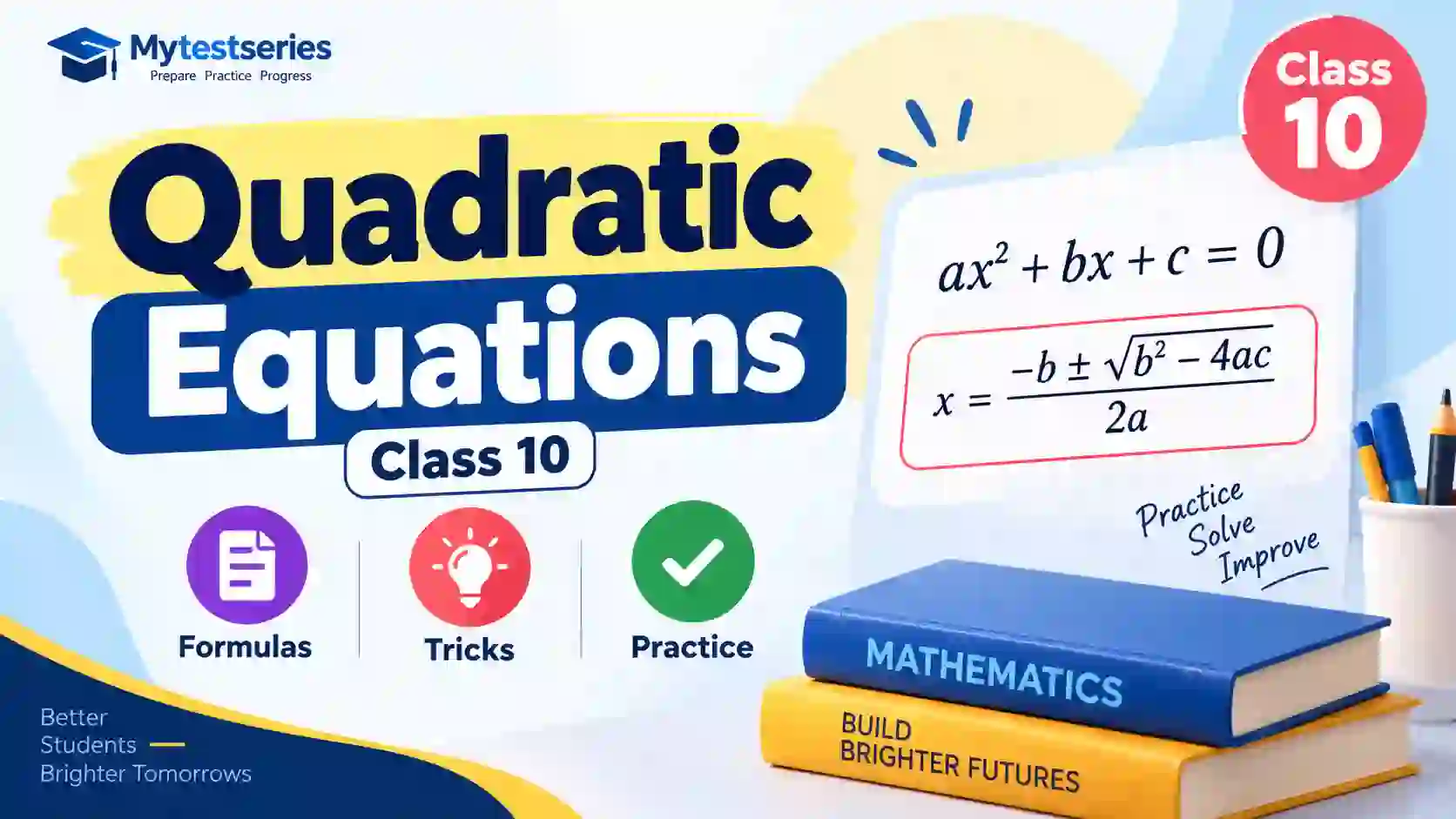
Quadratic Equations Class 10: Formulas, Tricks & Practice Questions (2026 Guide)

Quadratic Equations is where the "zeroes of a polynomial" idea from the last chapter turns practical: instead of just relating zeroes to coefficients, you now solve for them directly, using three distinct methods. It's also the chapter that quietly borrows from everything before it — factorisation from Polynomials, the coefficient-based reasoning from Linear Equations, and now a brand-new tool, the discriminant, that predicts what kind of roots you'll get before you even solve.
This guide lays out all three solving methods with a worked example each, the discriminant rule for nature of roots, real exam-style word problems, and the specific mistakes — sign slips, skipped checks, invalid negative answers — that quietly cost marks year after year.
📋 Table of Contents
- What Is a Quadratic Equation?
- Method 1 — Factorisation
- Method 2 — Completing the Square
- Method 3 — The Quadratic Formula
- The Discriminant & Nature of Roots
- 6 Fully Solved Examples
- Common Mistakes Students Make
- Quick Formula Recap Table
- Exam Tricks & How to Revise
- Frequently Asked Questions
- Related Test Series & Practice Sets

1. What Is a Quadratic Equation?
Any equation that can be rearranged into this exact form is quadratic — regardless of how it's originally written. The values of x that satisfy the equation are called its roots (or solutions), and geometrically they're the x-coordinates of the points where the parabola y = ax² + bx + c crosses the x-axis — the same "zeroes" idea from the Polynomials chapter, now solved for directly.
2. Method 1 — Factorisation
Split the middle term (bx) into two parts whose product equals ac and whose sum equals b. This lets you factor the expression into two linear brackets, each of which is set to zero separately.
3. Method 2 — Completing the Square
Rewrite the quadratic as a perfect square trinomial plus a constant, then isolate and take the square root of both sides. Unlike factorisation, this method always works — even when the roots aren't whole numbers.
Three methods, one right answer each time — but only if you practise choosing the fastest one. Try the 7-Day Demo Test Series for instant, explained solutions after every attempt.
4. Method 3 — The Quadratic Formula
This is the universal fallback — when factorisation isn't obvious and completing the square feels slow, the quadratic formula gets you to the answer directly, as long as you substitute a, b, and c carefully.
5. The Discriminant & Nature of Roots
| Discriminant (D) | Nature of Roots |
|---|---|
| D > 0 | Two distinct real roots |
| D = 0 | Two equal real roots (a repeated root) |
| D < 0 | No real roots |
6. Six Fully Solved Examples
Example 1 — Factorisation method
Solve x² − 3x − 4 = 0 by factorisation.
x² − 4x + x − 4 = 0 → x(x−4) + 1(x−4) = 0 → (x−4)(x+1) = 0
x = 4 or x = −1
Example 2 — Completing the square
Solve 2x² − 7x + 3 = 0 by completing the square.
Add (7/4)² = 49/16 to both sides: x² − (7/2)x + 49/16 = −3/2 + 49/16 = 25/16
(x − 7/4)² = 25/16 → x − 7/4 = ±5/4
x = 3 or x = 1/2
Example 3 — Quadratic formula
Solve 6x² − x − 2 = 0 using the quadratic formula.
x = (1 ± √49) / 12 = (1 ± 7) / 12
x = 8/12 = 2/3, or x = −6/12 = −1/2
Example 4 — Nature of roots
Without solving, find the nature of the roots of 2x² − 4x + 3 = 0.
Since D < 0, the equation has no real roots.
Example 5 — Word problem (consecutive integers)
The product of two consecutive positive integers is 306. Find the integers.
D = 1 + 1224 = 1225 = 35². x = (−1 ± 35)/2 → x = 17 or x = −18.
Since the integers must be positive, reject x = −18. The integers are 17 and 18.
Example 6 — Word problem (speed and time)
A train travels 360 km at a uniform speed. If the speed had been 5 km/hr more, it would have taken 1 hour less for the same journey. Find the original speed.
360/x − 360/(x+5) = 1 → 360(x+5) − 360x = x(x+5) → 1800 = x² + 5x → x² + 5x − 1800 = 0
D = 25 + 7200 = 7225 = 85². x = (−5 ± 85)/2 → x = 40 or x = −45.
Speed cannot be negative, so reject x = −45. Original speed = 40 km/hr.
7. Common Mistakes Students Make
Get daily Class 10 Maths practice questions and exam alerts straight to your phone — join the free MyTestSeries WhatsApp Channel.
Join Channel →8. Quick Formula Recap Table
| Concept | Formula / Condition |
|---|---|
| Standard form | ax² + bx + c = 0, a ≠ 0 |
| Quadratic formula | x = (−b ± √(b²−4ac)) / 2a |
| Discriminant | D = b² − 4ac |
| Two distinct real roots | D > 0 |
| Two equal real roots | D = 0 |
| No real roots | D < 0 |
| Sum of roots | −b/a |
| Product of roots | c/a |
9. Exam Tricks & How to Revise
⚡ Check the discriminant before you commit to a method. If D isn't a perfect square, factorisation won't give clean roots — switch straight to the quadratic formula and save time.
✍️ Memorise the formula as a rhythm, not a string of symbols. Say it out loud: "minus b, plus or minus root of b-squared minus 4ac, all over 2a" — this prevents mid-exam sign slips.
🧮 For word problems, define your variable in one sentence before writing the equation. Examples 5 and 6 above both start this way — it prevents the classic mistake of solving for the wrong quantity.
🎯 Always test whether a root makes physical sense. Speed, age, length, and count can never be negative — flag and reject invalid roots explicitly, don't just drop them silently.
🔁 Revisit this page before your unit test. Bookmark it, and use the Quick Formula Recap Table (Section 8) as your final five-minute revision before the exam.
📚 Also Useful on MyTestSeries
- Pair of Linear Equations in Two Variables — Class 10 Full Guide
- Polynomials Class 10 — Complete Notes with Solved Examples
- Real Numbers Class 10 — Formulas, Solved Examples & Common Mistakes
- Class 10 Mathematics Foundation Online Test Series — chapter-wise, topic-wise & full-syllabus mocks
- Class 8 Maths: Complete Chapter-wise Formula Sheet
- CBSE & ICSE Blog — All Study Guides & Exam Updates
🌐 Trusted External References
- NCERT Official Website — download the official Class 10 Maths textbook
- CBSE Academic — official syllabus & sample papers
- Quadratic Equation — Wikipedia — broader mathematical background
- Discriminant — Wikipedia — extended theory beyond the Class 10 syllabus
10. Frequently Asked Questions
What is a quadratic equation?
What is the quadratic formula?
What is the discriminant and what does it tell you?
What are the three methods to solve a quadratic equation?
Can a quadratic equation have a negative answer that is still valid?
What are the most common mistakes in Class 10 Quadratic Equations?
Conclusion: One Equation, Three Doors In
Quadratic Equations gives you three different ways to reach the same answer — factorisation when the numbers cooperate, completing the square when you need to understand the structure, and the quadratic formula when nothing else is faster. The discriminant, meanwhile, lets you predict the type of answer before you've solved anything at all — a genuinely useful shortcut in a timed exam.
Rework the six solved examples above without checking the answers first, say the quadratic formula out loud until the rhythm is automatic, and always ask whether a negative root makes sense in context. That combination — method, formula, and judgment — is what actually turns this chapter into consistent marks.
11. Related Test Series & Practice Sets
 Class 10 Maths Foundation Series
Tags: Quadratic Equations Class 10, Quadratic Formula, Discriminant, Completing the Square, Factorisation Method, Nature of Roots, CBSE 2026, NCERT Class 10 Maths Chapter 4