Pair of Linear Equations in Two Variables — Class 10 Full Guide

Two equations, two unknowns, one question: where do they agree? That's really all "Pair of Linear Equations in Two Variables" is asking. But the chapter packs in a lot — graphs, three different algebraic methods, a set of ratio-based consistency rules, and word problems that trip students up more from mistranslation than from the maths itself.
This guide separates all of that into clear, ordered pieces: how to read a pair of equations graphically, the exact ratio conditions that tell you the type of solution before you solve anything, all three solving methods side by side, and the specific mistakes that quietly cost marks — sign errors in cross-multiplication, skipped verification, and word-problem variable mix-ups.
📋 Table of Contents
- What Is a Pair of Linear Equations?
- Graphical Representation — 3 Types of Lines
- Consistency Conditions (Ratio Rules)
- Substitution Method
- Elimination Method
- Cross-Multiplication Method
- 6 Fully Solved Examples
- Common Mistakes Students Make
- Quick Formula Recap Table
- How to Revise This Chapter Effectively
- Frequently Asked Questions
- Related Test Series & Practice Sets

1. What Is a Pair of Linear Equations in Two Variables?
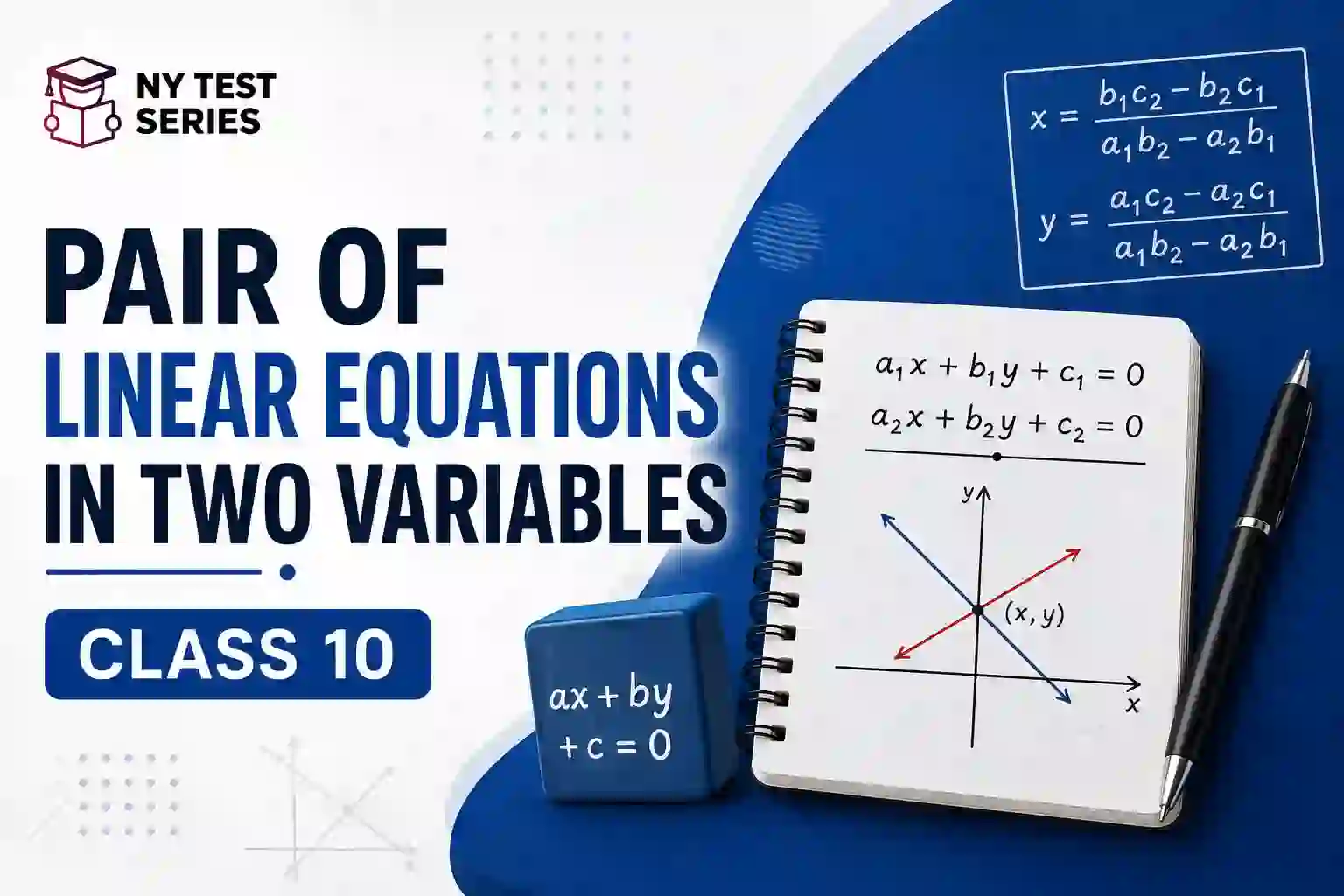
A linear equation in two variables is an equation of the form ax + by + c = 0, where a and b are not both zero. When you have two such equations together — a1x + b1y + c1 = 0 and a2x + b2y + c2 = 0 — you have a pair of linear equations. "Solving" the pair means finding the (x, y) values that make both equations true at the same time. Since every linear equation graphs as a straight line, solving the pair is really about finding where two lines meet — or discovering that they don't.
2. Graphical Representation — 3 Types of Lines
Plot both equations on the same graph and exactly one of three things happens:
| Type of Lines | What It Means | Number of Solutions |
|---|---|---|
| Intersecting lines | The lines cross at exactly one point | Unique solution |
| Coincident lines | The lines overlap completely — they're really the same line | Infinitely many solutions |
| Parallel lines | The lines never meet, however far extended | No solution |
3. Consistency Conditions (Ratio Rules)
You don't need to draw a graph to know which case you're in — comparing the coefficients directly tells you the answer.
Infinitely many solutions: a₁/a₂ = b₁/b₂ = c₁/c₂ (coincident lines)
No solution: a₁/a₂ = b₁/b₂ ≠ c₁/c₂ (parallel lines) Always write both equations in standard form ax + by + c = 0 before comparing ratios.
Ratio rules easier to state than to apply under exam pressure? Practise them with the 7-Day Demo Test Series — instant, explained solutions after every attempt.
4. Substitution Method
Solve one equation for one variable in terms of the other, then substitute that expression into the second equation. This reduces the problem to a single-variable equation, which you solve normally and then back-substitute to find the second variable.
5. Elimination Method
Multiply one or both equations by suitable constants so that the coefficient of one variable becomes equal (or opposite) in both equations. Add or subtract the equations to eliminate that variable, solve for the remaining one, then substitute back.
6. Cross-Multiplication Method
x / (b₁c₂ − b₂c₁) = y / (c₁a₂ − c₂a₁) = 1 / (a₁b₂ − a₂b₁) A direct formula — no substitution step needed — but sign mistakes are easy if you rush the cross-products.
7. Six Fully Solved Examples
Example 1 — Checking consistency (coincident lines)
Check whether the pair 2x + 3y = 7 and 4x + 6y = 14 is consistent.
a₁/a₂ = 2/4 = 1/2, b₁/b₂ = 3/6 = 1/2, c₁/c₂ = −7/−14 = 1/2.
All three ratios are equal → coincident lines, infinitely many solutions.
Example 2 — Checking consistency (parallel lines)
Check whether the pair 2x + 3y − 8 = 0 and 4x + 6y − 9 = 0 is consistent.
a₁/a₂ = b₁/b₂ but ≠ c₁/c₂ → parallel lines, no solution (inconsistent).
Example 3 — Substitution method
Solve: x + y = 14 and x − y = 4.
Then x = 14 − 5 = 9. Solution: x = 9, y = 5. Check: 9+5=14 ✓, 9−5=4 ✓
Example 4 — Elimination method
Solve: 3x + 2y = 11 and 2x + 3y = 4.
Subtract: 5x = 25 → x = 5. Substitute into 3x+2y=11: 15 + 2y = 11 → 2y = −4 → y = −2.
Solution: x = 5, y = −2. Check: 3(5)+2(−2)=15−4=11 ✓, 2(5)+3(−2)=10−6=4 ✓
Example 5 — Cross-multiplication method
Solve using cross-multiplication: x − 2y − 1 = 0 and 2x + y − 12 = 0.
x / (b₁c₂ − b₂c₁) = x / ((−2)(−12) − (1)(−1)) = x / (24+1) = x/25
y / (c₁a₂ − c₂a₁) = y / ((−1)(2) − (−12)(1)) = y / (−2+12) = y/10
1 / (a₁b₂ − a₂b₁) = 1 / ((1)(1) − (2)(−2)) = 1/(1+4) = 1/5
So x/25 = 1/5 → x = 5, and y/10 = 1/5 → y = 2. Solution: x = 5, y = 2.
Example 6 — Word problem (ages)
Five years ago, Nuri was thrice as old as Sonu. Ten years later, Nuri will be twice as old as Sonu. Find their present ages.
Condition 1: N − 5 = 3(S − 5) → N − 3S = −10
Condition 2: N + 10 = 2(S + 10) → N − 2S = 10
Subtracting: (N−2S) − (N−3S) = 10 − (−10) → S = 20. Substituting: N − 2(20) = 10 → N = 50.
Present ages: Nuri = 50 years, Sonu = 20 years. Check: 5 years ago, 45 = 3×15 ✓. 10 years later, 60 = 2×30 ✓
8. Common Mistakes Students Make
Get daily Class 10 Maths practice questions and exam alerts straight to your phone — join the free MyTestSeries WhatsApp Channel.
Join Channel →9. Quick Formula Recap Table
| Concept | Formula / Condition |
|---|---|
| Standard form | a₁x+b₁y+c₁=0, a₂x+b₂y+c₂=0 |
| Unique solution | a₁/a₂ ≠ b₁/b₂ (intersecting lines) |
| Infinitely many solutions | a₁/a₂ = b₁/b₂ = c₁/c₂ (coincident lines) |
| No solution | a₁/a₂ = b₁/b₂ ≠ c₁/c₂ (parallel lines) |
| Cross-multiplication | x/(b₁c₂−b₂c₁) = y/(c₁a₂−c₂a₁) = 1/(a₁b₂−a₂b₁) |
10. How to Revise This Chapter Effectively
📖 Start with the graph, not the algebra. Sketching a rough idea of intersecting, coincident, and parallel lines makes the ratio conditions feel obvious instead of memorised.
✍️ Pick one method and commit per question. Elimination is usually fastest for "nice" coefficients; cross-multiplication is more mechanical and reliable when numbers look awkward. Don't switch mid-solution.
🧮 Practise writing word problems as equations first, before solving. Example 6 above is the template — define your variables in one clear sentence each, form both equations, then solve.
🎯 Always verify. Substitute x and y back into both original equations — this single habit prevents almost every silly-mistake mark loss in this chapter.
🔁 Revisit this page before your unit test. Bookmark it, and use the Quick Formula Recap Table (Section 9) as your final five-minute revision before the exam.
📚 Also Useful on MyTestSeries
- Real Numbers Class 10 — Formulas, Solved Examples & Common Mistakes
- Class 10 Mathematics Foundation Online Test Series — chapter-wise, topic-wise & full-syllabus mocks
- Class 8 Maths: Complete Chapter-wise Formula Sheet
- NCERT vs Reference Books — Class 9 Strategy Guide
- CBSE vs ICSE vs State Board — Which Is Better for Competitive Exams?
- CBSE & ICSE Blog — All Study Guides & Exam Updates
🌐 Trusted External References
- NCERT Official Website — download the official Class 10 Maths textbook
- CBSE Academic — official syllabus & sample papers
- System of Linear Equations — Wikipedia — broader mathematical background
- Cramer's Rule — Wikipedia — the general method behind cross-multiplication
11. Frequently Asked Questions
What is a pair of linear equations in two variables?
How do you check if a pair of linear equations has a unique solution?
What are the conditions for infinitely many solutions or no solution?
What are the algebraic methods to solve a pair of linear equations?
What is the cross-multiplication method formula?
What are the most common mistakes in this chapter?
Conclusion: Match the Method to the Numbers
This chapter isn't about memorising one procedure — it's about recognising which tool fits the equation in front of you. Nice, round coefficients usually suit elimination or substitution; awkward ones are often faster with cross-multiplication. The ratio conditions in Section 3 let you predict the outcome before you even start solving, which is exactly the kind of shortcut that saves time in a board exam.
Rework the six solved examples above without checking the answers first, say the three consistency conditions out loud until they're automatic, and always finish with the verification step. That habit alone is what separates a correct method from a correct final mark.
12. Related Test Series & Practice Sets
 Class 10 Maths Foundation Series
Tags: Pair of Linear Equations in Two Variables Class 10, Substitution Method, Elimination Method, Cross Multiplication Method, Consistency of Linear Equations, CBSE 2026, NCERT Class 10 Maths Chapter 3