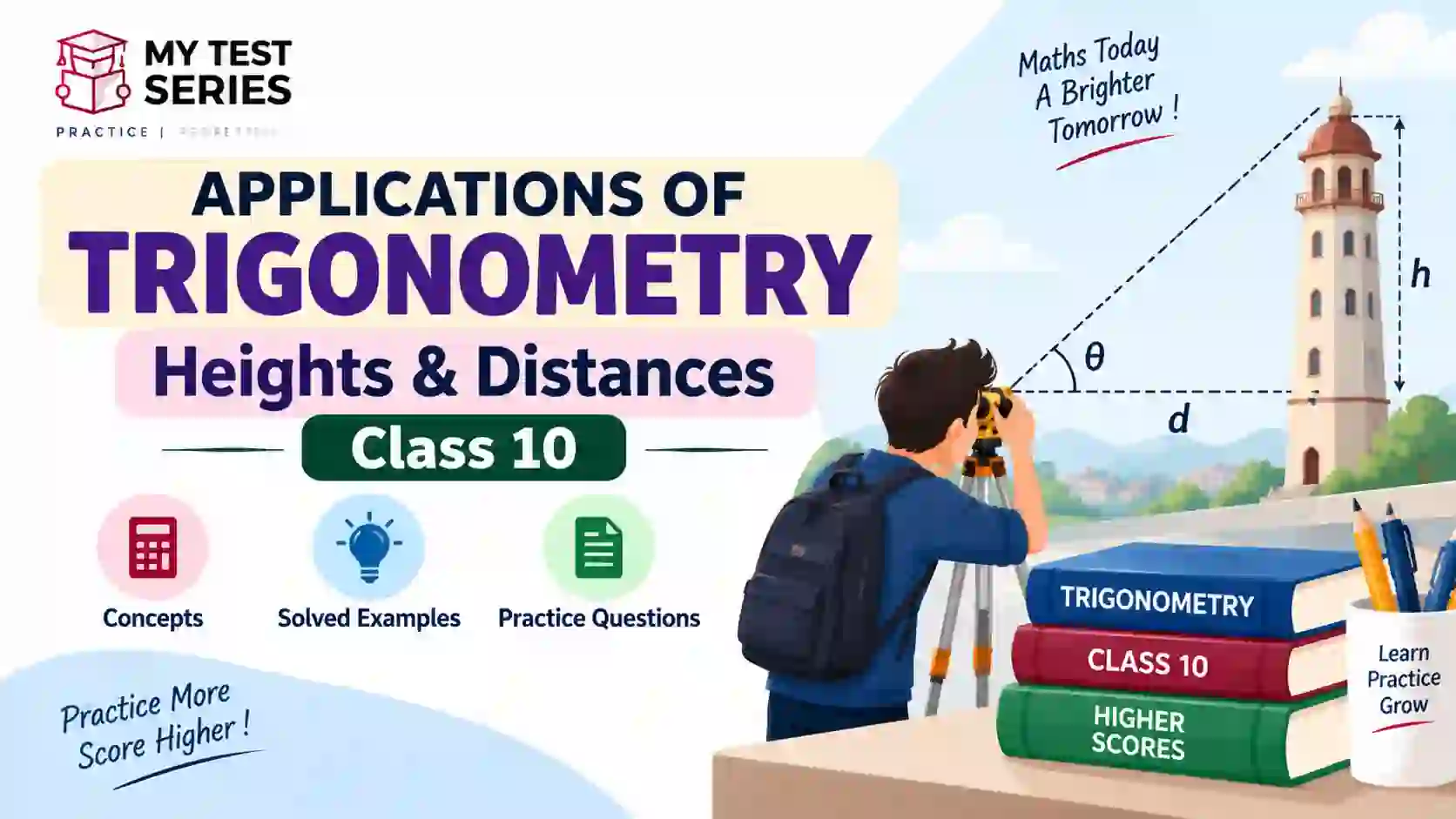
Applications of Trigonometry (Heights & Distances) — Class 10 Guide (2026)

This chapter doesn't introduce a single new formula — it takes everything from Introduction to Trigonometry and points it at a genuinely useful question: how tall is that tower, how far away is that boat, without ever having to measure it directly. The entire chapter runs on two ideas — the angle of elevation and the angle of depression — dropped into a right triangle you build yourself from the words of the problem.
This guide explains both angles clearly, shows exactly how to turn a word problem into a labelled diagram, and works through six solved examples covering every common variation — basic elevation, depression, distance between two objects, and the classic "observer's height" and "two poles" problems — followed by the specific mistakes that quietly cost marks.
📋 Table of Contents

1. Angle of Elevation & Angle of Depression
Angle of depression: the angle between the horizontal and the line of sight down to an object below the observer. Angle of elevation (from the ground, looking up) = Angle of depression (from the top, looking down) between the same two points — they're alternate interior angles between parallel horizontal lines.
2. How to Set Up a Heights & Distances Problem
Every problem in this chapter reduces to drawing one (or occasionally two) right triangles from the words given. The reliable process:
Step 2: Draw a horizontal line for the ground distance.
Step 3: Mark the given angle at the correct vertex — elevation from the ground, or depression from the top.
Step 4: Identify which sides are known and which is unknown, then choose sin, cos, or tan accordingly. Tan is used most often, since height and base distance (not the hypotenuse) are usually what's given.
The formulas are simple — the diagram is where marks are actually won or lost. Practise setting up diagrams correctly with the 7-Day Demo Test Series, with instant, explained solutions after every attempt.
3. Six Fully Solved Examples
Example 1 — Basic angle of elevation
A tower casts a shadow 30 m long when the sun's angle of elevation is 30°. Find the height of the tower.
Example 2 — Elevation from a given distance
From a point 20 m away from the base of a tower, the angle of elevation of its top is 60°. Find the tower's height.
Example 3 — Angle of depression
From the top of a 50 m tall lighthouse, the angle of depression of a boat is 30°. Find the distance of the boat from the base of the lighthouse.
tan30° = 50/d → d = 50/tan30° = 50 × √3 = 50√3 m (≈86.6 m)
Example 4 — Distance between two objects
From the top of a 100 m cliff, the angles of depression of two boats in a straight line with the cliff's base are 30° and 45°. Find the distance between the boats.
For the farther boat (30°): tan30° = 100/d₂ → d₂ = 100√3 m.
Distance between boats = d₂ − d₁ = 100√3 − 100 = 100(√3−1) m (≈73.2 m)
Example 5 — Accounting for the observer's height
A 1.5 m tall boy standing 30 m away from a tower observes the angle of elevation of the top of the tower to be 30°. Find the height of the tower.
h − 1.5 = 30 × tan30° = 30/√3 = 10√3 → h = 1.5 + 10√3 ≈ 18.8 m
Example 6 — Two poles of equal height (classic word problem)
Two poles of equal height stand on either side of a road 80 m wide. From a point on the road between them, the angles of elevation of the poles are 60° and 30°. Find the height of the poles and the distances of the point from each pole.
tan60° = h/x → h = x√3. tan30° = h/(80−x) → h = (80−x)/√3.
Equating: x√3 = (80−x)/√3 → 3x = 80−x → 4x = 80 → x = 20.
h = 20√3 ≈ 34.6 m. The poles are 20√3 m tall, and the point is 20 m from one pole and 60 m from the other.
4. Common Mistakes Students Make
Get daily Class 10 Maths practice questions and exam alerts straight to your phone — join the free MyTestSeries WhatsApp Channel.
Join Channel →5. Quick Reference Table
| Concept | Key Point |
|---|---|
| Angle of elevation | Measured upward from the horizontal, at the observer's level |
| Angle of depression | Measured downward from the horizontal, at the observer's level |
| Elevation ↔ Depression | Equal between the same two points (alternate angles) |
| Most-used ratio | tanθ = height/base |
| When hypotenuse is given | Use sinθ or cosθ instead |
| Observer's height given | Add/subtract it from the calculated height |
6. How to Revise This Chapter Effectively
📖 Always draw the diagram first, label it fully, then write the equation. This single habit prevents the majority of mistakes in this chapter — the maths itself is usually simple once the triangle is correctly set up.
✍️ Mark the angle at the correct vertex. Elevation angles sit at the base of the triangle looking up; depression angles sit at the top, measured from a horizontal line drawn through the observer.
🧮 Read the question twice for hidden details. Words like "eye level," "a boy of height 1.5 m," or "two boats in a line" are signals for the specific example patterns shown in Sections 3.4–3.6 above.
🎯 Keep answers in surd form until the final line. Only convert √3 to 1.732 (or similar) at the very end, to avoid compounding rounding errors across multi-step problems.
🔁 Revisit this page before your unit test. Bookmark it, and use the Quick Reference Table (Section 5) as your final five-minute revision before the exam.
📚 Also Useful on MyTestSeries
- Introduction to Trigonometry — Class 10 Formulas & Identities Cheat Sheet
- Coordinate Geometry Class 10 — Formulas & Problem-Solving Tricks
- Triangles Class 10 — Theorems, Proofs & Solved Examples
- Arithmetic Progressions Class 10 — Formulas, Concepts & Shortcuts
- Quadratic Equations Class 10 — Formulas, Tricks & Practice
- Pair of Linear Equations in Two Variables — Class 10 Full Guide
- Polynomials Class 10 — Complete Notes with Solved Examples
- Real Numbers Class 10 — Formulas, Solved Examples & Common Mistakes
- Class 10 Mathematics Foundation Online Test Series — chapter-wise, topic-wise & full-syllabus mocks
- CBSE & ICSE Blog — All Study Guides & Exam Updates
🌐 Trusted External References
- NCERT Official Website — download the official Class 10 Maths textbook
- CBSE Academic — official syllabus & sample papers
- Trigonometry — Wikipedia — broader mathematical background
- Clinometer — Wikipedia — the real-world tool used to measure angles of elevation
7. Frequently Asked Questions
What is the angle of elevation?
What is the angle of depression?
How are the angle of elevation and angle of depression related?
Which trigonometric ratio is normally used in heights and distances problems?
What are the most common mistakes in heights and distances problems?
Conclusion: The Diagram Does the Real Work
This chapter isn't really testing whether you know sin, cos, and tan — that was Chapter 8. It's testing whether you can translate a word problem into an accurate, correctly labelled right triangle. Once the diagram is right, the calculation is usually the easiest part of the whole question.
Rework the six solved examples above without checking the answers first, always sketch and label a diagram before writing an equation, and keep surds in exact form until the final step. That habit — diagram first, formula second, simplify last — is what turns this chapter into consistent exam marks.
8. Related Test Series & Practice Sets
 Class 10 Maths Foundation Series
Tags: Applications of Trigonometry Class 10, Heights and Distances, Angle of Elevation, Angle of Depression, CBSE 2026, NCERT Class 10 Maths Chapter 9