Surface Areas and Volumes — Class 10 Formula Sheet & Examples (2026)

Surface Areas and Volumes doesn't ask you to learn new mathematics as much as it asks you to organise a lot of formulas correctly — one set for the cube, another for the cylinder, another for the cone, and so on. The real challenge shows up when two solids are joined together, or when one shape is melted and reshaped into another, because that's where students who know every individual formula still make avoidable mistakes.
This formula sheet lays out every solid-shape formula in one place, explains exactly how combination-of-solids and melting-and-recasting problems work, and walks through six solved examples — including the classic toy (cone-on-hemisphere) and bucket (frustum) problems — followed by the mistakes that quietly cost marks even when the underlying formula is known perfectly well.
📋 Table of Contents
- Cube, Cuboid, Cylinder, Cone & Sphere Formulas
- Combination of Solids — The Key Idea
- Melting & Recasting
- Frustum of a Cone
- 6 Fully Solved Examples
- Common Mistakes Students Make
- Quick Formula Recap Table
- How to Revise This Chapter Effectively
- Frequently Asked Questions
- Related Test Series & Practice Sets

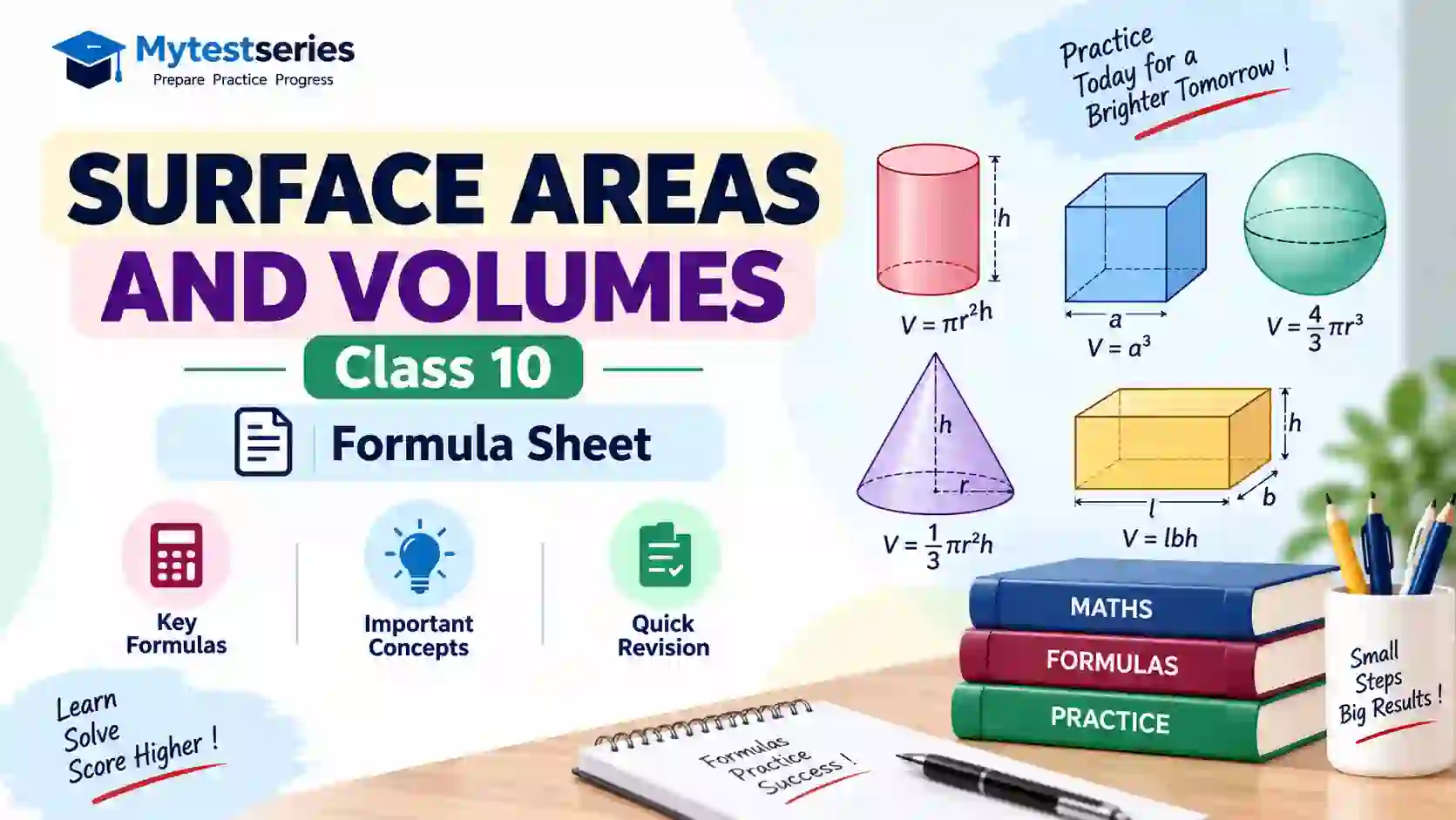
1. Cube, Cuboid, Cylinder, Cone & Sphere Formulas
| Solid | Curved/Lateral Surface Area | Total Surface Area | Volume |
|---|---|---|---|
| Cube (side a) | — | 6a² | a³ |
| Cuboid (l, b, h) | — | 2(lb+bh+hl) | lbh |
| Cylinder (r, h) | 2πrh | 2πr(r+h) | πr²h |
| Cone (r, h, slant l) | πrl | πr(r+l) | (1/3)πr²h |
| Sphere (r) | — | 4πr² | (4/3)πr³ |
| Hemisphere (r) | 2πr² | 3πr² | (2/3)πr³ |
2. Combination of Solids — The Key Idea
Volume, on the other hand, behaves more simply: the volume of a combined solid is always just the sum of the individual volumes, since volume measures the space occupied and joining two solids doesn't remove any of that space.
Combination-of-solids questions are where marks are usually won or lost in this chapter. Practise them with the 7-Day Demo Test Series — instant, explained solutions after every attempt.
3. Melting & Recasting
4. Frustum of a Cone
A frustum is what's left of a cone once its top portion is sliced off by a plane parallel to the base — the shape seen in buckets, lampshades, and drinking glasses.
CSA = π(r₁+r₂)l TSA = π[(r₁+r₂)l + r₁² + r₂²]
Volume = (1/3)πh(r₁² + r₂² + r₁r₂) r₁ and r₂ are the radii of the two circular faces (r₁ > r₂), and h is the vertical height of the frustum.
5. Six Fully Solved Examples
Example 1 — Volume of a cylinder
Find the volume of a cylinder with radius 7 cm and height 10 cm. (Use π = 22/7.)
Example 2 — Total surface area of a cube
Find the total surface area of a cube with side 5 cm.
Example 3 — Combination of solids (surface area)
A toy is a cone mounted on a hemisphere, both of radius 3.5 cm, with total height 15.5 cm. Find its total surface area.
Slant height: l = √(3.5² + 12²) = √(12.25+144) = √156.25 = 12.5 cm
CSA of cone = πrl = (22/7)(3.5)(12.5) = 137.5 cm². CSA of hemisphere = 2πr² = 2(22/7)(3.5²) = 77 cm².
Total surface area = 137.5 + 77 = 214.5 cm² (the flat circular base where they join is hidden, so it's excluded)
Example 4 — Combination of solids (volume)
For the same toy in Example 3, find its total volume.
Volume of hemisphere = (2/3)πr³ = (2/3)(22/7)(3.5³) ≈ 89.83 cm³
Total volume = 154 + 89.83 ≈ 243.83 cm³ (unlike surface area, volumes simply add together)
Example 5 — Melting and recasting
A metallic sphere of radius 4.2 cm is melted and recast into a cylinder of radius 6 cm. Find the height of the cylinder.
This becomes the cylinder's volume: πr²h = 310.46 → (22/7)(6²)h = 310.46 → 113.14h = 310.46
h = 310.46/113.14 ≈ 2.74 cm
Example 6 — Frustum (capacity of a bucket)
A bucket is in the shape of a frustum with top radius 15 cm, bottom radius 5 cm, and height 24 cm. Find its capacity.
= (1/3)(22/7)(24)(325) = (22×24×325)/(3×7) = 171600/21 ≈ 8171.4 cm³
Since 1000 cm³ = 1 litre, capacity ≈ 8171.4 cm³ (≈ 8.17 litres)
6. Common Mistakes Students Make
Get daily Class 10 Maths practice questions and exam alerts straight to your phone — join the free MyTestSeries WhatsApp Channel.
Join Channel →7. Quick Formula Recap Table
| Solid | Volume |
|---|---|
| Cube | a³ |
| Cuboid | lbh |
| Cylinder | πr²h |
| Cone | (1/3)πr²h |
| Sphere | (4/3)πr³ |
| Hemisphere | (2/3)πr³ |
| Frustum | (1/3)πh(r₁²+r₂²+r₁r₂) |
8. How to Revise This Chapter Effectively
📖 Build a formula sheet organised by shape, not by mixing area and volume together. Group everything about the cylinder in one row, the cone in another — this mirrors the recap table above and makes recall faster under exam pressure.
✍️ For every combination-of-solids question, physically identify the hidden face before writing anything. Sketch the shape, shade the joined face, and only add up what's left visible.
🧮 Practise slant height calculations as a separate first step. Get into the habit of computing l = √(r²+h²) before touching any cone or frustum surface area formula.
🎯 Double-check units before submitting a final answer. If the question mentions litres, capacity, or mixes cm and metres, do the conversion early — not as an afterthought.
🔁 Revisit this page before your unit test. Bookmark it, and use the Quick Formula Recap Table (Section 7) as your final five-minute revision before the exam.
📚 Also Useful on MyTestSeries
- Applications of Trigonometry (Heights & Distances) — Class 10 Guide
- Introduction to Trigonometry — Class 10 Formulas & Identities Cheat Sheet
- Coordinate Geometry Class 10 — Formulas & Problem-Solving Tricks
- Triangles Class 10 — Theorems, Proofs & Solved Examples
- Arithmetic Progressions Class 10 — Formulas, Concepts & Shortcuts
- Quadratic Equations Class 10 — Formulas, Tricks & Practice
- Pair of Linear Equations in Two Variables — Class 10 Full Guide
- Class 10 Mathematics Foundation Online Test Series — chapter-wise, topic-wise & full-syllabus mocks
- CBSE & ICSE Blog — All Study Guides & Exam Updates
🌐 Trusted External References
- NCERT Official Website — download the official Class 10 Maths textbook
- CBSE Academic — official syllabus & sample papers
- Frustum — Wikipedia — broader mathematical background
- Volume — Wikipedia — general theory and other solid formulas
9. Frequently Asked Questions
What is the difference between curved surface area and total surface area?
How do you find the surface area of a combination of two solids?
Is volume conserved when a solid is melted and recast into another shape?
What is a frustum of a cone?
What are the most common mistakes in Class 10 Surface Areas and Volumes?
Conclusion: Organisation Beats Memorisation
This chapter has more formulas than most, but very little genuinely new mathematics — the real skill is applying the right formula to the right shape and, critically, correctly handling what happens when shapes are combined or reshaped. Once the CSA-vs-TSA distinction and the "exclude the joined face" rule are automatic, this becomes one of the more reliably scorable chapters in the whole syllabus.
Rework the six solved examples above without checking the answers first, always sketch combination-of-solids problems before calculating anything, and double-check your units at the very end. That combination — organise, sketch, verify units — is what turns a long formula list into consistent exam marks.
10. Related Test Series & Practice Sets
 Class 10 Maths Foundation Series
Tags: Surface Areas and Volumes Class 10, Combination of Solids, Melting and Recasting, Frustum of a Cone, CBSE 2026, NCERT Class 10 Maths Mensuration