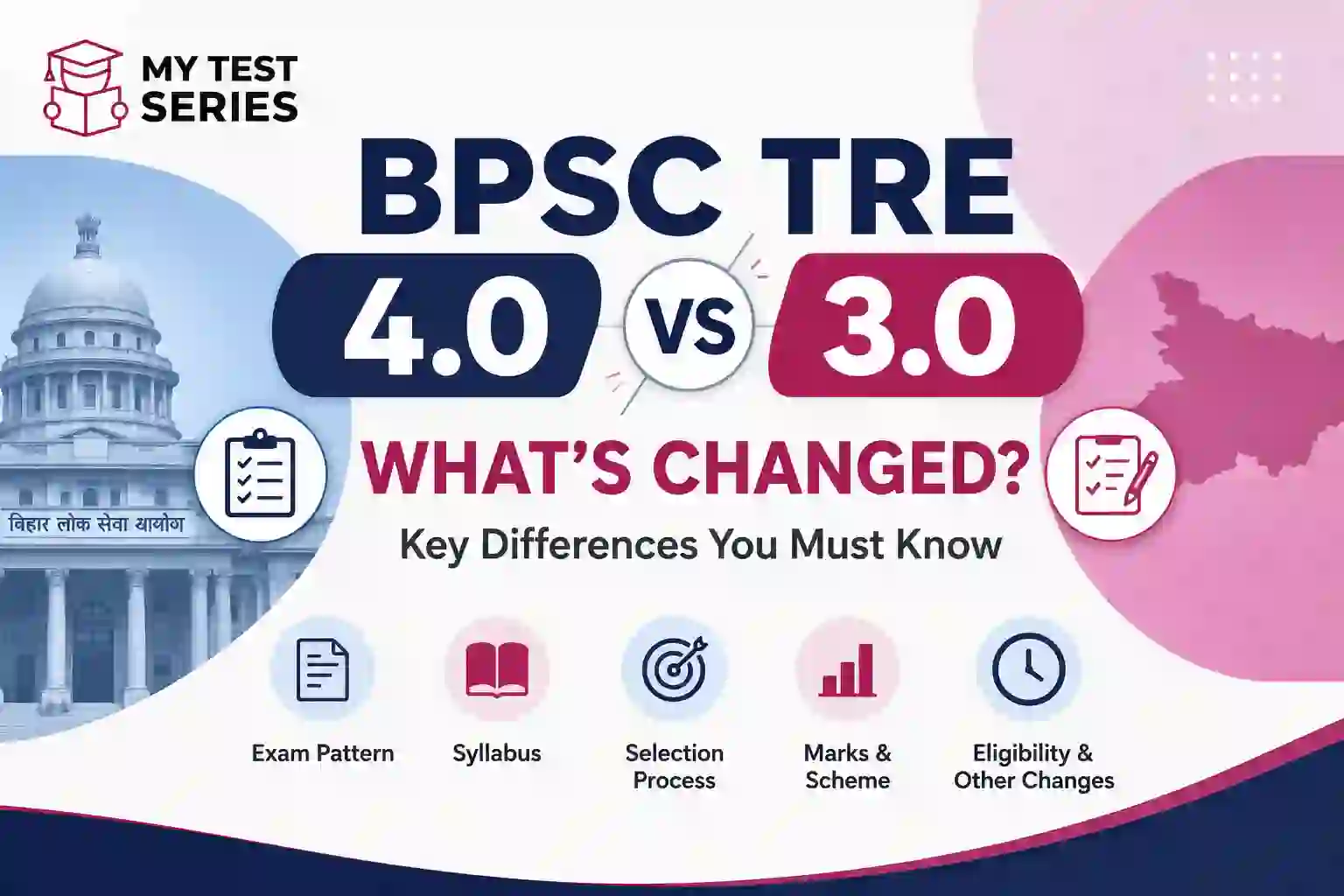
BPSC TRE 4.0 vs TRE 3.0: What's Changed? Full Comparison 2026
If you cleared — or attempted — BPSC TRE 3.0 in 2024, you cannot assume TRE 4.0 will run the same way. BPSC has quietly rebuilt the selection process for this cycle: a new qualifying stage has been added, the Main Exam's internal structure has been reshuffled, and the vacancy pool is dramatically smaller. This guide walks through every point of difference between BPSC TRE 4.0 (2026) and BPSC TRE 3.0 (2024) — vacancies, exam pattern, marking scheme, fees, eligibility and selection stages — backed by a quick-reference comparison table and FAQs, so you know exactly where to focus your preparation.
✅ What's Changed — Quick Verdict
- Selection stages: TRE 3.0 had one written exam. TRE 4.0 adds a qualifying Preliminary Test before the Main Exam — a first for the TRE series.
- Vacancies: Down sharply — from 87,000+ in TRE 3.0 to 32,388 in TRE 4.0.
- Main Exam structure: TRE 3.0 split Part II/III as General Studies (40Q) + Subject (80Q) separately. TRE 4.0 merges them into one 120-question Part II.
- Marking scheme: No negative marking in both — unchanged.
- Fees, duration & question count: ₹750/₹200 fee, 150 questions, 150 marks, 2h30m — all unchanged.
- Interview: Still no interview round in either cycle — merit is 100% written-exam based.
BPSC TRE 4.0 vs TRE 3.0 — Full Comparison Table
Here is every key parameter compared side by side. Rows highlighted in yellow mark the points where BPSC has actually changed something between the two cycles.
| Parameter | BPSC TRE 3.0 (2024) | BPSC TRE 4.0 (2026) |
|---|---|---|
| Advertisement | TRE Phase 3, 2024 | Advt. No. 14/2026 |
| Total Vacancies | 87,000+ posts Higher | 32,388 posts Lower |
| Posts Covered | Primary, Middle, Secondary, Sr. Secondary (Classes 1–12) | Primary, Middle, Secondary, Sr. Secondary (Classes 1–12) |
| Selection Stages | Single-stage written exam 1 stage | Preliminary (qualifying) + Main Exam 2 stages |
| Main Exam Structure | Part I Language (30Q) + Part II GS (40Q) + Part III Subject (80Q) | Part I Language (30Q, qualifying) + Part II GS/Reasoning/Subject combined (120Q) |
| Total Questions / Marks | 150 / 150 | 150 / 150 |
| Exam Duration | 2 hours 30 minutes | 2 hours 30 minutes |
| Negative Marking | None | None (per current notification) |
| Language Qualifying % | ~30% minimum | ~30% minimum (as commonly reported) |
| Interview / Personality Test | Not applicable | Not applicable |
| Application Fee (Gen/OBC) | ₹750 | ₹750 |
| Application Fee (SC/ST/Women/PwD) | ₹200 | ₹200 |
| CTET/STET Requirement | Mandatory as per post | Mandatory as per post |
| Application Window | Extended multiple times amid disruptions | Fixed single window: 1–30 Sept 2026 |
| Exam Integrity Issues | Paper leak allegations led to re-exams for some posts | Prelim stage seen as an added screening/integrity layer |
For the full official notification breakdown of TRE 4.0 — dates, PDF download link, salary and step-by-step apply process — see our detailed BPSC TRE 4.0 Notification 2026 PDF guide.
Vacancy Comparison: A Much Smaller Pool in TRE 4.0
The single biggest structural difference between the two cycles is scale. BPSC TRE 3.0 (2024) was one of the largest teacher recruitment drives in Bihar's history, targeting well over 87,000 posts across Primary, Middle, Secondary and Senior Secondary levels, with Primary Teacher (Classes 1–5) alone accounting for around 28,000 vacancies and Middle School Teacher (Classes 6–8) contributing roughly 19,000 more.
BPSC TRE 4.0 (2026), by contrast, has notified only 32,388 vacancies under Advertisement No. 14/2026 — a significantly smaller pool spread across the same four teaching levels. A post-wise, subject-wise split for TRE 4.0 is available in our BPSC TRE 4.0 Vacancy List: Subject & Class Wise guide.
Selection Stages: One-Stage TRE 3.0 vs Two-Stage TRE 4.0
This is the most consequential change in the entire recruitment cycle. In TRE 3.0, candidates appeared for a single written exam, and their score in that one paper directly determined their final merit position, subject to the qualifying cut-off on the Language section.
TRE 4.0 introduces a brand-new Preliminary Test that candidates must clear before they are even permitted to sit for the Main Exam. The Preliminary stage is qualifying only — its marks are not counted toward final merit — but it acts as a screening filter. Only candidates who clear the Prelim cut-off proceed to the Main Exam, which is the stage that fully decides your final rank, category-wise cut-off and selection.
Why this changes your prep timeline
Under TRE 3.0's single-stage system, every hour of preparation counted directly toward your one and only scoring attempt. Under TRE 4.0, you effectively need to peak twice — first to clear a screening round, then again for the exam that actually decides your rank. Full details on the two-stage system, section-wise duration and level-wise pattern differences (PRT vs TGT vs PGT) are covered in our BPSC TRE 4.0 Exam Pattern & Marking Scheme guide.
Exam Pattern Structure: What Changed Inside the Main Exam
Even though the total question count (150), total marks (150) and duration (2 hours 30 minutes) have stayed identical across both cycles, BPSC has restructured how those 150 questions are grouped.
- TRE 3.0 Main Exam: Three distinct parts — Part I Language (30 questions, qualifying), Part II General Studies (40 questions), Part III Subject Concerned (80 questions) — for Secondary and Senior Secondary posts.
- TRE 4.0 Main Exam: Two parts — Part I Language (30 questions, qualifying) and a combined Part II of General Studies, Reasoning and the Concerned Subject (120 questions) — merging what used to be two separate sections.
- Practical effect: General Studies and Subject-specific questions are no longer cleanly separated by section in TRE 4.0's confirmed pattern, so time-management strategies built around TRE 3.0's three-part split need to be revised.
Marking Scheme Comparison
Good news here: this is one area where nothing has changed. Both TRE 3.0 and TRE 4.0 follow a no-negative-marking policy on their currently confirmed notifications — a wrong answer costs you nothing, but an unattempted question earns zero marks either way.
| Situation | TRE 3.0 | TRE 4.0 |
|---|---|---|
| Correct Answer | +1 Mark | +1 Mark |
| Wrong Answer | No penalty | No penalty |
| Unattempted Question | 0 Marks | 0 Marks |
Because guessing carries zero downside in either cycle, the golden rule stays the same for TRE 4.0 aspirants: never leave a bubble blank. Build that instinct under timed conditions with our chapter-wise CDP, Maths & EVS mock tests.
Application Fee Comparison
| Category | TRE 3.0 | TRE 4.0 |
|---|---|---|
| General / OBC | ₹750 | ₹750 |
| SC / ST (Bihar Domicile) | ₹200 | ₹200 |
| Women Candidates (Bihar Domicile) | ₹200 | ₹200 |
| Persons with Disability (PwD) | ₹200 | ₹200 |
The fee slabs have carried over unchanged from TRE 3.0 to TRE 4.0. What has changed is the payment window itself — TRE 4.0 runs on a single fixed cycle from 1 to 30 September 2026, rather than the repeatedly extended windows candidates saw during TRE 3.0.
Eligibility & Age Limit: What's the Same
Core eligibility norms — CTET/Bihar STET requirement, B.Ed or equivalent teacher-training qualifications, and post-wise academic criteria — remain structurally the same across TRE 3.0 and TRE 4.0, since these are governed by national NCTE/State norms rather than BPSC's own discretion. Minor age-limit and category-relaxation details can shift cycle to cycle, so always confirm the exact figures for your category in the current notification. Full post-wise eligibility and domicile rules for TRE 4.0 are covered in our BPSC TRE 4.0 Eligibility Criteria guide. If you still need to clear CTET first, start with our CTET Eligibility Criteria 2026 breakdown.
Why Did BPSC Add a Preliminary Stage in TRE 4.0?
BPSC hasn't issued an official explanation, but the timing offers a strong clue. TRE 3.0's single-stage exam in 2024 was hit by paper-leak allegations that forced BPSC to cancel and reschedule the School Teacher competitive exam multiple times — first postponed from 15 to 16 March, then to 27–30 June, and finally held on 19–22 July 2024. A separate Head Teacher exam also had to be rescheduled after a date clash with another state-level exam.
Introducing a qualifying Preliminary Test before the high-stakes Main Exam is widely read by exam observers as a way to reduce pressure on any single exam sitting, manage the massive applicant volume more efficiently, and add a screening layer that may help contain future integrity risks — though this remains an informed inference rather than an officially stated reason.
What Should Change in Your Preparation Strategy
- Don't over-invest in the Prelim. It's qualifying only — clear it comfortably, then push the bulk of your hours into Main Exam subject depth.
- Re-map your Main Exam time split. With General Studies and Subject content now combined into one 120-question block instead of two separate sections, practise switching between topic types within a single timed block.
- Expect tighter competition per seat. With 32,388 seats against a large applicant base — down sharply from TRE 3.0's 87,000+ — accuracy will matter more than raw attempt count.
- Keep attempting every question. No negative marking carries over from TRE 3.0, so blank answers remain the only way to guarantee zero marks on a question.
- Track the notification page for pattern confirmation. Some unconfirmed reports mention a different structure — always verify against your admit card and BPSC's own release before your final revision push.
Prepare for the Real TRE 4.0 Pattern — Not the Old One
Full-length mock tests, subject-wise MCQs and instant All-India rank analysis, updated for the TRE 4.0 two-stage, no-negative-marking structure.
Frequently Asked Questions
What is the biggest difference between BPSC TRE 4.0 and TRE 3.0?
Are there fewer vacancies in BPSC TRE 4.0 compared to TRE 3.0?
Is there negative marking in BPSC TRE 4.0 like TRE 3.0?
Has the exam pattern structure changed from TRE 3.0 to TRE 4.0?
Is the application fee different in BPSC TRE 4.0 compared to TRE 3.0?
Does BPSC TRE 4.0 have an interview round like TRE 3.0?
Why did BPSC introduce a Preliminary stage in TRE 4.0?
Related Exam Updates & Preparation Resources
External References
For the legally binding, most accurate details, always cross-verify with the official BPSC website, the Bihar Education Department, and for CTET/STET qualification norms, the official CTET portal (ctet.nic.in) before submitting your application or making career decisions.
Preparing for BPSC TRE 4.0? Start Practising the New Pattern Today
Knowing what changed is step one — building real speed and accuracy for a two-stage, 150-question, no-negative-marking exam is step two. Get there with structured mock practice below.
CTET 2026 Test Series
30 full-length Paper 1 & 2 mock tests with instant All-India rank.
Start Practice →TET Test Series (CTET/BTET/STET)
Chapter-wise CDP, Maths & EVS MCQs in the exact TRE MCQ format.
Browse Series →Disclaimer: This article compares publicly available BPSC notification data and verified media reports for TRE 3.0 (2024) and TRE 4.0 (2026) for informational purposes only. Vacancy numbers, exam pattern and marking scheme details are subject to revision by BPSC until the final detailed notification and admit card are issued. MyTestSeries.in is not affiliated with the Bihar Public Service Commission. Please treat the official notification at bpsc.bih.nic.in as the final source of truth.